

GCSE Biblical Hebrew Grade 9 Rate Explained
GCSE Biblical Hebrew grade 9 rate data explained: see the latest annual figures, compare them with other GCSEs and interpret the results accurately.

A grade 999 can feel less like a result and more like membership of a very small club. That makes one question especially tempting: how many other students get there? The latest GCSE Biblical Hebrew grade 9 rate is 19.2%19.2\%19.2%. In the June 2025 series, 117117117 of the 609609609 home candidates recorded by Pearson achieved the top grade.
That is much higher than the rate across GCSE results generally. But it does not mean Biblical Hebrew is an easy GCSE. Its cohort is small and highly specialised, so comparisons need care. The useful story is not simply the percentage. It is what the percentage measures, how it changes and what students can learn from it.
The figures at a glance
Here is the clearest summary of Pearson's final grade statistics for the three most recent standard summer examination series:
| Exam year | GCSE Biblical Hebrew entries | Grade 999 results | Grade 999 rate |
|---|---|---|---|
| 2023 | 643643643 | 878787 | 13.5%13.5\%13.5% |
| 2024 | 562562562 | 120120120 | 21.4%21.4\%21.4% |
| 2025 | 609609609 | 117117117 | 19.2%19.2\%19.2% |
Across those three series combined, there were 324324324 grade 999 results from 1,8141{,}8141,814 entries. That gives a combined share of:
3241,814×100≈17.9%\frac{324}{1{,}814}\times 100\approx 17.9\%1,814324×100≈17.9%The quick checklist is therefore:
- The latest confirmed rate is 19.2%19.2\%19.2%.
- The annual rate has recently ranged from 13.5%13.5\%13.5% to 21.4%21.4\%21.4%.
- The cohort contains only a few hundred entries each year.
- The current GCSE is offered by Pearson Edexcel and has no foundation or higher tier split.
- A high subject rate does not tell an individual student how likely they are to earn a grade 999.
If you are checking the mark threshold rather than the proportion of candidates, MathsGenie's GCSE Biblical Hebrew grade boundaries show how the required mark has changed by series.
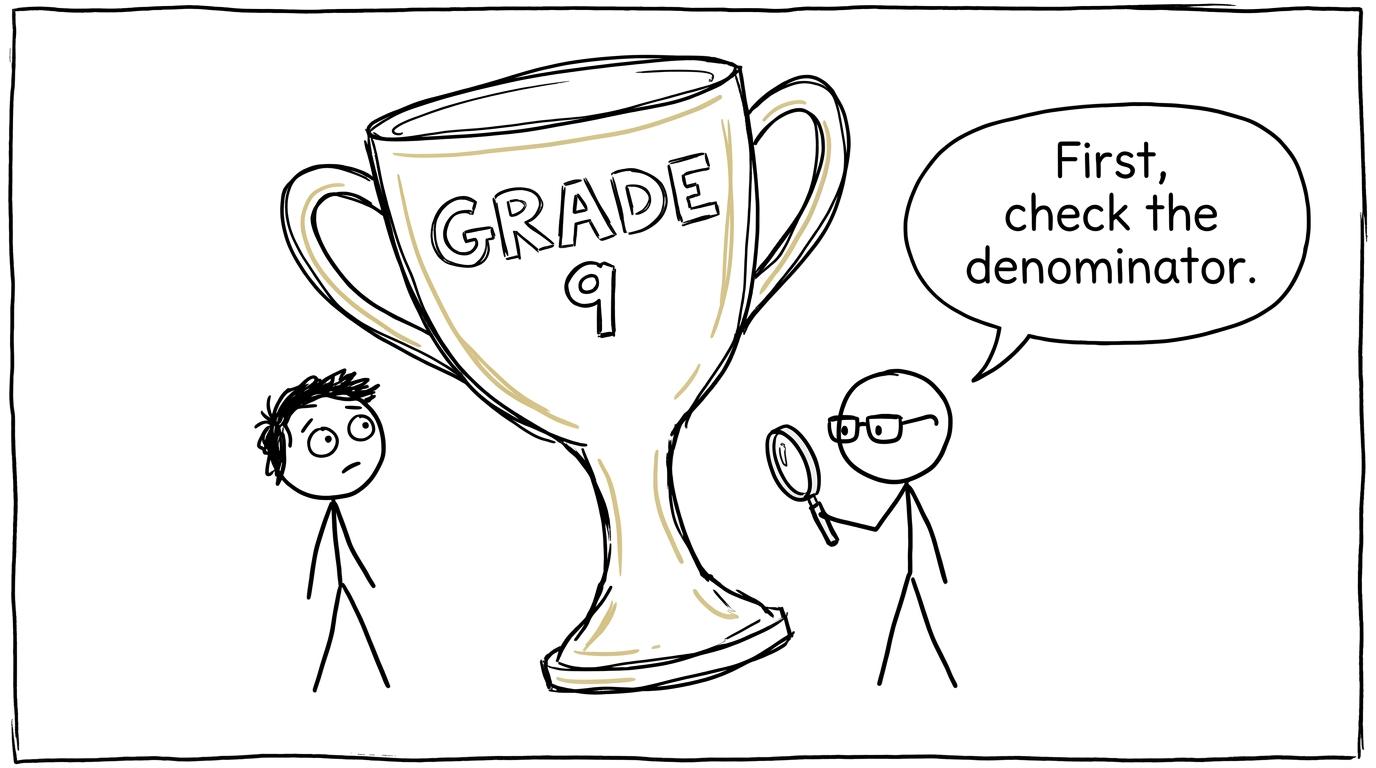 A student and statistician inspect what a grade 9 trophy really means
How the GCSE Biblical Hebrew grade 9 rate is calculated
Pearson's grade statistics report the number of candidates who sat the qualification and cumulative totals at each grade. Because grade 999 is the highest grade, its cumulative total is also the number receiving exactly grade 999.
The calculation is:
Grade 9 rate=number awarded grade 9number who sat the GCSE×100\text{Grade }9\text{ rate}=\frac{\text{number awarded grade }9}{\text{number who sat the GCSE}}\times 100Grade 9 rate=number who sat the GCSEnumber awarded grade 9×100For 2025, Pearson reported 117117117 grade 999 results among 609609609 candidates, producing the published rate of 19.2%19.2\%19.2% after rounding.
It is better to call these entries or candidates rather than assuming the data describes every student who learns Biblical Hebrew. Results statistics cover those entered for the examination, not students who began the course but did not sit it.
The figures for 2020 and 2021 are also poor comparison years because GCSE grades were awarded under pandemic-era arrangements rather than through the normal summer examination process. Examinations returned in 2022, but grading still included transitional protection. The 2023 to 2025 sequence gives a more useful recent view, although no year is perfectly interchangeable with another.
Why the percentage changes so much
A movement from 13.5%13.5\%13.5% in 2023 to 21.4%21.4\%21.4% in 2024 looks dramatic. In a small cohort, however, each candidate has a visible effect on the percentage.
With about 600600600 entries, one result represents roughly:
1600×100≈0.17%\frac{1}{600}\times 100\approx 0.17\%6001×100≈0.17%A difference of several dozen results can therefore move the headline rate substantially. Large subjects such as GCSE maths have hundreds of thousands of entries, so individual results barely disturb the national percentage.
The grade boundary changed too. Biblical Hebrew is assessed across two externally examined components worth 100100100 marks each, giving 200200200 marks overall. Pearson's grade 999 thresholds were:
| Exam year | Grade 999 boundary | Share of available marks |
|---|---|---|
| 2023 | 156156156 out of 200200200 | 78%78\%78% |
| 2024 | 162162162 out of 200200200 | 81%81\%81% |
| 2025 | 149149149 out of 200200200 | 74.5%74.5\%74.5% |
Boundaries are set after the papers have been taken. They can move to reflect differences in paper demand while maintaining the intended grading standard. This is why treating last year's boundary as a guaranteed target is risky, whether you are revising Biblical Hebrew or maths.
How Biblical Hebrew compares with other GCSEs
Across all GCSE subjects reported by JCQ in 2025, approximately 5.1%5.1\%5.1% of results were at grade 999. Biblical Hebrew's rate of 19.2%19.2\%19.2% was therefore about 14.114.114.1 percentage points higher and nearly 3.83.83.8 times the overall rate.
That comparison answers the numerical question, but it does not prove that one qualification is easier than another. GCSE subject cohorts differ in at least four important ways.
Cohort size and selection
Biblical Hebrew had 609609609 candidates in Pearson's 2025 home statistics. GCSE maths is taken by a vastly larger and much broader group because it is a core subject. Biblical Hebrew candidates are more likely to have chosen, or been specifically prepared for, a specialist ancient-language qualification.
Prior knowledge
Students do not enter every language GCSE with the same background. Some may have extensive familiarity with the language, texts or traditions before beginning the course. National result tables do not measure that prior experience.
Assessment structure
The Edexcel Biblical Hebrew GCSE consists of a language paper and a literature paper, each lasting two hours and contributing 50%50\%50% of the qualification. GCSE maths is divided by tier and tests a very different collection of knowledge and problem-solving skills. A raw percentage comparison cannot remove those structural differences.
Different subject populations
Grade distributions reflect who takes a subject as well as what appears on its papers. Some optional languages and classical subjects often have higher top-grade rates than compulsory, mass-entry subjects. That is a cohort effect, not an invitation to rank subjects by difficulty.
For maths students, the broader lesson is valuable: always inspect the denominator, the population and the assessment before drawing a conclusion from a percentage.
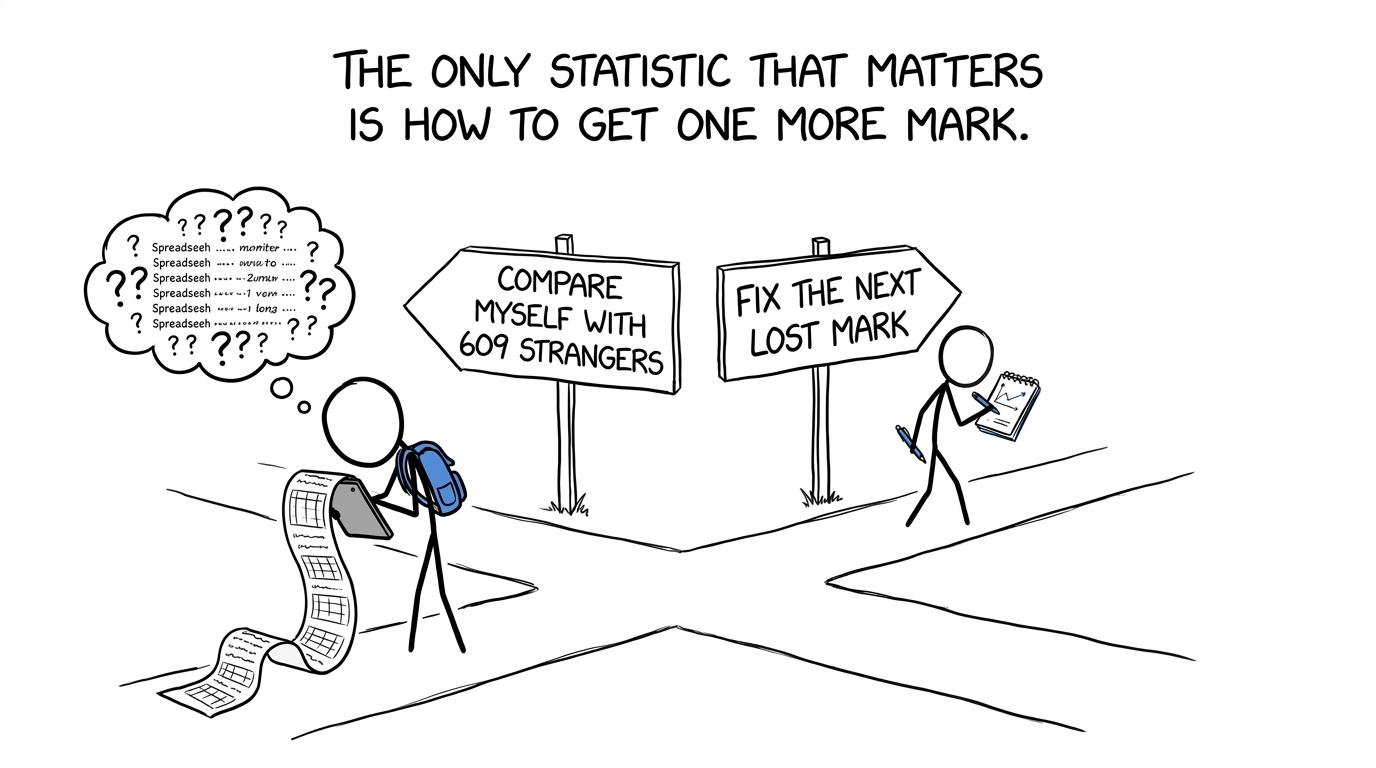 A student chooses between comparing strangers and fixing the next lost mark
What the rate means for your own grade target
Suppose almost one in five entries receives a grade 999. That does not give every future candidate a fixed one-in-five chance. Exam grades are not lottery tickets handed out randomly from a national pile.
Your result depends on the evidence in your scripts and the boundary set for that series. The better questions are personal and actionable:
- Which parts of the specification are secure?
- Where are marks repeatedly lost?
- Can you complete both papers accurately under timed conditions?
- Are you reviewing examiner expectations rather than merely counting correct answers?
This is equally true in GCSE maths. A national grade distribution describes a cohort; it does not diagnose your algebra, geometry or probability. Use the free GCSE Maths revision hub to choose Edexcel, AQA, OCR, Eduqas, WJEC or CCEA resources that match your actual exam board and tier.
If you are unsure where the gaps are, MathsGenie's guide to finding your weakest GCSE topics turns lost marks into a short, practical revision list. That is more useful than allowing a national percentage to become either a promise or a warning.
A sensible way to use grade statistics
Grade statistics are most useful as context. They show whether an outcome is common or unusual and how a subject's distribution changes over time. Grade boundaries answer a different question: the minimum total mark associated with each grade in a particular series.
Neither should become your revision plan. A stronger sequence is:
- learn or revisit one weak topic;
- complete focused practice questions;
- mark the work carefully;
- record why each mark was lost;
- retest the skill later;
- build towards timed papers.
MathsGenie's one-month GCSE maths revision plan provides a manageable structure for that process. When full-paper practice becomes appropriate, use GCSE maths past papers with official mark schemes and available worked or video solutions. The aim is not to admire the grade boundary from a distance. It is to improve the work that will eventually be judged against it.
Common mistakes when reading grade 9 data
Confusing a grade rate with a grade boundary
The 2025 grade 999 rate was 19.2%19.2\%19.2%, while the boundary was 149149149 marks out of 200200200. One describes the share of candidates receiving the grade; the other is the minimum total mark required in that examination series.
Assuming a higher rate means an easier subject
Candidate selection, prior knowledge, cohort size and assessment design all affect grade distributions. The statistics alone cannot measure subject difficulty.
Comparing percentages without checking the population
Pearson's Biblical Hebrew statistics relate to its candidates. National all-subject figures combine a much wider range of boards, subjects and students. The comparison is informative, but not perfectly like-for-like.
Treating last year's boundary as fixed
The Biblical Hebrew grade 999 boundary moved from 162162162 in 2024 to 149149149 in 2025. Maths boundaries move too. Revise for command of the specification rather than aiming narrowly at an old threshold.
Watching the top grade instead of fixing mistakes
Statistics can become a sophisticated form of procrastination. For maths, a GCSE revision timetable and regular marking will do more for your result than repeatedly checking how many strangers earned grade 999.
 A mark scheme becomes a treasure map past common exam mistakes
Turn comparison into preparation
The direct answer is clear: 117117117 of 609609609 candidates achieved grade 999 in GCSE Biblical Hebrew in 2025, a rate of 19.2%19.2\%19.2%. The figure was 21.4%21.4\%21.4% in 2024 and 13.5%13.5\%13.5% in 2023. Recent rates have therefore been substantially higher than the roughly 5.1%5.1\%5.1% of GCSE results awarded grade 999 across all subjects in 2025.
But the calmest conclusion is also the most useful. Cohort statistics explain the crowd; they do not decide your script.
For your maths exams, start with MathsGenie's free revision lessons and practice questions, then test your progress using mini tests and Edexcel GCSE maths past papers. Nearer the examinations, add GCSE predicted papers, mark every attempt carefully and use the video solutions to repair methods that still feel uncertain. Grade 999 is an outcome. The next corrected mistake is the work that moves you towards it.










