

GCSE Biblical Hebrew Grade 4 Meaning Explained
GCSE Biblical Hebrew grade 4 meaning: understand the standard pass, old grade C comparison, changing boundaries and what it says about ability today.
Results slips compress years of lessons, vocabulary and practice into a single digit. That can make a grade feel more mysterious than useful. The short answer to gcse biblical hebrew grade 4 meaning is this: a grade 444 is officially a standard pass, and its lower boundary is comparable with the lower boundary of the old grade C.
In Biblical Hebrew, it indicates that your combined performance in language and literature met the grade 444 standard for that examination series. It does not mean that you understood exactly 40%40\%40% of the course, achieved the same mark as every previous year or demonstrated fluency in every assessed skill.
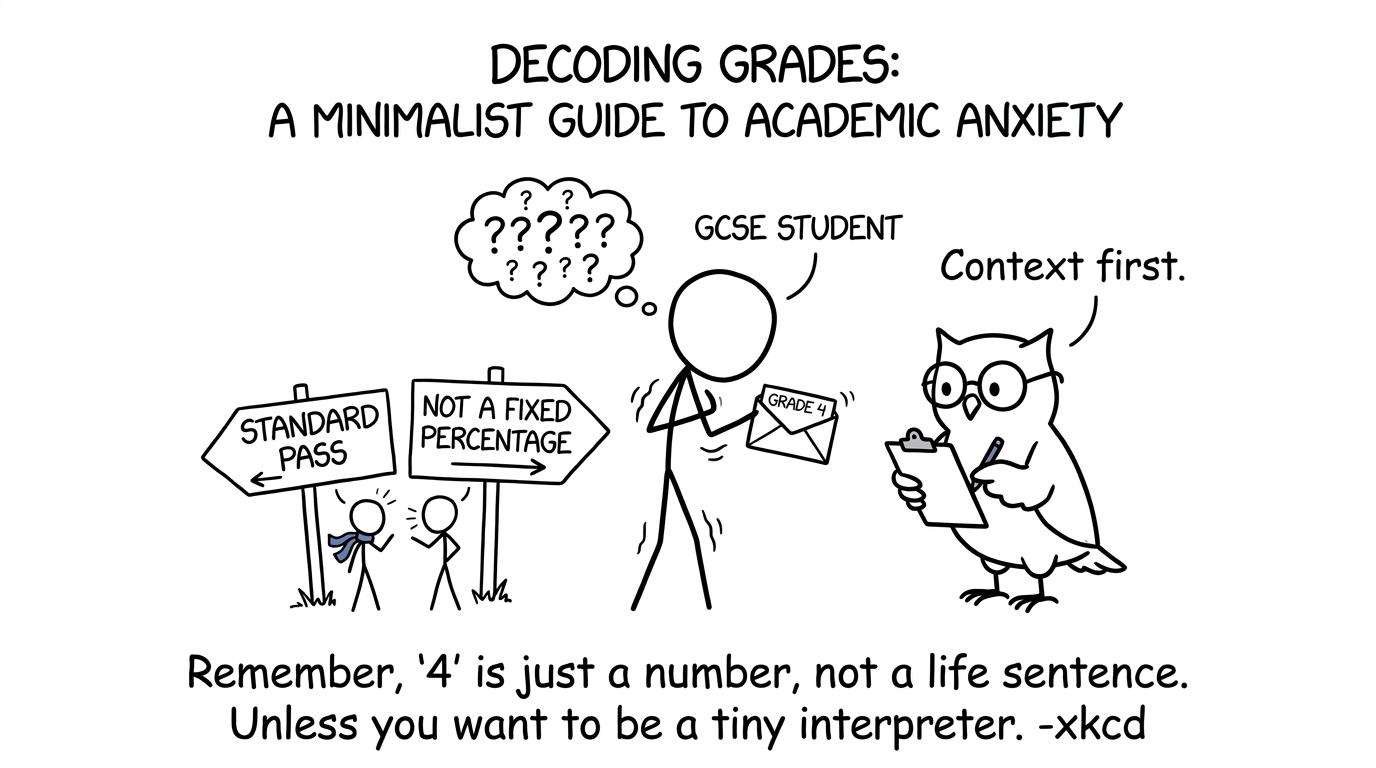 A student trying to decode what grade 4 means
Grade 4 in GCSE Biblical Hebrew at a glance
Here is the practical interpretation:
- Grade 444 is a standard pass in England's GCSE grading system.
- Its lower boundary is aligned with the lower boundary of the old grade C.
- It is below grade 555, which the government describes as a strong pass.
- It represents achievement across both Biblical Hebrew language and literature.
- It is based on an overall mark, so it does not prove equal strength in every skill.
- The mark needed changes between examination series.
- Biblical Hebrew does not use the foundation and higher tiers familiar from GCSE maths.
- A grade 444 in Biblical Hebrew does not create the same post-161616 continuation requirement as a grade below 444 in English or maths.
If you are checking a particular result, start with the Edexcel GCSE Biblical Hebrew grade boundaries. A grade only makes complete sense when matched to the correct year and examination series.
What ability does a grade 4 actually represent?
The current Pearson Edexcel GCSE in Biblical Hebrew assesses two broad areas. Language accounts for 50%50\%50% of the qualification, while literature accounts for the remaining 50%50\%50%.
The language component assesses whether students can read and understand unseen Biblical Hebrew, answer comprehension questions and translate passages into English. It also examines grammatical knowledge through the options defined in the specification.
The literature component assesses knowledge and understanding of prescribed texts. Students must also analyse, evaluate and respond to the literature using relevant evidence. Across the complete qualification, the assessment objective weighting is:
| Assessment area | Qualification weighting |
|---|---|
| Knowledge and understanding of language | 50%50\%50% |
| Knowledge and understanding of literature | 25%25\%25% |
| Analysis, evaluation and response to literature | 25%25\%25% |
A grade 444 therefore suggests that the student demonstrated enough combined competence in these areas to reach the standard-pass threshold. In practical terms, they could gain credit from translation, comprehension, grammar and literary responses with sufficient accuracy and relevance overall.
That wording matters. A grade is an overall judgement, not a detailed diagnosis. One student might be relatively secure when translating unseen prose but weaker when analysing set texts. Another might know the literature well but lose language marks through gaps in vocabulary or morphology. Both could finish with the same total grade.
A result of 444 should consequently be read as credible foundational achievement, not complete command of Biblical Hebrew. It says that the assessed standard was met. It does not say that every passage was understood, every grammatical form recognised or every literary argument fully developed.
How grade 4 compares with the old letter grades
The numbered scale is not a direct conversion table for the old A* to G system. Ofqual and the government identify particular alignment points instead:
- the bottom of grade 777 is comparable with the bottom of old grade A;
- the bottom of grade 444 is comparable with the bottom of old grade C;
- the bottom of grade 111 is comparable with the bottom of old grade G.
For that reason, the clearest comparison is that grade 444 occupies approximately the role once played by grade C as the standard-pass threshold. It is reasonable to describe it as broadly comparable with an old C, but less accurate to claim that every grade 444 performance would have received precisely the same letter grade under an older specification.
The assessments, content and grading structures are not identical. The comparison concerns the standard at key boundaries, rather than a simple replacement in which each number has one exact letter partner.
Maths students may recognise the same distinction from the meaning of a grade 4 in GCSE maths. The label is shared across GCSEs, but the knowledge and skills being assessed remain subject-specific.
Why a grade 4 is not a fixed percentage
A common assumption is that a grade 444 always requires 40%40\%40%. It does not.
Grade boundaries are set for each examination series after the papers have been taken and marked. They reflect the demand of that particular assessment while maintaining the intended grading standard. This means a more demanding paper can have a lower raw-mark boundary without representing a lower standard of achievement.
The latest complete summer series available at the time of writing is June 202520252025. For Edexcel Biblical Hebrew, the overall grade 444 boundary was 919191 marks from a possible 200200200:
91200×100=45.5%\frac{91}{200}\times 100=45.5\%20091×100=45.5%In June 202420242024, the grade 444 boundary was 102102102 from 200200200:
102200×100=51%\frac{102}{200}\times 100=51\%200102×100=51%Earlier boundaries also varied. The threshold was 898989 marks in 202320232023 and 757575 marks in 202220222022. These figures are historical evidence, not predictions for a future paper.
This is why students should avoid revising towards an assumed percentage. A safer goal is to improve the quality of every available response and leave a margin above previous boundaries. The same principle applies when using GCSE maths papers: raw marks become informative only when connected to the correct paper, tier, board and series.
What grade 4 does not tell you
A single grade leaves several useful questions unanswered.
It does not identify your strongest component
Because the final result combines language and literature, the grade alone cannot show whether translation, grammar, comprehension, textual knowledge or analysis was your strongest area. Teacher feedback and marked practice are more useful for that diagnosis.
It does not mean you were one mark from grade 5
A grade 444 covers a range of marks. You might have been close to the lower boundary or close to grade 555. Check the official boundary and your total mark before drawing conclusions.
It does not guarantee entry to every course
A grade 444 is a standard pass, but schools, sixth forms, colleges and employers can set their own entry requirements. A course may request particular grades or subjects. Check the published requirement directly rather than assuming that the word “pass” settles every decision.
It does not trigger the English and maths continuation rule
In England, relevant post-161616 students who have not achieved grade 444 or above in English and/or maths must continue studying approved qualifications in those subjects. That specific funding condition does not apply to Biblical Hebrew.
This difference is easy to miss. GCSE grades use one scale, but the consequences attached to individual subjects are not always the same.
A useful lesson for your GCSE maths revision
The reader searching for a Biblical Hebrew result may still have a maths examination ahead. There is a helpful connection: in both subjects, the final grade is less useful than the pattern of marks underneath it.
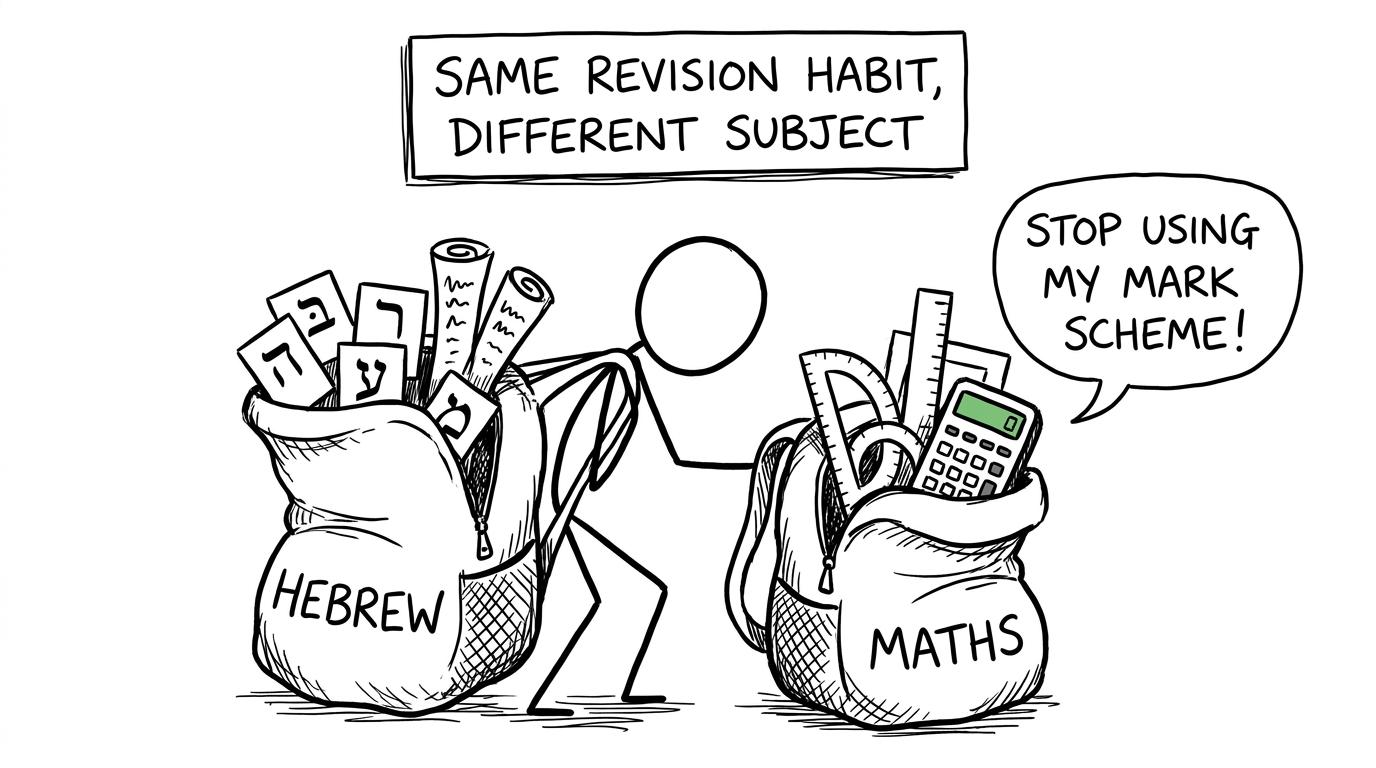 Two subject backpacks requiring the same revision habit
In Biblical Hebrew, a broad instruction such as “improve language” is difficult to act on. A diagnosis such as “unseen translation loses marks through verb recognition” is much better. In maths, “revise algebra” is similarly vague. “Practise forming linear equations from worded problems” gives you somewhere to begin.
Use this revision loop:
- identify one specific weakness;
- revisit the method or required knowledge;
- complete focused practice questions;
- mark the work carefully;
- record why each mark was lost;
- return to the skill later without notes;
- test it under timed conditions.
The GCSE Maths revision hub lets you choose resources for Edexcel, AQA, OCR and Eduqas, as well as other UK boards. If you are unsure what belongs on your revision list, use the GCSE maths topics by exam board and tier as a map.
Once individual methods are more secure, move into mixed assessment. The Edexcel GCSE Maths past papers include mark schemes and worked solutions where available. The guide to when to start GCSE past papers explains how to progress from short diagnostics to full timed papers.
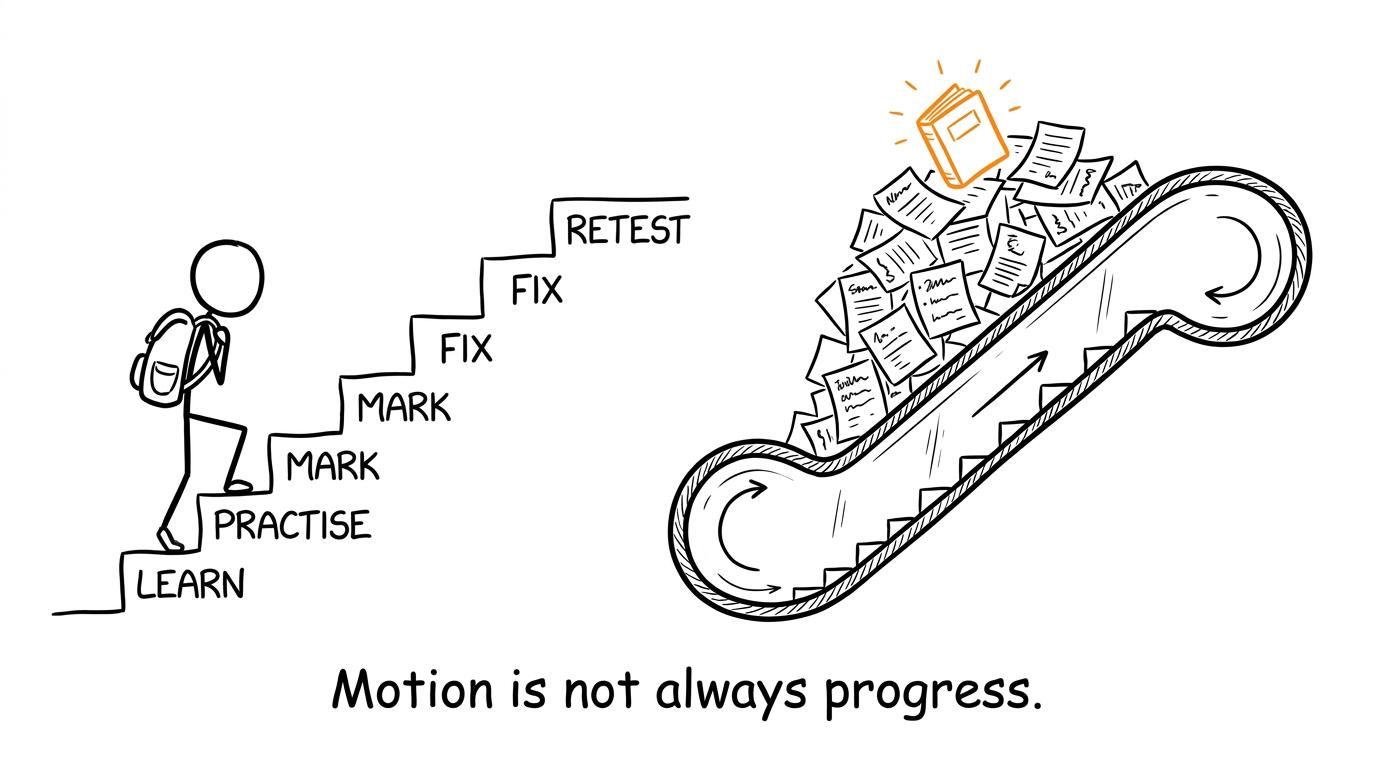 A deliberate revision staircase beside random notes going nowhere
Common mistakes when interpreting the result
Calling grade 4 a fail
Grade 444 is officially a standard pass. Grade 555 is a strong pass, but that does not turn grade 444 into a failing result.
Treating grade 4 as exactly the old C
The bottom of grade 444 is aligned with the bottom of old grade C. The numbered and letter scales are not directly equivalent at every point.
Assuming the boundary is always the same
Biblical Hebrew boundaries have changed substantially between series. Always check the correct year rather than borrowing a percentage from another paper or subject.
Confusing Biblical Hebrew with Modern Hebrew
They are different GCSE subjects with different specifications and assessments. Biblical Hebrew focuses on an ancient language and prescribed literature; it is not assessed as a modern spoken-language qualification.
Applying maths tier rules to Biblical Hebrew
GCSE maths commonly has foundation and higher tiers. Biblical Hebrew does not follow that tiered model. A result should be interpreted through its own specification and boundaries.
Revising from the total mark alone
A total tells you where you finished, not what to repair. Students trying to move beyond a pass grade should classify lost marks by topic and error type. MathsGenie's guide to revision when you are stuck at a pass grade offers a focused way to do this.
Turn the grade into a useful next step
A grade 444 in GCSE Biblical Hebrew means that you achieved the standard-pass threshold and performed at a level broadly comparable, at the lower boundary, with the old grade C. It reflects meaningful ability across language and literature, but it is not a claim of fluency, equal strength in every component or a fixed percentage score.
That is the calmest way to read any result: respect what the grade confirms, then look beneath it for your next action.
For your maths preparation, make MathsGenie's free GCSE revision resources your starting point. Use revision lessons and practice questions to repair individual topics, mini tests to check recall, and past papers to build stamina. Nearer the examination, add predicted papers, then use mark schemes and video solutions to turn every lost mark into a specific improvement.










