GCSE Biblical Hebrew Exam Dates 2026 Guide
GCSE Biblical Hebrew exam dates 2026, paper times, assessment details and a practical test-day checklist for students balancing Hebrew and maths.
An exam date can look like a small detail until it begins shaping every revision decision around it. For students balancing Biblical Hebrew with GCSE maths, the order of the papers matters almost as much as the dates themselves.
The GCSE Biblical Hebrew exam dates 2026 were Thursday 7 May for Language and Tuesday 19 May for Literature. Both Pearson Edexcel papers lasted two hours. Language was a morning examination; Literature was an afternoon examination. Those dates came from Pearson's final Summer 2026 timetable, but your personal timetable from your school or examination centre remained the document to follow for arrival times, rooms and access arrangements.
This guide brings together the timetable, paper structure, practical preparation and the maths revision decisions surrounding both examinations.
GCSE Biblical Hebrew exam dates 2026 at a glance
Pearson Edexcel was the awarding body for the current GCSE Biblical Hebrew qualification, identified by specification code 1BH0.
| Component | Paper code | Date | Session | Duration |
|---|---|---|---|---|
| Component 1: Language | 1BH0/01 | Thursday 7 May 2026 | Morning | 2 hours |
| Component 2: Literature | 1BH0/02 | Tuesday 19 May 2026 | Afternoon | 2 hours |
A useful checklist was therefore:
- confirm that your entry showed Pearson Edexcel Biblical Hebrew 1BH0;
- copy both dates and sessions onto your calendar;
- check the room, seat number and arrival time on your personal timetable;
- keep Wednesday 24 June 2026 available as the national contingency day;
- identify every other GCSE paper falling between the two Hebrew components;
- separate your Hebrew resources from your maths equipment and revision plans.
The official session label does not necessarily tell you the exact time at which your centre expects you to arrive. Under JCQ arrangements, the published starting times are normally 9.00 am for morning examinations and 1.30 pm for afternoon examinations. Centres have limited flexibility within each session, so follow your school's instructions rather than assuming that the published time is your arrival time.
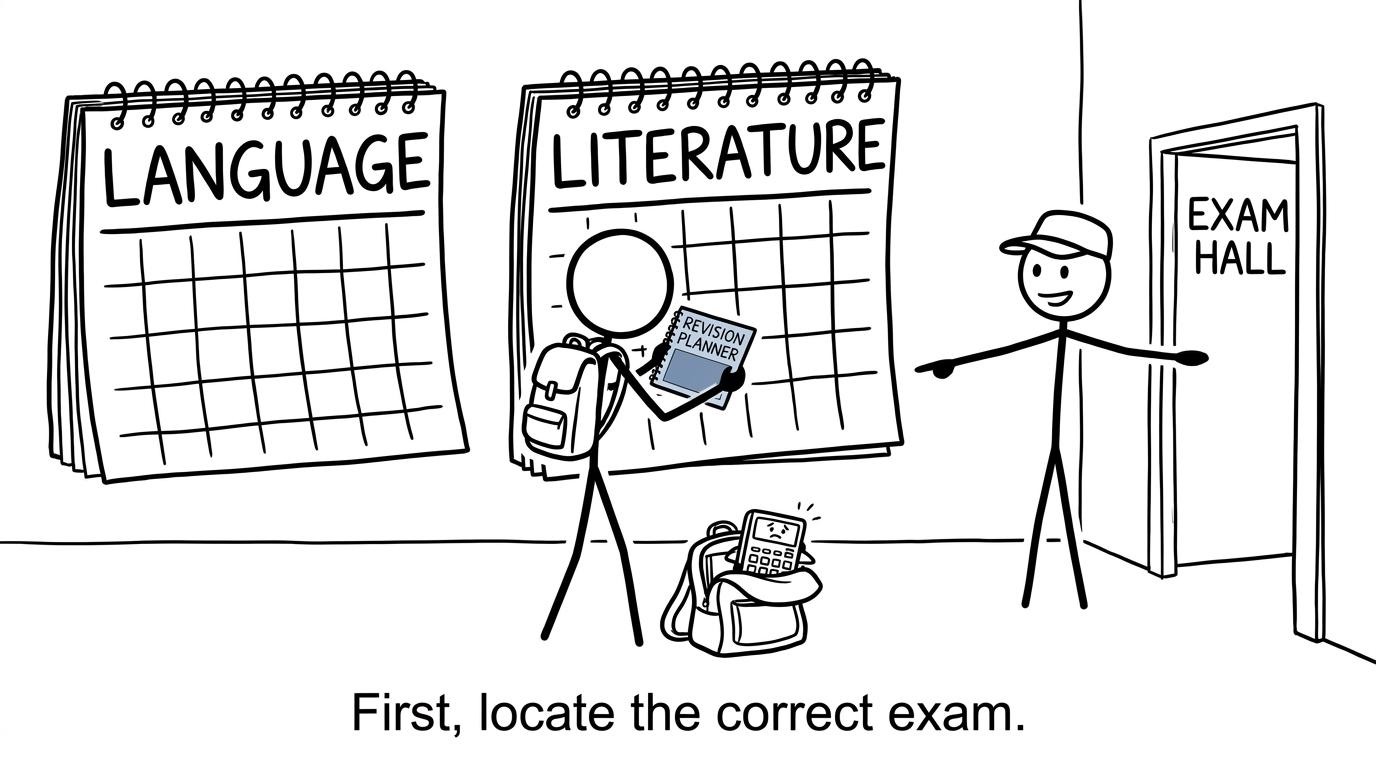 A student navigates two giant exam calendar pages with a revision planner
What each Biblical Hebrew paper covers
Knowing the date creates order. Knowing the paper creates purpose.
The Edexcel GCSE is linear, meaning both examinations are taken at the end of the course. There is no coursework or controlled assessment component. Each paper is worth 100100100 marks and contributes 50%50\%50% of the qualification.
Component 1: Language
The Language paper lasts two hours and contains two equally weighted sections:
- Section A: Comprehension, worth 505050 marks;
- Section B: Translation, worth 505050 marks.
The published assessment structure includes compulsory comprehension work, optional content questions and translation tasks. Read the rubric carefully rather than relying on what you remember from a mock. Optionality can create avoidable mistakes if a student answers too much, too little or the wrong combination.
Translation preparation should involve active writing, not merely rereading vocabulary. Complete short passages under time pressure, compare your response with the mark scheme and record recurring problems such as tense, person, number or omitted words.
Component 2: Literature
The Literature paper also lasts two hours and is worth 100100100 marks. Its three sections are arranged as follows:
- Section A: Set text 1, worth 444444 marks;
- Section B: Set text 2, worth 444444 marks;
- Section C: Synoptic question, worth 121212 marks.
The first two sections include short-response work, translation and an extended response. The synoptic section asks you to draw understanding together rather than treating each text as an isolated collection of quotations.
Your teacher should confirm the prescribed texts and the precise material studied by your class. Do not revise from an old specification list simply because it appears in an inherited folder or online document.
How Biblical Hebrew fits around GCSE maths
The calendar creates an unusual rhythm. The Language paper was on Thursday 7 May, followed one week later by the first GCSE maths paper used by AQA, Pearson Edexcel and OCR on Thursday 14 May. The Literature paper then followed five days later on Tuesday 19 May.
In interval form:
Language to first maths paper=7 days\text{Language to first maths paper}=7\text{ days}Language to first maths paper=7 days First maths paper to Literature=5 days\text{First maths paper to Literature}=5\text{ days}First maths paper to Literature=5 daysThat does not mean you should stop one subject and begin the other. A better plan keeps both active while changing the emphasis.
Before Language, give Biblical Hebrew the longer session and retain a short daily maths block. After Language, increase maths practice while continuing brief retrieval of set texts. Once the first maths paper is complete, shift the larger block towards Literature without abandoning preparation for the remaining maths papers in June.
Use the GCSE Maths revision hub to choose resources for your board and tier. If decisions are consuming revision time, the GCSE maths revision timetable guide offers a manageable structure for mixing topic work with timed practice.
Use short sessions between major papers
A two-hour language examination is tiring. Planning an enormous maths session immediately afterwards may look ambitious on paper but produce poor work. A shorter, deliberate task is more useful: one mini test, careful marking and a note of the next topic to repair.
MathsGenie's Edexcel GCSE Maths mini tests are useful for this kind of focused check. Students following another board can begin from the main GCSE hub and select the appropriate resources.
The deeper principle is simple: revision should preserve continuity. Even 202020 purposeful minutes can stop a method becoming unfamiliar. The 20-minute GCSE maths revision routine explains how to combine recall, questions and marking on crowded school days.
What to sort before test day
A calm examination morning is usually built the evening before. It begins with removing decisions.
Confirm your personal timetable
Check all of the following against the timetable issued by your centre:
- your name and candidate details;
- the qualification and paper code;
- the date and session;
- your examination room and seat;
- your required arrival time;
- approved access arrangements;
- any timetable clash instructions.
If anything appears wrong, contact your teacher or examinations officer promptly. Do not try to resolve an entry problem at the examination-room door.
Pack only permitted equipment
JCQ's 2025/26 candidate guidance advises students to bring at least two black-ink pens in a clear pencil case. A clear, unlabelled water bottle may be permitted. Follow the instructions printed on the paper and any additional directions from your centre.
Phones, watches of every kind, revision notes and smart devices must not be taken into the examination room. This includes smartwatches and devices such as earbuds or smart glasses. If you accidentally bring an unauthorised item to school, hand it in as instructed before entering.
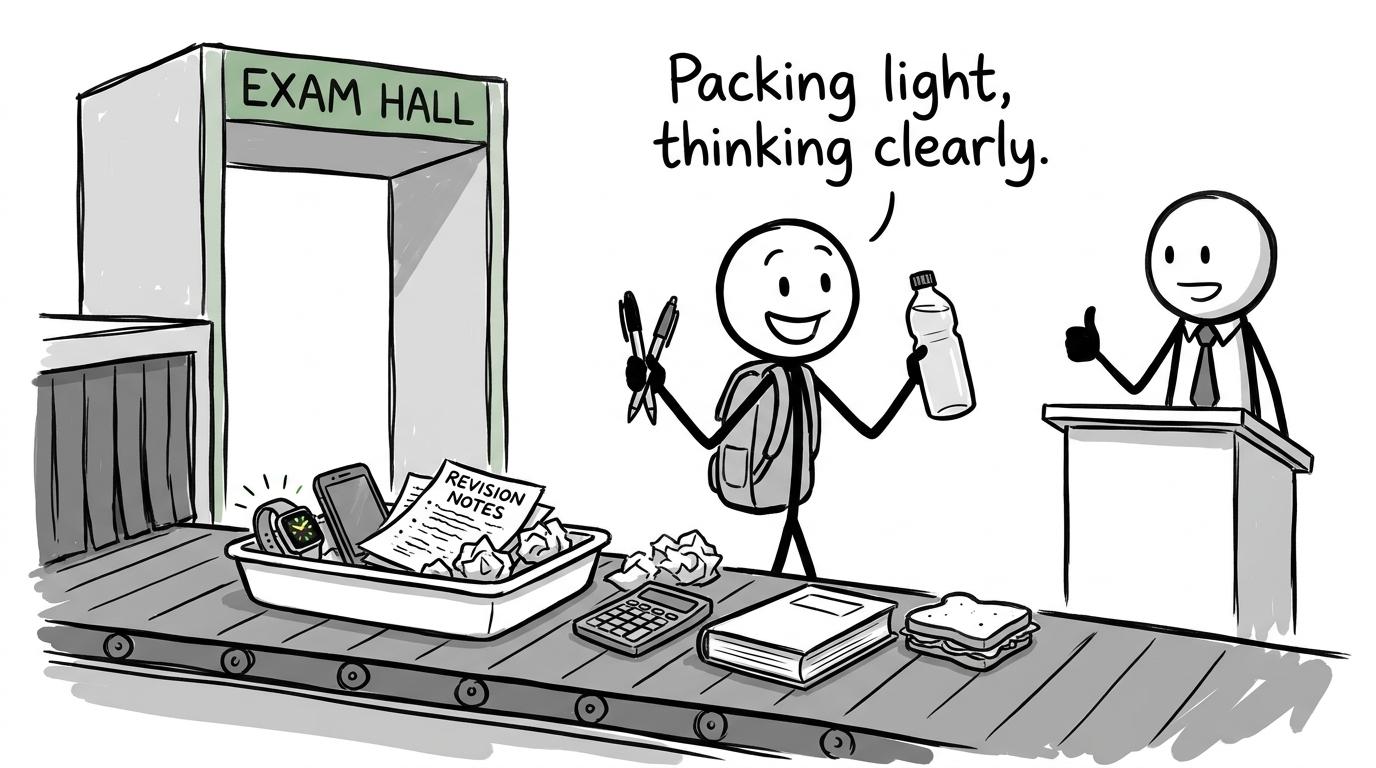 A student passes an exam-hall security check with pens and a clear water bottle
Plan the journey
Work backwards from the arrival time set by your centre. Include ordinary delays rather than imagining a perfect journey. Set an alarm, prepare clothes, arrange transport and save the school's emergency contact details somewhere accessible outside the examination room.
If illness, disruption or an emergency may make you late or absent, contact the centre immediately. The contingency day is not a spare resit date for an examination an individual candidate misses.
How the examination session usually unfolds
Procedures vary slightly between centres, but the broad sequence is familiar.
You will normally gather at an instructed location, enter in silence and sit at your assigned desk. The invigilator will explain the rules and tell you when to complete details on the answer booklet. Check that you have the correct Biblical Hebrew component and all listed materials.
Do not open the paper or begin writing until instructed. Once the examination starts, read the front-page instructions and rubric carefully. The marks shown beside questions can help you judge how much time and detail each response deserves.
If you need extra paper, feel unwell or believe something is missing, raise your hand and wait for an invigilator. Invigilators can explain procedure, but they cannot interpret an examination question for you.
At the end, stop writing when told. Ensure additional sheets carry the required candidate information and are placed in the correct order. Remain silent until you have left the examination area.
The final revision approach for both subjects
The last stage should be about evidence, not reassurance. Rereading familiar notes can feel smooth while concealing what you cannot yet produce independently.
For Biblical Hebrew, alternate translation, comprehension, set-text retrieval and timed written responses. Mark what you complete and convert each mistake into a precise action.
For maths, use three layers:
- revision lessons and practice questions to rebuild individual methods;
- mini tests to check whether those methods can be recalled;
- timed past or predicted papers to practise selection, accuracy and stamina.
MathsGenie's Edexcel GCSE Maths past papers include mark schemes and worked solutions where available. Nearer an examination, Edexcel GCSE Maths predicted papers can provide fresh exam-style practice. The guide to using GCSE maths past papers properly explains how to turn lost marks into targeted revision rather than simply recording a score.
Common mistakes to avoid
Confusing Biblical Hebrew with Religious Studies
GCSE Biblical Hebrew is a language and literature qualification. It is not the same examination as GCSE Religious Studies Judaism. Confirm the subject title and Edexcel code 1BH0 on your personal timetable.
Remembering the date but not the session
Language was in the morning; Literature was in the afternoon. Record both the date and session, then add the earlier arrival time required by your centre.
Treating the two-hour paper as one undivided task
Both components contain sections with different mark totals and demands. Practise moving between them and leave time to check omissions, question choices and additional sheets.
Revising only one subject at a time
The gap around the first maths examination is too short for a complete stop-start strategy. Keep both subjects active, even when one receives a smaller daily allocation.
Taking prohibited technology into the room
A silent phone or watch is still unauthorised. Check pockets and bags before entering, then follow your centre's storage procedure.
Booking plans before the contingency day
Candidates had to remain available through Wednesday 24 June 2026. The contingency session existed for national or significant local disruption, not personal convenience.
Turn dates into a plan
A timetable cannot revise for you, but it can remove uncertainty. Write down the two Biblical Hebrew components, place your maths papers beside them and decide what each available day is for. That small act turns a crowded month into a sequence of manageable tasks.
For the maths side of the plan, make MathsGenie's free GCSE revision resources your starting point. Use revision lessons and practice questions to strengthen weak topics, mini tests for quick checks, then past papers and predicted papers for realistic rehearsal. Mark everything with the available mark schemes and video solutions.
The aim is not to feel perfectly prepared every morning. It is to know where to go, what to bring and what useful task comes next.