GCSE Biblical Hebrew Access Arrangements Guide
GCSE Biblical Hebrew access arrangements explained: extra time, evidence, school requests and a clear timeline for securing support before exams.
The hardest part of an exam should be showing what you know. It should not be reading a page you cannot see clearly, writing through pain, or processing questions against a clock that does not reflect your usual way of working.
GCSE Biblical Hebrew access arrangements can remove those barriers. If you have a disability, learning difficulty, medical condition or temporary injury, speak to your school’s SENCo or exams officer as early as possible. Your centre identifies the appropriate support, gathers evidence and, where required, submits the application through Access Arrangements Online. Students cannot normally make the formal application themselves.
The rules are set annually by the Joint Council for Qualifications, commonly called JCQ. This guide reflects the regulations and deadlines available at the time of publication, but your exams officer must check the rules for your examination series.
Your access arrangements checklist
Start with these actions:
- Tell your SENCo, learning-support team or exams officer about the difficulty early.
- Explain how it affects you in lessons, timed assessments and mock examinations.
- Ask which arrangement is being considered and what evidence is required.
- Use the arrangement in internal tests so that it becomes an established way of working.
- Confirm whether your centre must apply online or can provide the arrangement under delegated rules.
- Ask for a trial in Biblical Hebrew and maths, because the effect may differ between subjects.
- Check the final decision and practical details before the examination series begins.
Access arrangements are not bonus marks or an easier version of the qualification. They are intended to let you demonstrate your knowledge without changing what the assessment is designed to test.
How GCSE Biblical Hebrew is assessed
GCSE Biblical Hebrew is currently offered by Pearson Edexcel under specification code 1BH0. Unlike GCSE maths, it does not have foundation and higher tiers.
The qualification has two externally examined components:
- Paper 111: Language, lasting 222 hours and worth 100100100 marks.
- Paper 222: Literature, lasting 222 hours and worth 100100100 marks.
Each paper contributes 50%50\%50% of the qualification. Students complete both components in the same May or June examination series.
That structure matters when arrangements are planned. A student might need extra time because processing Biblical Hebrew text is unusually slow, a word processor because handwriting causes substantial difficulty, or a modified paper because standard print is inaccessible. However, the arrangement must not remove the skill being assessed. A reader, for example, cannot translate text, explain vocabulary or provide help that changes the assessment demand.
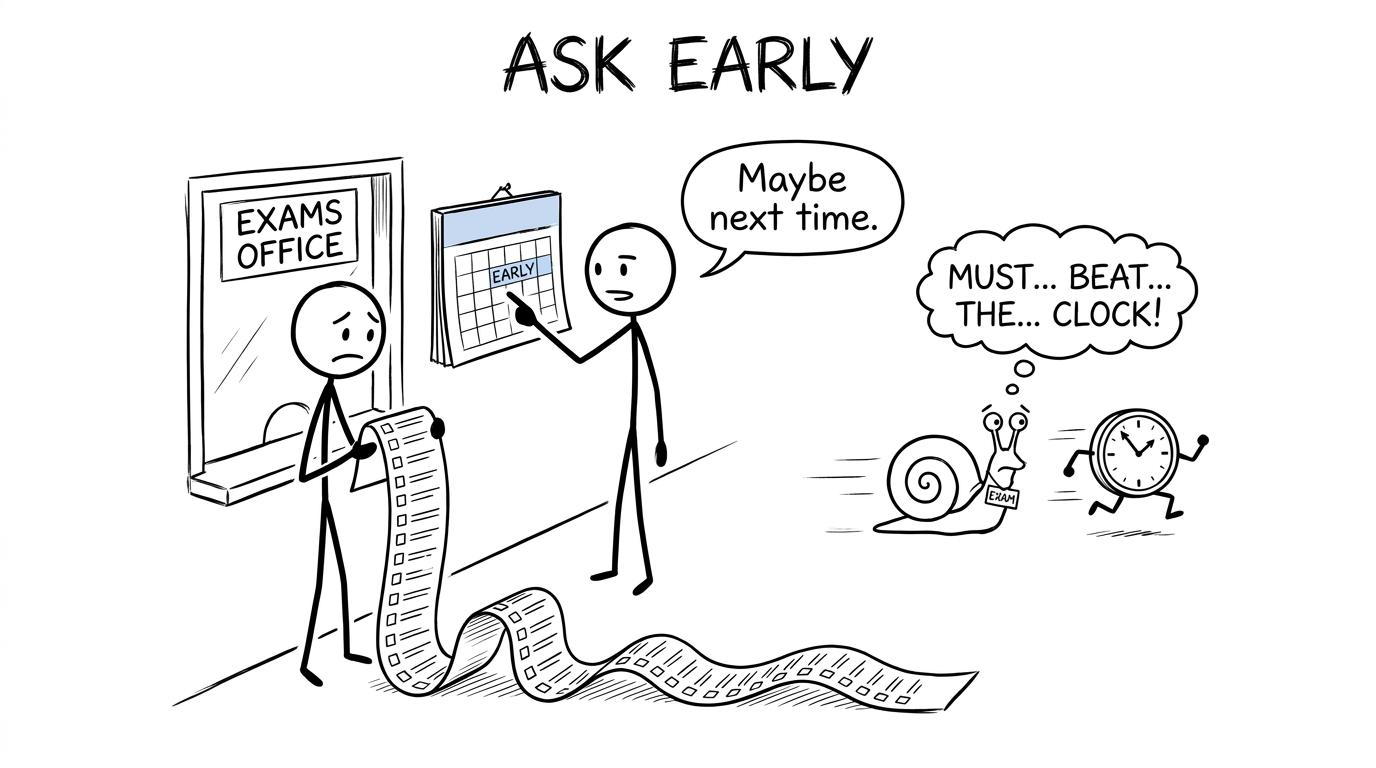 A student arrives at the exams office with a checklist while a snail races the application clock
Who can request access arrangements?
You should raise the issue if a persistent difficulty affects your ability to access examinations. Relevant circumstances may include:
- dyslexia or another learning difficulty;
- a visual, hearing, physical or sensory impairment;
- a long-term medical condition;
- social, emotional or mental health needs;
- difficulties with attention, communication or processing;
- a temporary injury, such as an injured writing hand.
A diagnosis does not automatically produce a particular arrangement. Equally, a student does not always need a named diagnosis before their school can investigate a genuine need. JCQ’s approach considers the evidence, the effect of the difficulty and the student’s normal way of working.
An Education, Health and Care Plan can support an application, but it does not automatically guarantee extra time, a reader or a scribe. The school must still establish why the specific arrangement is necessary for the examination.
How to request GCSE Biblical Hebrew access arrangements
Speak to the right person
Tell your subject teacher, SENCo or exams officer as soon as you notice that a barrier is affecting timed work. Do not wait for the final mock or assume that arrangements used in primary school will transfer automatically.
Describe the practical effect rather than simply naming a condition. For example, explain whether you struggle to finish, need frequent breaks, cannot read standard-sized print, experience pain when writing or use assistive technology in lessons.
Let the centre build a picture of need
The SENCo may collect:
- teacher observations;
- marked internal tests and mock papers;
- records of support used in lessons;
- samples showing how extra time was used;
- specialist assessment results;
- medical or professional evidence where applicable;
- evidence from the student about what helps and why.
For applications for 25%25\%25% extra time processed under the JCQ rules introduced from September 2025, centres need representative internal test or mock evidence across relevant subjects, together with staff comments explaining why the time is needed and how it is used. Requirements depend on the student’s circumstances, so the SENCo must follow the current form and evidence route.
Trial the proposed support
A trial answers an important question: does the arrangement actually remove the barrier?
Your school might compare your work with and without supervised rest breaks, or record what you complete during extra time. If you use a word processor, you should be familiar with the approved examination setup before the real paper.
This is also why timed practice matters in maths. Use the GCSE Maths revision hub to choose an appropriate paper or short test, then practise under the conditions your centre has authorised. The purpose is not to prove that more time feels pleasant. It is to establish whether the support is necessary and effective.
The centre completes the formal process
For arrangements requiring approval, the exams officer or SENCo submits the application through Access Arrangements Online. Some applications receive an immediate online outcome when the required criteria are met. Others must be referred to the awarding body and may require further evidence.
Some arrangements, including supervised rest breaks in appropriate circumstances, do not require an online application. The centre must still hold the evidence or records required by JCQ and organise the arrangement correctly.
How extended time works
The most familiar arrangement is 25%25\%25% extra time, but it is not automatic and is not the right support for every student.
A standard Biblical Hebrew paper lasts 222 hours, or 120120120 minutes. With approved 25%25\%25% extra time, the additional allowance is:
120×0.25=30 minutes120 \times 0.25 = 30 \text{ minutes}120×0.25=30 minutesThe total permitted time becomes:
120+30=150 minutes120 + 30 = 150 \text{ minutes}120+30=150 minutesThat is 222 hours 303030 minutes for each paper. The exams team will explain how the extra time is administered and how it interacts with any other arrangement.
More than 25%25\%25% extra time is possible in limited circumstances, but it requires stronger evidence of a substantial difficulty and closer awarding-body scrutiny. Extra time is not normally awarded simply because a student works carefully, has English as an additional language or feels nervous in examinations.
Supervised rest breaks may sometimes be more appropriate. During an authorised rest break, the examination clock is paused and the student must remain supervised without discussing or working on the paper. JCQ expects centres to consider rest breaks before applying for extra time in relevant cases.
Other arrangements that may be available
The correct arrangement depends on the barrier rather than the subject name.
| Arrangement | What it may address |
|---|---|
| Supervised rest breaks | Fatigue, pain, concentration difficulties or some medical needs |
| Word processor | Significant handwriting, physical or legibility difficulties where this is the normal way of working |
| Reader or computer reader | Eligible reading-access needs, subject to restrictions where reading is being assessed |
| Scribe or speech recognition | Severe writing or physical difficulties, with appropriate evidence |
| Modified paper | Visual or accessibility needs requiring Braille, modified enlarged print or another approved format |
| Prompter | A substantial difficulty remaining focused on the examination task |
| Separate or smaller room | A consequence of an approved arrangement or an established need, not simply a preference |
The equipment must be configured for examination use. A word processor does not mean unrestricted internet access, stored notes or automatic assistance that the regulations prohibit.
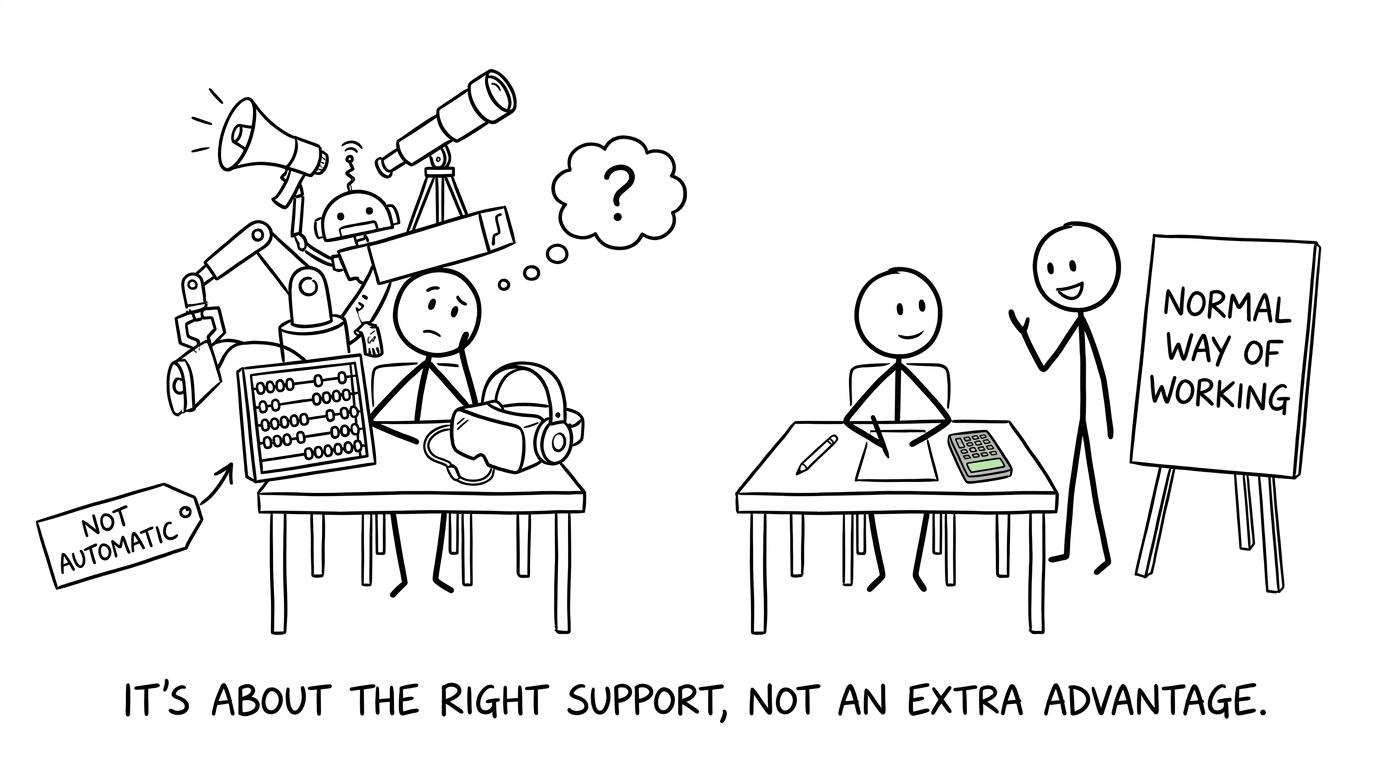 One student requests random gadgets while another calmly uses the support that reflects their normal way of working
The timeline for getting arrangements approved
Early discussion matters because evidence must be gathered before the application deadline. A calm timeline looks like this:
Year 101010 or the start of Year 111111
Raise concerns and begin trials. The SENCo can review classroom evidence, previous support and any need for specialist assessment. If the arrangement may also apply to maths, practise it during suitable internal assessments.
Students can use AQA GCSE Maths revision resources or the Eduqas GCSE Maths revision hub to rehearse independently before a formally supervised mock.
Autumn term of the examination year
The centre should gather teacher comments and evidence from timed work. Ask whether the proposed arrangement has been trialled specifically in Biblical Hebrew, particularly if the format or language demands create different practical issues from maths.
Private candidates must contact an accepting examination centre much earlier. The centre needs time to review the evidence, establish its responsibilities and confirm that it can deliver the arrangement.
January onwards
Modified papers have an earlier deadline than most other arrangements. For the June 2026 series, the JCQ deadline was 31 January 2026 for modified papers and 21 March 2026 for other online access-arrangement applications. Awarding-body information also lists 31 January 2027 for June 2027 modified-paper requests.
Students preparing for June 2027 should ask their exams officer to confirm the current JCQ and Pearson deadlines rather than relying on a previous year’s dates. Schools usually impose earlier internal deadlines so that assessment, evidence checking and online processing can be completed safely.
Before the first examination
Ask for written confirmation of what has been approved. Check the room, equipment, breaks and timing. If you receive extra time in both Biblical Hebrew and maths, use the correct conditions when completing Edexcel GCSE Maths predicted papers.
A short paper can make the trial more manageable. MathsGenie’s guidance on finding weak GCSE topics explains how to turn timed practice into useful evidence rather than treating every score as a judgement.
Common mistakes to avoid
Waiting until the examination week
Normal access arrangements are agreed in advance. Tell the centre immediately if a new injury or unexpected condition occurs, but do not delay a long-standing concern until May.
Assuming a diagnosis guarantees extra time
The decision concerns need, evidence and normal working practice. A condition may lead to rest breaks, technology or another adjustment rather than extra time.
Never using the arrangement in mocks
An arrangement should not appear for the first time in the final examination. Trials help the school document need and help you learn how to use the support effectively.
Confusing access arrangements with special consideration
Access arrangements remove known barriers before or during an assessment. Special consideration is a separate post-examination process for temporary illness, injury or another adverse event affecting performance at the time of the assessment.
Practising with unlimited or unofficial support
Use only the conditions your centre has approved. For maths, work with the correct board and tier through MathsGenie’s GCSE Maths resources, then mark your work honestly. The guide to using GCSE past papers at the right time can help you build this into a wider revision plan.
Make the arrangement part of your revision routine
The best access arrangement is one that feels familiar by examination day. Confirm it early, practise with it and ask questions whenever the practical details are unclear.
Then return your attention to the work itself. MathsGenie gives GCSE students free revision lessons, practice questions, mini tests, past papers, predicted papers, mark schemes and video solutions. Build a routine through the GCSE Maths revision area, using exactly the approved conditions you will have in the examination.
Access arrangements cannot revise for you. But when they are evidence-based, approved on time and practised properly, they can ensure the exam measures your understanding rather than an avoidable barrier. Speak to your SENCo or exams officer now, confirm the timeline, and give yourself the chance to prepare calmly.