

GCSE Bengali Tutoring Cost: A UK Price Guide
GCSE Bengali tutoring cost explained: realistic UK hourly ranges, hidden fees, tutor checks and how to decide whether private tuition is worth it.
The first tutoring quote can create a surprisingly difficult question. Is the tutor expensive because they are excellent, or simply expensive? And will paying for more lessons genuinely improve the result?
The short answer is that GCSE Bengali tutoring cost in the UK will commonly fall between about £20\pounds 20£20 and £50\pounds 50£50 per hour. Less experienced online tutors may charge below this range, while qualified teachers, exam specialists and tutors in London may charge £50\pounds 50£50 to £70\pounds 70£70 or more. Bengali is a specialist subject, so prices and tutor availability can vary considerably.
Price matters. But the more useful question is what each lesson changes. A focused tutor who identifies an exact weakness may offer better value in six lessons than a less suitable tutor provides in an entire term.
GCSE Bengali tutoring cost at a glance
Prices advertised by UK tutoring marketplaces vary widely, and there is no official national fee. A realistic starting guide is:
| Type of Bengali tuition | Typical advertised cost |
|---|---|
| Student tutor or newer independent tutor | £15\pounds 15£15 to £25\pounds 25£25 per hour |
| Experienced online GCSE tutor | £25\pounds 25£25 to £45\pounds 45£45 per hour |
| Experienced face-to-face tutor | £30\pounds 30£30 to £50\pounds 50£50 per hour |
| Qualified teacher or exam specialist | £40\pounds 40£40 to £70\pounds 70£70 or more per hour |
| Small-group tuition | Roughly £8\pounds 8£8 to £25\pounds 25£25 per student per hour |
These are broad market ranges rather than guaranteed prices. Listings reviewed in August 2026 included inexpensive independent Bengali tutors alongside experienced tutors charging around £40\pounds 40£40 to £55\pounds 55£55 per hour. Always check whether a quoted price is for GCSE exam preparation, conversational Bengali or general language teaching. They are not the same service.
Before booking, use this checklist:
- Confirm the exact qualification and specification.
- Ask whether the price includes marking and lesson preparation.
- Check the cancellation policy and any platform fee.
- Request evidence of relevant exam experience.
- Discuss safeguarding and an Enhanced DBS check.
- Agree on a measurable goal for the first few lessons.
- Avoid buying a large package before testing the fit.
Why Bengali tutoring prices vary so much
Tutoring prices do not behave like the price of a textbook. Two tutors may advertise the same lesson length while offering quite different levels of preparation, feedback and specification knowledge.
Qualification and exam-board knowledge
The phrase “GCSE Bengali” can describe different qualifications in everyday conversation. AQA offers GCSE Bengali, with listening, speaking, reading and writing assessments. Each skill contributes approximately 25%25\%25% of the qualification, and students are entered for foundation or higher tier across the qualification.
Pearson offers an International GCSE in Bangla. Its current specification focuses on reading, writing and translation in one externally examined paper. A tutor experienced in one course is not automatically prepared to teach the other.
This distinction is one of the first things to check. Ask the tutor to name the qualification, specification code and assessment structure. Familiarity with conversational Bengali is valuable, but exam tuition also requires knowledge of task types, mark schemes, timing and the standard expected in written responses.
Experience and professional background
A university student or fluent speaker beginning tutoring may charge less. A qualified language teacher, experienced GCSE tutor or examiner will generally charge more because their fee reflects subject knowledge, planning and assessment experience.
The higher fee is worthwhile only when that expertise is relevant. A tutor should be able to explain how they will diagnose weaknesses, select tasks and measure progress. Qualifications alone do not guarantee a productive relationship, just as a low price does not prove poor teaching.
Online or face-to-face lessons
Online tuition is often cheaper because the tutor has no travel time or transport cost. It also widens the search beyond the local area, which is particularly useful for a specialist subject with a smaller pool of tutors.
Face-to-face teaching may suit a student who struggles to concentrate online or needs close support with handwriting and written accuracy. Travel charges may be included in the hourly rate or added separately, so ask before comparing quotations.
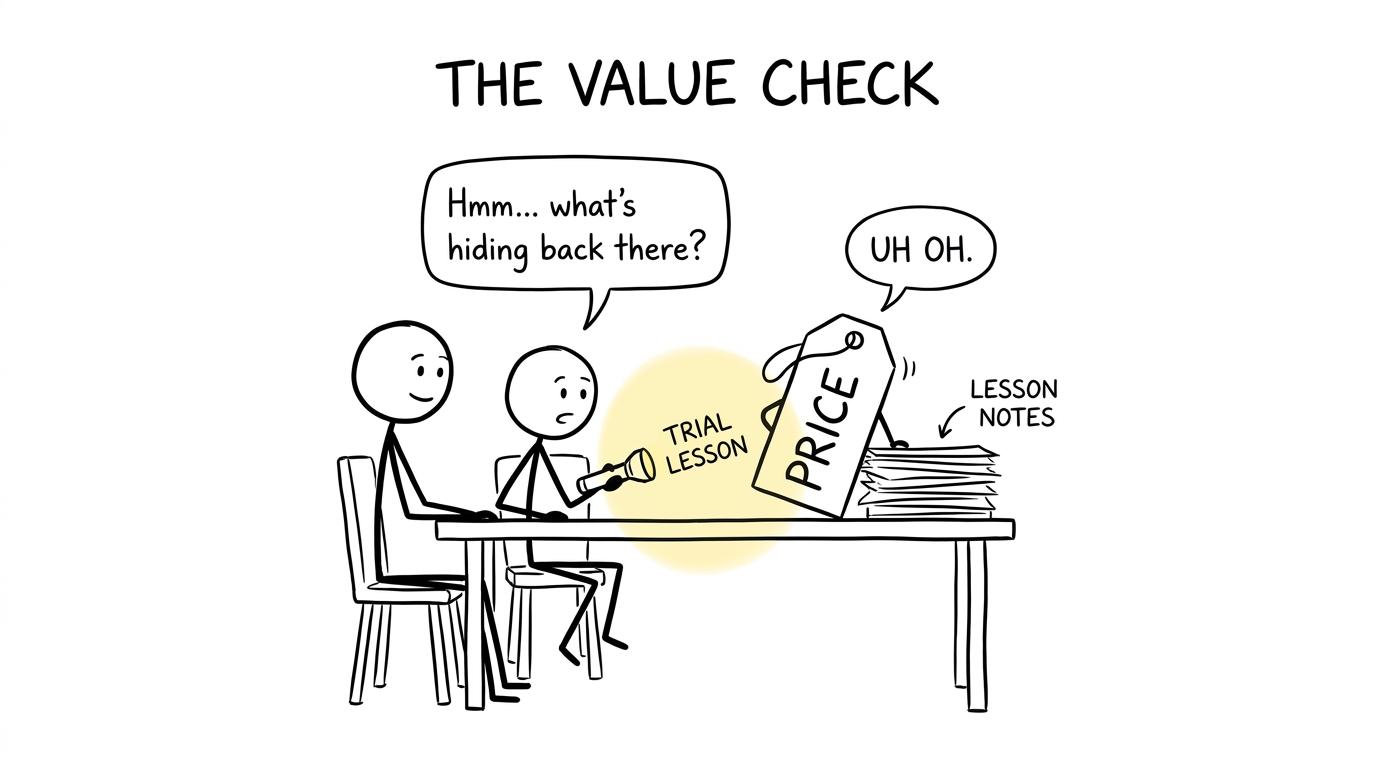 A student examines tutoring value with a trial lesson
Lesson length, location and demand
A shorter lesson does not always reduce the price proportionally. Tutors still need to prepare materials, communicate with parents and review work. London prices also tend to be higher than those in many other parts of the UK, especially for home visits.
Demand can rise as examinations approach. Searching earlier gives families more choice and makes it easier to trial a tutor without feeling pressured into the first available option.
What should the quoted price include?
An hourly figure is useful only when you know what sits behind it. Ask whether the fee covers:
- a diagnostic assessment;
- an individual lesson plan;
- specification-matched materials;
- marking between sessions;
- feedback to the student or parent;
- vocabulary, grammar or translation tasks;
- speaking practice where required by the qualification;
- mock assessments and progress reviews.
Some tutors charge only for live teaching and expect homework to be completed independently. Others include detailed marking and written feedback. Either arrangement can work, but it should be clear before lessons begin.
Also check platform commissions, joining fees, minimum bookings and cancellation terms. A tutor charging £30\pounds 30£30 per hour with extensive preparation may offer better value than one charging £25\pounds 25£25 while adding separate fees for marking.
How to estimate the full tutoring budget
Think beyond the hourly rate. The basic relationship is:
Total cost=hourly fee×number of lessons+additional fees\text{Total cost}=\text{hourly fee}\times\text{number of lessons}+\text{additional fees}Total cost=hourly fee×number of lessons+additional feesFor weekly lessons across a school term, even a moderate hourly price becomes a meaningful commitment. Ask whether the student truly needs weekly tuition or whether a shorter block focused on one weakness would be enough.
Useful models include:
- A diagnostic block: a small number of lessons to identify gaps and establish a revision plan.
- Fortnightly support: suitable when the student can complete substantial independent work.
- Weekly tuition: useful for persistent weaknesses or when regular accountability is needed.
- Exam-season support: intensive but targeted work on timed responses and exam technique.
- Small-group lessons: lower cost per student, provided the group follows the same specification and works at a similar level.
Do not assume that more hours automatically produce more progress. Tuition works between lessons as much as during them. Homework, retrieval practice and correction are where guidance becomes independent skill.
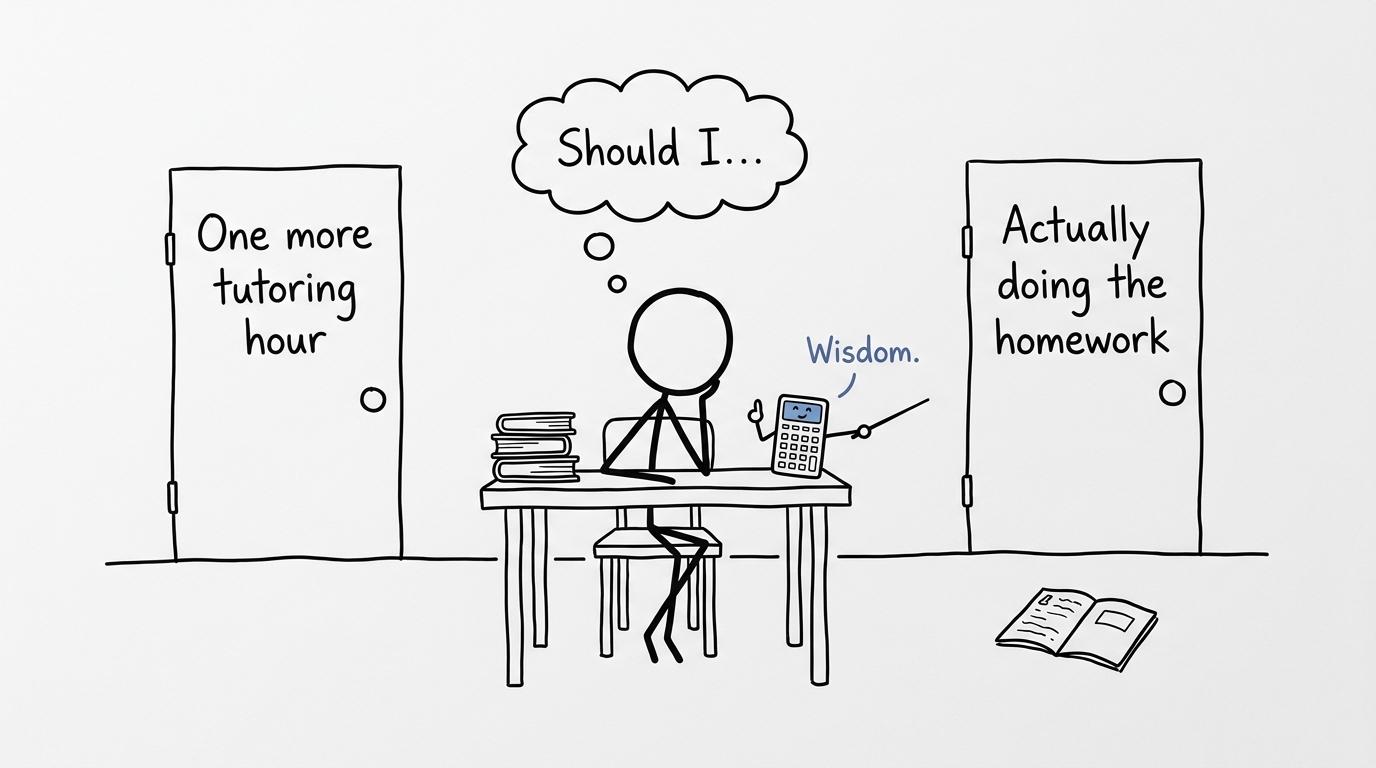 A calculator recommends doing the homework rather than buying endless lessons
How to decide whether Bengali tutoring is worth it
Private tuition is most valuable when the problem is specific. “I need help with Bengali” is too broad. “I can understand spoken Bengali but lose marks in formal writing and translation” gives a tutor something they can act upon.
Look for a clear diagnosis
A strong tutor should establish what the student can already do and where marks are being lost. The diagnosis should reflect the actual qualification rather than a generic language course.
After the initial sessions, you should be able to answer:
- Which assessment skill needs the most attention?
- What type of error appears repeatedly?
- What will the student practise independently?
- How will improvement be checked?
This is the same evidence-led approach that works in maths. MathsGenie’s guide to finding your weakest GCSE topics shows how assessment, marking and retesting can replace guesswork with a focused plan.
Measure progress, not lesson attendance
Attendance is an input, not an outcome. Keep a simple record of timed-task marks, recurring language errors and independent work completed. Compare like with like rather than relying on whether lessons merely feel helpful.
Agree on a review point before starting. If there is no clearer method, stronger accuracy or improved performance after a reasonable trial, ask what needs to change. Sometimes the answer is a different lesson structure. Sometimes it is a different tutor.
Protect time for other GCSE subjects
A Bengali lesson has an opportunity cost as well as a financial cost. It occupies time that might otherwise be used for maths, English or science. The aim is not to give every subject equal time, but to allocate time according to need.
Students preparing for maths alongside Bengali can use the free GCSE maths revision hub for board-specific lessons and practice. The GCSE maths revision timetable guide can also help prevent one subject from quietly consuming the entire week.
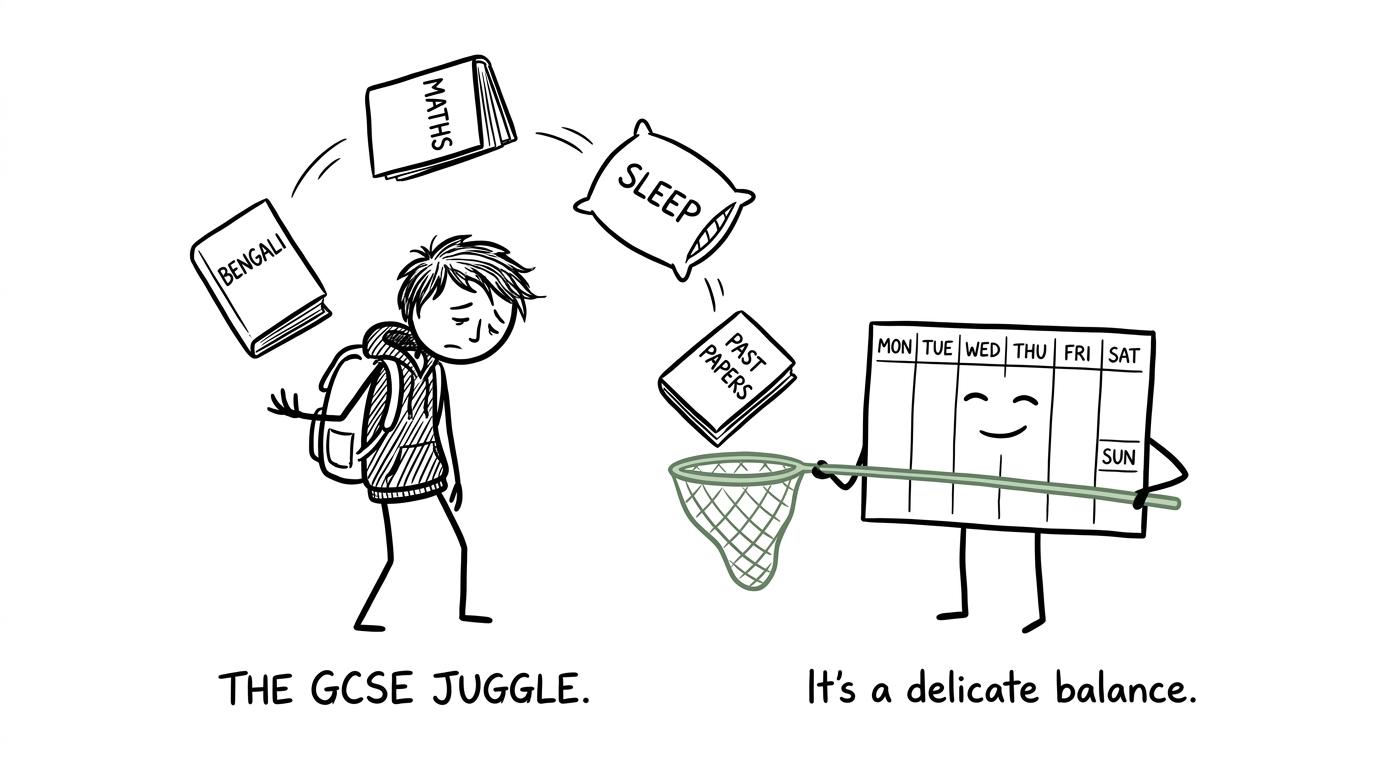 A weekly planner catches the subjects a GCSE student is juggling
Questions to ask a prospective tutor
A short conversation before booking can reveal more than a long profile. Ask:
- Which Bengali or Bangla qualification do you teach?
- Have you taught the current specification and tier?
- How do you assess a new student?
- What happens between lessons?
- Do you provide and mark exam-style tasks?
- How often will progress be reviewed?
- Is preparation and marking included in the fee?
- What is your cancellation policy?
- Can you provide appropriate references and DBS information?
Private tutors do not all have to be qualified teachers or approved by a statutory tutoring body. Parents should therefore verify identity, experience, references and safeguarding arrangements rather than relying solely on an online profile. For a student under 181818, communication and lesson arrangements should remain transparent to a parent or carer.
Lower-cost alternatives to weekly private tuition
Tutoring is one tool, not the default solution to every revision problem. Before committing to a long package, explore:
- support offered by the school or examination centre;
- small-group tuition;
- occasional marking or feedback sessions;
- a short diagnostic course followed by independent revision;
- specification materials and official past assessments;
- structured practice with a fluent adult, where appropriate;
- shared tuition with another student following the same course.
Free resources can also preserve the tutoring budget for the area where specialist feedback matters most. For maths, students can diagnose gaps using the GCSE maths self-assessment resources, check progress with GCSE mini tests, and learn how to turn papers into improvement through the guide to using GCSE past papers properly.
Board-specific paper collections are available for Edexcel GCSE Maths, AQA GCSE Maths and OCR GCSE Maths revision. That leaves paid tuition for the support that cannot easily be reproduced alone.
Common mistakes when choosing Bengali tuition
Choosing by price alone
The cheapest tutor may lack specification knowledge; the most expensive may offer expertise the student does not need. Compare the complete service and the quality of the diagnosis.
Confusing fluency with exam expertise
A fluent Bengali speaker may be an excellent tutor, but fluency alone does not establish familiarity with assessment objectives, formal writing conventions or mark schemes.
Booking the wrong qualification
AQA GCSE Bengali and Pearson Edexcel International GCSE Bangla have different assessment structures. Confirm the exact course before paying for lessons or materials.
Purchasing a large package immediately
A trial lesson or short initial block provides evidence about punctuality, communication, teaching style and student-tutor fit. Large advance payments reduce flexibility.
Ignoring independent practice
A lesson cannot compensate for unfinished homework or repeated passive revision. The student should leave each session knowing exactly what to practise and how success will be checked.
Forgetting safeguarding checks
Experience, recommendations and a friendly manner do not replace proper safeguarding. Parents should check references, DBS information, communication boundaries and the arrangements for online or in-person lessons.
Pay for a change, not simply an hour
A realistic GCSE Bengali tutor may cost around £20\pounds 20£20 to £50\pounds 50£50 per hour, with specialist teaching sometimes costing more. The right price depends on the qualification, the student’s needs, the tutor’s relevant experience and what is included beyond the live lesson.
Start small. Confirm the specification. Set one measurable goal, review progress and expand the arrangement only when the lessons are producing a visible change.
Meanwhile, keep maths revision moving without adding another private-tuition bill. MathsGenie brings free revision lessons, practice questions, mini tests, past papers, predicted papers, mark schemes and video solutions into one clear routine. Open the GCSE maths revision hub, choose your exam board and turn the next lost mark into a specific task.










