

GCSE Bengali Revision: Silence or Background Noise?
GCSE Bengali revision silence or noise? See what evidence says about lyrics, instrumental sound and choosing the best setup for each language task.
There is a familiar moment at the start of revision: the book is open, the phone is nearby and the room suddenly feels too quiet. Music promises to make the session easier. The question is whether it also makes the learning harder.
For GCSE Bengali revision, silence or noise is not simply a matter of taste. The evidence points to a useful default: choose quiet conditions for vocabulary recall, reading, translation and demanding writing. If silence feels uncomfortable or your surroundings are unpredictable, quiet instrumental sound may be a workable alternative. Music with lyrics is the riskiest choice because language competes with language.
This does not mean every student must revise in complete silence. It means the sound should serve the task, rather than merely make the session feel pleasant.
The quick revision checklist
Use this decision rule before each session:
- Choose silence for learning words, recalling spellings and completing translations.
- Keep speech, television and lyrical music off during reading and writing.
- Use quiet, familiar instrumental sound only if it helps you settle without drawing attention.
- Practise listening and speaking with deliberate Bengali audio, not unrelated background noise.
- Complete timed exam practice under conditions resembling the real assessment.
- Test your choice using recall scores and accuracy, not mood alone.
- Put your phone out of reach, because changing songs can be more disruptive than the music itself.
The best environment is the one in which you can produce accurate Bengali after the sound has stopped.
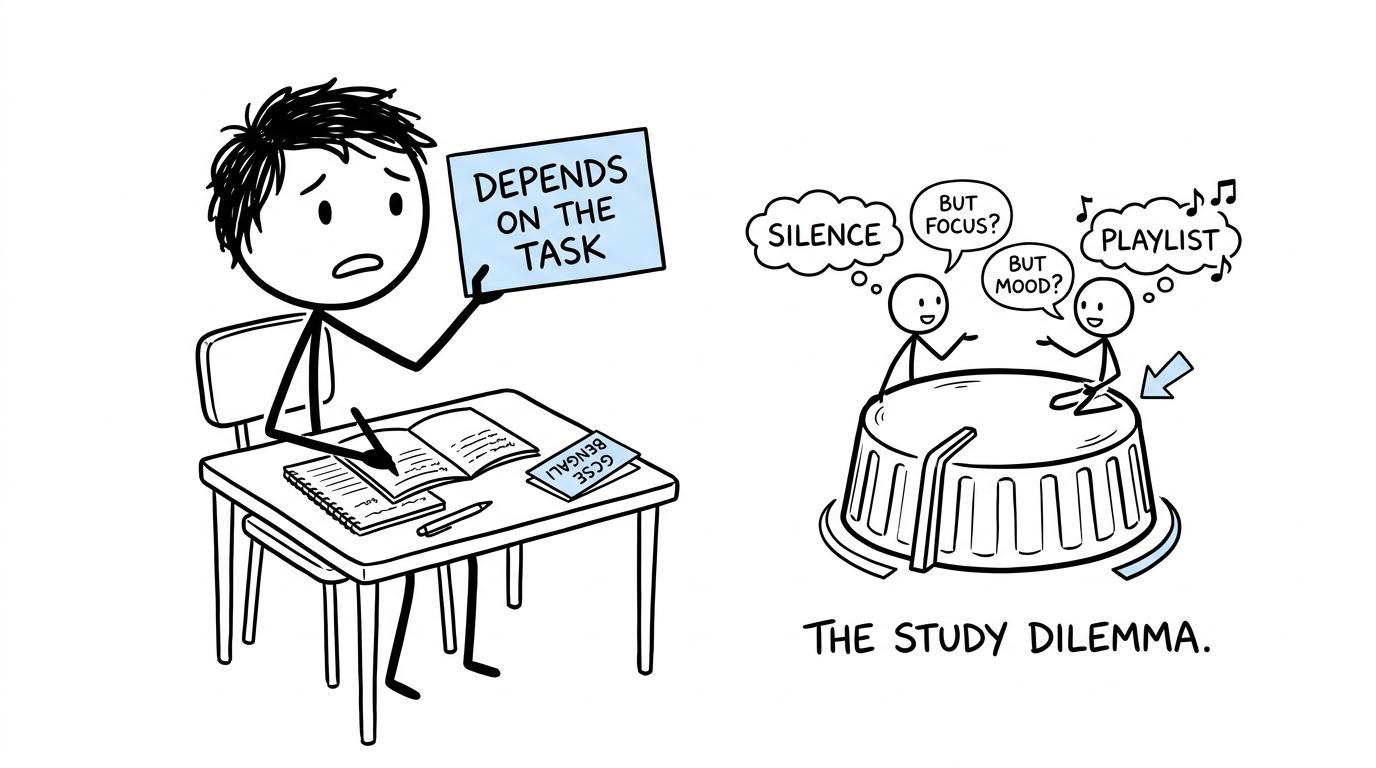 A student choosing between silence and a playlist for Bengali revision
What the evidence says about silence and background noise
Research on background music is not perfectly uniform. Different studies use different tasks, music and participants, so claims that one soundtrack works for everyone should be treated carefully.
Even so, several patterns are reasonably consistent. Systematic reviews generally find that background music offers no reliable overall improvement to memory or language performance. Where significant effects appear, they are more often negative than positive. Difficult tasks also appear more vulnerable to distraction than easy or highly familiar ones.
Music with lyrics causes the clearest concern. Research comparing silence, instrumental music and lyrical music has found poorer verbal memory and reading performance with lyrics. Recent studies have similarly reported reduced reading comprehension when participants listened to lyrical pop music rather than working without music.
Instrumental music is more complicated. It often produces little measurable difference compared with quiet conditions. That means it may be acceptable for some students, but there is no strong reason to assume that instrumental music automatically improves learning. Fast, loud or changing music can still capture attention.
Environmental noise is different from a chosen playlist, yet the broad lesson is similar. Reviews of noise and cognition have linked some forms of sustained environmental noise with poorer reading and language outcomes in children. The strength of evidence varies by noise source and outcome, so this should not be simplified into “every sound damages revision”. Unpredictable speech and intrusive noise are nevertheless sensible things to reduce.
Why GCSE Bengali is particularly sensitive to lyrics
Bengali revision often depends on verbal working memory: the limited mental space used while holding and processing words. You may be remembering a spelling, interpreting a sentence and planning an answer at the same time.
Song lyrics also contain words. Even when you believe you are ignoring them, the brain may continue processing parts of the vocal stream. This creates competition during tasks such as:
- memorising vocabulary;
- reading an unfamiliar passage;
- translating between Bengali and English;
- checking grammar and spelling;
- planning extended writing;
- retrieving phrases without notes.
The effect can be especially noticeable when the song is familiar. Familiarity may make a track feel safe, yet it also makes the next line easy to anticipate. Attention drifts towards the song before you consciously decide to listen.
Silence does not make revision effective by itself. You still need retrieval practice, feedback and repeated exposure. It simply removes one avoidable competitor for your attention.
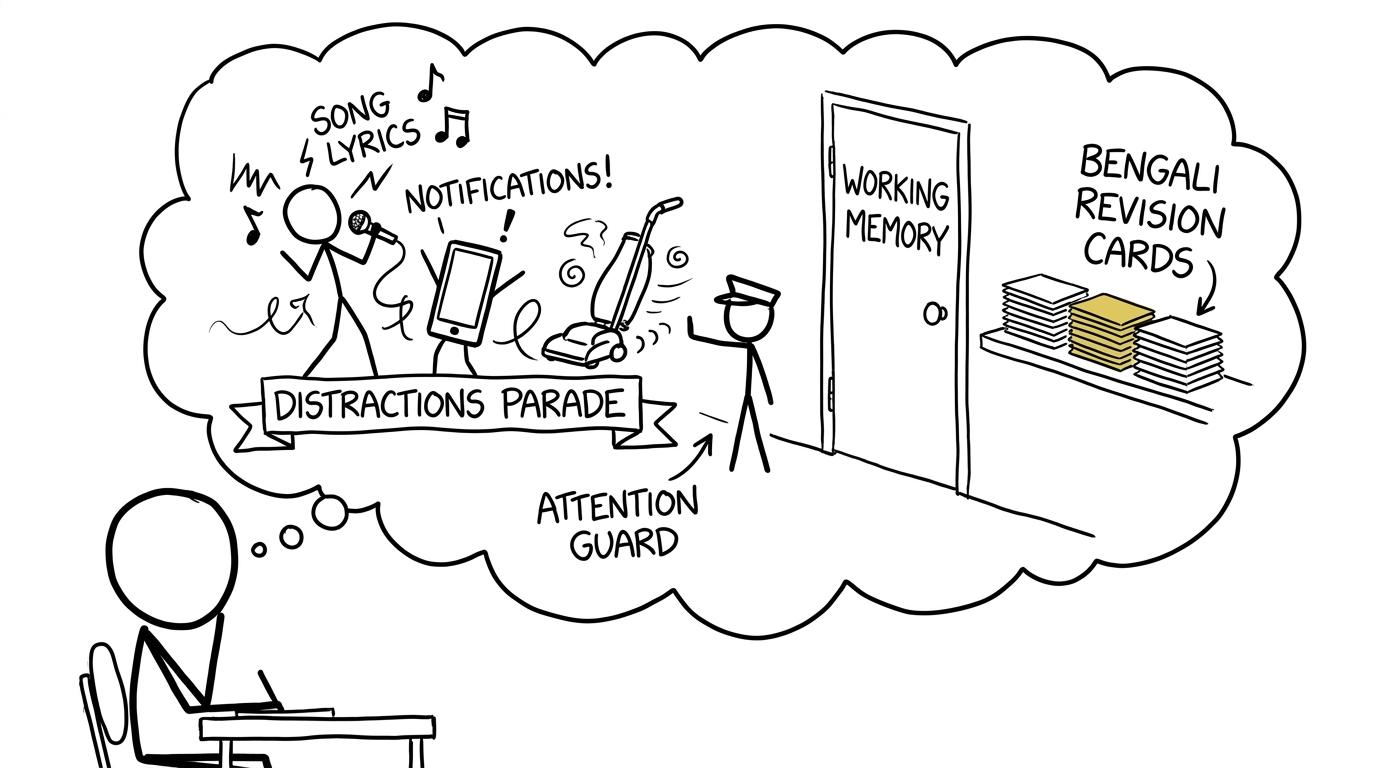 A tiny guard protecting working memory from lyrics and notifications
Match the sound environment to the Bengali task
A useful revision environment changes with the work. Treat sound as a tool with different settings rather than a permanent personality choice.
Vocabulary and spelling
Use silence when first learning vocabulary and when testing yourself. Look at the English meaning, cover the Bengali answer, retrieve it and then check the spelling carefully. Repeat the process in both directions.
Quiet instrumental sound may be harmless during low-demand organisation, such as sorting cards into topics. Turn it off once genuine recall begins. Copying words while listening to music can feel fluent without proving that you can retrieve them independently.
Reading and translation
Quiet is the strongest default. These tasks require you to hold meaning across clauses, notice detail and resist plausible but inaccurate interpretations. Speech in the background is particularly unhelpful because it occupies the same verbal channel.
If you cannot find silence at home, try reducing intelligible speech first. Move away from the television, close the door where practical or use non-lyrical sound at a low and stable volume to mask irregular household noise.
Extended writing
Planning may tolerate gentle instrumental sound if the task is familiar. Drafting and proofreading deserve quiet, particularly when you are checking agreements, tense, word order, spelling and whether every bullet point has been addressed.
Your final practice should match the conditions of your assessment. A playlist can become a cue you expect before writing, but it will not accompany you into the examination room.
Listening and speaking
These skills need sound, but it should be purposeful sound. Bengali recordings, teacher questions and your own spoken responses are learning material rather than background noise.
For listening practice, remove unrelated audio and focus fully on the recording. For speaking, practise responding without music so you can hear pronunciation, fluency and hesitation clearly. Recording yourself can expose gaps that silent reading conceals.
The exact assessment structure depends on your qualification. For example, AQA GCSE Bengali assesses listening, speaking, reading and writing at foundation or higher tier, while an International GCSE qualification may have a different structure. Confirm the board, specification and tier with your school before planning practice.
A practical way to test silence against noise
Personal preference matters, but preference is not proof. Run a small, fair comparison instead.
Choose two similar Bengali tasks. They might be two vocabulary sets of comparable difficulty or two short reading passages. Complete one in quiet conditions and the other with your usual background sound. Keep the session length, time of day and revision method as similar as possible.
Test yourself immediately, then test the same material again on another day without notes. Record:
- how many words or details you recalled;
- how many spelling or translation errors you made;
- whether you finished within the planned time;
- how often you changed tracks or checked your phone;
- how much you remembered after the delay.
Repeat the comparison rather than trusting one session. Choose the condition that produces stronger delayed recall and more accurate work. A soundtrack may improve your mood while leaving achievement unchanged, which is useful to know rather than a reason to feel guilty.
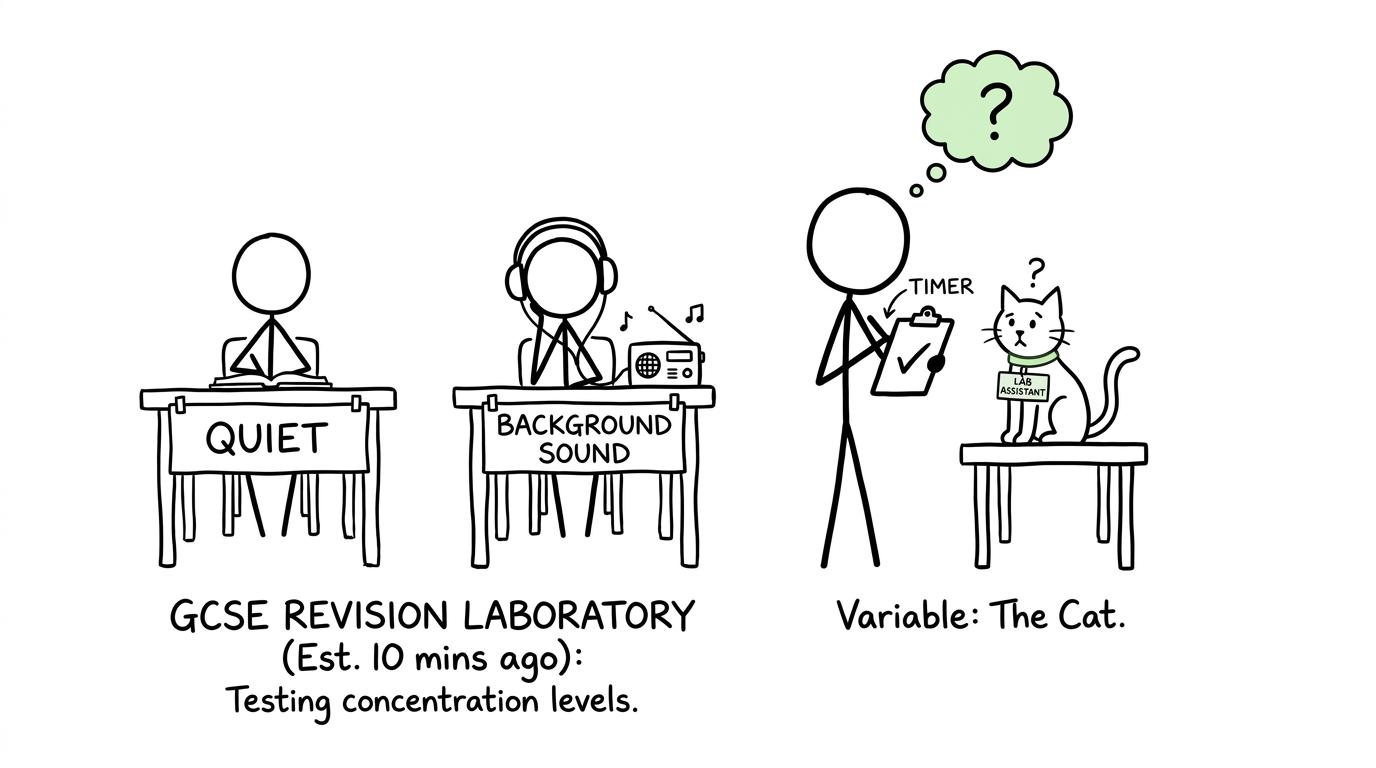 A student running a tiny quiet-versus-noise revision experiment
Build a routine that works across Bengali and maths
Many students asking this question are balancing Bengali with GCSE maths. The subjects differ, but the revision principle transfers: match the environment to the mental demand.
For Bengali reading and vocabulary recall, quiet usually has the advantage. For routine maths questions, instrumental music may be less disruptive than it is for verbal work, although difficult problem solving and timed papers still deserve a low-distraction setting. One controlled study found that lyrical music impaired memory and reading but did not produce a credible effect on its arithmetic task. That does not prove music is harmless for every maths topic; multi-step reasoning is not the same as retrieving simple arithmetic facts.
Use the free GCSE Maths Revision hub to choose a topic, then work in a short cycle: learn, retrieve, practise, mark and fix. The twenty-minute maths revision routine is useful when Bengali and other subjects are competing for space in the week.
A practical mixed evening might include quiet Bengali vocabulary recall, a break, then focused maths questions. If you want short assessment rather than a full paper, use the Edexcel GCSE Maths mini tests. A realistic GCSE maths revision timetable can help you protect separate sessions for language learning rather than switching repeatedly between subjects.
Common mistakes when choosing revision sound
Treating comfort as evidence
A pleasant playlist can make time pass quickly. That does not necessarily mean more has entered long-term memory. Judge the session through later recall and accuracy.
Choosing music with familiar lyrics
Songs you know well are easy to follow automatically. For verbal revision, familiar vocals can be more distracting than an unfamiliar, steady instrumental track.
Turning revision into playlist management
Searching for songs, skipping tracks and replying to notifications repeatedly breaks concentration. If you use music, choose it before beginning and keep the phone out of reach.
Using one environment for every task
Copying headings, retrieving vocabulary and completing a timed translation do not demand the same concentration. Make the sound decision again whenever the task changes.
Never practising in exam conditions
Revision should eventually survive without your favourite soundtrack. The same applies to maths: complete GCSE predicted papers and past-paper practice in quiet, timed conditions. MathsGenie's guide to using past papers properly explains how to mark, diagnose and retest rather than merely collect scores.
Make quiet revision active, not passive
Silence only creates room for learning. You still have to use that room well.
For Bengali, retrieve vocabulary before checking it, translate in both directions, answer reading questions from memory and compare writing against your teacher's feedback or the relevant mark scheme. Revisit mistakes after a gap. The goal is not to recognise a word when it appears in your notes; it is to produce or understand it when the exam requires it.
Use the same disciplined loop for maths. MathsGenie provides free revision lessons, practice questions, mini tests, mark schemes and video solutions through the GCSE revision area. Once individual topics are secure, predicted papers and timed practice reveal whether the method remains reliable under pressure. Students moving beyond GCSE can apply the same principles through the A Level Maths Revision hub.
The final verdict
For most demanding GCSE Bengali work, silence is the safest starting point. Quiet instrumental sound can be a reasonable compromise when it masks distracting surroundings or helps you begin, but it should remain low, steady and free from lyrics. Spoken background noise and lyrical music are poor partners for vocabulary, reading and translation.
Do not turn this into another rule to worry about. Test your setup honestly, measure what you remember and adapt it to the task. Then bring the same calm discipline to maths: open a MathsGenie revision lesson, complete the practice questions, mark your work and move towards mini tests, past papers and predicted papers. Better revision is rarely about finding a perfect atmosphere. It is about removing friction, practising actively and returning often enough for the knowledge to stay.










