GCSE Bengali Paper 4 Exam Date 2026: AQA
GCSE Bengali Paper 4 exam date 2026 was 11 June, AM. Check AQA paper lengths, equipment rules and how to plan your maths revision around it.
Finding an exam date should be simple. Yet in a crowded GCSE timetable, one uncertain morning can make the whole revision plan feel less secure.
The GCSE Bengali Paper 4 exam date 2026 was Thursday 11 June 2026, in the morning session, for AQA GCSE Bengali. Paper 4 was the writing examination. Foundation Tier candidates had 111 hour, while Higher Tier candidates had 111 hour 151515 minutes.
That is the direct answer. If you took this examination, your school timetable remained the final instruction for your arrival time, room and candidate details.
This guide explains what candidates needed to have ready, what the paper assessed and how students could organise Bengali preparation alongside GCSE maths. MathsGenie does not provide Bengali lessons, but its free GCSE Maths revision hub can keep the maths side of a busy exam timetable clear and manageable.
GCSE Bengali Paper 4 date and details at a glance
The official AQA May/June 2026 timetable and Bengali specification gave the following information:
| Detail | AQA GCSE Bengali Paper 4 information |
|---|---|
| Exam date | Thursday 11 June 2026 |
| Session | Morning |
| Component | Paper 4: Writing |
| Foundation code | 8638/WF |
| Higher code | 8638/WH |
| Foundation duration | 111 hour |
| Higher duration | 111 hour 151515 minutes |
| Foundation marks | 505050 raw marks |
| Higher marks | 606060 marks |
| Qualification weighting | 25%25\%25% of the GCSE |
| Dictionary | Not permitted |
Students should always use the personalised timetable issued by their school or examination centre. The national timetable identifies the morning session, but the centre confirms when candidates must arrive and where they must report.
AQA requires candidates to take the same tier across all four Bengali skills. In other words, a student entered for Foundation Tier takes Foundation listening, speaking, reading and writing components; the same principle applies to Higher Tier.
What GCSE Bengali Paper 4 assessed
Paper 4 assessed the ability to communicate effectively in written Bengali for different purposes. It was not simply a vocabulary test. Candidates needed to select relevant content, respond to every required bullet point and communicate with suitable language and structures.
Foundation Tier structure
The Foundation paper lasted 111 hour and carried 505050 raw marks. Its tasks included:
- four sentences responding to a photograph;
- a short continuous passage of approximately 404040 words;
- translation from English into Bengali, with a minimum of 353535 words; and
- a structured writing task of approximately 909090 words, chosen from two options.
The paper included questions worth 888, 161616, 101010 and 161616 marks respectively. Candidates needed to read the instructions carefully because some tasks required every listed point to be covered.
Higher Tier structure
The Higher paper lasted 111 hour 151515 minutes and carried 606060 marks. It contained:
- a structured response of approximately 909090 words, chosen from two questions;
- an open-ended response of approximately 150150150 words, also chosen from two questions; and
- an English-to-Bengali translation of at least 505050 words.
These tasks were worth 161616, 323232 and 121212 marks respectively. The longer response rewarded more than length alone. Candidates had to address both bullet points, develop relevant ideas and use a range of vocabulary and structures.
That distinction matters. Writing more is not automatically the same as communicating better.
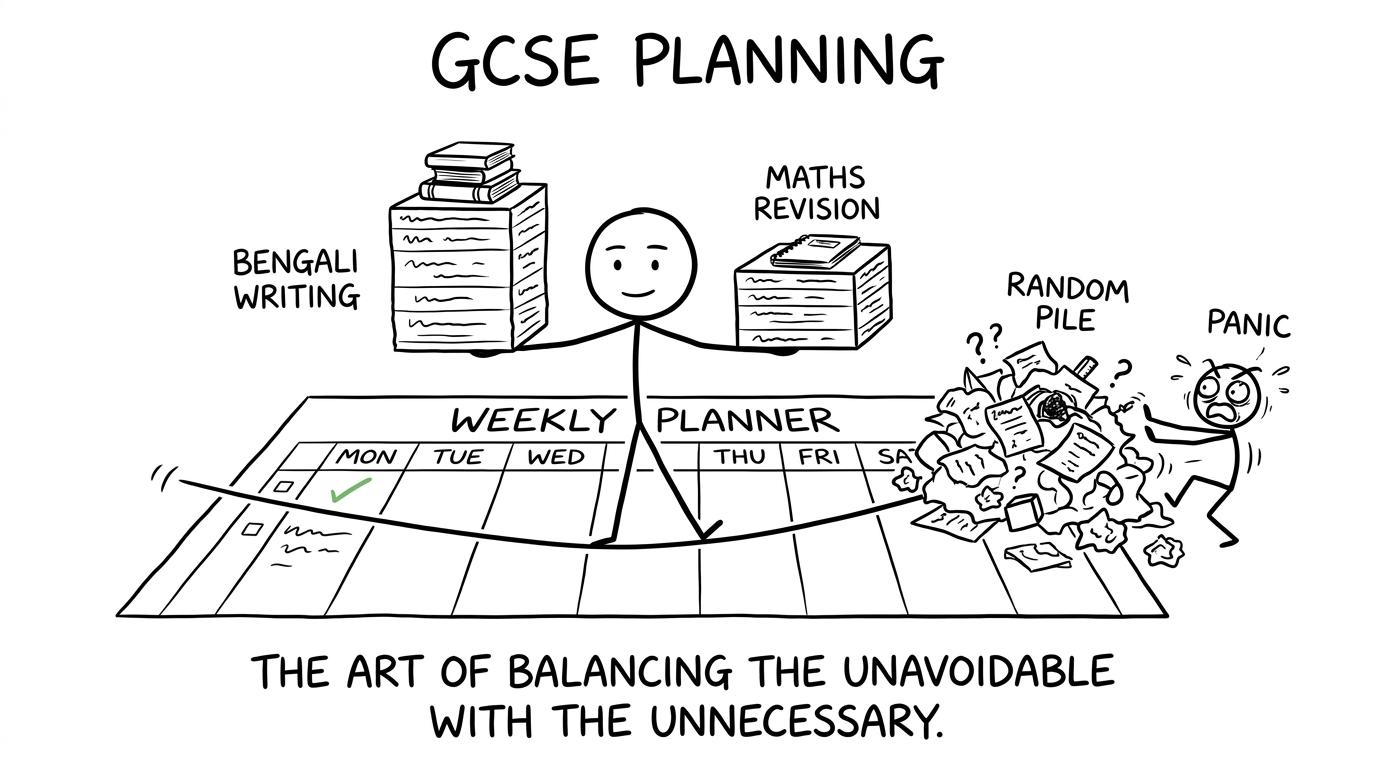 A stick-figure student balancing Bengali and maths revision while panic tries to overload the planner
What candidates needed to have ready
Good preparation removes small decisions before they become large distractions. For this specific examination, candidates needed to follow the instructions on their paper and those provided by their centre.
Essential exam information
Before travelling to the examination, students needed to confirm:
- the date: Thursday 11 June 2026;
- the morning session and their centre's arrival time;
- whether they were entered for Foundation or Higher Tier;
- the correct examination room;
- their candidate number and centre number, where required; and
- any identification or entry documentation requested by the centre.
Students should not assume that every morning examination begins at exactly the same time in every school. Centres operate within examination regulations and issue their own reporting instructions. A personalised timetable takes priority over a revision website, calendar reminder or friend's message.
Writing equipment
AQA Paper 4 instructions require candidates to use black ink or a black ball-point pen. Bringing at least one spare black pen is sensible. The published Higher Tier paper states that no other materials are needed.
A dictionary is not allowed. This rule applies throughout the writing test, so last-minute preparation should focus on recalling language rather than expecting to look it up in the room.
Candidates should also follow their centre's rules concerning clear pencil cases, water bottles, mobile phones, watches and other belongings. Access arrangements are individual and must be organised through the school or examination centre in advance.
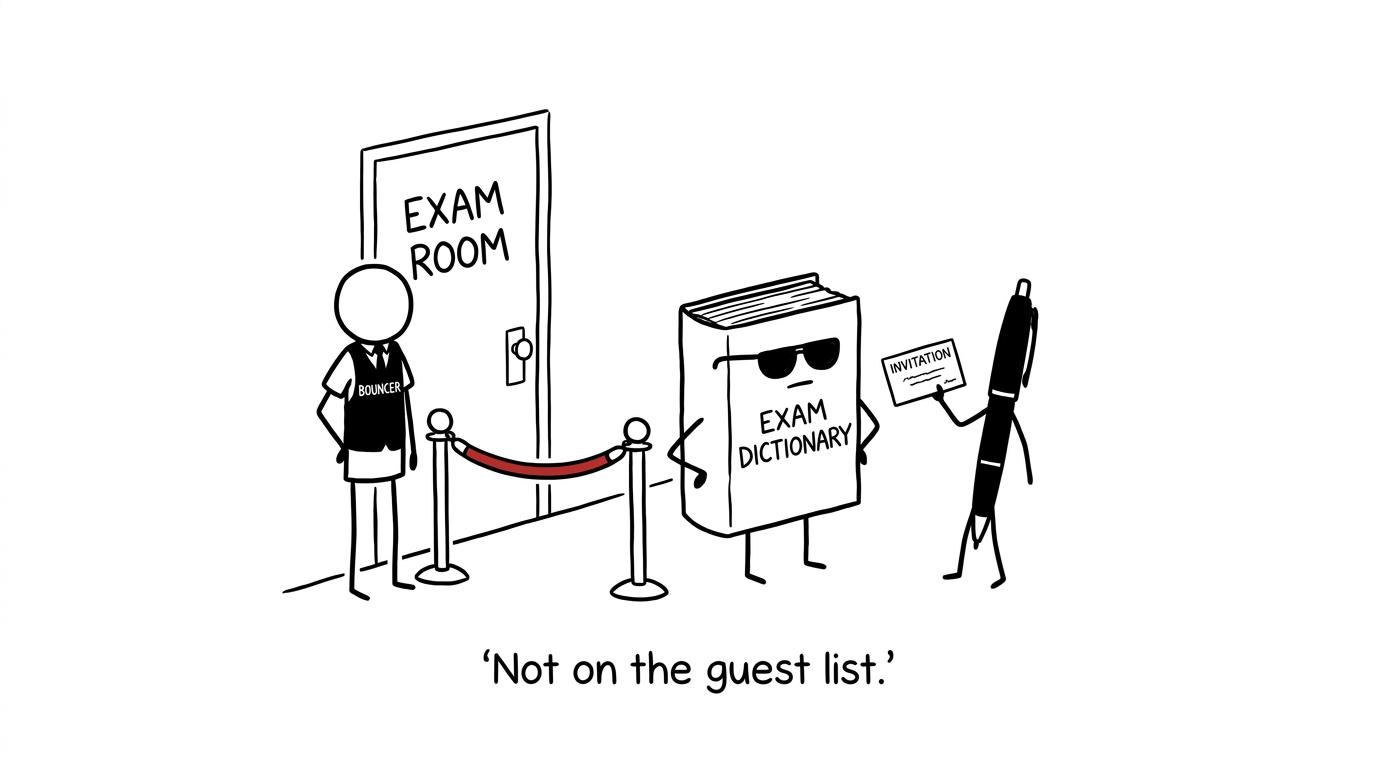 A dictionary wearing sunglasses being refused entry while a black pen shows its invitation
A calm checklist before the writing paper
The best final preparation is rarely a dramatic burst of new learning. It is usually a short sequence of familiar actions performed carefully.
In the days before
Candidates could use this checklist:
- confirm the tier, room and arrival instructions;
- review the exact task formats for that tier;
- practise planning responses around every bullet point;
- revisit familiar vocabulary, opinions, reasons and time frames;
- complete timed writing and translation practice;
- compare completed work with official mark schemes or teacher feedback;
- identify recurring spelling, grammar or script errors; and
- pack black pens and any centre-approved identification.
A timed response is useful because writing knowledge and writing within a limit are different skills. The aim is not to produce the most elaborate answer imaginable. It is to produce a relevant, accurate and complete answer before the invigilator ends the examination.
On the morning
The morning plan should be deliberately ordinary:
- arrive at the time stated by the centre;
- check that prohibited items are stored as instructed;
- listen to the invigilator;
- fill in candidate information carefully;
- read all choices before selecting a writing task;
- keep each response within the correct answer area; and
- cross through rough work that should not be marked.
Where a task gives bullet points, candidates should quietly account for each one. Missing an entire required point is more serious than choosing a slightly simpler phrase.
Fitting Bengali Paper 4 around GCSE maths
For many students, the real difficulty is not one examination. It is the traffic between examinations.
A Bengali writing paper can require focused language recall while maths demands methods, accuracy and timed problem-solving. Trying to revise both in the same way usually creates unnecessary strain. Bengali writing benefits from active production and correction. Maths benefits from attempting questions, marking them and repairing specific method gaps.
Use the exam date as a fixed point in a wider plan. MathsGenie's GCSE maths revision timetable guide explains how to build manageable sessions around an examination calendar. Keep Bengali practice in focused writing blocks, then give maths its own separate question-based sessions.
For maths, a useful revision cycle is:
- choose one weak topic;
- use a revision lesson to rebuild the method;
- complete practice questions without copying;
- check the solutions or mark scheme;
- record the precise cause of each lost mark; and
- retest the topic later.
When time is tight, GCSE mini tests provide shorter bursts of maths practice. When you need full exam realism, select papers matching your board and tier, such as AQA GCSE Maths past papers, Edexcel GCSE Maths past papers or the OCR GCSE Maths revision hub.
The important idea is separation. A Bengali writing session should not quietly become a maths session because algebra feels more comfortable. Equally, maths revision should not become passive reading because your attention is still on tomorrow's language paper.
Keep the wider 2026 exam period available
Official guidance required GCSE candidates to remain available for the complete examination period, including the contingency day on Wednesday 24 June 2026. This date was reserved for examinations that might need to be moved because of national or significant local disruption.
It was not an alternative sitting for an examination missed by an individual student. If illness, an emergency or unexpected disruption affected attendance, the student or parent needed to contact the school immediately and follow its instructions.
Even after Bengali Paper 4 was complete, students therefore needed to keep checking their personal timetable. Finishing one subject does not necessarily mean the examination season is over.
Common mistakes to avoid
Confusing Paper 4 with another Bengali component
For AQA GCSE Bengali, Paper 4 is writing. Listening and reading were separate components, while speaking arrangements were managed differently. Check the component code rather than relying only on a paper number.
Using the wrong date or an old timetable
Previous papers may show different dates. The relevant 2026 entry was scheduled for Thursday 11 June in the morning. Students needed the correct year's timetable and their centre-issued version.
Bringing a dictionary
Dictionaries were not permitted. Revision should therefore build independent recall of spelling, structures and useful language.
Answering both options
Where the paper offers a choice, candidates should select the required option rather than answering both. The front-page instructions state exactly which questions and choices must be completed.
Ignoring bullet points
A polished response can still lose marks if it does not address the task. Before writing, candidates should identify every required point; before finishing, they should check each one again.
Letting one exam erase the rest of the timetable
A busy paper can attract all available attention. That feels responsible, but it can leave the next maths examination exposed. Protect short maths maintenance sessions with the MathsGenie guide to using past papers properly, rather than trying to rescue several topics at once later.
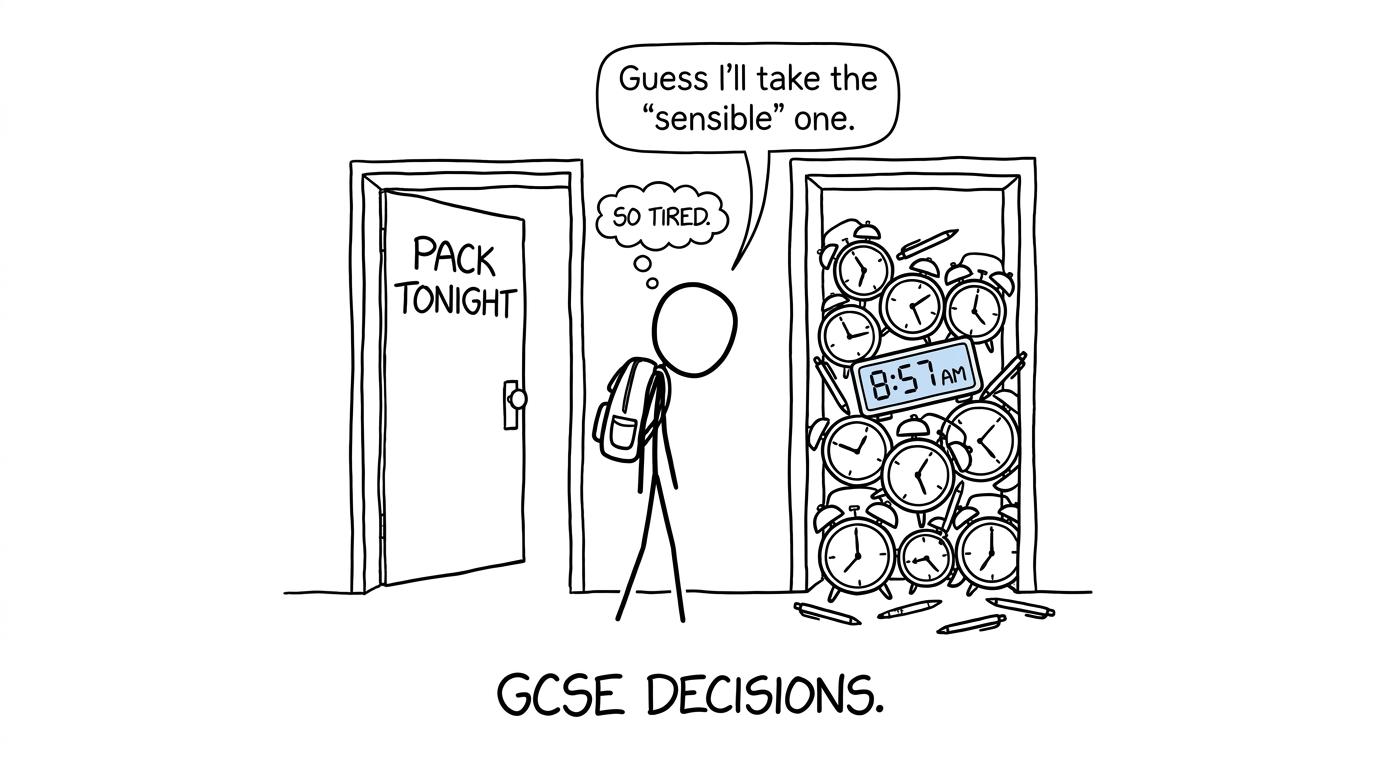 A student choosing between packing early and chasing runaway pens just before an exam
Turn the date into a practical plan
An exam date is useful only when it changes what you do next. For AQA candidates, GCSE Bengali Paper 4 was held on Thursday 11 June 2026 in the morning, with a duration of 111 hour at Foundation Tier and 111 hour 151515 minutes at Higher Tier.
The practical lesson is simple: confirm the centre timetable, know the task structure, prepare black pens, leave the dictionary at home and practise completing the required writing within the allowed time.
Then protect the rest of your GCSE preparation. Use MathsGenie's free revision lessons and practice questions to fix weak maths topics, predicted GCSE Maths papers for an appropriate final rehearsal, and past papers, mark schemes and video solutions to understand where marks are gained or lost. If an examination is close, the GCSE maths night-before plan will help you reduce decisions rather than create more of them.
The calendar tells you when to arrive. Careful practice determines what you can do once the paper opens.