

GCSE Bengali Exam Conditions Practice at Home
GCSE Bengali exam conditions practice: create realistic timed sessions at home for listening, reading, writing and speaking, then review effectively each time.

A familiar room can make an unfamiliar exam feel deceptively easy. Your notes are nearby, your phone is within reach and pausing the clock seems harmless. Then the real paper begins, and those small comforts disappear.
Effective GCSE Bengali exam conditions practice means recreating the important constraints of the examination: the correct paper, exact time limit, permitted materials, uninterrupted work and honest marking. You do not need a classroom. You need a quiet desk, a visible clock, someone to help with speaking practice and a routine you repeat often enough for exam conditions to feel normal.
This guide focuses on AQA GCSE Bengali. Pearson Edexcel International GCSE Bangla is a different qualification with a different assessment structure, so confirm your qualification, specification and paper code with your teacher or exams officer before using any timings.
Your realistic home-practice checklist
Before starting, check that you have:
- the correct exam board, tier and paper;
- an unused past or specimen paper;
- the matching audio file for listening practice;
- the official time shown on the paper;
- black pens and only the materials permitted by the paper;
- a visible clock showing the actual time;
- a quiet, well-lit and comfortably ventilated room;
- a family member or teacher available for speaking practice where possible;
- the mark scheme, kept closed until the session ends;
- extra time, rest breaks or other arrangements matching those formally approved for you.
The principle is simple: make the session realistic before it begins so that you do not negotiate with yourself halfway through it.
Confirm which Bengali qualification you are taking
This is the step students are most tempted to skip. It is also the step that prevents an entire practice session being built around the wrong format.
AQA GCSE Bengali assesses four skills: listening, speaking, reading and writing. Each contributes 25%25\%25% of the qualification. Foundation tier covers grades 111 to 555, while higher tier covers grades 444 to 999. A candidate takes all four assessments at the same tier and in the same examination series.
Under the current AQA specification, the published assessment times are:
- Listening: 353535 minutes at foundation, or 454545 minutes at higher, including 555 minutes of reading time.
- Speaking: 777 to 999 minutes at foundation, or 101010 to 121212 minutes at higher, plus 121212 minutes of preparation.
- Reading: 454545 minutes at foundation, or 606060 minutes at higher.
- Writing: 606060 minutes at foundation, or 757575 minutes at higher.
These details are specific to AQA GCSE Bengali. International GCSE Bangla should not be treated as interchangeable, even if an online file uses a similar subject name. Always use the front cover and current specification as your final authority.
The same discipline matters in maths. An Edexcel paper is not automatically suitable for an AQA, OCR or Eduqas student. MathsGenie's guide to GCSE maths topics by exam board and tier shows why checking the specification comes before practising the paper.
Build a room that behaves like an exam hall
You cannot reproduce every school procedure at home, nor do you need to. Your aim is to recreate the conditions that affect concentration and decision-making.
Clear the desk completely. Remove revision cards, vocabulary lists, wall charts, dictionaries and translated notes unless the paper explicitly permits something. Put your mobile phone, smartwatch, earbuds and other connected devices outside the room. Switching a phone face down is not enough; part of the exercise is knowing that escape is unavailable.
Use a separate desk if possible. Sit upright in the chair you intend to use for the whole session. Place an analogue or digital clock where it can be seen without turning around. Current JCQ instructions for formal examinations require candidates to be able to see a reliable clock showing the actual time; countdown and count-up clocks are not used as the examination-room clock. At home, writing your actual start and finish times on paper creates a closer rehearsal than relying only on a disappearing countdown.
 A student protects a home mock from one persuasive notification
Tell everyone at home when you are starting and finishing. Ask them not to enter, speak to you or play loud audio. Choose a time when predictable interruptions are least likely. Realism does not mean deliberately arranging chaos; formal examination rooms are expected to provide appropriate lighting, temperature, ventilation and noise conditions.
Run the written session without hidden advantages
Print the complete paper in advance, preferably double-sided if that matches its original layout. Check that every page is present, but do not read the questions. Keep the mark scheme in another room or ask someone else to hold it.
At the start:
- check the subject, paper, tier and time on the front cover;
- read the instructions exactly as you would in school;
- write down the actual start and finish times;
- begin only when the room is ready;
- do not pause the clock for difficult questions, drinks or ordinary distractions.
If you finish early, remain at the desk and check your work until the scheduled finishing time. That final stretch is valuable. It teaches you how to inspect translations, missing bullet points, spelling, verb forms and unanswered questions when your first instinct is to stop.
Practising under pressure should be introduced gradually. A full paper is useful once you understand most of its content, but shorter timed sections can build control first. Maths students can use the same progression through Edexcel GCSE maths mini tests before moving to complete Edexcel GCSE maths past papers.
Recreate listening conditions carefully
Listening practice becomes unrealistic when the recording is paused after every sentence or replayed until an answer appears. Use the audio according to the instructions supplied with that specific paper. Do not invent extra repeats, change playback speed or turn on captions.
Test the device and volume before the timed session, using unrelated audio rather than the examination recording. Play it through speakers unless your school has told you that your approved arrangement is different. Once the assessment starts, do not touch the controls except where the official recording or instructions require it.
Use the included reading time properly. Scan the questions, notice the required response language and anticipate what information you must identify. In AQA listening and reading assessments, some sections require answers in English and others in Bengali or a non-verbal response. The wording of the paper decides what is required.
 A suspiciously serious home invigilator guards a listening practice session
If a genuine technical failure occurs, note the time and problem. Restart only to restore the position you would reasonably have reached. Do not turn a malfunction into an opportunity to hear a difficult passage repeatedly.
Make speaking practice feel spontaneous
Speaking is the hardest component to simulate alone because genuine interaction matters. Ask a Bengali teacher, tutor or suitable adult to act as the interlocutor. Give them the official teacher materials and instructions, but ask them not to coach, correct or simplify your answers during the timed attempt.
Keep the preparation period separate from the assessment. Use only the notes permitted by the relevant task instructions. When preparation ends, remove anything that would not be available in the real assessment.
Record the practice if everyone involved agrees. The recording is for review afterwards, not live correction. Listen for:
- whether you answered the precise question asked;
- how often hesitation interrupted meaning;
- whether answers developed beyond one short statement;
- pronunciation and intonation;
- the range and accuracy of vocabulary and structures;
- whether prepared language prevented you from responding naturally.
If no partner is available, record yourself answering unseen prompts displayed one at a time. This cannot fully reproduce interaction, but it can still expose hesitation, short answers and weak time control.
Use time checkpoints without watching the clock constantly
Good pacing is not the same as dividing every paper mechanically. Different tasks carry different marks and require different amounts of reading or planning. Before the session, choose two or three checkpoints based on the paper's sections. During the session, look at the clock only at those checkpoints unless you suspect you are seriously behind.
Do not allocate time using instinct alone. If a paper has MMM available marks and lasts TTT minutes, its average pace is:
TM minutes per mark\frac{T}{M}\text{ minutes per mark}MT minutes per markThis is a planning guide rather than a rigid rule. Reading instructions, choosing a writing task and checking answers also consume time. The purpose is to notice when one question is absorbing a disproportionate share of the examination.
Schedule these rehearsals rather than waiting until you feel ready. The free MathsGenie revision planner can help you place Bengali and maths practice around schoolwork, recovery time and other GCSE subjects.
Mark the evidence, not your memory of the attempt
Take a short break after the finish time. Then mark with the official mark scheme and any available examiner guidance. Do not award an answer because it was “basically what you meant”. Credit only what appears on the page or recording.
Create a brief error log with four headings: task, lost marks, cause and next action. Useful causes include vocabulary gap, misunderstood instruction, inaccurate grammar, incomplete bullet point, weak inference and poor pacing.
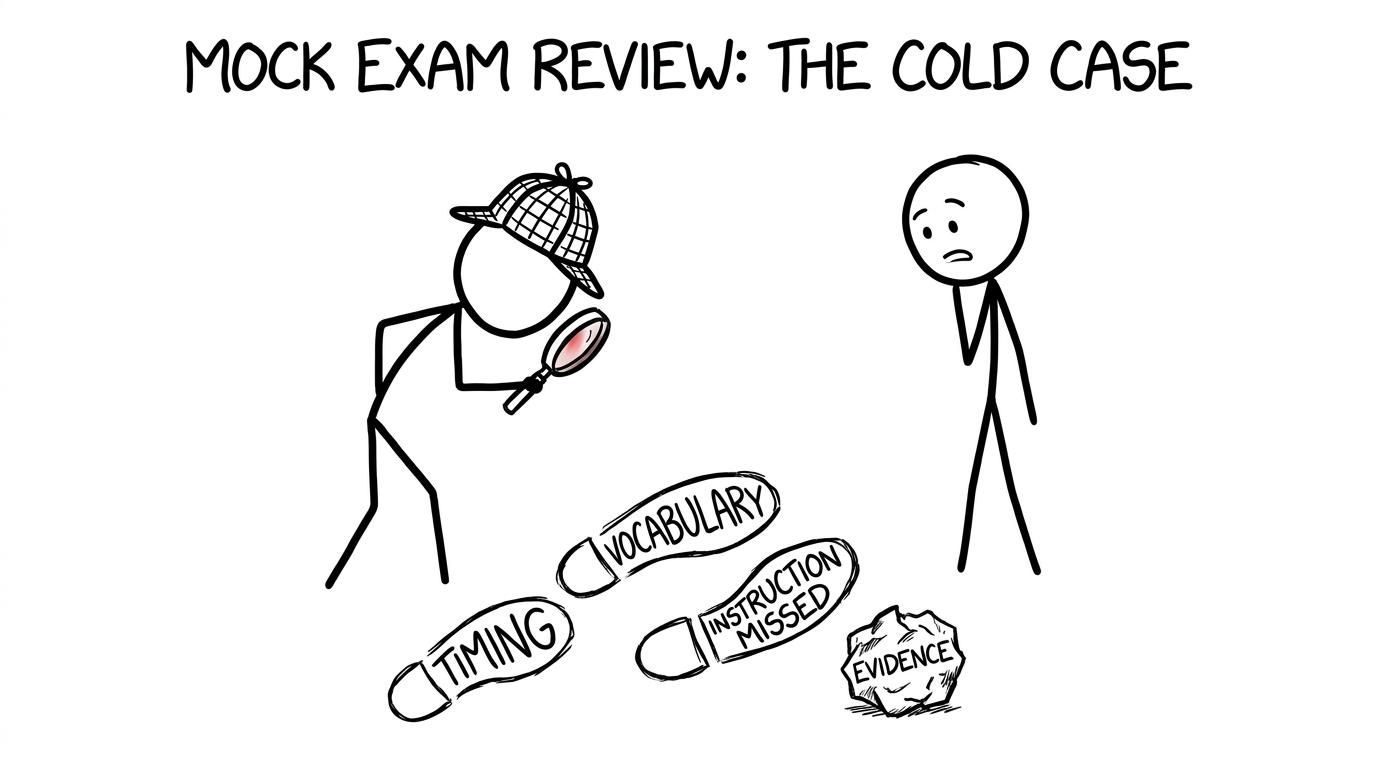 A student detective follows the evidence left by timing and vocabulary mistakes
The total mark tells you how the session went. The causes tell you what to do tomorrow. This is also the best way to use maths papers: complete a paper from the AQA GCSE maths past-paper collection or OCR GCSE maths revision hub, mark it carefully and return to the specific skills responsible for lost marks.
Common mistakes in home exam practice
Making every session fully timed
Exam conditions test performance; they do not teach missing knowledge. Alternate strict mocks with untimed vocabulary, grammar, translation and speaking work. In maths, revision lessons and practice questions repair methods before another timed paper tests them.
Quietly using unauthorised help
Checking one word, opening one note or accepting one hint changes the evidence. If you become stuck, leave the answer, continue and investigate the gap afterwards.
Using the wrong paper or tier
AQA GCSE Bengali and Pearson Edexcel International GCSE Bangla have different formats. Foundation and higher papers also differ. Match the exact qualification shown by your school.
Pausing whenever concentration drops
Ordinary discomfort is part of the rehearsal. Keep going unless there is a real interruption, illness or approved rest break. Record genuine incidents so that you can interpret the result fairly.
Marking immediately but never repairing
A carefully calculated score changes nothing by itself. Select a small number of weaknesses, practise them and retest them with fresh material. MathsGenie's guidance on when to start GCSE past papers explains this progression from diagnosis to timed performance.
Turn one honest rehearsal into a repeatable system
The first realistic session may feel worse than ordinary revision. That is useful information, not a verdict. It reveals what disappears when notes, pauses and hints are removed.
Repeat the cycle: prepare, sit, mark, diagnose, repair and retest. Use strict Bengali sessions to build listening discipline, spontaneous speaking, reading pace and writing stamina. Then transfer the same habits to maths with Edexcel GCSE predicted papers, past papers, mini tests, mark schemes and video solutions.
MathsGenie is the free home for structured GCSE and A Level maths revision. Use its revision lessons and practice questions to repair weak topics, then use past papers and predicted papers to make those methods survive the clock. Exam confidence rarely arrives all at once. More often, it is built in quiet rooms where realistic practice stops the real examination from feeling new.










