GCSE Bengali Christmas Holiday Revision Plan
GCSE Bengali Christmas holiday revision: plan sensible hours, balance all four skills, protect rest and return ready for January mocks.
Christmas revision has a strange way of expanding. One vocabulary list becomes an entire afternoon; one missed session feels like failure. Yet GCSE Bengali Christmas holiday revision does not need to consume the break. For most students, a reasonable target is 444 to 666 focused sessions of 303030 to 454545 minutes across the holiday, with extra time only when January mocks, unfinished work or a specific weakness make it necessary.
The purpose is not to finish the whole course. It is to keep Bengali active, repair a few important gaps and return to school rested enough to learn well. That same principle matters when Bengali must share the holiday with GCSE maths and several other subjects.
A reasonable revision checklist
A balanced Christmas plan should include:
- at least several completely revision-free days;
- 444 to 666 short Bengali sessions across a typical two-week break;
- practice covering listening, speaking, reading and writing;
- one or two priority topics rather than the whole specification;
- immediate checking and correction where answers are available;
- enough sleep, movement and time with family or friends;
- separate, realistic slots for other subjects, including maths.
If mocks begin immediately after Christmas, you might increase this to 666 to 888 sessions. If your Bengali work is secure and no assessment is close, the lower end may be enough. Your teacher's guidance should take priority because they know your course, tier and recent performance.
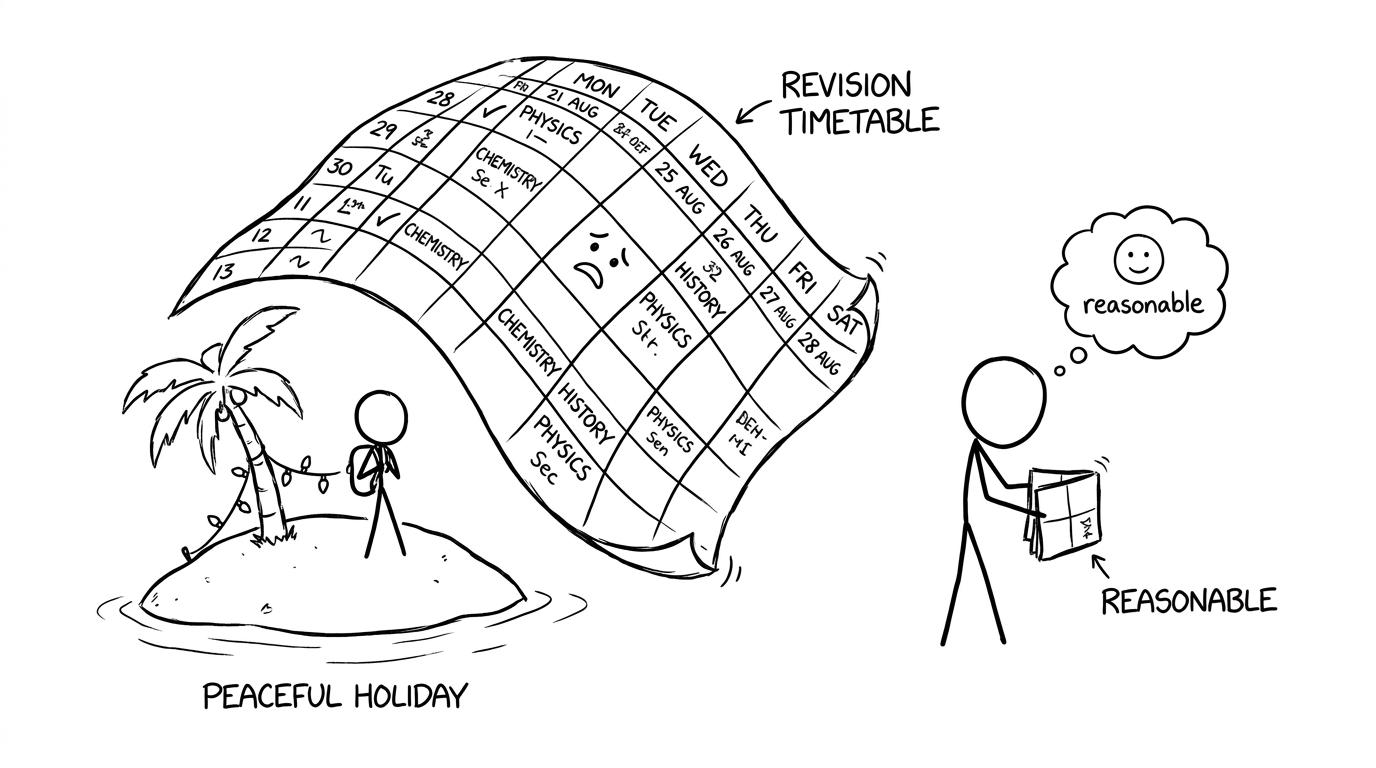 A student calmly folding an enormous revision timetable into a reasonable plan
What does the GCSE Bengali course assess?
Before dividing your time, be clear about the qualification you are taking. The current AQA GCSE Bengali specification, qualification code 863886388638, assesses four skills:
- listening;
- speaking;
- reading;
- writing.
Each skill contributes 25%25\%25% of the qualification. AQA offers Foundation tier, covering grades 111 to 555, and Higher tier, covering grades 444 to 999. Students take all four components at the same tier and in the same examination series.
The specification is organised around identity and culture; local, national, international and global interests; and current and future study and employment. That means effective revision should connect vocabulary and grammar to topics such as family, technology, festivals, travel, the environment, education and careers.
Do not assume every qualification called Bengali or Bangla has the same assessment structure. International GCSE courses can differ. Check the exact title, exam board, tier and specification with your school before choosing materials.
How much GCSE Bengali Christmas holiday revision is enough?
A timetable is reasonable when you can complete it consistently without pushing aside sleep, celebrations and every other subject. Hours alone are a poor measure. Four attentive sessions with clear outcomes are worth more than ten distracted hours spent copying vocabulary.
A useful starting point is:
| Situation | Sensible Bengali target |
|---|---|
| No immediate mock and work is secure | 444 sessions of 303030 then 404040 minutes |
| January mock or several known weaknesses | 666 sessions of 353535 then 454545 minutes |
| Significant unfinished work | Agree a catch-up plan with your teacher, then add short revision sessions |
For example, six focused sessions lasting 404040 minutes give:
6×40=240 minutes=4 hours6 \times 40 = 240\text{ minutes} = 4\text{ hours}6×40=240 minutes=4 hoursSpread across a fortnight, that is substantial practice without turning every day into a school day. Treat these figures as planning ranges, not universal rules. Your health, school deadlines and access arrangements matter.
Teenagers generally need around 888 to 101010 hours of sleep each night, according to NHS guidance. Revision that repeatedly removes sleep is not a sensible bargain. Protecting rest is part of the plan, not a reward for finishing it.
Build each session around one clear outcome
The easiest way to waste a short session is to begin with the instruction “revise Bengali”. It is too broad. Choose a result you can recognise when the timer ends.
Useful session goals include:
- retrieve vocabulary for one specification topic;
- complete and check a short listening task;
- answer speaking prompts aloud without reading a script;
- read a passage and identify opinions, time frames and key details;
- plan or write one response suited to your tier;
- correct recurring spelling, grammar or translation errors.
A 404040-minute session could contain 555 minutes of recall, 252525 minutes of focused practice and 101010 minutes of checking. This is a session structure, not an exam technique: adjust it if your teacher has set a particular task.
Checking matters because completion and improvement are different things. Record one or two precise corrections, such as an insecure verb form, a missed negative or vocabulary confused in listening. Begin the next session by retrieving those corrections.
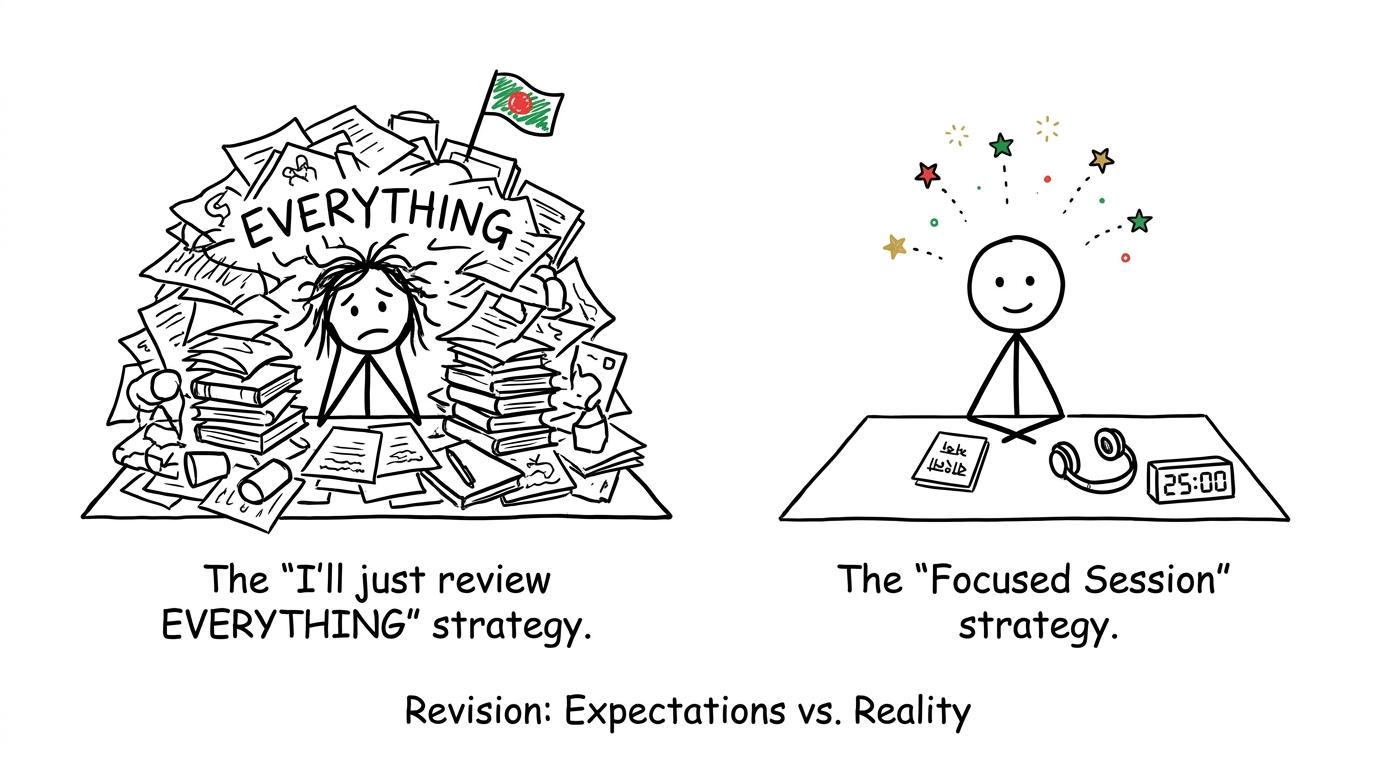 One focused revision desk wins against an absurd mountain labelled Everything
Balance the four Bengali skills
It is natural to choose the comfortable skill. A confident speaker may talk fluently but avoid accurate writing. Another student may memorise vocabulary quietly while neglecting listening. Because the AQA components are equally weighted, Christmas revision should not become one long vocabulary exercise.
Listening and speaking
Use short audio extracts supplied by your school or exam board and listen for meaning rather than trying to translate every word. After listening, note the topic, overall opinion, time frame and several supporting details.
For speaking, answer familiar prompts aloud. Practise extending an answer with a reason, opinion or contrasting idea, but avoid memorising a long paragraph so rigidly that an unexpected question causes panic. Recording yourself can reveal hesitation and pronunciation issues that silent preparation hides.
Reading and writing
For reading, practise locating evidence before deciding on an answer. Pay attention to negatives, connectives, changes of opinion and references to past, present or future events.
For writing, use tasks that match your tier. Plan before writing, address every bullet point and leave time to check accuracy. Your corrections are especially valuable: turn repeated errors into a small checklist for the next response rather than producing pages of untouched work.
Fit Bengali around maths and other GCSE subjects
The holiday problem is rarely Bengali alone. Students may also have maths mocks, science content, English texts and coursework deadlines competing for the same hours. The answer is not to give every subject the whole day. It is to make priorities visible.
Start by listing genuine deadlines and mock dates. Then choose the subjects needing active maintenance and those needing repair. A simple rotation might place Bengali on three or four alternate days, leaving other sessions for maths and another priority subject.
For maths, use the GCSE maths revision hub to select the correct exam board and tier. The GCSE maths revision timetable guide can help you build a wider schedule that leaves room for rest rather than filling every empty square.
Keep maths sessions equally specific. Choose a topic, attempt questions, mark the work and record the exact error. GCSE mini tests are useful when a full paper is too large for a holiday session. If you need a longer runway towards exams, the one-month GCSE maths revision plan provides a structure you can adapt after Christmas.
Match practice to your board through the Edexcel GCSE maths revision area, AQA GCSE maths revision area or OCR GCSE maths revision area. Bengali and maths require different knowledge, but the productive loop is similar: attempt, check, identify the weakness and revisit it.
Make the plan survive real Christmas days
A timetable that ignores family plans is not ambitious. It is fictional.
Mark celebrations, visits, travel and rest days first. Place revision in the quieter spaces that remain. Morning sessions often work well because the task is finished before the day becomes busy, but choose a time you can realistically repeat.
Build in at least one catch-up slot. If a session is missed, move the task there rather than doubling the next day. Also set a stopping time. Finishing when planned protects the holiday and makes it easier to start again later.
A small visible record can help. Tick completed sessions and write the next action beside each one. Record outcomes, not vague hours: “practised school-topic speaking questions” is more useful than “did Bengali”.
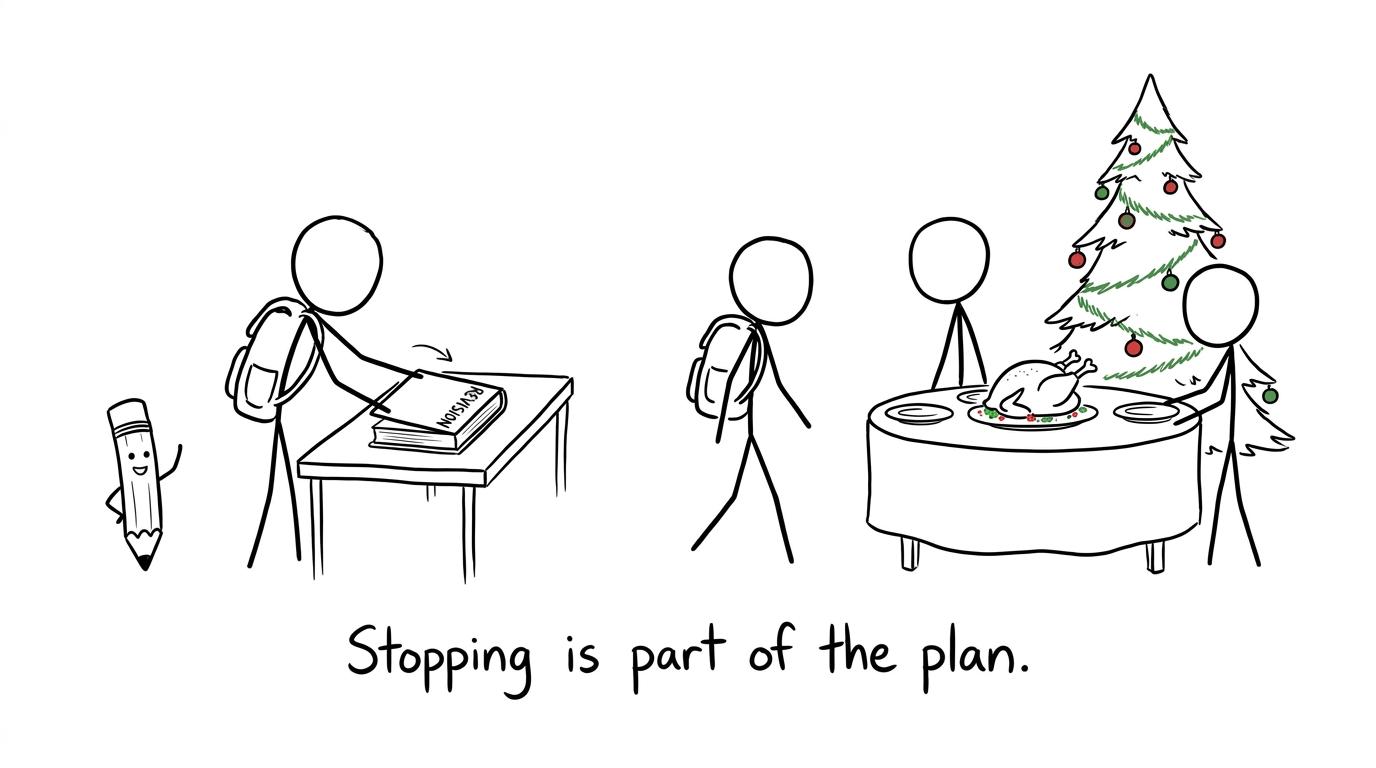 A student stops revision on time and walks towards Christmas celebrations
Common Christmas revision mistakes
Trying to cover the entire specification
Christmas is a checkpoint, not the final revision season. Select weaknesses using teacher feedback, mock performance and recent work. One repaired skill is more valuable than twelve topics briefly reread.
Revising only vocabulary
Vocabulary matters, but GCSE Bengali also tests comprehension, communication, accuracy and response to unfamiliar material. Put vocabulary into listening, speaking, reading and writing tasks.
Counting time instead of outcomes
Sitting near a textbook for two hours does not prove useful work happened. Give every session a target and finish with a check, correction or retrieval task.
Ignoring the correct tier and assessment format
Foundation and Higher tasks differ. Use materials that match your entry and verify your exam board rather than relying on a resource simply labelled “GCSE Bengali”.
Sacrificing sleep to catch up
Late-night revision can create the appearance of commitment while making the next day harder. Keep a firm finish time and protect a regular sleep routine.
Completing papers without learning from them
A paper reveals gaps; the improvement comes from what happens next. The same principle is explained in MathsGenie's guide to using GCSE past papers properly. Mark carefully, name the weakness, practise it and retest it later. Save GCSE predicted papers for appropriate maths exam preparation rather than treating them as a substitute for rebuilding weak topics.
Finish the holiday with a clear next step
Reasonable Christmas revision should leave you feeling informed, not exhausted. By the final weekend, you should know which Bengali skills are secure, which errors still recur and what you will ask your teacher in January.
Choose your first four short sessions now. Give each one a precise Bengali skill, protect several complete days off and place maths in separate focused blocks. When you revise maths, let MathsGenie organise the difficult part: use free revision lessons to rebuild understanding, practice questions and mini tests to test it, then past papers, predicted papers, mark schemes and video solutions to sharpen exam performance.
The holiday does not have to disappear for progress to happen. A modest plan, followed honestly, is enough to keep moving.