

GCSE Astronomy Revision Environment: Does It Matter?
GCSE astronomy revision environment advice: learn what genuinely improves focus, memory and maths practice, plus a simple setup for effective sessions.
It is easy to believe that effective revision begins with the right desk: quiet room, perfect lighting, colour-coded notes and perhaps a suitably astronomical view of the night sky. But a GCSE astronomy revision environment matters for a simpler reason. It can protect your attention and make useful revision easier to repeat. It cannot, however, turn passive reading into learning.
The short answer is yes, where you revise can affect how much sticks, particularly when noise, notifications or discomfort repeatedly interrupt you. Yet the method you use matters more than whether your desk looks perfect. A plain table where you test yourself, answer calculations and correct mistakes will usually beat an immaculate setup where you only reread notes.
Your revision environment checklist
Before changing your entire bedroom, check these essentials:
- Choose somewhere with manageable noise and few interruptions.
- Put your phone out of reach or silence non-essential notifications.
- Keep only the resources needed for the current task on your desk.
- Use a chair, temperature and light level that allow you to work comfortably.
- Decide on one specific outcome before starting.
- Include retrieval practice, calculations and exam questions.
- Mark your work and record what needs another attempt.
- Take sensible breaks and protect your sleep.
- Use a different location when your usual space is genuinely unworkable.
That is enough. Your revision environment is a support system, not an interior-design project.
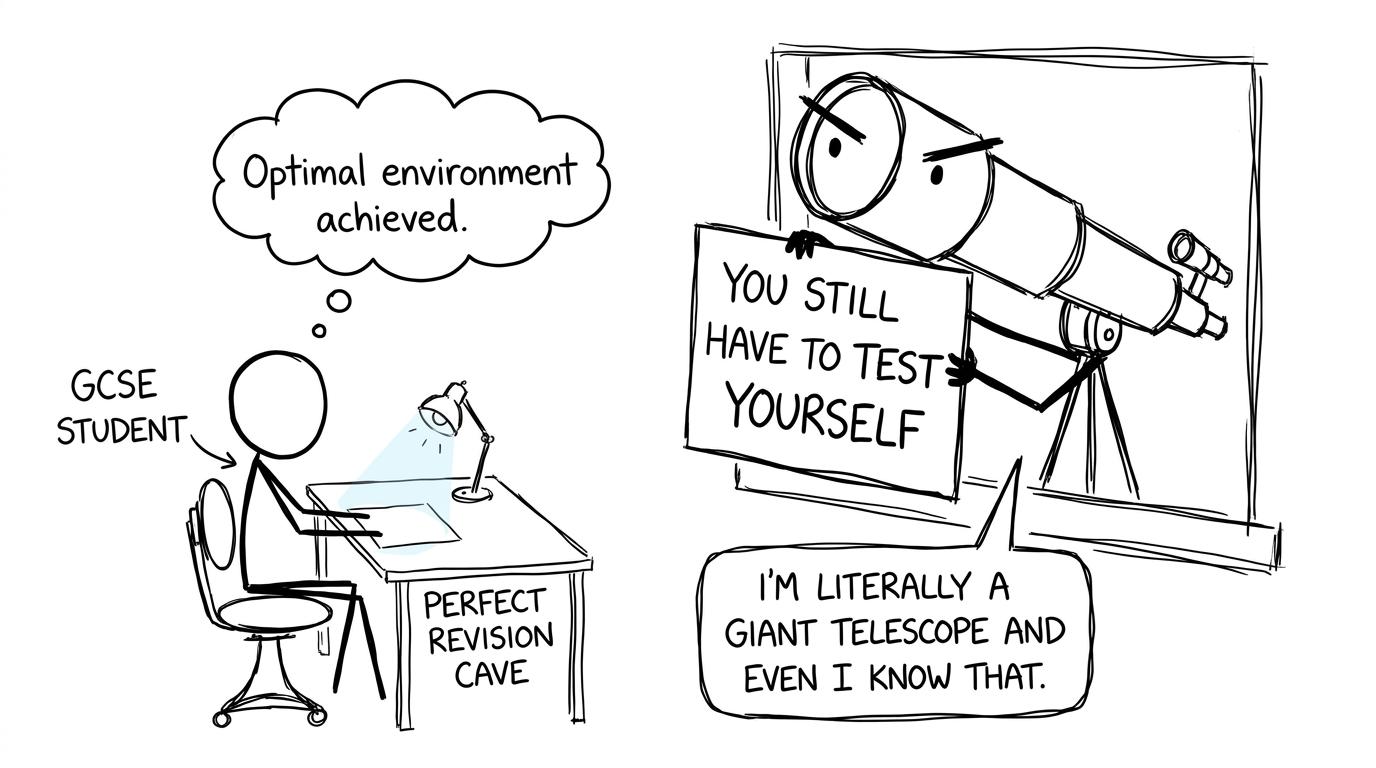 A student discovers that a perfect revision cave cannot replace self-testing
Why the environment can change what you remember
Attention is the doorway into memory. If part of your mind is following a conversation, checking a message or wondering when someone will interrupt, fewer mental resources remain for understanding celestial coordinates, interpreting a graph or rearranging an equation.
Research reviews on noise and learning have found that irrelevant sound can disrupt reading, listening and short-term recall, although the effect varies with the sound, the person and the task. Speech is particularly difficult to ignore because your brain automatically tries to process it. This explains why revising beside a television or an active group conversation can feel productive while producing surprisingly weak recall later.
The solution is not necessarily absolute silence. Some students find a low, steady background sound comfortable. Others work best in a silent library. Lyrics are more likely to compete with reading or writing because both tasks involve language. Treat this as something to test rather than a rule about your personality.
After two comparable sessions, close your materials and write down everything you can recall. Then compare the accuracy and number of questions completed. Choose the environment that improves the evidence, not merely the atmosphere.
Method matters more than mood
A comfortable room can help you begin, but learning happens through what you do once you sit down. Reviews of classroom research consistently support retrieval practice: attempting to recall knowledge without looking at the answer, then receiving feedback.
For GCSE Astronomy, this might mean:
- recalling the stages of stellar evolution from memory;
- labelling a diagram without notes;
- explaining why an observation has limitations;
- interpreting unfamiliar data;
- completing a calculation before checking the method;
- answering a short exam question and comparing it with the mark scheme.
Start from the Edexcel GCSE Astronomy revision hub, which brings together lessons, questions and past papers. Read or watch enough to understand the idea, then close the explanation and retrieve it. Difficulty at this stage is useful information. It shows what your memory cannot yet produce independently.
A good environment reduces the friction around that process. Keep the relevant question set, calculator and paper ready. Remove unrelated tabs. Make the desired action obvious and the distracting action inconvenient.
Make the space fit the astronomy task
GCSE Astronomy is not one type of learning. Your environment should change slightly with the task rather than following one rigid routine.
Learning facts and explanations
Use a low-distraction setting for definitions, sequences and extended explanations. Work from short prompts rather than copying paragraphs. Once you can recall the facts, practise connecting them: cause, observation, evidence and conclusion.
Completing mathematical questions
The current Pearson Edexcel GCSE Astronomy specification includes calculations, graphical questions and data handling. Mathematical skills account for at least 20%20\%20% of the qualification's written examination marks, so calculation practice is not an optional extra.
Keep a calculator, ruler and working paper available. You may need standard form, unit conversion, ratios, significant figures, algebra, gradients, logarithms and angular measures. MathsGenie's standard form revision resources and changing the subject of a formula guide can strengthen skills that transfer directly into astronomy calculations.
Your setting should encourage visible working. Revising calculations mentally on a crowded bus may be less useful than using a desk where you can set out units, substitutions and intermediate steps clearly.
Practising observations
Astronomy is unusual because part of the learning concerns real observation. Pearson Edexcel requires observational work, including unaided and aided observation. This does not mean every revision session belongs outside at night. It means your indoor revision should connect with practical decisions such as location, weather, light pollution, equipment, risk and the reliability of observations.
Follow your school or teacher's instructions for observational work. A dark location may support observation, but safety and appropriate supervision come first. Afterwards, use a well-lit space to organise records and evaluate the quality of the evidence.
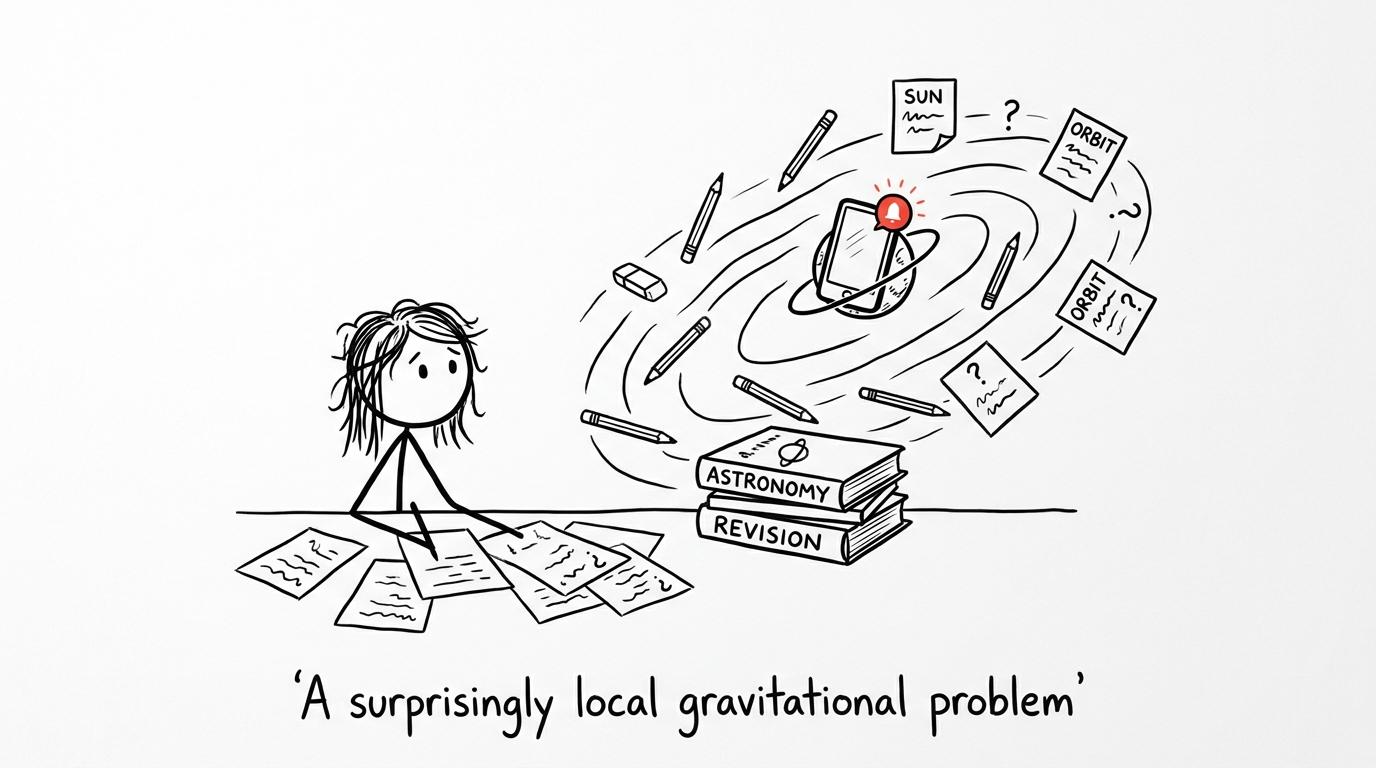 A smartphone creates its own notification gravity during astronomy revision
Control the biggest distraction first
For many students, the main problem is not the chair or wall colour. It is the phone.
A notification creates two interruptions: the moment you look and the time needed to rebuild concentration afterwards. Even if you resist opening it, part of your attention may remain on what it could contain. Put the device in another room when possible, or use a focus mode that allows urgent calls while blocking routine alerts.
The same principle applies to computers. Close messaging services, video feeds and unrelated browser tabs. Open the exact MathsGenie page you need before the session begins. The wider GCSE maths revision hub is useful when an astronomy error reveals a weakness in algebra, graphs or number skills, but avoid drifting into resources that do not serve the session's goal.
Write the goal on paper:
- answer a specific set of questions;
- recall one specification topic;
- repair one calculation skill;
- mark one timed section.
A clear finish line makes distraction easier to resist.
Should you always revise in the same place?
Consistency can help because a familiar location becomes a cue to begin. Sitting at the same cleared table at a regular time reduces the number of decisions you must make.
But do not become dependent on ideal conditions. The examination room will not match your bedroom, and real revision weeks are rarely peaceful. Once knowledge is secure, complete occasional questions in a library, classroom or another sensible location. More importantly, practise some work under exam-like conditions: no notes, no phone, a visible time limit and only permitted equipment.
MathsGenie's guide to starting GCSE past papers explains how to progress from short sections to complete timed papers. The past-paper viewer and mark-scheme tools can help create a focused exam routine without collecting files from several places.
Current GCSE Astronomy is offered by Pearson Edexcel under specification 1AS01\mathrm{AS}01AS0. It is untiered, unlike foundation and higher tier GCSE Maths, and consists of two equally weighted written papers. Each paper lasts 111 hour 454545 minutes and carries 100100100 marks. Use the Edexcel GCSE Astronomy resources so that your practice matches the correct qualification rather than assuming AQA, OCR or Eduqas offers the same astronomy paper structure.
Build a repeatable revision session
A productive session can follow a simple loop:
Prepare
Choose one small topic and place the required resources within reach. Remove obvious distractions. Decide what completed work will look like.
Retrieve
Spend the first few minutes recalling ideas without notes. Use questions, blank diagrams or short written explanations. This exposes gaps before familiarity creates false confidence.
Practise
Complete astronomy questions or the relevant maths skill. If the problem is mathematical, the full Edexcel GCSE Maths revision pathway provides topic lessons, worksheets and exam-style practice.
Mark and repair
Use the mark scheme. Classify each mistake as missing knowledge, weak application, inaccurate maths, misunderstood wording or incomplete working. Then correct it while the reasoning is still fresh.
Retest later
Return to the idea on another day. Spacing revision across separate sessions is more informative than repeating an answer immediately while it remains in short-term memory.
This routine also makes the environment easier to judge. If you cannot complete the loop because people continually interrupt, change location. If the loop works but your answers remain weak, change the revision method rather than rearranging the room.
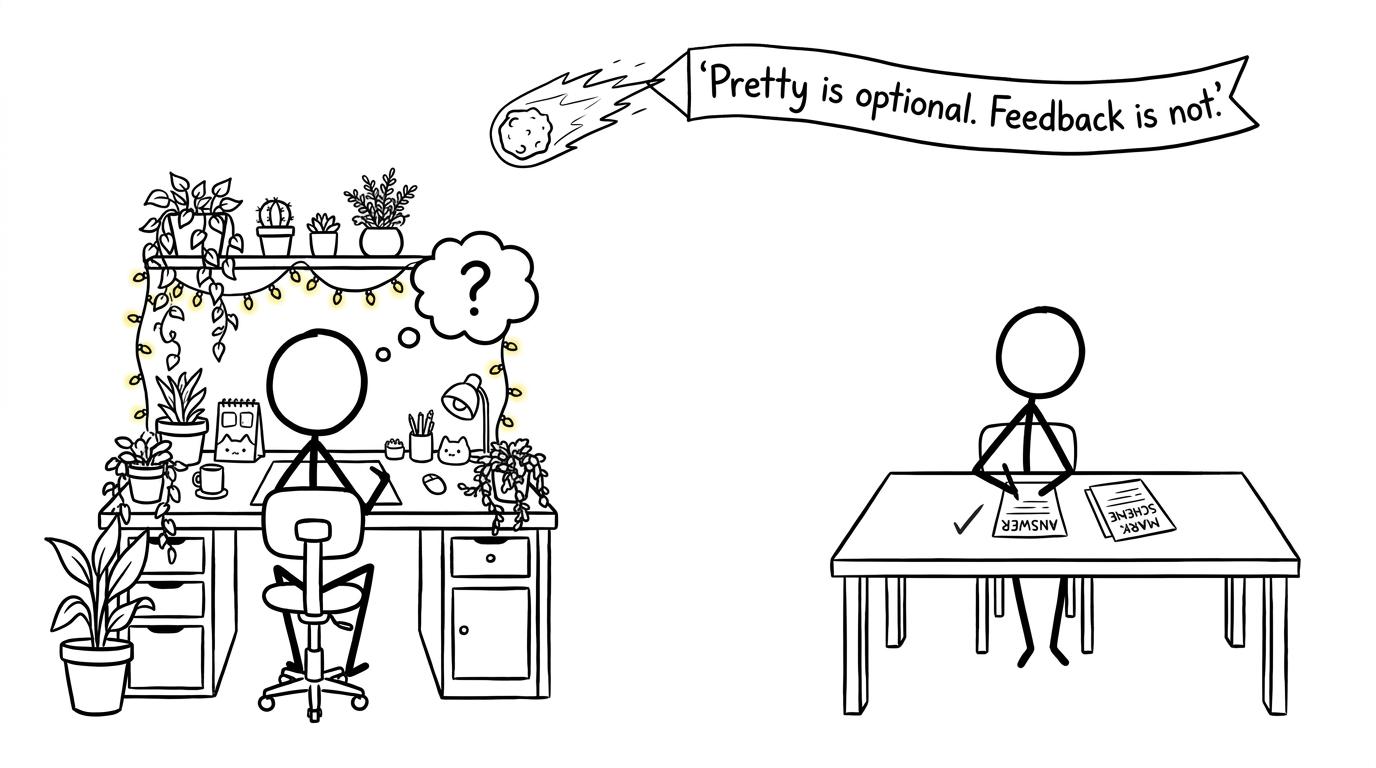 A plain desk with feedback defeats an elaborate but unused revision setup
Protect sleep instead of creating a midnight observatory
Astronomy's association with the night sky can make late revision feel strangely appropriate. Your brain does not award extra marks for thematic timing.
Sleep supports attention, memory and emotional regulation. Government exam guidance recommends regular revision in manageable chunks, testing yourself, taking breaks and maintaining healthy routines rather than relying on last-minute cramming. If revision pushes bedtime later and later, the environment has stopped helping.
Use the GCSE night-before revision plan as a model: choose a small amount of focused work, correct important errors, prepare your equipment and stop at a sensible time.
Common revision-environment mistakes
Waiting for perfect conditions
A quieter room may help, but waiting for silence, motivation and a spotless desk can become avoidance. Improve the largest problem, then begin.
Making the setup the revision
Organising stationery and rewriting a timetable can feel purposeful without testing any astronomy. Put a strict limit on preparation time.
Listening to distracting audio by habit
Music is not automatically harmful, but lyrics and frequent track changes may compete with reading. Compare your recall under different conditions.
Revising comfortably but passively
A sofa may be fine for watching a short lesson, but it can encourage endless viewing. Follow explanations with closed-book recall or questions.
Keeping every resource open
More tabs do not mean broader revision. One lesson, one question set and one mark scheme are often enough.
Marking only with ticks and crosses
A mark total tells you what happened, not what to change. Record the reason for each repeated error and schedule a retest.
Create an environment that makes good revision ordinary
Your GCSE astronomy revision environment genuinely matters, but it is neither magic nor overrated. It matters when it protects attention, lowers the effort needed to start and supports the kind of practice the examination demands. It matters much less than active recall, exam questions, feedback and sleep.
Start with one modest improvement today: move your phone, clear one working area and choose one precise task. Then open the free MathsGenie GCSE Astronomy revision hub. Use the revision lessons to rebuild knowledge, practise the mathematical skills that astronomy depends on, and finish with past papers and mark schemes. For broader exam preparation, MathsGenie's practice questions, mini tests, video solutions and predicted papers can turn a tidy desk into something more valuable: a repeatable route towards better marks.










