

Is a GCSE Astronomy Revision Bootcamp Worth It?
GCSE astronomy revision bootcamp guide: compare teaching, feedback, course value and free alternatives before paying for a holiday revision course.
A revision course can feel most attractive when time feels shortest. The exam date is approaching, the specification looks vast, and somebody offers to organise everything for you. A GCSE astronomy revision bootcamp can be worth paying for if it provides expert teaching, specification-specific feedback and a structured plan that you genuinely need. It is poor value when it simply compresses generic notes into a long day.
There is another consideration for students preparing for GCSE Maths: Astronomy uses mathematical skills, but it is not a substitute for focused maths revision. Before booking anything, ask whether the course will address your actual gaps without taking time away from higher-priority subjects.
The short answer: when is a bootcamp worth it?
A paid course is most likely to be worthwhile when:
- the tutor knows the current Pearson Edexcel GCSE Astronomy specification;
- teaching is based on your weaker topics rather than a generic presentation;
- the group is small enough for questions and individual feedback;
- the course includes exam questions, marking and correction time;
- observational skills are covered properly;
- you leave with a realistic follow-up plan;
- the cost is affordable without creating pressure to treat one course as a guaranteed solution.
Be cautious if the provider promises rapid grade improvements, does not identify the specification being taught, or cannot explain what students will do beyond listening to lectures.
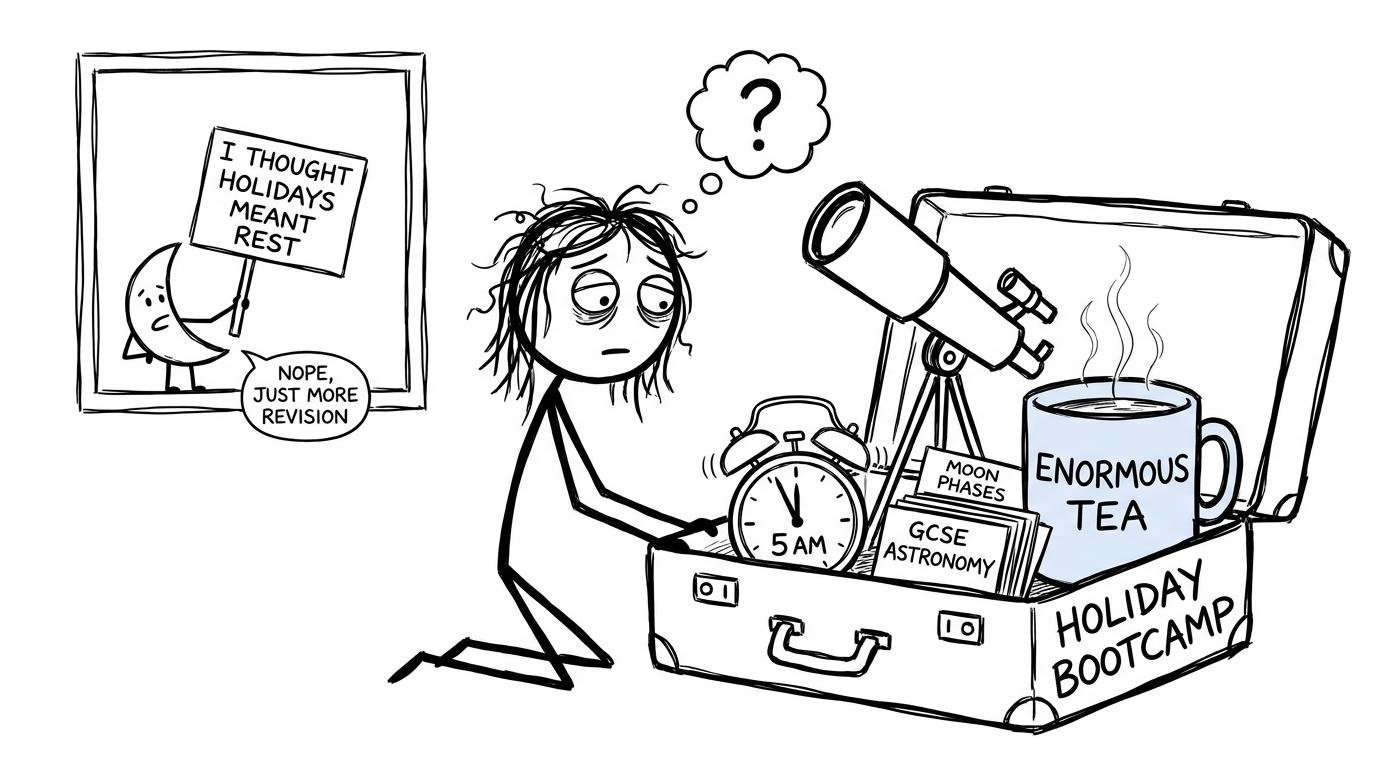 A student discovers that an astronomy holiday bootcamp contains rather less holiday than expected
What GCSE Astronomy holiday courses actually offer
There is no single standard format. A GCSE Astronomy holiday course might be a live online class, a day at a learning centre, several shorter sessions or private tuition presented as a bootcamp. The word itself tells you little about quality.
Most courses combine some of the following:
Specification review
A tutor may revisit areas such as naked-eye astronomy, lunar and solar systems, planetary systems, stars, galaxies and cosmology. A good course makes clear which specification statements are being addressed and how they may be assessed.
Pearson Edexcel GCSE Astronomy is assessed through two externally examined written papers. The specification also requires students to develop observational skills and undertake astronomical observations, including aided and unaided work. A useful course should therefore do more than teach factual recall: it should connect knowledge, observations, calculations and exam technique.
Exam-question practice
Students may attempt past-paper questions under timed or semi-timed conditions. The important feature is not the number of questions completed. It is what happens afterwards.
Useful feedback identifies why marks were lost: missing astronomical terminology, an incorrect calculation, weak interpretation of data, insufficient observational detail or failure to answer the command word. Simply displaying answers is much less valuable than helping students diagnose the pattern behind their errors.
Condensed notes and resources
Many providers supply booklets, slides, checklists or recordings. These can be convenient, but the thickness of a booklet is not evidence of learning. Ask whether materials are mapped to the current specification and whether access continues after the course.
Observational-skills guidance
A course may discuss planning observations, choosing instruments, recording conditions, reducing risk and evaluating evidence. However, an external provider cannot necessarily replace observational work organised through your school or centre. Confirm arrangements with your teacher rather than assuming a holiday course fulfils every requirement.
Structure and accountability
This is often the real product. Students are not always paying for secret knowledge; they are paying for a fixed time, a clear sequence and somebody who notices when they are stuck.
Structure can be valuable. But it can also be built independently with a revision timetable, targeted questions and honest marking.
The maths value hidden inside Astronomy
Astronomy regularly draws on transferable mathematical skills, including standard form, scale, ratio, angles, graphs, units, substitution and interpreting data. Strengthening these skills can support both subjects.
For example, students need to be comfortable reading quantities written as a×10na \times 10^na×10n, where 1≤a<101 \leq a < 101≤a<10, and recognising proportional relationships. They may also need to rearrange a stated formula, substitute values consistently and give an answer to an appropriate degree of accuracy.
Before paying for additional teaching, use the free GCSE Maths revision topics on MathsGenie to check whether the underlying difficulty is mathematical. If standard form or graphs are the real problem, targeted maths practice may solve more than another broad Astronomy lecture.
This distinction matters. A student can understand what a light-year represents yet still lose marks through powers-of-ten errors. Equally, strong algebra does not replace accurate astronomical knowledge. The two skill sets overlap, but they are not identical.
How to judge whether the cost represents value
Price alone is a poor measure. A cheaper course that does not meet your needs wastes both money and revision time. A more expensive course is not automatically better.
A practical way to think about value is:
revision value=useful teaching+feedback+lasting resourcesmoney+time+fatigue.\text{revision value}=\frac{\text{useful teaching}+\text{feedback}+\text{lasting resources}}{\text{money}+\text{time}+\text{fatigue}}.revision value=money+time+fatigueuseful teaching+feedback+lasting resources.This is a decision framework rather than a calculation with fixed numerical values. It reminds you to count the hidden costs. A full-day course may occupy a holiday day, require travel and leave little energy for Maths or another examination the following morning.
Ask these questions before booking
- Which GCSE Astronomy specification does the course follow?
- Who teaches it, and what relevant experience do they have?
- How many students will be in each group?
- Is there individual marking or only whole-class explanation?
- Are observational skills included?
- Will students complete authentic exam-style questions?
- Are recordings, notes or follow-up support included?
- What happens if the course is cancelled or a student cannot attend?
- Is there a published timetable and refund policy?
The current GCSE Astronomy qualification considered here is Pearson Edexcel. References to AQA, OCR and Eduqas may be relevant to your GCSE Maths exams, but they should not be presented as equivalent Astronomy specifications. Always check exactly what a provider means by “GCSE Astronomy”.
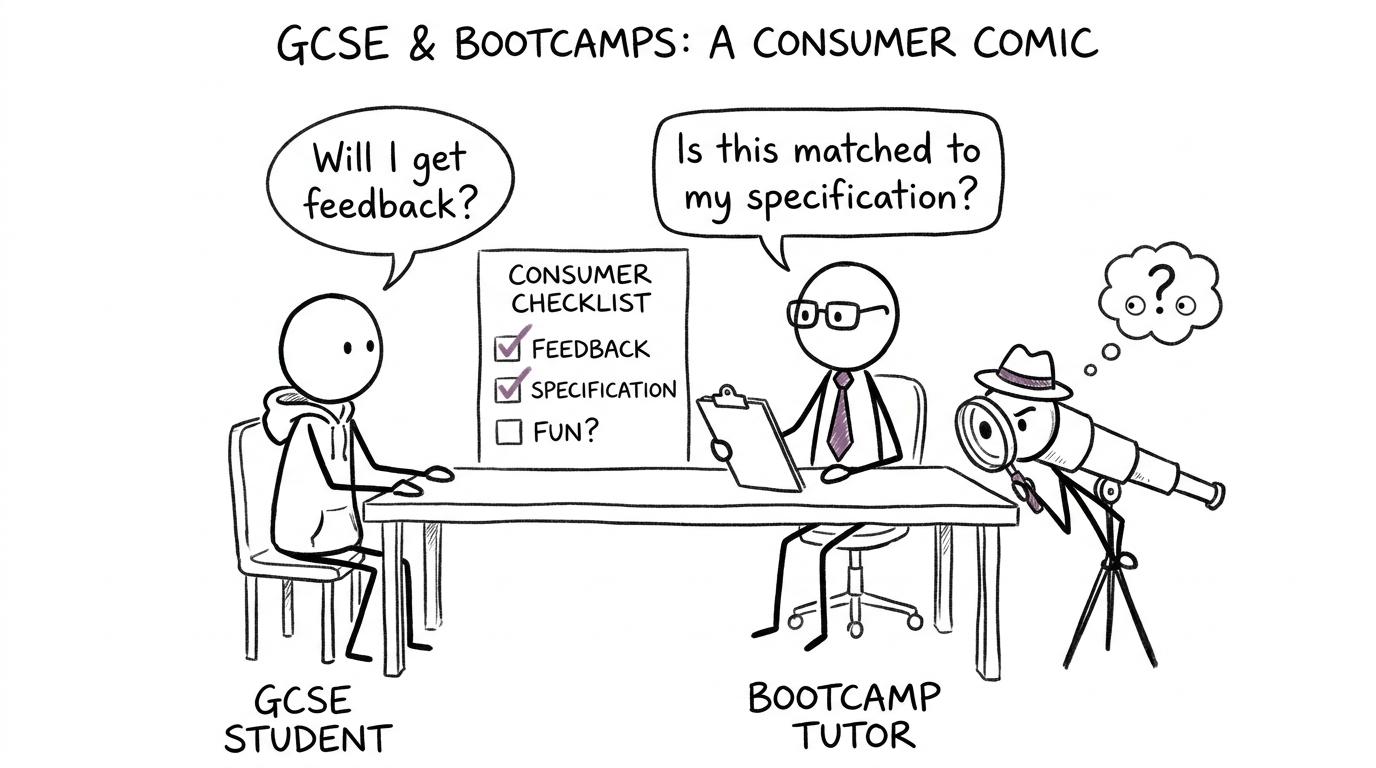 A telescope helps a student question a revision-course provider about feedback and specification coverage
When paying is genuinely sensible
A bootcamp may be a sensible purchase when you have already identified a specific need. Perhaps Astronomy is not taught regularly at your school, you are preparing through distance learning, or you repeatedly misunderstand topics that written resources have not clarified.
It can also help when:
- you learn better through live questioning;
- your existing revision lacks structure;
- you need expert feedback on exam responses;
- the timing fits comfortably around your other subjects;
- your teacher or centre agrees that the course addresses a genuine gap.
The strongest reason to pay is access to something difficult to reproduce alone: knowledgeable diagnosis. A tutor who can see why you keep losing marks and adapt the teaching accordingly offers more value than someone delivering the same slides to every group.
When a bootcamp is probably not worth it
Do not book solely because revision anxiety makes action feel urgent. Buying a course can create a brief sense of progress before any learning has occurred.
It may not be worthwhile if:
- you have not yet used the resources supplied by your school;
- the course repeats topics you already understand;
- there is no marking or personal feedback;
- the group is too large for meaningful interaction;
- the timetable clashes with important Maths revision;
- the provider relies on vague promises rather than a clear curriculum;
- the fee would create financial strain.
Students preparing for Maths can already access substantial free support. MathsGenie's GCSE past papers help you practise under examination conditions, while predicted papers provide additional exam-style practice. Predicted papers are revision materials, not forecasts of the exact questions that will appear.
If you take AQA or OCR Maths, use the appropriate AQA GCSE Maths papers or OCR GCSE Maths papers. Matching practice to your own exam board is more useful than completing random questions because they happen to be available.
A free alternative revision plan
Before committing to a course, try a short diagnostic cycle:
- list the Astronomy specification areas you must know;
- rate each area as secure, uncertain or weak;
- attempt relevant questions without notes;
- mark them carefully;
- record the precise reason for every lost mark;
- revise the weakest cause;
- attempt a fresh question to check whether it has improved.
For the mathematical parts, start with the MathsGenie GCSE revision programme, where lessons, videos and practice questions are organised by topic and grade. Then move from isolated skills to full GCSE Maths past-paper practice.
One focused hour correcting a recurring misconception can be more productive than several hours passively rereading material. The goal is not to make revision feel intense. It is to make future answers more accurate.
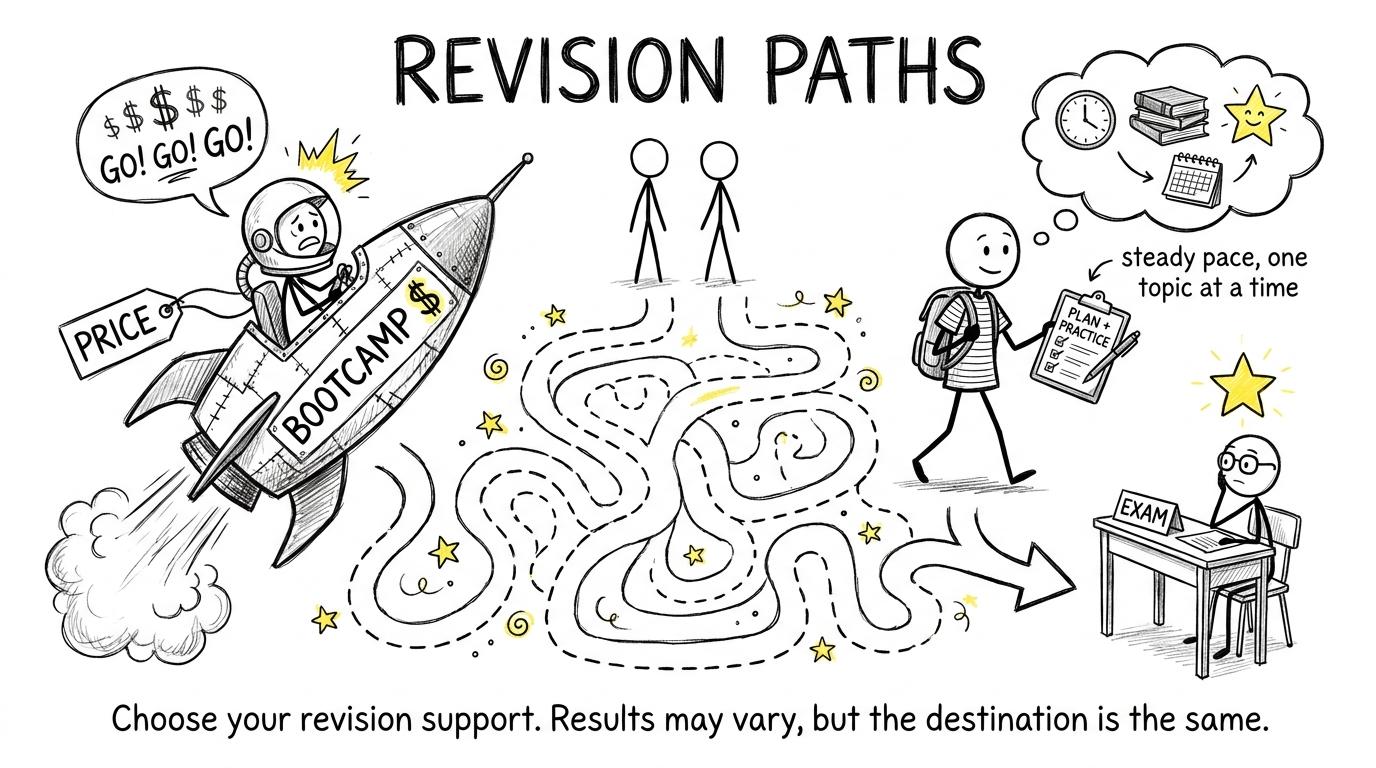 A calm revision plan and a dramatic bootcamp rocket take different routes towards the same exam desk
Common mistakes when choosing a revision course
Confusing attendance with improvement
Sitting through every session does not guarantee that knowledge can be recalled or applied. Improvement requires retrieval, practice, feedback and another attempt.
Ignoring the exact specification
Astronomy terminology and assessment requirements must match the qualification being taken. A polished course can still be irrelevant if it teaches the wrong content or treats observational work superficially.
Paying before diagnosing the problem
If lost marks come from standard form, rearranging formulae or interpreting graphs, begin with those skills. If the problem is astronomical knowledge, choose specialist teaching. Diagnosis should come before purchase.
Forgetting the opportunity cost
Every holiday course uses hours that could have gone towards Maths, English or Science. Consider your whole examination timetable, not one subject in isolation.
Expecting a last-minute rescue
A bootcamp can organise knowledge and expose gaps. It cannot replace practice completed over time. Be wary of language suggesting that one day can guarantee a particular grade.
Make the decision that fits your revision
A GCSE astronomy revision bootcamp is worth the cost when it offers specialist, specification-aligned teaching and individual feedback that you cannot easily obtain elsewhere. It is not essential for success, and intensity should never be mistaken for quality.
Start by identifying your weakest topics and testing the free support already available. For the mathematical skills Astronomy depends upon, MathsGenie provides free revision lessons, video solutions, practice questions, mini tests, past papers, predicted papers and mark schemes. Visit the MathsGenie GCSE Maths revision hub, build a focused plan and spend money only when you can clearly name the problem the course will solve.










