GCSE Astronomy Exam Time of Day: Does It Matter?
GCSE astronomy exam time of day explained: discover whether morning or afternoon sessions affect performance and how to prepare for either timetable.
The words Afternoon session can trigger two opposite reactions. One student sees extra revision time. Another imagines a slow morning spent becoming steadily more nervous.
So, does the GCSE astronomy exam time of day affect your performance? Potentially, but not in a simple or guaranteed way. Research suggests that alertness can vary with a teenager's chronotype, sleep and the time of assessment. Some students with a later body clock may find mornings harder. However, your preparation, subject knowledge, sleep, food, pacing and familiarity with exam conditions are usually more useful targets than trying to predict whether your brain will be at its absolute peak.
The practical answer is reassuring: you cannot choose the session, but you can train for it.
The short answer
Keep these points in mind:
- Morning and afternoon exams are marked in exactly the same way.
- The paper does not become easier or harder because of its session.
- Research indicates that time of day may affect alertness, but the effect differs between students.
- Your school or exam centre confirms the exact start and arrival times.
- Practising at the likely exam time can make the routine feel more familiar.
- Sleep, sensible food, hydration and calm preparation matter in either session.
- Check the official timetable for your own exam series rather than relying on an old screenshot or social-media post.
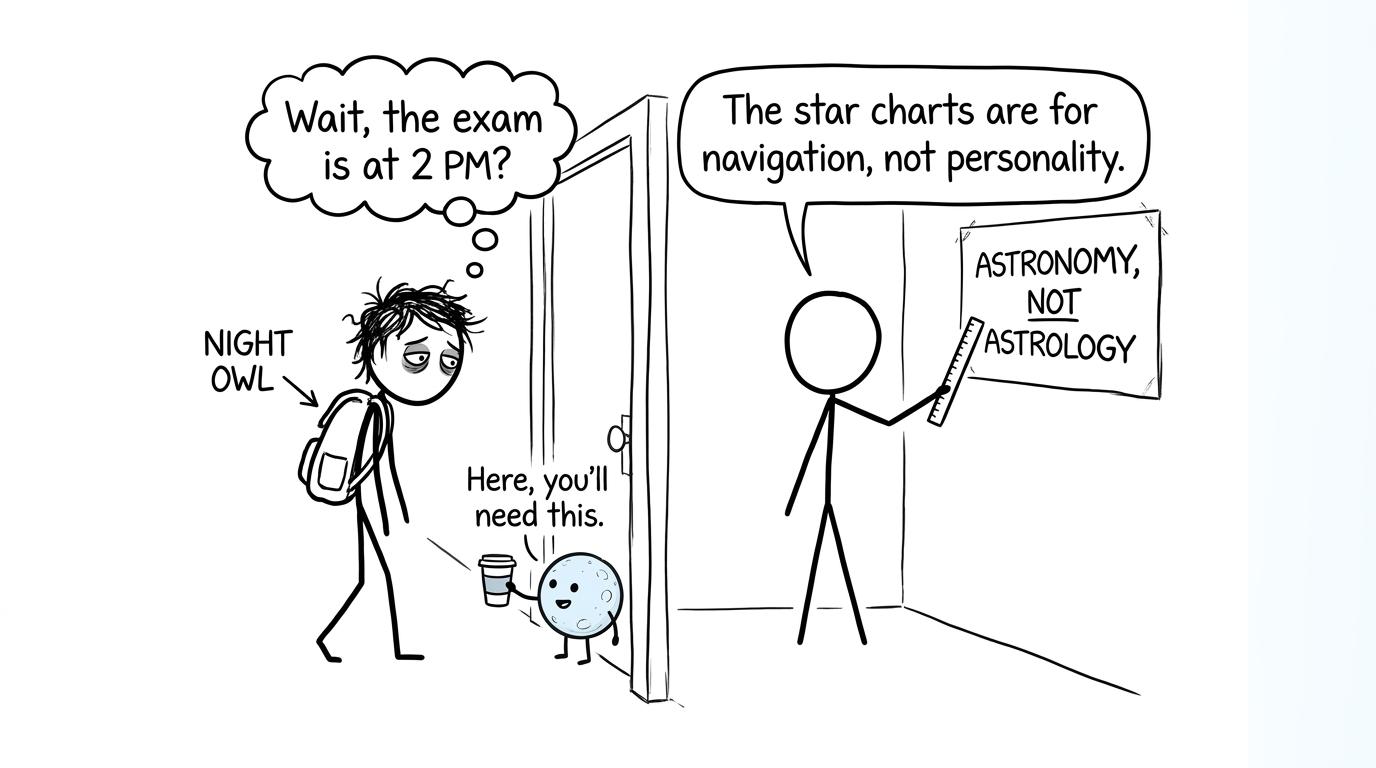 A night owl arrives for an astronomy exam while the Moon offers coffee
When is the GCSE Astronomy exam?
Pearson Edexcel GCSE Astronomy is an untiered qualification, so there are no separate foundation and higher papers. It has two equally weighted written examinations:
- Paper 111, Naked-eye Astronomy, lasts 111 hour 454545 minutes and is worth 100100100 marks.
- Paper 222, Telescopic Astronomy, also lasts 111 hour 454545 minutes and is worth 100100100 marks.
Both papers permit a calculator and include a mixture of multiple-choice, short-answer, calculation, graphical and extended-response questions. This matters because alertness is not simply about recalling facts. You must also interpret information, select a method and remain accurate through a reasonably long paper.
In Pearson's final summer 202620262026 timetable, both GCSE Astronomy papers were assigned to afternoon sessions. Paper 111 was scheduled for Monday 111 June and Paper 222 for Thursday 111111 June. Those details belong specifically to the 202620262026 series. Future dates and sessions may change, so always check your candidate timetable and the latest information supplied by your centre.
For the 202520252025 to 202620262026 exam year, the published JCQ starting times were 9.009.009.00 am for morning sessions and 1.301.301.30 pm for afternoon sessions. Centres were allowed limited flexibility around those times under JCQ rules. That is why your own school might give a start time that looks slightly different from the headline timetable. Follow the instructions from your exams officer.
Does morning versus afternoon affect performance?
There is no honest basis for saying that every student performs better in the afternoon, or that morning exams always produce lower marks. The evidence is more nuanced.
A 202320232023 review of research into adolescent circadian preference found signs of a synchrony effect: some cognitive performance can be stronger when a task matches a person's preferred time of day. It also found that morning-type adolescents often achieved more strongly than evening types in school settings, although results varied and many other factors were involved.
Other school-based research has found that differences between early and late chronotypes can be more noticeable during morning tests and may reduce during the afternoon. That gives some support to what many teenagers already suspect: a student with a later body clock may feel less disadvantaged after lunch than at the beginning of the school day.
But there are important limits. These studies do not prove that moving one GCSE Astronomy paper from morning to afternoon will raise a particular student's mark. They examine different populations, tasks and educational settings. A GCSE result also depends on months of learning, question selection, calculation accuracy, written explanations and exam technique.
Time of day is a condition. It is not a verdict.
Why an afternoon session may help
An afternoon paper can give you time to wake fully, eat normally and settle into the day. If you tend to think more clearly later, calculations involving angles, standard form or data interpretation may feel less effortful.
There is also less danger of waking late and rushing straight to the centre. A calm morning can be valuable, provided it stays calm.
Why an afternoon session may feel harder
Waiting creates space for worry. Students sometimes spend the morning attempting frantic revision, comparing predictions or discussing topics with friends. By the time the exam begins, they are mentally tired before opening the paper.
Lunch can also work against you if you eat far more or far less than usual. The aim is not to design a perfect scientific meal on exam day. It is to avoid surprising your body with an unfamiliar routine.
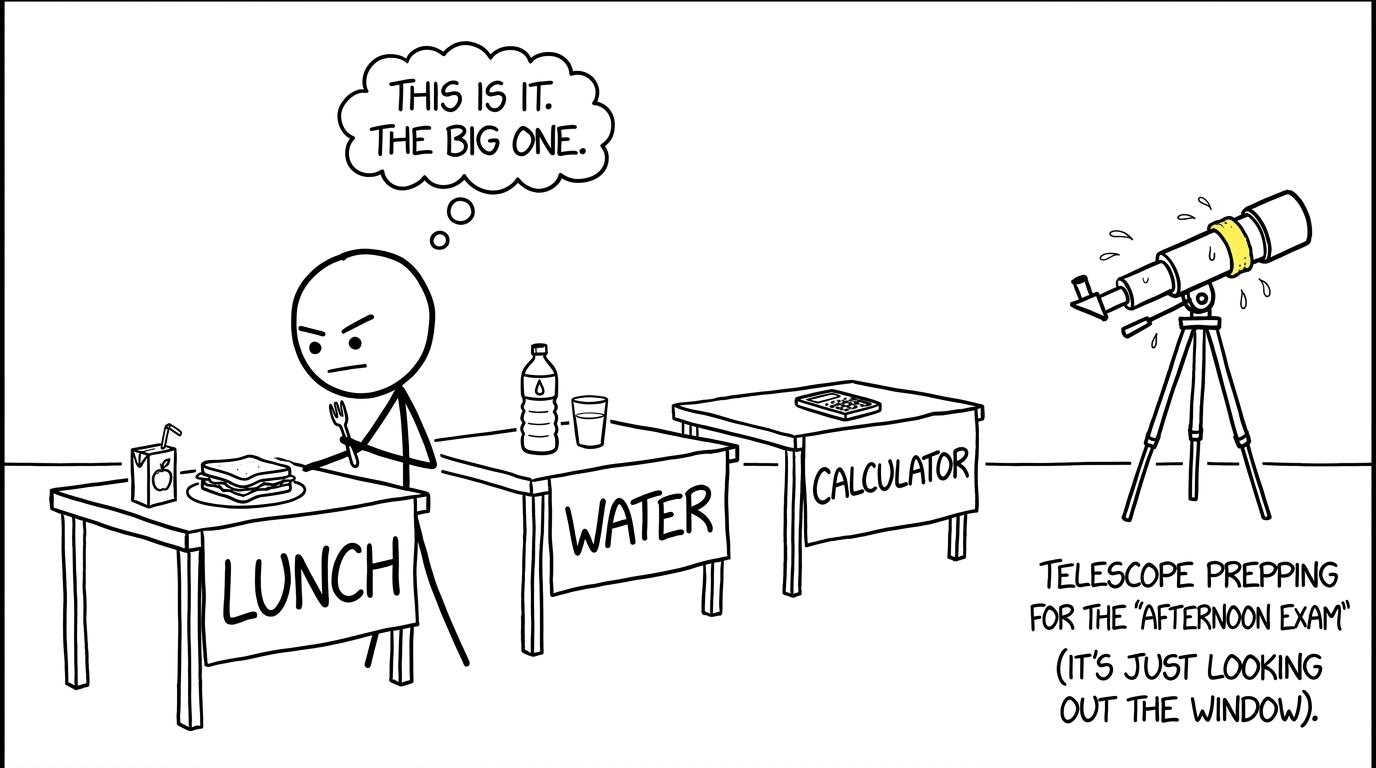 A student prepares lunch, water and a calculator while a telescope trains like an athlete
How to prepare for an afternoon Astronomy exam
Rehearse the real time window
Complete some demanding practice during the afternoon rather than doing every paper early in the morning or late at night. You are not trying to change your body clock overnight. You are learning what concentration feels like at the relevant time.
A full Astronomy paper lasts 105105105 minutes. If suitable Astronomy papers are available through your school or Pearson, sit them using the correct duration and permitted equipment. For transferable exam stamina, MathsGenie's GCSE past papers collection provides timed practice with mark schemes across GCSE subjects, while the guide to using GCSE past papers properly explains how to turn mistakes into a focused revision plan.
Afterwards, classify errors:
- Knowledge: you did not know the astronomical fact or process.
- Method: you understood the topic but selected the wrong calculation.
- Accuracy: rounding, units, calculator entry or transcription caused the loss.
- Timing: you rushed or left marks untouched.
That diagnosis is more useful than simply deciding that you are “bad in the afternoon”.
Use the morning without exhausting yourself
Brief retrieval is sensible. A complete mock paper immediately before the real examination is usually not. Review a compact list of formulae, definitions and recurring errors, then stop.
If planning revision feels harder than doing it, organise the week with the free MathsGenie revision planner. The same principle works for Astronomy: schedule small, specific tasks instead of writing “revise space” across an entire morning.
Protect the mathematical marks
Astronomy contains substantial mathematical thinking. You may need to use graphs, substitute into formulae, work with very large or small values and interpret geometrical relationships.
For astronomical quantities, standard form is particularly useful:
a×10n,1≤a<10 a \times 10^n, \qquad 1 \leq a < 10 a×10n,1≤a<10Use the standard form GCSE lesson to strengthen powers-of-ten calculations. For angles and right-angled triangles, revise with the SOHCAHTOA trigonometry resources.
These are not substitutes for Astronomy revision. They reinforce the maths that lets you express astronomical understanding accurately.
Keep your routine ordinary
Prepare your calculator, ruler and permitted stationery in advance. Check the calculator is working and that you know how to use brackets, powers and scientific notation. Confirm where you must report and when you should arrive.
Eat and drink in a familiar way. Avoid treating exam day as an experiment involving unusually large amounts of caffeine or a completely different lunch. Predictability reduces the number of decisions competing for your attention.
What if your exam is in the morning?
The same principle applies: rehearse the session you have, rather than wishing for another one.
Try several timed tasks beginning at roughly the expected start time. Establish a wake-up routine that gives you enough time to become alert, eat and travel without rushing. Do not rely on the exam itself to be the first occasion on which you attempt sustained calculations at that hour.
Students who identify as night owls should not assume that a morning paper is already lost. Research describes average patterns, not an individual destiny. Familiar questions, secure methods and a controlled first ten minutes can stabilise performance quickly.
For shorter rehearsal when a full paper is too much, use the GCSE mini tests. They can help you test whether calculator fluency and mathematical recall remain reliable at different times.
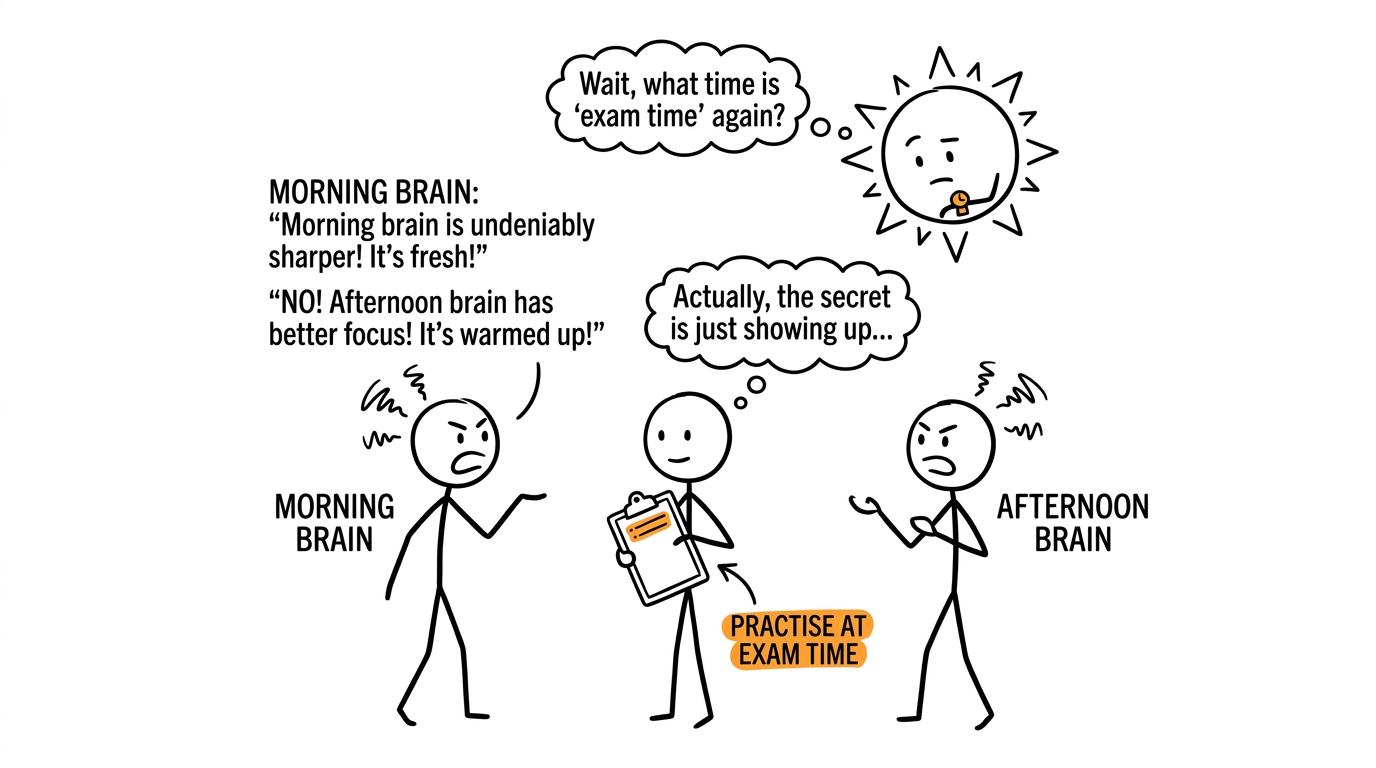 Students debate morning and afternoon brains while the Sun checks its watch
Common mistakes around exam timing
Trusting an unofficial timetable
Dates can change between exam series, and old timetables remain online. Check the timetable supplied by your centre. Confirm the date, session, location and arrival time for both papers.
Turning an afternoon exam into an all-morning revision marathon
More revision is not automatically better revision. A tired brain carrying ten newly reread topics may be less useful than a rested brain with a short list of secure ideas.
Changing sleep dramatically the night before
Trying to force an unusually early bedtime can create more pressure. Build a steady routine before the exam period rather than attempting a sudden correction on one evening.
Ignoring calculator technique
Knowing an equation does not guarantee a correct answer. Misplaced brackets, incorrect powers and premature rounding can lose marks at any time of day. MathsGenie's GCSE maths revision hub offers revision lessons and practice questions for the numerical skills that support Astronomy.
Blaming every error on the session
Feeling tired is real, but “I cannot work in the afternoon” is too broad to guide improvement. Mark your practice carefully and locate the actual failure. Was it recall, interpretation, arithmetic, units or pacing?
Make the timetable work for you
The GCSE Astronomy exam time of day may influence how alert you feel, particularly if your body clock strongly favours mornings or evenings. It does not alter the mark scheme, the value of each paper or the knowledge being assessed. The most productive response is to practise in the correct time window, protect your routine and strengthen the skills that survive under pressure.
Begin with the MathsGenie revision planner, then use free revision lessons, practice questions and mini tests to repair weak maths. Build stamina with past papers and mark schemes, and use Edexcel GCSE Maths predicted papers for fresh timed practice and video-supported review.
You cannot move the clock. You can make the student who meets it better prepared.