GCSE Astronomy 6 to 9: A Practical Revision Plan
GCSE astronomy 6 to 9: learn how stronger maths, application, observation and past-paper review can turn secure knowledge into top-grade exam performance.
A grade 666 in GCSE Astronomy usually means you know a substantial amount. You can recall facts, recognise familiar ideas and complete many routine calculations. Yet the route from gcse astronomy 6 to 9 is not mainly about collecting more facts. It is about using what you know with greater precision.
Grade 999 performance comes from connecting topics, applying ideas to unfamiliar information, handling mathematical details accurately and evaluating observational methods rather than merely describing them. The practical answer is simple: diagnose where marks are being lost, practise the exact skill behind each loss, and repeat it under exam conditions.
Your grade 6 to 9 checklist
Focus your revision on these changes:
- replace isolated facts with connected explanations;
- apply knowledge to unfamiliar diagrams, data and observations;
- make observational plans specific enough to carry out;
- strengthen standard form, algebra, graphs, ratios and units;
- use evidence when evaluating a conclusion or method;
- study mark schemes to learn the required precision;
- keep an error log and retest every recurring weakness;
- complete timed questions from both papers.
A grade is not a personality trait. It is a record of what happened on a particular set of questions. Change the processes behind those answers and the grade can change too.
Understand what the GCSE Astronomy exam rewards
The current Pearson Edexcel GCSE Astronomy qualification is untiered. Unlike GCSE Maths, there is no separate foundation or higher paper. Students sit two written examinations: Paper 111, Naked-eye Astronomy, and Paper 222, Telescopic Astronomy. Each lasts 111 hour 454545 minutes, carries 100100100 marks and contributes 50%50\%50% of the qualification.
Questions include multiple-choice, short-answer, calculation, graphical and extended open-response tasks. That variety matters. A student cannot reach the top grade by revising every topic in the same way.
The official assessment objectives are weighted as follows:
| Assessment objective | What it rewards | Weighting |
|---|---|---|
| AO1 | Knowledge and understanding of scientific ideas, techniques and procedures | 40%40\%40% |
| AO2 | Applying that knowledge and understanding | 40%40\%40% |
| AO3 | Analysing and evaluating information, observations, data and methods | 20%20\%20% |
This explains why knowing the course is necessary but insufficient. AO2 and AO3 together account for 60%60\%60% of the assessment. A student who only rereads notes is disproportionately training for AO1.
Grade boundaries are set after each examination series and can change with the demand of the papers. There is therefore no permanent mark that guarantees a grade 999. Build performance across the specification instead of aiming at an assumed boundary.
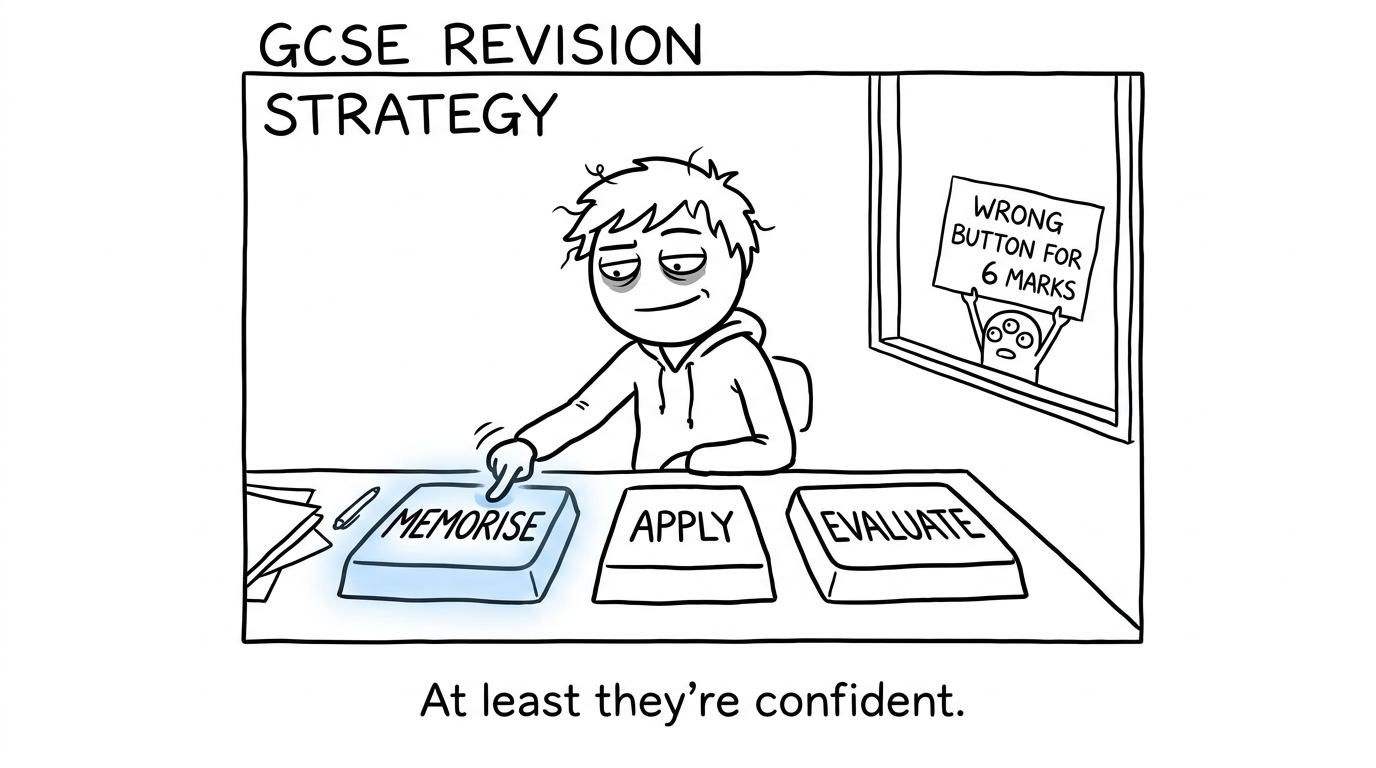 A student chooses between memorising, applying and evaluating while an alien offers exam advice
What separates a grade 6 from a grade 9?
Knowledge becomes a chain of reasoning
A grade 666 response may contain correct statements but leave the relationship between them implicit. A top-band response makes the causal chain visible: what happens, why it happens and what observable consequence follows.
When revising lunar phases, stellar evolution, planetary motion or cosmology, do not stop after recalling the sequence. Ask yourself:
- What physical process drives the change?
- What evidence would an astronomer observe?
- How does this idea connect with another specification topic?
- Which common misconception must be excluded?
This makes knowledge usable when a question changes the context or presents an unfamiliar diagram.
Application replaces pattern matching
Some students become excellent at recognising questions they have seen before. That can produce a secure grade 666, but unfamiliar material then feels like a different subject.
For a grade 999, practise extracting the physics or astronomy from the surface details. Before answering, identify the topic, the relevant principle, the information supplied and the command word. A new telescope, fictional planet or unfamiliar graph may still test a familiar relationship.
Annotate the question rather than searching your memory for an identical one. This is the transition from remembering an answer to selecting an idea.
Evaluation becomes evidence-led
Weak evaluation answers rely on portable phrases such as “repeat the observation” or “use better equipment”. These suggestions are not always wrong, but they are incomplete.
A stronger response identifies a particular limitation, explains its effect on the data and proposes a realistic improvement. Repetition should be linked to random variation or reliability. A different location should be connected to light pollution, horizon visibility or atmospheric conditions. A longer observing period should be justified by the period or change being investigated.
The best evaluation is local to the question. It sounds like a response to this observation, not a paragraph prepared for every observation.
Turn mathematical fluency into astronomy marks
At least 20%20\%20% of the marks across GCSE Astronomy must reward mathematical skills. These are assessed inside astronomical contexts, so revising maths separately is only the first stage. You must also recognise when to use it.
The required skills include:
- decimal and standard form;
- ratios, fractions, percentages and inverse-square relationships;
- base-101010 logarithms and logarithmic scales;
- significant figures and orders of magnitude;
- astronomical units, light-years, parsecs and megaparsecs;
- substitution and rearranging formulae;
- graph plotting, gradients and intercepts;
- angular measurements, including degrees, minutes and seconds of arc.
The inverse-square relationship, for example, has the structure
I∝1r2.I \propto \frac{1}{r^2}.I∝r21.You should be able to interpret what happens when distance changes, not merely recite the notation. Likewise, a graph question may require you to choose a sensible scale, plot accurately, draw an appropriate line and interpret its gradient.
Use MathsGenie’s rearranging harder formulae revision resources if changing the subject interrupts your astronomy calculations. The bounds revision guide is useful for strengthening your understanding of measurement accuracy and uncertainty.
Three small habits protect a surprising number of marks:
- write the relationship before entering calculator values;
- keep units attached throughout the method;
- round only the final answer unless instructed otherwise.
If your final value is astronomically implausible, pause. Checking the power of 101010, unit conversion and calculator brackets is often more valuable than starting again blindly.
Treat observational skills as examinable knowledge
Students must undertake at least one unaided and one aided observation. The observations themselves do not contribute a coursework mark, but centres must confirm completion, and observational knowledge is assessed in the written papers. At least 15%15\%15% of the examination marks assess observational skills.
That means practical work is not an administrative extra. It is preparation for questions about designing, making, analysing and evaluating observations.
For every observational method, create a four-part summary:
Design
State the target, location, timing, duration, equipment, variables and safety considerations. Explain why each choice suits the phenomenon.
Make
Know what must be recorded: date, time, location, weather, seeing conditions, instrument settings and the observation itself. A usable record allows another observer to understand what happened.
Analyse
Explain how raw observations become a conclusion. This may involve plotting a graph, comparing repeated measurements, identifying a pattern or calculating a quantity.
Evaluate
Distinguish random variation, systematic effects and practical limitations. Then connect each improvement to the problem it addresses.
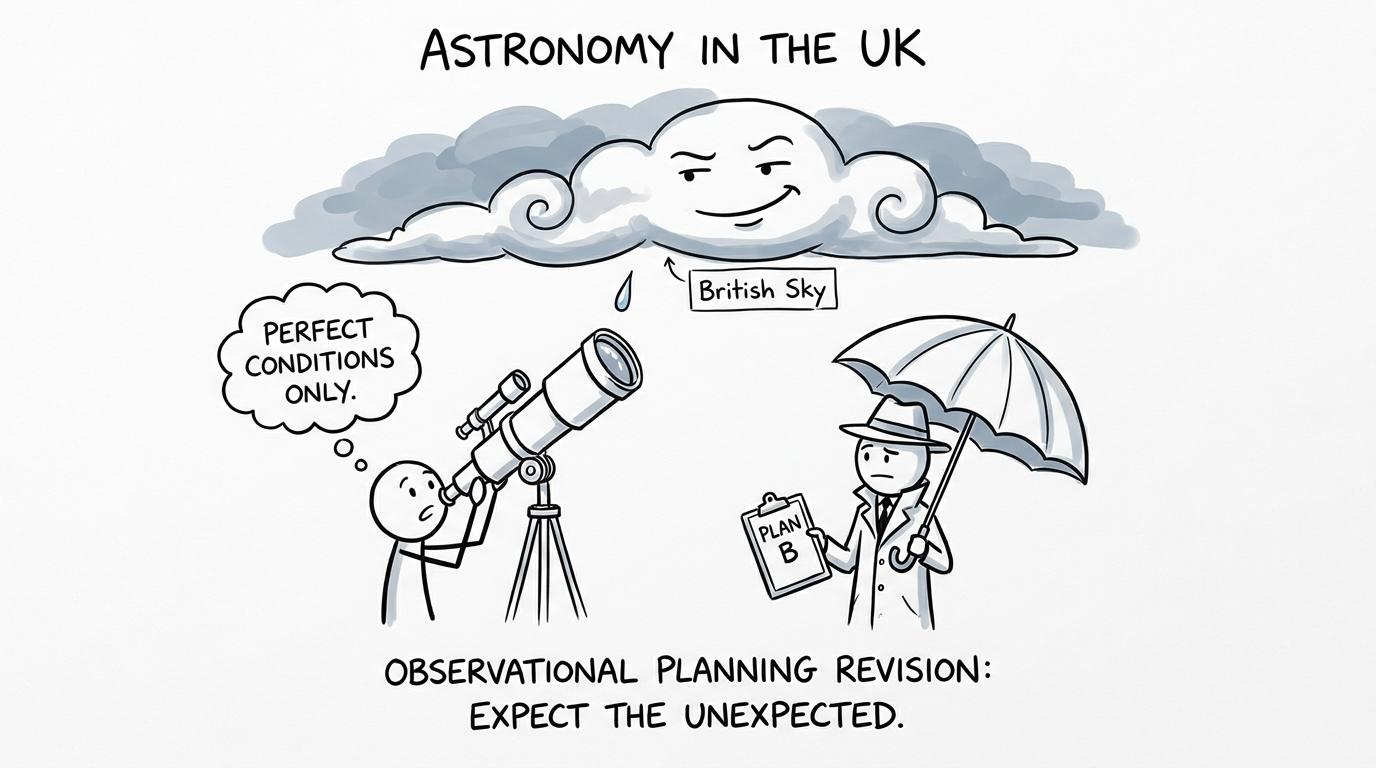 Two astronomers respond very differently to a cloudy British sky
Top-grade planning answers are operational. “Observe regularly” is vague. A strong plan specifies what will be observed, how consistently it will be measured and which conditions must be recorded. Never describe direct viewing of the Sun. Any solar method must include suitable, approved procedures and equipment.
Build a revision system that changes your answers
Revision becomes effective when it produces feedback. Use this weekly cycle.
Diagnose
Complete a timed set of questions across both papers. Mark it strictly and classify every lost mark as knowledge, application, maths, observation, command-word interpretation or avoidable accuracy.
MathsGenie’s guide to using GCSE past papers properly explains the paper, mark, fix and retest cycle. Its principles transfer directly to Astronomy, even though you should obtain Astronomy papers and official mark schemes through your school or exam board.
Repair
Choose one weakness rather than vaguely revising “space”. If gradients are costing marks, revisit that mathematical skill and then apply it to astronomy data. MathsGenie’s GCSE Maths topic list can help you locate the underlying technique.
Use revision lessons and practice questions until you can complete the skill without prompts. Watching a solution can clarify a method, but confidence should be measured by what you can produce independently.
Retest
Return to a parallel question after a short gap. If the same mistake survives, your revision activity has not yet solved the problem. Change the method, not the goal.
A structured one-month GCSE revision plan can help organise topic repair, retrieval and timed practice. You can also use MathsGenie’s past-paper platform to develop general exam discipline and calculator accuracy through GCSE Maths papers.
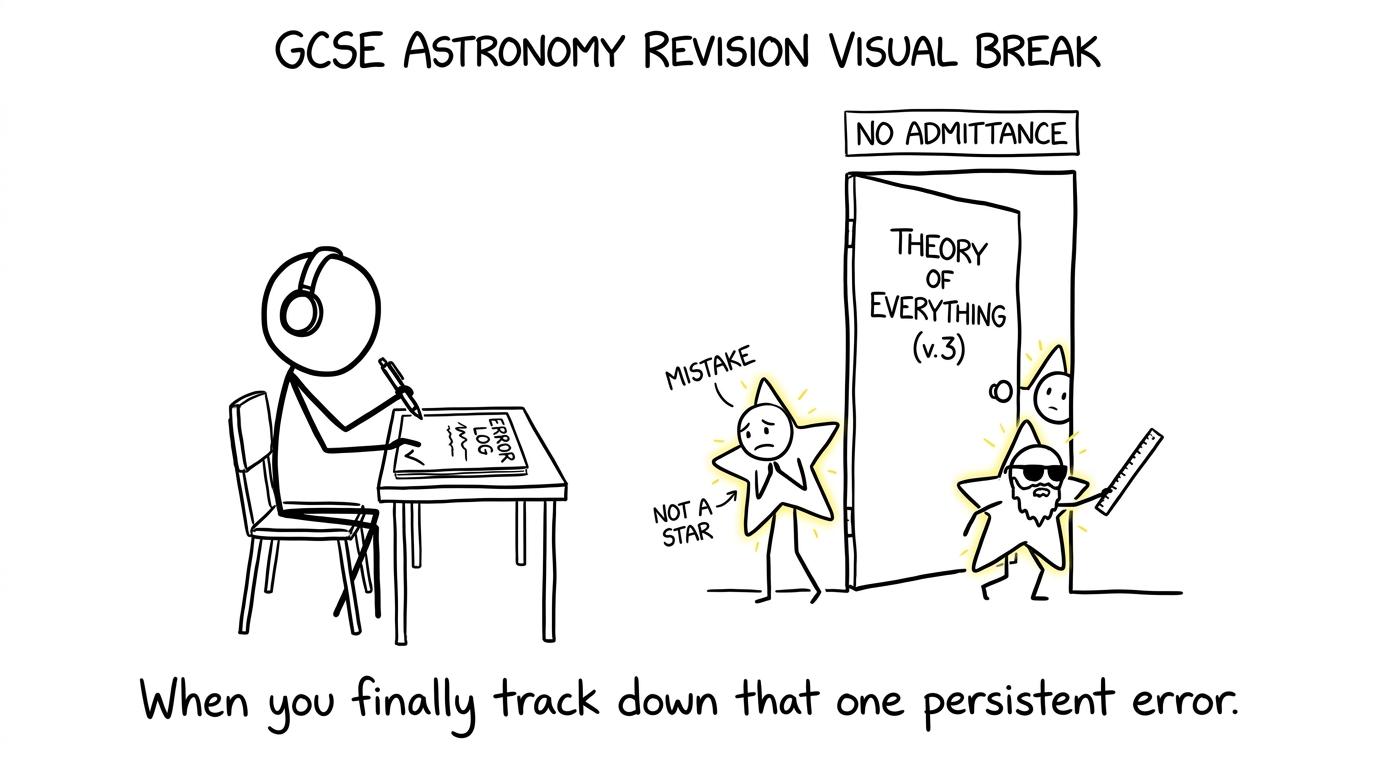 An error log prevents the same cartoon mistakes from sneaking back
Common mistakes that hold students at grade 6
Rereading instead of retrieving
Notes can feel familiar without being retrievable. Close the book and reproduce a diagram, explanation or observation plan from memory. Then compare it with the specification and correct the gaps.
Ignoring command words
“State”, “explain”, “calculate” and “evaluate” require different responses. An accurate description may still lose marks if the question asks for a reason or judgement.
Giving generic practical improvements
“Repeat it” needs a purpose. State what should be repeated, what will be compared or averaged, and how that improves the evidence.
Dropping mathematical communication
A calculator answer without a relationship, substitution, unit or sensible precision can conceal correct thinking. Show enough working for the examiner to follow your method.
Revising only favourite topics
Comfort is a poor revision planner. Use marks lost, not enjoyment, to choose the next session. Save MathsGenie predicted papers and mini tests for sharpening your underlying GCSE Maths skills, but use the complete Astronomy specification and official Astronomy papers to protect full subject coverage.
Make the next mark easier to win
The move from grade 666 to grade 999 is rarely one dramatic leap. It is a collection of smaller changes: one explanation with a complete causal chain, one graph plotted carefully, one observation plan made specific and one recurring calculator error removed.
Start with a timed Astronomy question set. Mark it, identify the two largest marks leaks and repair the maths behind them with MathsGenie’s free GCSE revision resources. Use revision lessons, practice questions, mark schemes and video solutions to build fluency, then test that fluency with mini tests, past papers and predicted papers.
Do not ask whether you “feel like” a grade 999 student yet. Ask whether today’s answers are more precise, better evidenced and harder to mark down than yesterday’s. That is how the grade moves.