GCSE Astronomy 6 to 8: A Practical Revision Plan
GCSE astronomy 6 to 8 revision guide: improve mathematical accuracy, observational evaluation, extended answers and exam technique for a higher grade.
A grade 6 often means you know a good deal of astronomy. You can describe stellar evolution, recognise lunar features and recall the broad shape of the Solar System. Yet unfamiliar data or a demanding evaluation can still pull your mark down.
Moving from gcse astronomy 6 to 8 is therefore less about collecting more facts and more about using what you know with precision. Grade 8 performance combines comprehensive knowledge, accurate terminology, confident mathematical reasoning, logical data analysis and critical evaluation of observational methods.
That change is achievable. But it requires a different kind of revision: fewer hours spent rereading and more time applying, checking and refining.
Your grade 6 to grade 8 checklist
Use this as a quick diagnosis:
- Know the full Pearson Edexcel GCSE Astronomy specification, not just favourite topics.
- Explain unfamiliar situations rather than repeating memorised notes.
- Complete multi-step calculations with units, substitutions and sensible rounding.
- Interpret tables, graphs, photographs and observational data confidently.
- Evaluate methods using specific sources of error and realistic improvements.
- Build extended answers around linked scientific reasoning.
- Practise both papers under timed conditions and learn from the mark schemes.
- Keep an error log and revisit mistakes until they stop recurring.
GCSE Astronomy is currently offered by Pearson Edexcel as specification 1AS0. It is untiered, so there is no foundation or higher paper: every candidate sits the same assessment. Paper 1 covers Naked-eye Astronomy and Paper 2 covers Telescopic Astronomy. Each paper lasts one hour and forty-five minutes, carries 100100100 marks and contributes 50%50\%50% of the qualification.
What separates a grade 6 from a grade 8?
There is no official grade 6 descriptor for GCSE Astronomy. Ofqual publishes broad descriptors at grades 2, 5 and 8, and these are intended to indicate typical performance rather than act as mark schemes. So the distinction below is a practical interpretation, not an alternative set of grade boundaries.
| A developing grade 6 response | A grade 8 response |
|---|---|
| Recalls mostly accurate facts | Selects comprehensive, relevant knowledge |
| Explains familiar situations | Applies ideas in familiar and unfamiliar contexts |
| Completes routine multi-step calculations | Chooses and combines mathematical methods for complex problems |
| Identifies patterns in data | Analyses data critically and supports conclusions with evidence |
| Suggests a general improvement | Evaluates limitations and proposes a specific, viable refinement |
| Uses some astronomical vocabulary | Uses precise terminology consistently |
The important word is control. A grade 8 student is not expected to know every fact ever discovered about the universe. They are expected to control the knowledge in the specification: selecting it, connecting it and applying it to what is actually being asked.
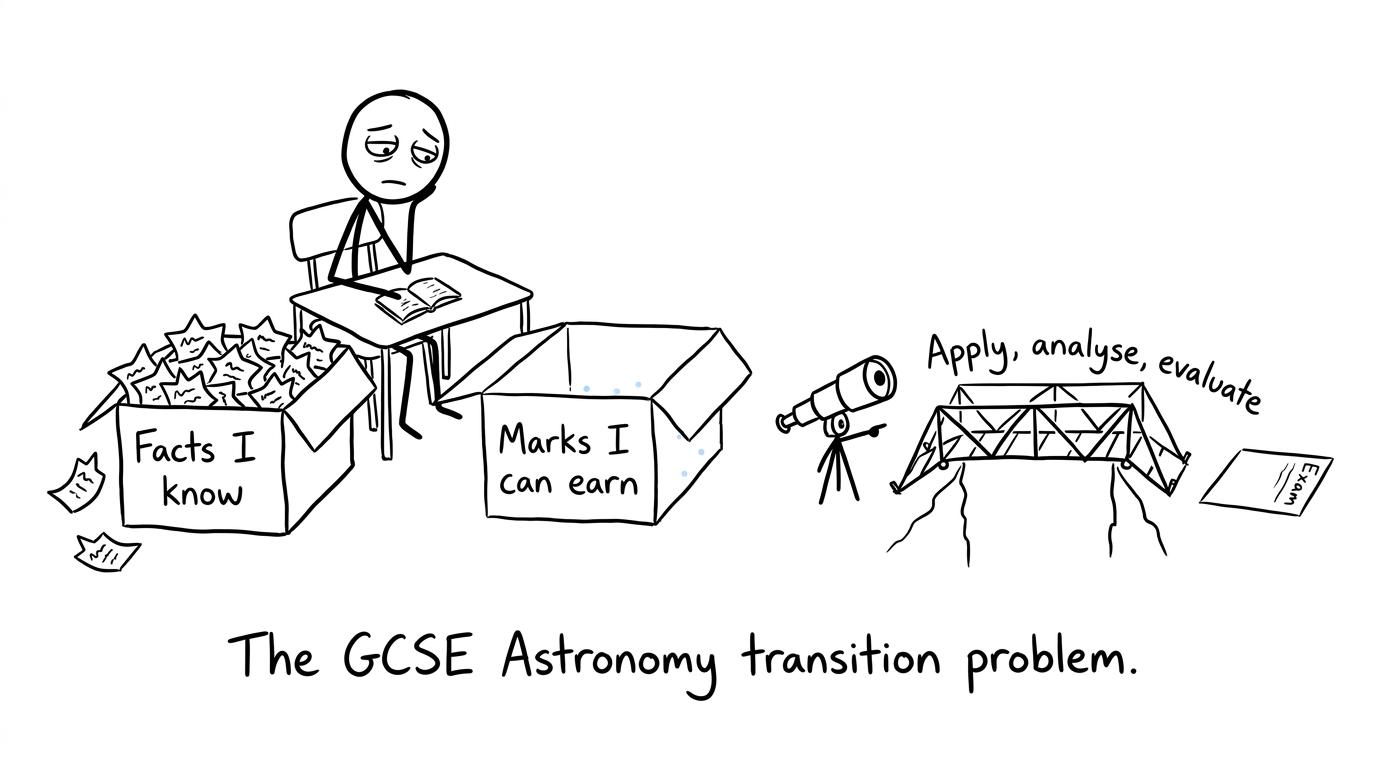 A student building a bridge between astronomy facts and exam marks
Shift from recalling facts to applying them
The assessment objective weighting explains why passive revision eventually stops working. Across the qualification, AO1 knowledge and understanding accounts for 40%40\%40%, AO2 application accounts for 40%40\%40%, and AO3 analysis and evaluation accounts for 20%20\%20%.
That means most marks require more than recall.
After revising a topic, close your notes and ask:
- Could I explain this process without the textbook wording?
- Could I apply it to an unfamiliar planet, star or observation?
- Could I interpret evidence that appears to challenge the expected result?
- Could I connect this idea to another specification topic?
For example, revising redshift should involve more than remembering that spectral lines move towards longer wavelengths. You should be ready to connect observed spectra, relative motion, Hubble's law and evidence for an expanding universe.
Make your retrieval prompts relational. Instead of writing “define”, use “explain why”, “compare”, “predict” and “evaluate”. These verbs train the thinking that higher-tariff questions require.
Make the mathematical marks dependable
At least 20%20\%20% of the written examination marks assess mathematical skills. The formula and data sheet provides key equations and astronomical data, but it does not decide which equation to use, rearrange it or check your answer.
A secure calculation should usually show:
- the relevant equation;
- a correct substitution;
- a clear rearrangement where required;
- consistent units;
- an appropriate number of significant figures;
- a quick sense-check of scale and direction.
Astronomy commonly draws on ratios, angular measurements, graphs and very large distances. Scientific notation is especially important. In standard form,
a×10nwhere1≤a<10a \times 10^n \quad \text{where} \quad 1 \leq a < 10a×10nwhere1≤a<10You may also need relationships such as Hubble's law,
v=H0d,v = H_0d,v=H0d,or the inverse-square relationship for intensity,
I∝1d2.I \propto \frac{1}{d^2}.I∝d21.The grade-raising habit is not merely memorising these expressions. It is recognising the relationship in a new context and preserving accuracy through several steps.
Use MathsGenie's free standard form revision resources to strengthen calculations involving astronomical scales. If changing the subject causes hesitation, practise rearranging harder formulae. For angular questions and right-angled diagrams, revisit the SOHCAHTOA trigonometry revision guide.
Do not hide all your working in the calculator. Written structure makes your reasoning visible and gives you a better chance of accessing method marks when the final value is wrong.
Turn observations into grade 8 evaluation
Students must undertake at least one unaided and one aided observation during the course. Observational knowledge is then assessed in the written examinations, so practical experience is not separate from exam preparation.
Pearson describes astronomical observation as an iterative cycle: design, observe, analyse and evaluate. A strong response understands the whole cycle.
Replace vague evaluation with a chain of reasoning
Weak evaluations often say “repeat the observation” or “use better equipment”. These ideas may be relevant, but they are incomplete without explanation.
Build evaluation around four questions:
- What limitation occurred? Identify the precise issue.
- How could it affect the data? State whether it changes accuracy, precision or reliability.
- What improvement is realistic? Match the refinement to the limitation.
- Why would it help? Explain the expected effect on the evidence or conclusion.
You should also distinguish random error from systematic error. Repeated observations can reveal variation and support a mean, but repetition alone does not remove a consistent calibration error. Likewise, a larger telescope is not automatically the correct improvement if cloud cover, poor timing or an unsuitable observing location caused the problem.
Grade 8 evaluation is specific. It judges whether the proposed method is viable rather than listing generic laboratory phrases.
Read data as evidence, not decoration
Astronomy papers can present graphs, tables, spectra, images and unfamiliar observational results. Before calculating anything, establish:
- what each axis or column represents;
- the units and scale;
- whether the relationship is linear, curved or inverse;
- whether there are anomalies;
- what conclusion the evidence supports;
- what the evidence cannot establish by itself.
A logical conclusion should refer directly to the data. A critical conclusion should also recognise uncertainty or limitations.
The relevant maths is transferable. MathsGenie's cumulative frequency resources develop careful graph reading, while the ratio revision guide helps with comparisons and scale. The contexts differ, but the habits are the same: read labels, preserve units and justify what the numbers mean.
Write extended answers that accumulate marks
Longer answers reward organised reasoning, not sheer length. Plan briefly before writing. Identify the command word and select only the knowledge that advances the answer.
A useful structure is:
- make a relevant scientific statement;
- explain the mechanism or reason;
- connect it to the scenario or evidence;
- add a limitation, consequence or comparison where required.
For “compare” questions, discuss both sides using matched points. For “explain” questions, show cause and effect. For “evaluate” questions, weigh evidence or limitations before reaching a reasoned judgement.
Accurate terminology matters. Terms such as rotation, revolution, luminosity, apparent magnitude and absolute magnitude are not interchangeable. Precision prevents a scientifically correct idea from becoming an ambiguous answer.
Use a revision cycle that changes your performance
Begin with an official Pearson Astronomy past paper or sample assessment material. Complete a timed section, mark it carefully and classify every lost mark as one of four types:
- missing knowledge;
- weak application;
- mathematical error;
- exam technique or incomplete communication.
Then fix the cause, not just the question. Relearn the relevant content, practise a small set of similar tasks and retry the original question without notes several days later.
A balanced week might contain two topic sessions, one mathematical-skills session, one observational-evaluation session and one timed paper section. If you need a structure for fitting this around other subjects, adapt MathsGenie's one-month GCSE revision plan.
MathsGenie's GCSE past-paper hub and GCSE predicted papers are designed for maths rather than Astronomy, but they are valuable alongside your Astronomy revision. They build calculator fluency, algebraic control, graph interpretation and timed accuracy. For Astronomy itself, use current official Pearson papers and mark schemes.
Common mistakes that keep students near grade 6
Revising only the interesting topics
Black holes and cosmology may be memorable, but both papers sample a broad specification. Neglecting timekeeping, coordinate systems, observational methods or early Solar System models creates avoidable gaps.
Naming facts without answering the command word
A correct fact does not automatically answer “explain”, “analyse” or “evaluate”. Return to the wording after each paragraph and ask whether you have completed the requested task.
Giving generic observational improvements
“Take more readings” needs a purpose. State how repetition affects reliability, helps identify anomalies or supports the calculation of a representative value.
Rounding too early
Keep full calculator values during intermediate steps and round only at the end unless the question instructs otherwise. Early rounding can distort a multi-stage result.
Ignoring units or scale
Astronomical quantities vary enormously. Check whether the answer should be in metres, kilometres, astronomical units, light-years or parsecs, and make conversions explicit.
Marking without correcting
Reading the mark scheme is not the same as learning from it. Write a corrected answer, record the reason for the loss and repeat the skill later.
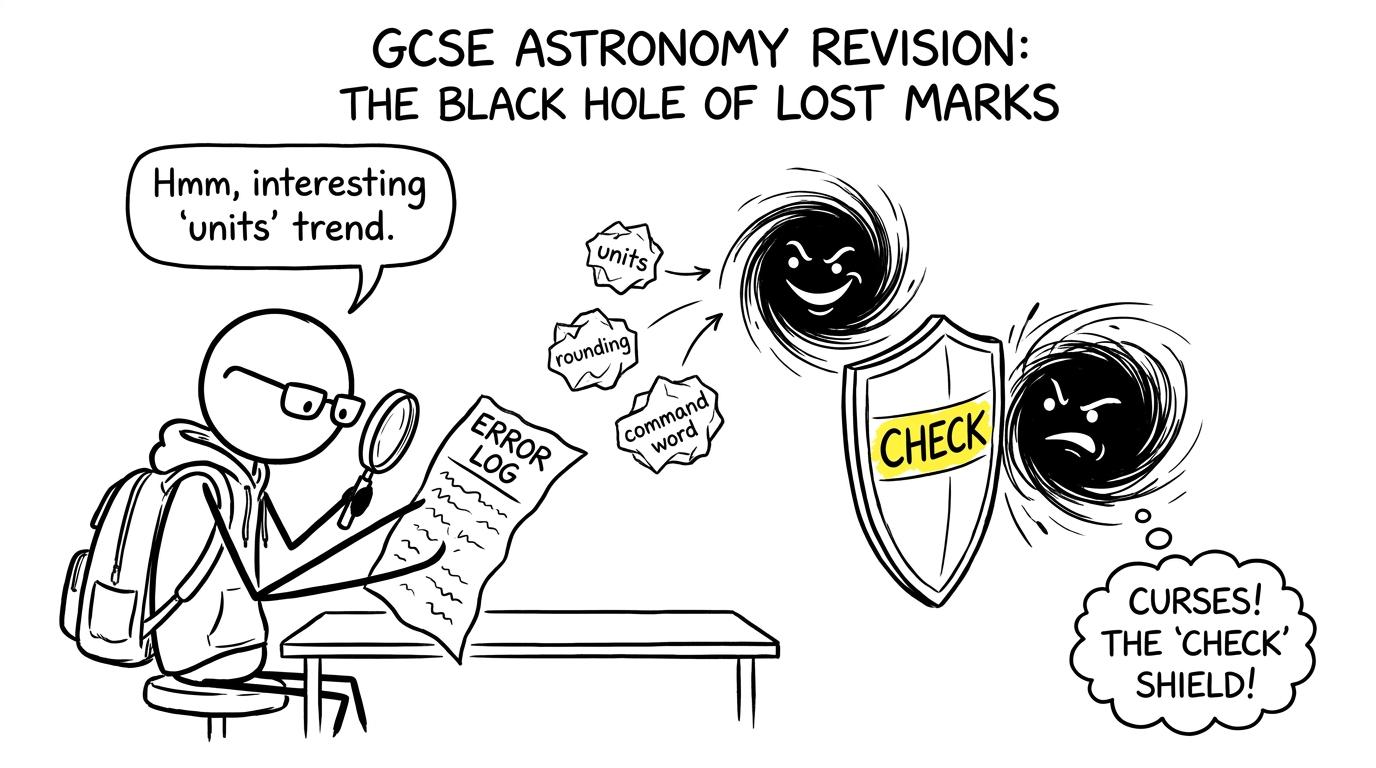 A student protecting marks from a mischievous black hole of avoidable errors
Make the next mark easier to earn
The move from grade 6 to grade 8 is rarely one dramatic leap. It is a collection of quieter changes: a unit checked, a conclusion supported by data, an improvement linked to a real limitation, and an unfamiliar calculation approached without panic.
Start with one timed Astronomy section and build an honest error log. Use official Pearson papers for subject-specific practice, then strengthen the mathematics beneath those questions with MathsGenie's free revision lessons, practice questions and video solutions. As your wider GCSE maths exams approach, add MathsGenie past papers, mini tests and predicted papers.
Knowledge gets you into the question. Precision, application and evaluation carry you towards grade 8.