GCSE Art and Design Exam Time of Day: Does It Matter?
GCSE art and design exam time of day can affect alertness, but preparation matters more. Learn how to perform well in morning or afternoon sessions.
There is a particular kind of worry that appears just before a long practical assessment: What if I am more creative in the afternoon, but my school puts the exam in the morning? The short answer is reassuring. Your GCSE art and design exam time of day may affect how alert you feel, particularly if you are naturally a late riser, but there is no good evidence that morning or afternoon scheduling alone determines your result.
Preparation, sleep, familiarity with your materials and a realistic plan for the supervised time are likely to matter far more. Unlike a standard GCSE maths paper, the Art and Design assessment is usually a sustained practical session arranged by your school rather than a nationally timetabled written examination.
The answer at a glance
- Some research suggests that later chronotypes can perform less well on academic tasks early in the morning.
- The research is not specific to GCSE Art and Design, so it cannot prove that afternoon art sessions produce higher marks.
- Major GCSE Art and Design specifications use a supervised period of around 101010 hours, often divided into several sessions.
- Your school or college normally determines the dates, session lengths and start times within the exam board's rules.
- You should prepare for the time you have been given rather than assuming another session would be better.
- Sleep, food, hydration, equipment and a clear creative plan are controllable. The clock usually is not.
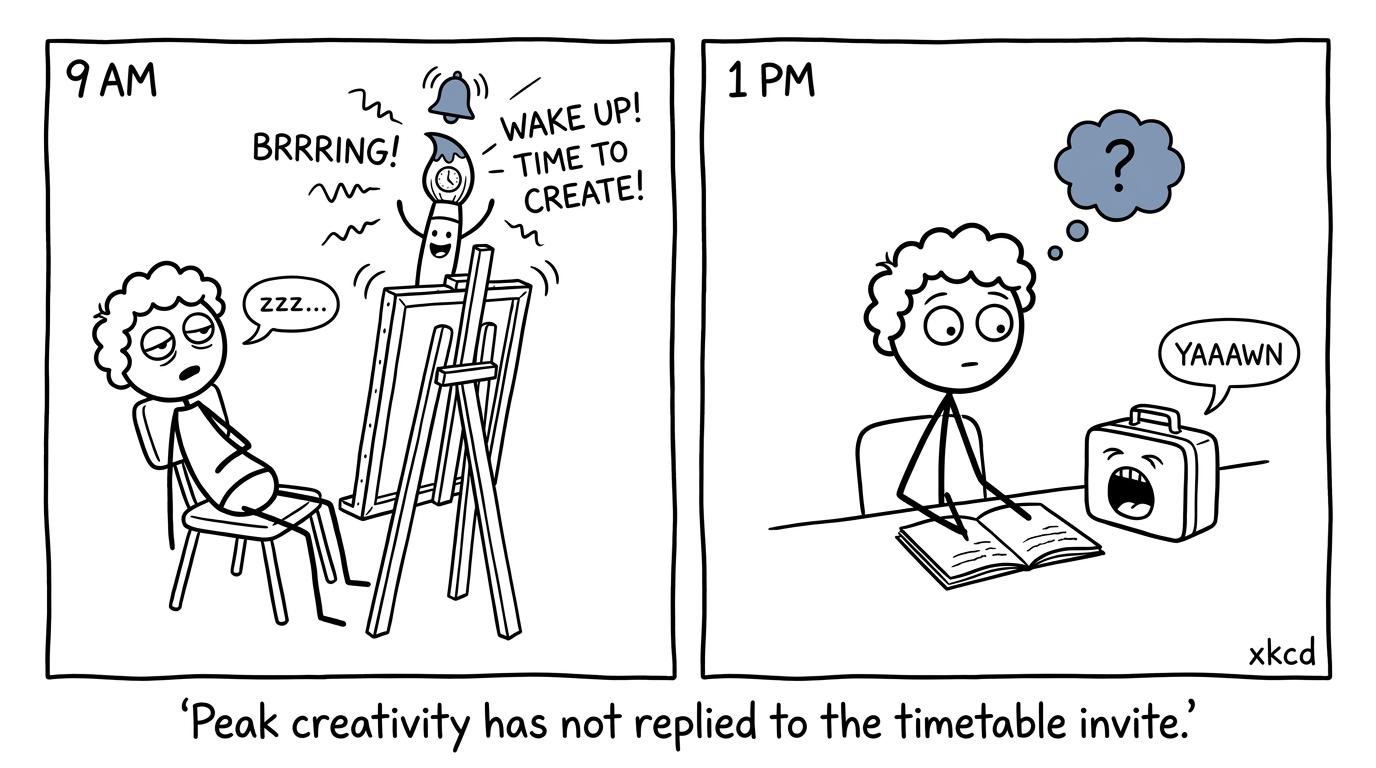 A sleepy art student negotiates with the timetable
How the GCSE Art and Design assessment is scheduled
Students often call the supervised period the "art exam", but exam boards generally classify it as an externally set assignment or non-exam assessment. You receive a starting point, complete preparatory work and then realise your intentions under supervised conditions.
For the current specifications used by AQA, Pearson Edexcel, OCR and Eduqas, the sustained supervised period is normally 101010 hours. The precise arrangements vary by board.
For example, AQA requires the first 222 hours to be consecutive and allows schools to arrange the remaining 888 hours at their discretion. OCR states that the 101010-hour period may be divided into sessions to suit the centre, with at least one session lasting at least 222 hours. Pearson Edexcel also permits the sustained focus period to take place over more than one session, subject to its administrative rules.
This means there is not usually one national morning or afternoon slot for every Art and Design candidate. Your school may organise two full days, several shorter sessions or another permitted structure. Your teacher or exams officer should confirm the exact arrangement.
This differs from ordinary timetabled GCSE papers. Under the JCQ instructions for the 202520252025/262626 academic year, the published starting times for standard morning and afternoon examinations are 9.009.009.00 am and 1.301.301.30 pm, although centres have limited flexibility around those times. Those published sessions should not be assumed to dictate the structure of your Art and Design supervised assessment.
Can morning versus afternoon affect performance?
There is a plausible effect, but it needs to be kept in proportion.
People differ in chronotype, meaning their natural preference for being active earlier or later in the day. Research involving secondary-age students has found that later chronotypes can be disadvantaged in morning academic tests compared with earlier chronotypes. In some studies, that difference became smaller or disappeared in the afternoon.
A review of research into adolescent chronotype and performance found evidence of a "synchrony effect": people may perform better when a task takes place closer to their naturally preferred time. However, findings vary across tasks and studies. Academic performance is also influenced by sleep duration, attendance, motivation, prior learning and many other factors.
Most importantly, this research does not directly establish that a GCSE Art and Design candidate will gain higher marks in an afternoon session. A practical art assessment is different from a short memory or intelligence test. It involves prolonged concentration, physical organisation, decision-making and techniques that have usually been rehearsed during the preparatory period.
So the honest conclusion is this: time of day might influence alertness, but it is unlikely to outweigh the quality of your preparation and execution.
Why the length of the session may matter more
A 101010-hour assessment is an endurance task. The challenge is not simply to feel inspired at the beginning. You need to maintain judgement and control across a long period.
Fatigue may appear in different ways:
- rushing an important section because time feels short;
- repeatedly changing an area that was already working;
- forgetting to leave time for drying, assembly or exporting digital work;
- losing accuracy as the session continues;
- concentrating on detail before the overall composition is secure.
The best protection is a plan based on stages rather than mood. Know what must be established early, what can be refined later and what you will simplify if a process takes longer than expected. Your preparatory work should remove major decisions from the supervised period without making you so rigid that you cannot respond intelligently to the work in front of you.
Maths students already use a similar principle when practising under timed conditions: the aim is to make good decisions while the clock is running. The free GCSE maths revision hub and GCSE mini tests can help build that wider exam habit without requiring another long revision session.
Preparing for a morning Art and Design session
If your assessment begins in the morning, the goal is to become alert before you sit at the easel, workstation or bench.
Protect your sleep
NHS guidance says that most teenagers need around 888 to 101010 hours of sleep. Staying up late to adjust preparatory work may feel productive, but tiredness can reduce concentration the next day. Follow the assessment rules carefully: once supervised work begins, exam boards restrict what may be changed or accessed between sessions.
Keep your sleep and waking times reasonably consistent during the preceding week. One unusually early night cannot always repair several late ones.
Remove decisions from the morning
Pack permitted materials in advance and check practical details with your teacher. Know where you need to be, when you must arrive and what the centre provides. Eat a familiar breakfast if you normally do so, and leave enough time to avoid arriving flustered.
Use the opening minutes to orient yourself. Check your plan, arrange materials safely and identify the first meaningful action. Do not interpret normal early-morning sluggishness as evidence that the whole session will go badly.
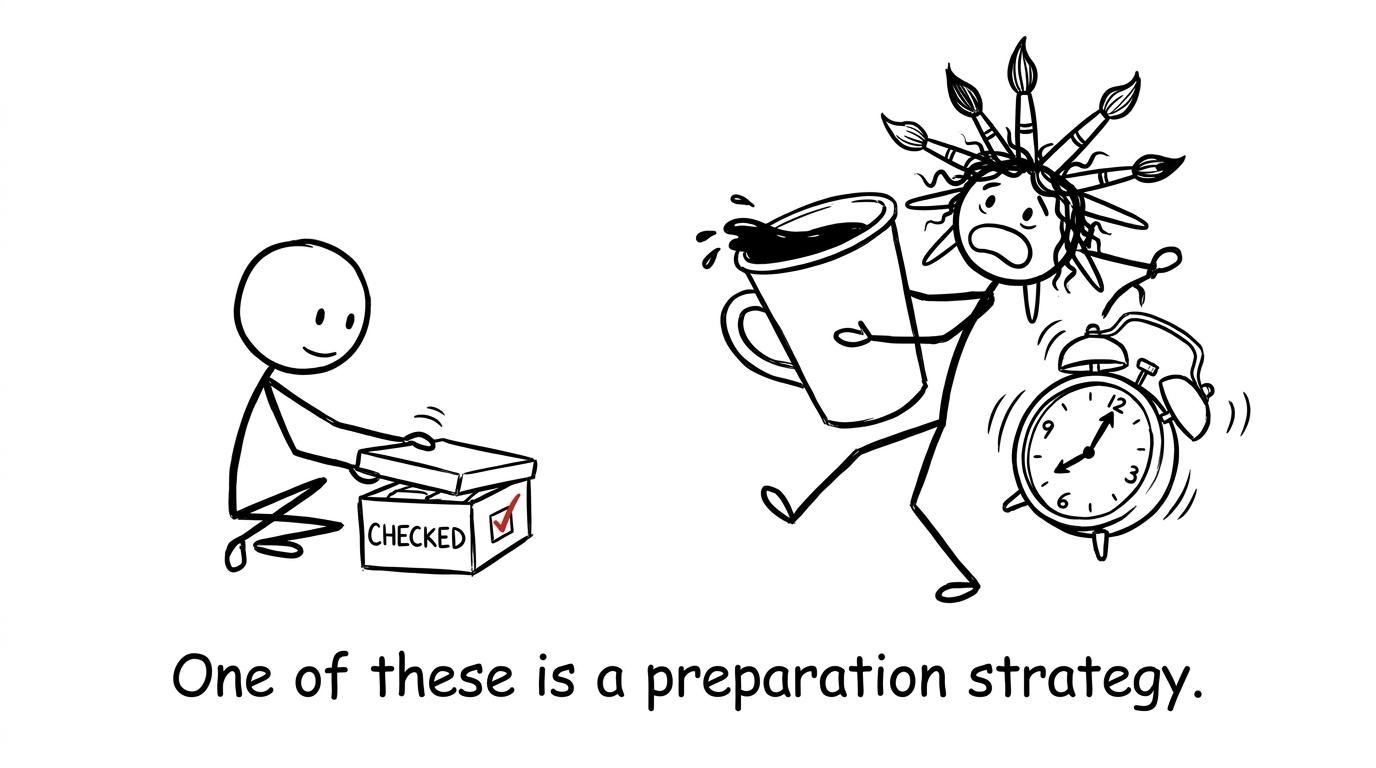 A prepared student and a chaotic student pack for an art assessment
Preparing for an afternoon Art and Design session
An afternoon start may suit students who become more alert later, but it brings different risks. The morning can become a long waiting room in which anxiety grows and energy is wasted.
Keep the morning ordinary. Follow your school's instructions about preparatory work and do not make unauthorised changes. Avoid spending hours mentally redesigning an outcome you have already planned.
Eat a familiar lunch that leaves you comfortable rather than overly full. Drink normally instead of attempting to "fix" tiredness with excessive caffeine or energy drinks. If your session follows lessons, use the final break to reset: visit the toilet, organise permitted equipment and focus on the first stage of the task.
The danger of an afternoon session is often not the afternoon itself. It is using too much attention before the assessment has started.
Rehearse at the time you will perform
If your school has confirmed the schedule, complete one or two realistic practice sessions at approximately the same time of day. This is not about producing another finished piece. It is about noticing practical patterns:
- How long does it take you to settle?
- When does your concentration dip?
- Which processes create waiting or drying time?
- What food and drink leave you comfortable?
- Which materials need to be laid out first?
A morning student may discover that a short set-up routine is enough to feel focused. An afternoon student may learn that a heavy lunch is distracting. These observations are more useful than attaching a fixed identity to yourself as someone who "cannot work in the morning".
The same rehearsal principle helps with the rest of your exam season. Use the MathsGenie revision planner to place demanding maths practice at realistic times, then build confidence with GCSE predicted papers. Predicted papers are practice tools, not guarantees of future questions, but they can help you rehearse concentration and timing.
Protect your maths revision around the art assessment
A long art session can occupy most of a school day and leave less energy for foundation or higher-tier maths revision. That does not mean you need to abandon your timetable.
On art assessment days, make maths revision deliberately small. A brief set of practice questions, followed by immediate checking, is more useful than an exhausted full paper. The 20-minute GCSE maths revision routine offers a manageable structure, while the GCSE one-week revision plan can help if several examinations are close together.
Save full timed papers for a day when you can review them properly. Sitting a paper without checking the mark scheme creates activity, not necessarily learning. MathsGenie's practice questions, mark schemes and video solutions make it easier to identify the exact method that needs attention.
Common mistakes to avoid
Assuming your start time fixes your result
Being a night owl does not make a morning result inevitable. Treat chronotype research as useful context, not a prediction of your grade.
Changing your normal routine dramatically
An unfamiliar breakfast, a large caffeine dose or a sudden sleep schedule can create more problems than it solves. Consistency is usually safer.
Ignoring your exam board's rules
Rules differ over preparatory work, internet access, storage and what can be changed between sessions. Follow instructions from your teacher and centre rather than advice from another school's students.
Planning every minute too rigidly
A practical process can behave unexpectedly. Build in contingency time and know which details could be simplified without weakening the central idea.
Doing heavy revision after a long session
A tired evening is better used for light retrieval, checking mistakes or planning tomorrow. The GCSE maths exam-week checklist can help you decide what is genuinely worth doing.
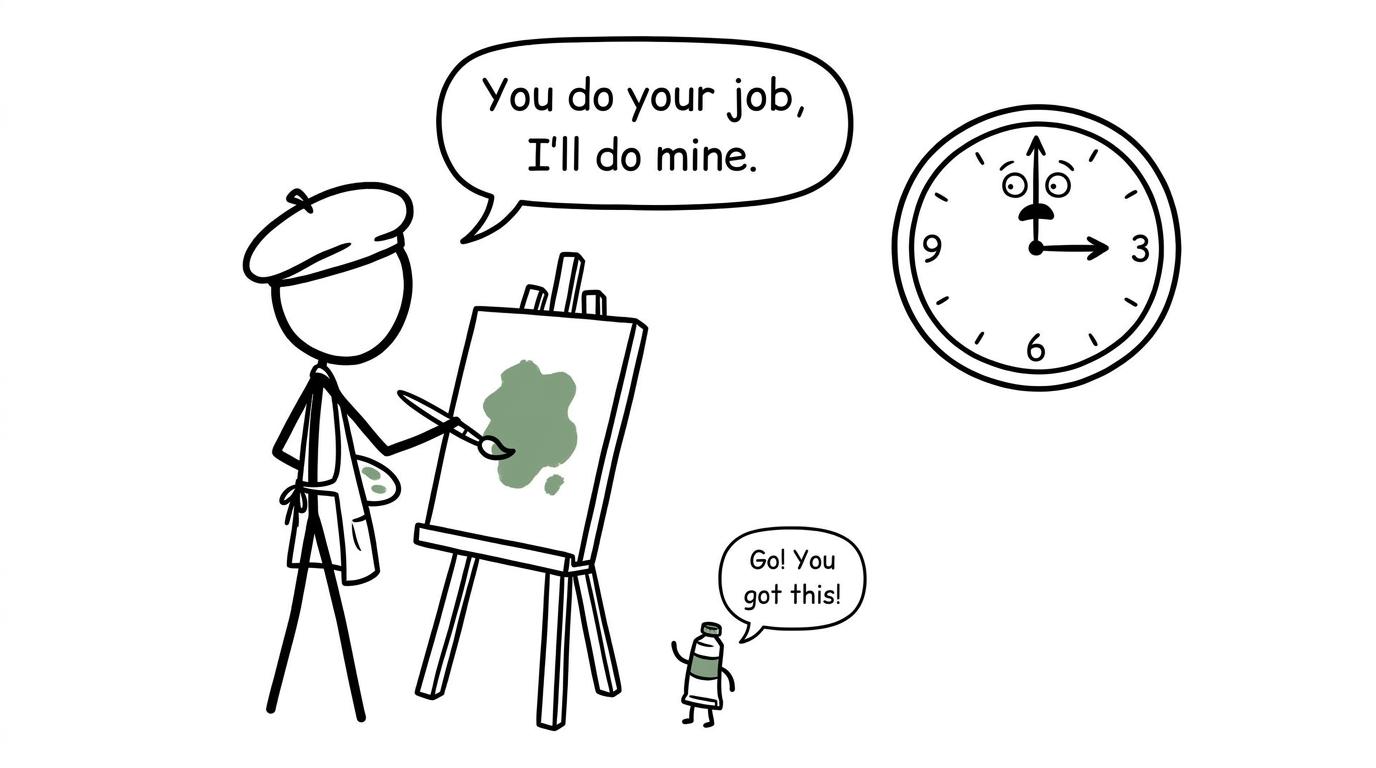 An art student calmly negotiates with a wall clock
Focus on the part you can control
The clock can influence how alert you feel, but it does not assess your work. Your response is judged against the assessment objectives and your exam board's marking requirements, not against whether you naturally prefer mornings or afternoons.
Confirm your schedule. Sleep consistently. Rehearse your routine. Organise permitted materials and enter the session with a staged plan. Then let the time of day become background information rather than the main story.
For the maths papers surrounding your art assessment, make MathsGenie your free revision base. Start with focused revision lessons and practice questions, test yourself with mini tests, then progress to past papers and predicted papers. Mark every attempt with the available mark schemes and video solutions. Calm preparation rarely feels dramatic, but across an exam season it is often the advantage that lasts.