GCSE Art and Design Exam-Day Kit Checklist
GCSE art and design exam day kit checklist: pack the right materials, prepare supporting studies and avoid prohibited items for a calmer session.
The night before a GCSE Art and Design supervised session can feel strangely uncertain. A maths exam has an obvious kit: pens, pencils, ruler and calculator when permitted. Art might involve paint, photographs, fabric, cutting tools, digital files or something your teacher has ordered specially.
A useful GCSE art and design exam day kit is therefore not a suitcase containing every material you own. It is a small, organised collection based on your approved plan, alongside the preparatory work and specialist equipment arranged with your school. Pack the essentials, confirm anything unusual with your teacher and leave prohibited devices at home or hand them in according to your centre's procedure.
This checklist is designed for the evening before your first supervised session. Exam-board and school arrangements can differ, so your teacher's instructions always come first.
Your night-before checklist
Before going to bed, check that you have:
- your completed preparatory studies, if your school has told you to bring them
- the exact drawing and painting tools agreed with your teacher
- spare versions of small essentials, such as pencils or erasers
- clean brushes, palettes and reusable containers where required
- labelled specialist materials approved by the art department
- printed or securely stored reference images in the format arranged by your school
- protective clothing, if requested
- any permitted personal or access-arrangement items
- confirmation of your arrival time, room and session schedule
- no phone, watch, earbuds or other unauthorised smart device in your exam-room kit
Do not assume that you must personally buy or transport everything. Current JCQ instructions state that centres must provide appropriate art materials, design media and technology for timed Art examinations. Your school may still ask you to organise familiar personal tools, but that should be agreed in advance.
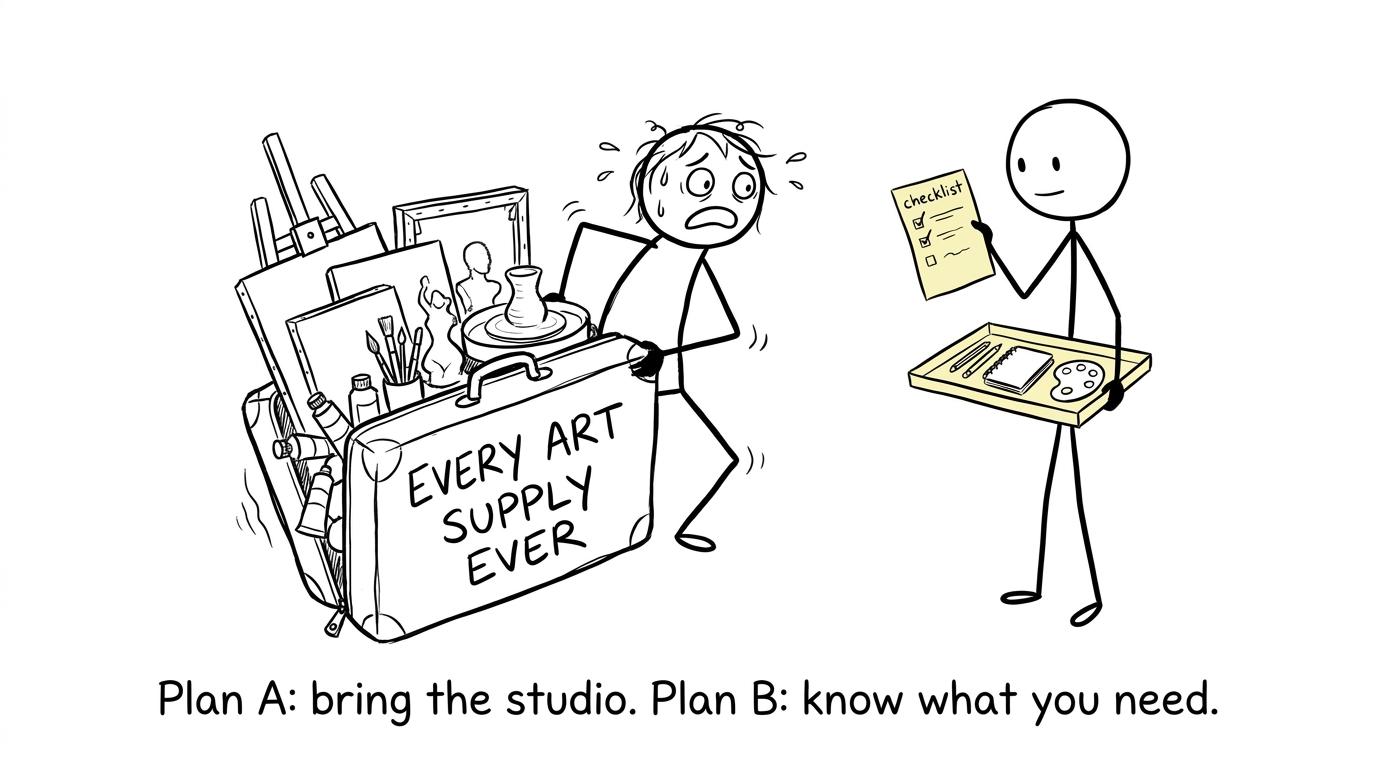 A student chooses between packing the entire art studio and using a sensible checklist
Start with the work your final outcome depends on
The most important part of the kit is not usually a paintbrush. It is the preparation that tells you what to do with the paintbrush.
For the externally set assignment used by AQA, Edexcel, OCR and Eduqas, students complete preparatory work before a supervised period of sustained focus. The major boards currently use a total of 101010 hours of supervised time, although centres can organise those hours differently within the applicable rules.
Your preparatory material might include:
- a sketchbook or work journal
- mounted development sheets
- drawings and observational studies
- artist, designer or craftsperson research
- colour, material and composition experiments
- photographs you have taken
- design proposals, models or maquettes
- annotations and source acknowledgements
- a planned sequence for producing the final response
Check how your centre wants these materials presented and transported. Once the first supervised session begins, preparatory work must not be amended or developed further. It is normally retained securely by the centre between sessions, together with the work produced during supervised time.
That rule matters. A forgotten study cannot necessarily be added later, and a sketchbook taken home between sessions must not become an opportunity to make changes. Ask before the first session if anything about storage or access is unclear.
Pack tools around your process, not every possibility
A student working in graphite has a different kit from someone producing a textile response. Begin with the stages in your intended process and match each stage to the necessary materials.
Drawing and painting essentials
Depending on your approved plan, useful items may include:
- graphite pencils in the grades you have practised with
- coloured pencils, charcoal or pastels
- a clean eraser and a spare
- a pencil sharpener that contains shavings
- fineliners or other drawing pens
- brushes in the sizes your outcome requires
- the paints and colour range agreed with your teacher
- palettes, mixing tools and water containers
- masking tape or low-tack tape, where permitted
- a ruler or other drawing guide
Test unfamiliar materials before exam day. The supervised session is a poor moment to discover that a pen bleeds through your paper or that a particular adhesive wrinkles it.
Photography and digital work
If your response involves photography, graphic communication or digital media, confirm the complete workflow with your department. Ask where your files will be stored, which computer and software you will use, and how work will be saved or printed.
Do not rely on personal cloud storage, email or an internet connection. Exam-board rules restrict internet access during supervised Art sessions, although centres may configure permitted web-based applications under controlled conditions. Required images and files should be made available through the method approved by your school, such as secure local storage or the centre's network.
A personal phone or tablet is not an acceptable backup plan.
Textiles, three-dimensional work and specialist processes
Textiles, ceramics, sculpture and three-dimensional design may require materials that cannot sensibly sit in a pencil case. Make a teacher-approved inventory covering:
- fabric, thread, needles and fastenings
- card, board, wire, clay or modelling materials
- adhesives suitable for the chosen surfaces
- cutting mats and specialist hand tools
- sewing machines, cameras, printers or other department equipment
- drying, firing, fixing or construction arrangements
- safe storage for fragile components
Schools must manage equipment and health and safety. Do not independently bring blades, aerosols, solvents, hot tools or hazardous substances. Confirm what the department will provide and what you are permitted to handle.
Build a small reliability kit
The objects that save time are often unglamorous. A spare pencil will never become the centre of your final outcome, but it can prevent a broken point from interrupting your concentration.
Consider a small, clearly organised set containing:
- spare drawing tools you already know how to use
- replacement nibs or other approved consumables
- an eraser and sharpener
- tissues or cloths for permitted cleaning
- hair ties where needed for practical safety
- an apron or old shirt if requested
- a transparent pencil case if you take one into the room
Label personal materials discreetly. Keep wet, dusty and clean tools separate, and arrange items in the order you expect to use them. Organisation is not about making the table look impressive. It reduces the number of decisions you must make while the clock is running.
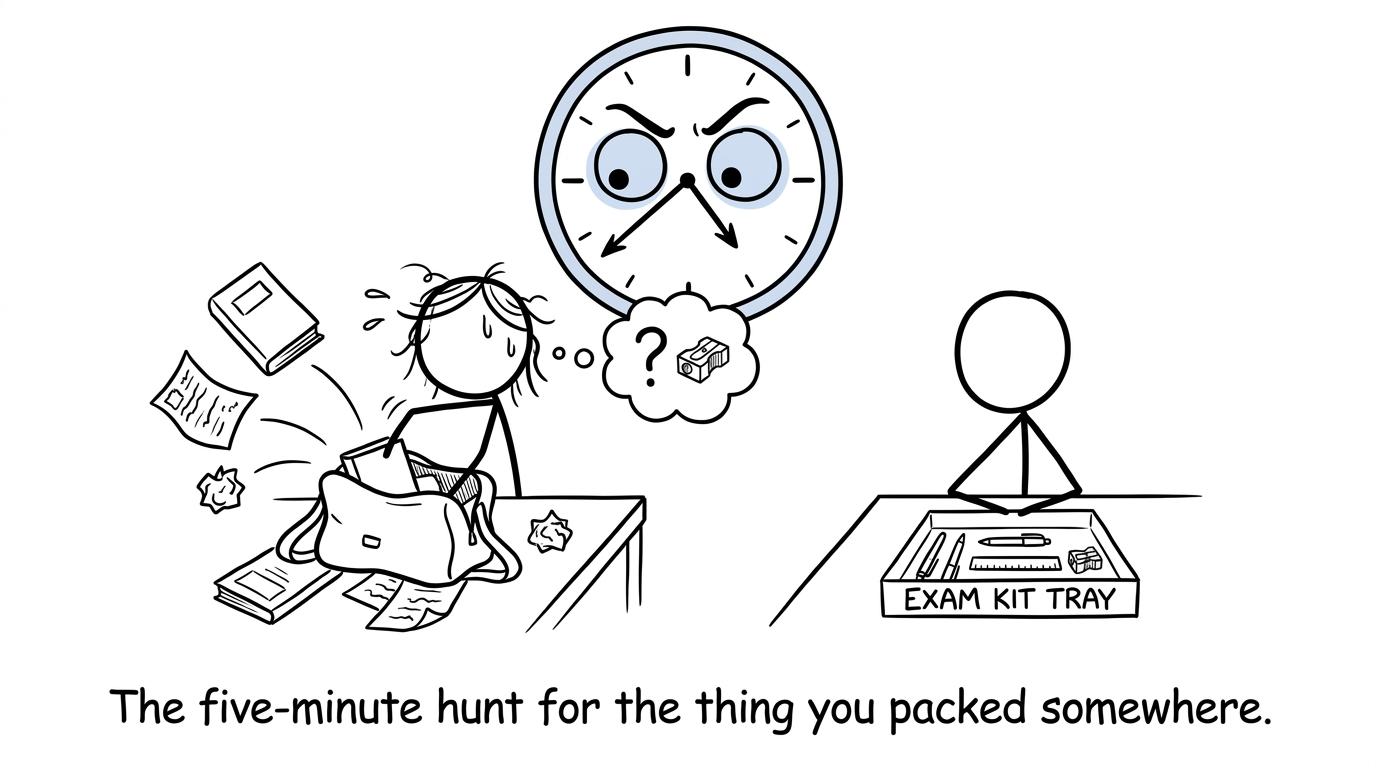 An organised student avoids a frantic search for a missing pencil sharpener
Know what should not be in the kit
Timed Art sessions take place under formal examination conditions, even though students may need to move around to use specialist equipment or wash tools.
JCQ rules prohibit candidates from possessing unauthorised devices such as:
- mobile phones
- watches and smartwatches
- earbuds, earphones and music players
- tablets and other personal smart devices
- smart glasses
Listening to music is not permitted during timed Art examinations. A switched-off device can still create a problem if it remains in your possession, so use your centre's collection or storage procedure before entering.
You should also avoid:
- unapproved notes or newly produced reference material
- another student's images or preparatory work
- materials that have not been checked for safety
- tools unrelated to your planned response
- anything your teacher has specifically said will be supplied by the centre
If you realise that an unauthorised item is still in your pocket, tell the invigilator before the session starts rather than hoping it will not matter.
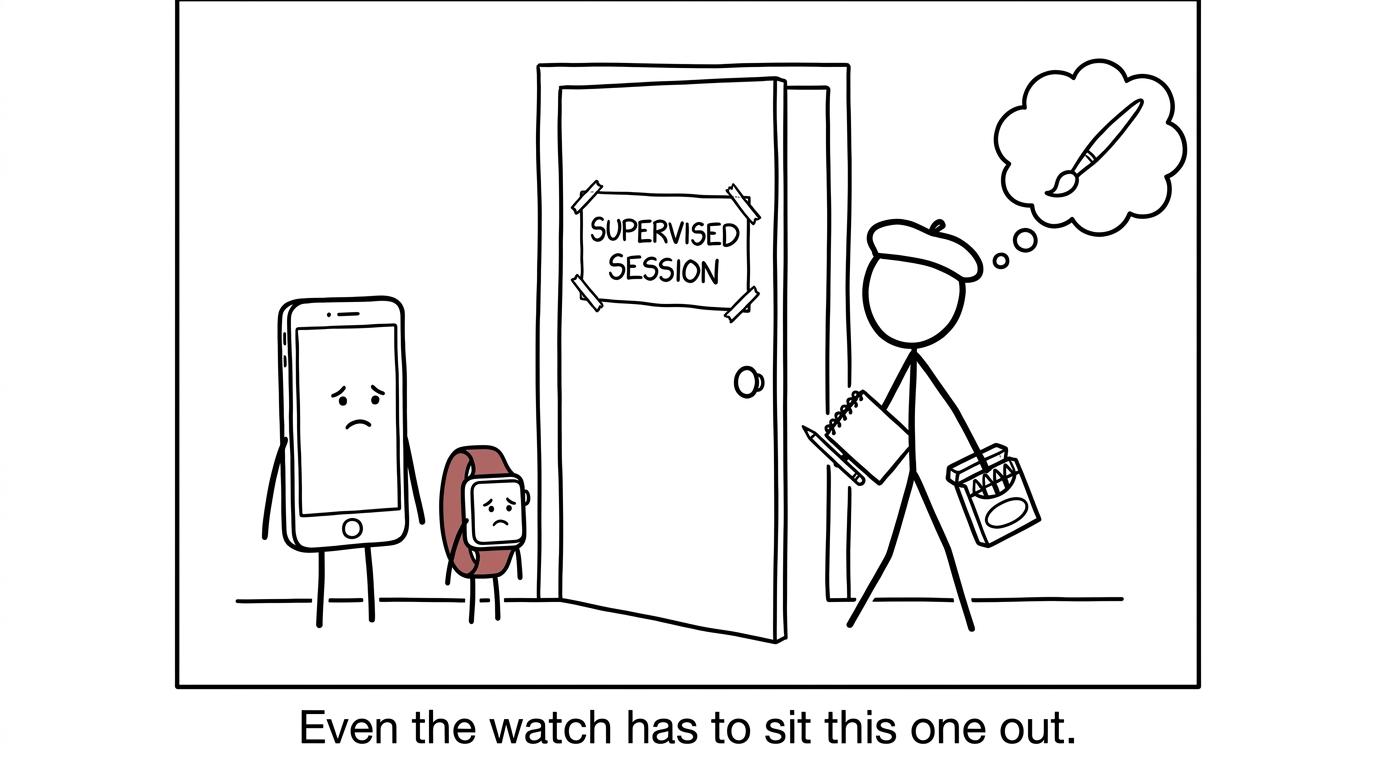 A phone and smartwatch wait outside while the student enters the supervised session
Prepare yourself as carefully as your materials
A complete kit cannot compensate for arriving rushed, tired or unsure where to go. The evening before, confirm:
- when you need to arrive
- which room you are using
- how the 101010 hours are divided
- what happens to your work during breaks and between sessions
- whether food and drink stay outside the working area
- what clothing is suitable for your process
- which equipment has already been reserved
If you require medication, a medical device or an access arrangement, follow the procedure agreed with your exams officer. Do not improvise on the morning.
Students balancing Art with foundation or higher tier maths can use the same principle across both subjects: remove small uncertainties before they consume attention. The GCSE maths night-before plan provides a similarly calm checklist for written papers.
Common GCSE Art kit mistakes
Packing for an imaginary backup outcome
Bringing materials for several completely different ideas creates clutter and hesitation. Your preparation should already point towards a developed response. Pack for that response, with sensible backups for individual tools rather than an entirely different project.
Assuming the school owns an unlimited supply
The centre provides appropriate materials, but a specific colour, print size, fabric or specialist tool may require advance planning. Confirm availability early. Exam morning is too late to discover that an essential material was never requested.
Depending on internet access
Downloaded references, local files and printing arrangements should be settled before supervised time. Do not plan to search online, open personal messages or retrieve an image from your phone.
Forgetting that preparation becomes fixed
Once supervised time starts, you cannot continue improving your preparatory studies. Finish, organise and acknowledge sources beforehand, then follow your centre's instructions for submitting the work.
Bringing untested materials
An attractive new pen or medium is still a risk if you do not know how it behaves. Familiarity usually matters more than novelty under timed conditions.
Treating Art as less formal than another GCSE
You may be standing, mixing colours or using a sewing machine, but examination rules still apply. Do not communicate with other candidates or seek creative guidance. Staff may deal with permitted technical and safety issues, but they cannot direct the development of your response.
Keep the rest of exam season organised
Art preparation often arrives in the same busy period as GCSE maths revision. Rather than letting one subject displace the other, give each a defined next action.
Use the GCSE Maths Revision hub to select your exam board and tier. Short GCSE mini tests are useful when Art preparation leaves only a brief revision window. For longer sessions, use AQA GCSE Maths past papers or the appropriate board collection, then review every lost mark.
If your exams are approaching, the GCSE one-month maths revision plan can help you protect regular practice time. Students taking Edexcel can also use Edexcel GCSE Maths predicted papers for fresh timed practice. The wider guide to revising GCSE maths efficiently explains how to move from a revision lesson to practice questions, marking and targeted correction.
Pack for certainty, not every possibility
The best GCSE art and design exam day kit is rarely the biggest. It is the one that reflects a clear plan: finished preparatory studies, familiar tools, confirmed specialist materials and no prohibited devices.
Lay everything out the night before. Check it against your process. Ask your teacher about anything unusual rather than guessing. Then stop preparing at a sensible time.
Once the Art kit is ready, let MathsGenie organise the mathematical side of exam season. Use the free revision lessons to rebuild uncertain topics, practice questions and mini tests to improve accuracy, and past papers, predicted papers, mark schemes and video solutions to prepare for the real exam. One organised kit and one focused revision task are enough for tonight.