GCSE Arabic Weekend Revision: A Two-Day Plan
GCSE Arabic weekend revision: build a calm two-day plan for listening, speaking, reading and writing while keeping your GCSE maths revision on track.
The final weekends before an exam can feel strangely expensive. Every hour given to Arabic seems to be taken from maths, science or English. Then indecision consumes the time that revision was meant to protect.
A useful GCSE Arabic weekend revision routine solves that problem early. Divide the weekend between the four assessed language skills, practise under exam conditions, review mistakes on the same day and leave a protected block for GCSE maths. You do not need to revise everything. You need to identify what is costing you marks and act on it.
For the current Pearson Edexcel GCSE Arabic qualification, listening, speaking, reading and writing each contribute 25%25\%25% of the qualification. Foundation and Higher papers have different demands, but students must be entered for the same tier across all four papers. Check your statement of entry and use materials for your exact qualification because International GCSE Arabic has a different assessment structure.
Your weekend revision checklist
Before Saturday morning, prepare the following:
- your exam board, qualification and tier details
- one appropriate Arabic past paper or set of exam-style tasks
- the corresponding audio, transcript and mark scheme where available
- a vocabulary list organised by theme
- an error log divided into listening, speaking, reading and writing
- a timer, headphones and a quiet place to work
- a separate maths task chosen before the weekend begins
Keep the maths decision simple. Use the GCSE Maths revision hub to select your board and tier, then choose one weak topic or a short paper. Making this decision on Friday prevents Saturday morning from becoming an hour of browsing.
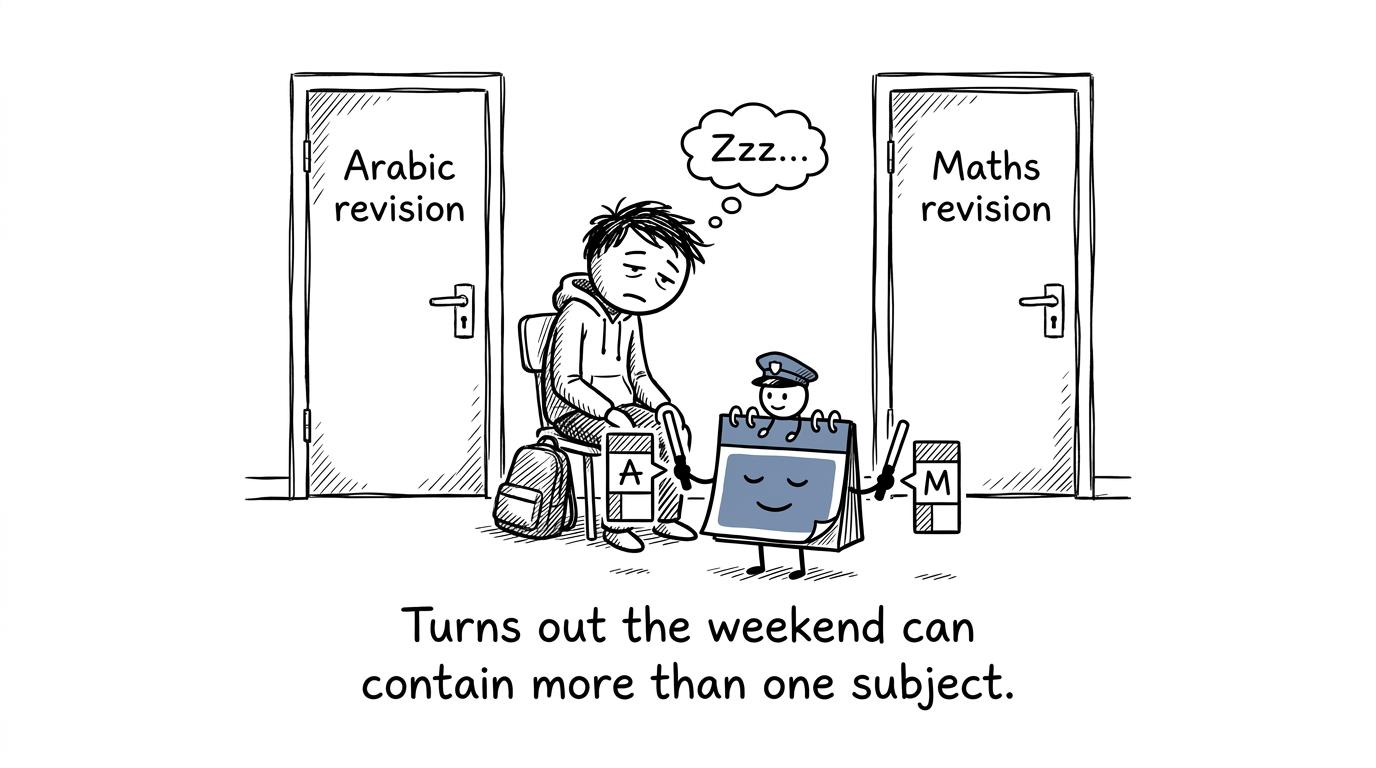 A student fitting Arabic and maths into calm weekend blocks
Start by checking the exam you will actually sit
The regulated Pearson Edexcel GCSE Arabic qualification currently contains four compulsory components: listening, speaking, reading and writing. Each is externally assessed, although the speaking test is conducted by a teacher and submitted for external marking.
The papers also test different behaviours. Listening involves understanding standard spoken Arabic. Speaking includes a role play, questions based on a picture stimulus and a conversation. Reading includes responses to Arabic texts and a translation into English. Writing requires extended responses and translation into Arabic.
This matters because “revise Arabic” is not a usable instruction. “Practise extracting detail from a Higher listening recording” is. The smaller and more precise the instruction, the easier it is to begin.
Do not assume that an Arabic qualification follows the same board options as GCSE maths. Maths students may take Edexcel, AQA, OCR or Eduqas, while the Arabic course described here is Pearson Edexcel GCSE Arabic. If your entry says International GCSE or another qualification, follow that specification and its timings instead.
Saturday morning: diagnose before you revise
Begin with a short, closed-book diagnostic rather than reading vocabulary lists. Retrieval practice requires you to bring information back from memory, which makes it useful both for learning and for finding gaps. Spacing those retrieval attempts across Saturday and Sunday is more productive than one uninterrupted session of rereading.
Use a focused diagnostic block
Spend approximately 757575 to 909090 minutes on three activities:
- complete a short listening section without pausing the recording
- answer a reading passage under a time limit
- plan or record a brief speaking response without using a script
Mark what can be marked and classify each difficulty. Was the problem unknown vocabulary, slow recognition, misunderstood instructions, weak grammar, spelling, pronunciation or time pressure?
Your result should be a short repair list, not a vague judgement about whether you are “good at Arabic”. Limit it to three priorities. A list of twenty weaknesses creates anxiety; three priorities create a plan.
This diagnostic principle works just as well in maths. The GCSE maths self-assessment resources can reveal which topics deserve your separate weekend maths block.
Saturday afternoon: repair vocabulary and receptive skills
After a proper break, return to the weaknesses exposed that morning. This session should concentrate on listening and reading because both depend on recognising language accurately and quickly.
Revise vocabulary through retrieval
Choose vocabulary from the themes and topics listed in your specification, particularly words you failed to recognise in the diagnostic. Then use a four-step cycle:
- cover the Arabic and recall it from the English meaning
- reverse the direction and recall the English meaning from Arabic
- say the Arabic word or phrase aloud
- use it in a short sentence or response
Sort words into “secure”, “uncertain” and “unknown”. Spend most of your time on the last two groups. Copying familiar words can feel smooth, but smooth work is not always useful work.
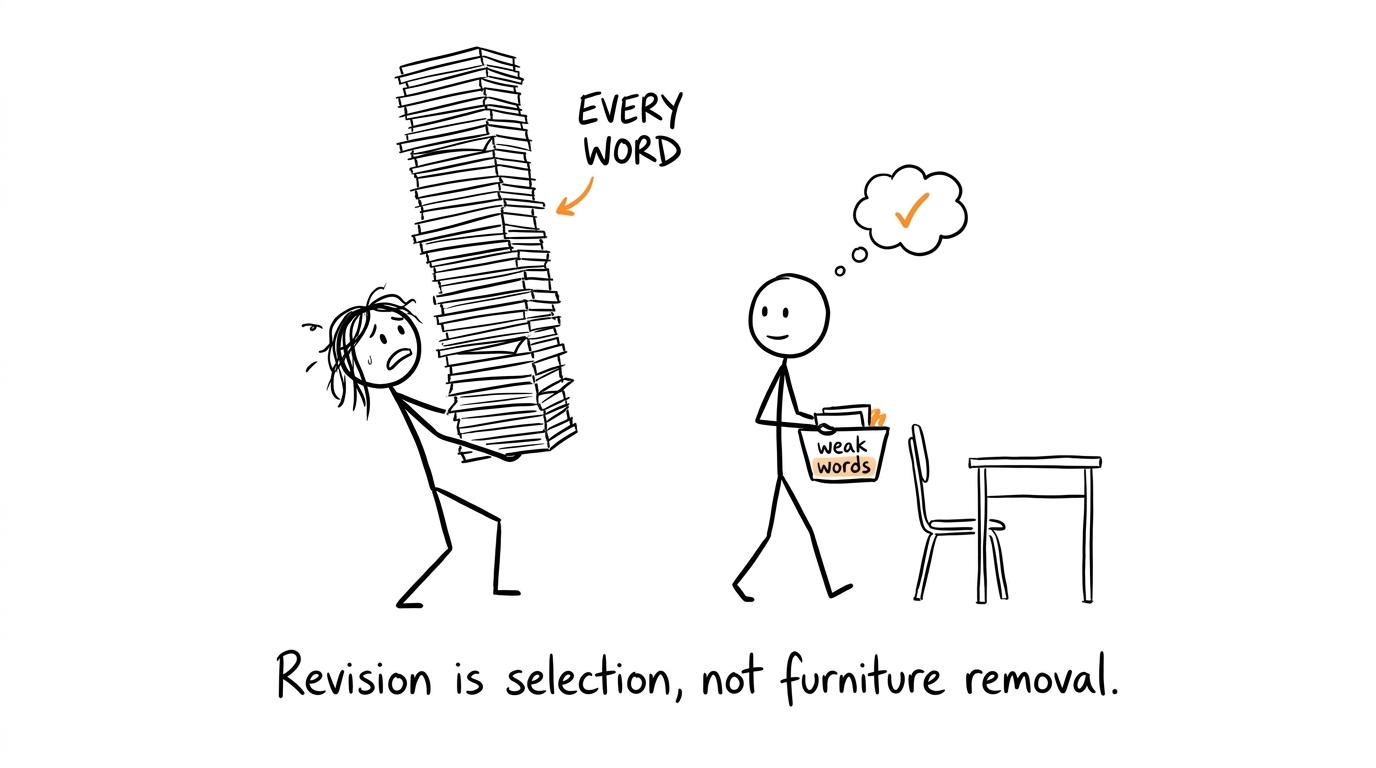 One student carrying every word while another selects weak vocabulary
Train listening as an exam skill
Listening practice should include one uninterrupted attempt. That is the only way to expose difficulties with pace, concentration and moving between questions.
After marking, replay only the sections that caused problems. Use the transcript if one is available and identify the precise obstacle: a missed negative, an unfamiliar synonym, a number, a tense or an answer written in the wrong language. Then listen again without the transcript.
For reading, underline the instruction words before reading the passage closely. Notice whether the response must be in English, Arabic or a non-verbal form. Locate evidence rather than translating every word. An unfamiliar expression does not automatically prevent you from understanding the writer’s main point.
Saturday evening: protect a short maths session
Arabic should not swallow the entire weekend, particularly when GCSE maths examinations are also approaching. A focused maths session of 454545 minutes is enough to keep another subject moving without exhausting you.
Choose one of these options:
- a revision lesson followed by targeted practice questions
- a short mixed test
- one half of a timed paper
- corrections from a paper completed earlier in the week
MathsGenie’s GCSE Maths 454545-minute tests are useful when a full paper would be too much after language revision. If you are preparing for Edexcel, the Edexcel GCSE Maths past papers place papers and mark schemes together.
Finish by recording one or two exact maths errors. “Algebra” is too broad. “Changed a sign incorrectly when rearranging” gives your next session a clear starting point.
Sunday morning: practise productive Arabic
Writing and speaking are productive skills: you must generate language rather than recognise it. They improve through producing an answer, checking it and producing a better one.
Build speaking flexibility
Practise a role play, a picture-based task and short conversation questions in the order used by your specification. Record your answers so that you can hear hesitation, repetition and unclear pronunciation.
Avoid memorising one long response that only fits one question. Prepare adaptable building blocks instead:
- opinions with reasons
- references to past, present and future time
- questions suitable for role-play situations
- connectives that extend an answer naturally
- accurate phrases for common themes
The goal is not to sound theatrical. It is to communicate clearly, respond to the question and recover calmly if you forget a word.
Make writing practice measurable
Select a task appropriate to your tier. First plan your content briefly, then write under a time limit without a dictionary, matching the conditions stated in the current GCSE specification.
When checking, separate communication from accuracy. Ask whether you answered every bullet point, expressed opinions, gave reasons and used an appropriate range of structures. Then check agreements, verb forms, spelling and whether your meaning remains clear.
Do not rewrite the entire response merely to make it look tidy. Correct the recurring patterns and add them to your error log. Those patterns are the part worth revisiting next weekend.
Sunday afternoon: complete a timed mixed session
Now combine the weekend’s work. Choose a different listening or reading section and one short productive task. Work without notes and observe the official conditions for your paper.
A practical block is:
- 353535 to 454545 minutes of timed receptive practice
- a 101010-minute break
- 252525 to 353535 minutes of speaking or writing
- 202020 minutes for marking and error analysis
The precise timings can change according to your tier, the paper and how close you are to the exam. The important feature is the sequence: attempt, mark, diagnose and repair.
Mark schemes are not just scorekeepers. They show what the question required. If you lost a mark, write why in one sentence and specify the next action. “Did not know the word” leads to vocabulary retrieval. “Knew it but missed it at speed” leads to listening repetition. “Ignored the final bullet point” leads to instruction checking.
 A determined phone attempting to interrupt a timed revision session
Sunday evening: close the loop without cramming
The final session should be light. Re-test Saturday’s weak vocabulary, speak through two previously difficult questions and read your error log. Stop while you can still concentrate.
Then plan the following week. Schedule brief returns to the material rather than waiting until the next weekend. One vocabulary retrieval, one short listening task and one speaking recording can preserve what you have strengthened.
Do the same for maths. A realistic GCSE maths revision timetable can help you balance topic practice with timed papers. In the final run-up, use official past papers first and treat predicted topics and papers as additional practice, not a promise about what will appear.
Common mistakes in GCSE Arabic weekend revision
Spending the whole weekend making notes
Notes can support revision, but they do not show whether you can retrieve vocabulary, follow a recording or produce an answer under pressure. Begin tasks without notes, then use your materials to repair what failed.
Revising only your favourite skill
Reading may feel safer than speaking, or vocabulary may feel easier than timed writing. The current Pearson Edexcel GCSE gives equal weighting to the four skills, so your routine should not quietly abandon one of them.
Using the wrong paper or tier
Foundation and Higher tasks and timings differ. International GCSE Arabic also differs from GCSE Arabic. Check the paper code, tier and qualification before starting.
Treating every unknown word as equally important
Prioritise vocabulary from the specification, repeated classroom themes and mistakes found in exam practice. Revision is selection. Trying to relearn an entire course in one weekend usually leaves too little time for application.
Marking without changing anything
A score is historical information. Improvement comes from the correction, targeted practice and later re-test. The same is true in maths, which is why using GCSE past papers properly matters more than simply completing many of them.
Finish the weekend with a smaller, stronger list
A successful weekend does not end with every topic completed. It ends with fewer unknowns, clearer error patterns and a plan for the next retrieval attempt.
Use Saturday to diagnose and repair. Use Sunday to produce language, practise under time pressure and revisit what nearly slipped away. Keep one protected maths block so that Arabic revision strengthens your overall exam plan rather than disrupting it.
For that maths block, make MathsGenie your free revision base. Start with revision lessons and practice questions, move into mini tests and past papers, then use mark schemes, video solutions and predicted papers to turn mistakes into specific next steps. Open the GCSE Maths revision hub, choose your board and tier, and decide now what your next weekend session will contain.