

GCSE Arabic vs GCSE Modern Hebrew: Which to Pick?
GCSE Arabic vs GCSE Modern Hebrew compared by papers, skills, scripts and support. Choose the language that best fits your experience and strengths.
Choosing a GCSE language can feel strangely permanent. You are not simply picking a timetable box; you are choosing the vocabulary, grammar and speaking practice that will share space with maths, English and science for the next two years.
The short answer to GCSE Arabic vs GCSE Modern Hebrew is that neither qualification is automatically easier. Both assess listening, speaking, reading and writing, with each skill contributing 25%25\%25% of the qualification. The better choice is usually the language you already understand more confidently, can practise regularly and can study with reliable teaching and exam support.
Before choosing, check:
- your current speaking, listening, reading and writing ability
- whether you can read and write the relevant script accurately
- which course and exam board your school actually offers
- the quality of teaching and speaking practice available
- whether you can access suitable past papers and feedback
- how the subject will fit beside your GCSE maths revision
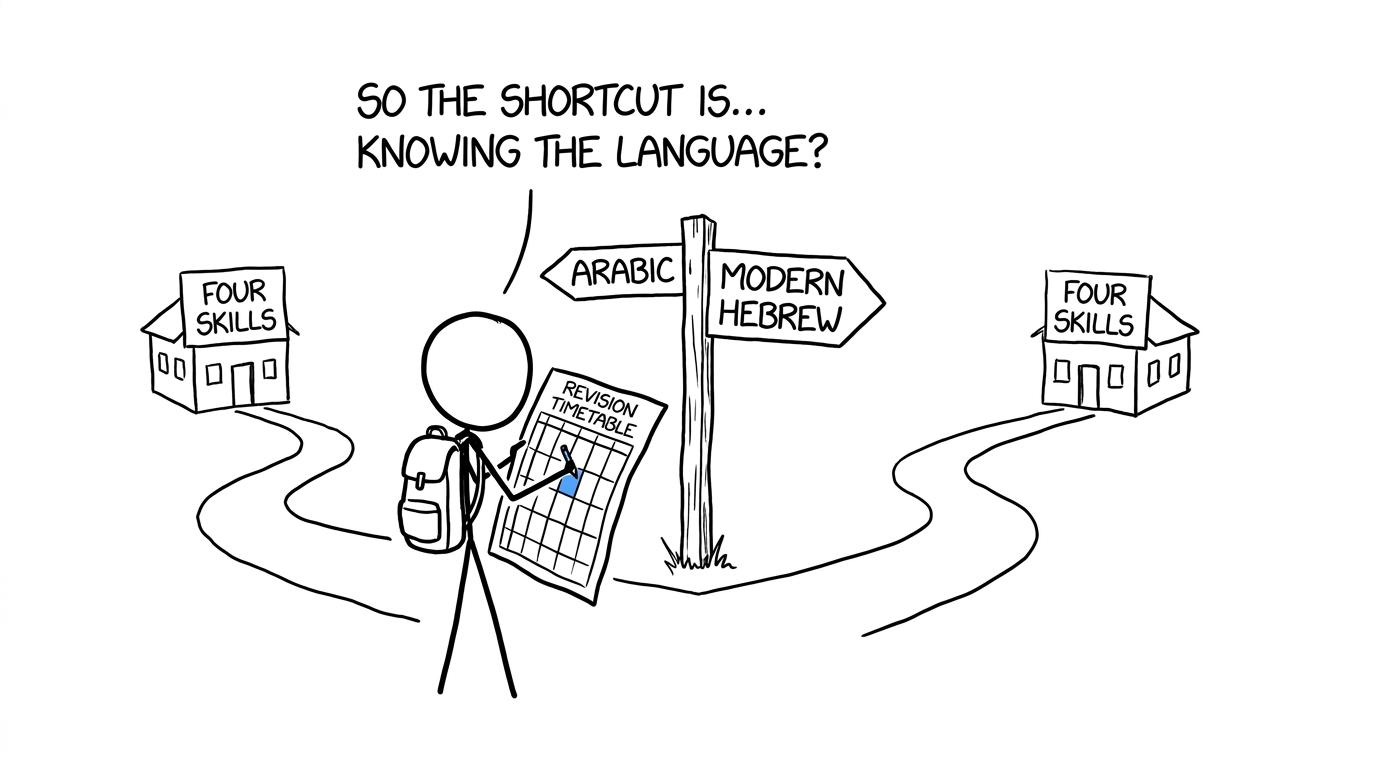 A student discovers that both language routes lead to four assessed skills
GCSE Arabic vs GCSE Modern Hebrew at a glance
For the current qualifications commonly available in England, GCSE Arabic is offered by Pearson Edexcel under specification code 1AA01\text{AA}01AA0, while GCSE Modern Hebrew is offered by AQA under code 867886788678. Your school or examination centre must confirm the qualification for your particular exam series.
| Feature | GCSE Arabic | GCSE Modern Hebrew |
|---|---|---|
| Current exam board | Pearson Edexcel | AQA |
| Main specification | 1AA01\text{AA}01AA0 | 867886788678 |
| Assessed skills | Listening, speaking, reading and writing | Listening, speaking, reading and writing |
| Weighting | 25%25\%25% per skill | 25%25\%25% per skill |
| Tiers | Foundation and higher | Foundation and higher |
| Foundation grades | Grades 111 to 555 | Grades 111 to 555 |
| Higher grades | Grades 444 to 999 | Grades 444 to 999 |
| Writing direction | Right to left | Right to left |
| Qualification structure | Linear | Linear |
Both qualifications require all four assessments to be taken at the same tier and in the same exam series. That makes your tier decision important. Foundation tier targets grades 111 to 555, while higher tier targets grades 444 to 999. A student should not choose higher simply because it sounds more ambitious; the right tier is the one that gives them the best opportunity to demonstrate what they know.
What the two GCSEs have in common
The similarities are more important than they first appear. In both subjects, being able to chat informally is useful, but it is not the complete qualification.
You must be able to:
- understand spoken language at exam speed
- respond clearly during a speaking assessment
- read unfamiliar passages and identify key details
- communicate facts, ideas and opinions in writing
- apply vocabulary and grammar accurately
- translate short material between English and the assessed language
Both courses also cover familiar GCSE language contexts. These include identity, family life, technology, free time, local areas, travel, education, future plans, employment and wider social or global issues. The themes are organised differently by Edexcel and AQA, but the practical demand is similar: you need language that works beyond one narrow setting.
This is why fluency in family conversation should not be mistaken for complete exam readiness. A heritage speaker may have excellent listening skills but need focused work on spelling, formal writing, translation or grammatical terminology. Conversely, a careful classroom learner may write accurately but need much more spontaneous speaking practice.
How the assessment formats differ
The four-skill structure is shared, but the precise paper timings and task formats are not identical.
Under the current published Pearson Edexcel Arabic specification, listening lasts 353535 minutes at foundation and 454545 minutes at higher, including reading time. Reading lasts 505050 minutes at foundation and 656565 minutes at higher. Writing lasts 808080 minutes at foundation and 858585 minutes at higher.
Under AQA Modern Hebrew, listening lasts 353535 minutes at foundation and 454545 minutes at higher, including reading time. Reading lasts 454545 minutes at foundation and 606060 minutes at higher. Writing lasts 606060 minutes at foundation and 757575 minutes at higher.
Both speaking assessments use structured tasks and a general conversation, with longer overall speaking time at higher tier. Exact instructions, preparation arrangements and task wording should always be checked against the current specification and information supplied by your centre.
These timing differences should not decide the subject by themselves. A shorter paper is not necessarily an easier paper. What matters is whether you can complete its particular tasks accurately and at a sustainable pace.
 An invigilator becomes confused by right-to-left writing
Which language fits your existing experience?
Choose GCSE Arabic if your Arabic is broader and more secure
Arabic may be the stronger option if you regularly hear or speak it, already read Arabic script and can develop accurate written responses in the form required by the specification.
However, everyday spoken Arabic can vary across regions and communities. Familiarity with a home variety is valuable, particularly for listening and speaking, but you must still prepare for the vocabulary, structures and written conventions expected by the Edexcel course. Ask a teacher to assess all four skills rather than relying on conversational confidence alone.
Arabic is likely to suit you if you can:
- read unfamiliar Arabic text without depending entirely on context
- write legibly and accurately under time pressure
- move beyond familiar home conversations
- express and justify opinions across several GCSE themes
- access a teacher who understands the Edexcel assessment
Choose GCSE Modern Hebrew if it is your stronger working language
Modern Hebrew may be the better choice if you use it at home, school or in your community and can already read and write its script with reasonable accuracy.
The AQA course requires more than recognition of common words. You need to handle different time frames, express views, translate, respond to unfamiliar material and use grammar appropriate to your tier. A strong foundation in reading can be particularly helpful, but speaking and listening still account for half of the qualification together.
Modern Hebrew is likely to suit you if you can:
- follow spoken Modern Hebrew across familiar topics
- read unvowelled everyday text at an appropriate level
- form accurate written sentences independently
- discuss school, relationships, travel, social issues and future plans
- obtain regular feedback aligned with AQA mark schemes
A practical way to make the decision
Do not choose by reputation. Gather evidence.
Ask your school for a short diagnostic in each language you could realistically take. It should sample all four skills rather than testing vocabulary alone. Then record each area as secure, developing or currently weak.
Consider these questions:
- Which language can I understand when the speaker is unfamiliar?
- In which script can I write most accurately without copying?
- Which language lets me explain and justify an opinion?
- Where can I get regular speaking feedback?
- Which course has dependable teaching and exam entry arrangements?
- Which option requires the smaller realistic improvement over two years?
The final question matters. Students sometimes choose the language with the strongest emotional connection even when they have little access to formal teaching. That connection can be excellent motivation, but motivation needs a system around it.
Availability may settle the issue. A school may offer one qualification but not the other, and private candidates must find a centre willing and able to conduct the speaking assessment. Confirm entry, tier, fees and assessment arrangements directly with the school or centre before building a revision plan.
Balance language preparation with GCSE maths
A second subject becomes difficult when it consumes revision time unpredictably. Protect your maths by giving language practice a repeatable place in the week rather than allowing it to expand whenever an assessment approaches.
Use the MathsGenie revision planner to map lessons, language speaking sessions and maths practice. A useful pattern is frequent short language retrieval alongside two or three protected maths blocks.
For maths, begin by identifying genuine gaps rather than revising comfortable topics. The guide to finding your weakest GCSE topics explains how to turn lost marks into a focused list. You can then use Edexcel GCSE Maths mini tests for short checks without sacrificing an entire evening.
As exams approach, move towards realistic paper practice. The GCSE past-paper method shows how to attempt, mark, fix and retest rather than merely collecting scores. Edexcel students can use GCSE Maths past papers with mark schemes, followed later by Edexcel predicted papers.
This approach creates boundaries. Language revision receives regular attention, while maths remains active through lessons, practice questions, mini tests and timed papers.
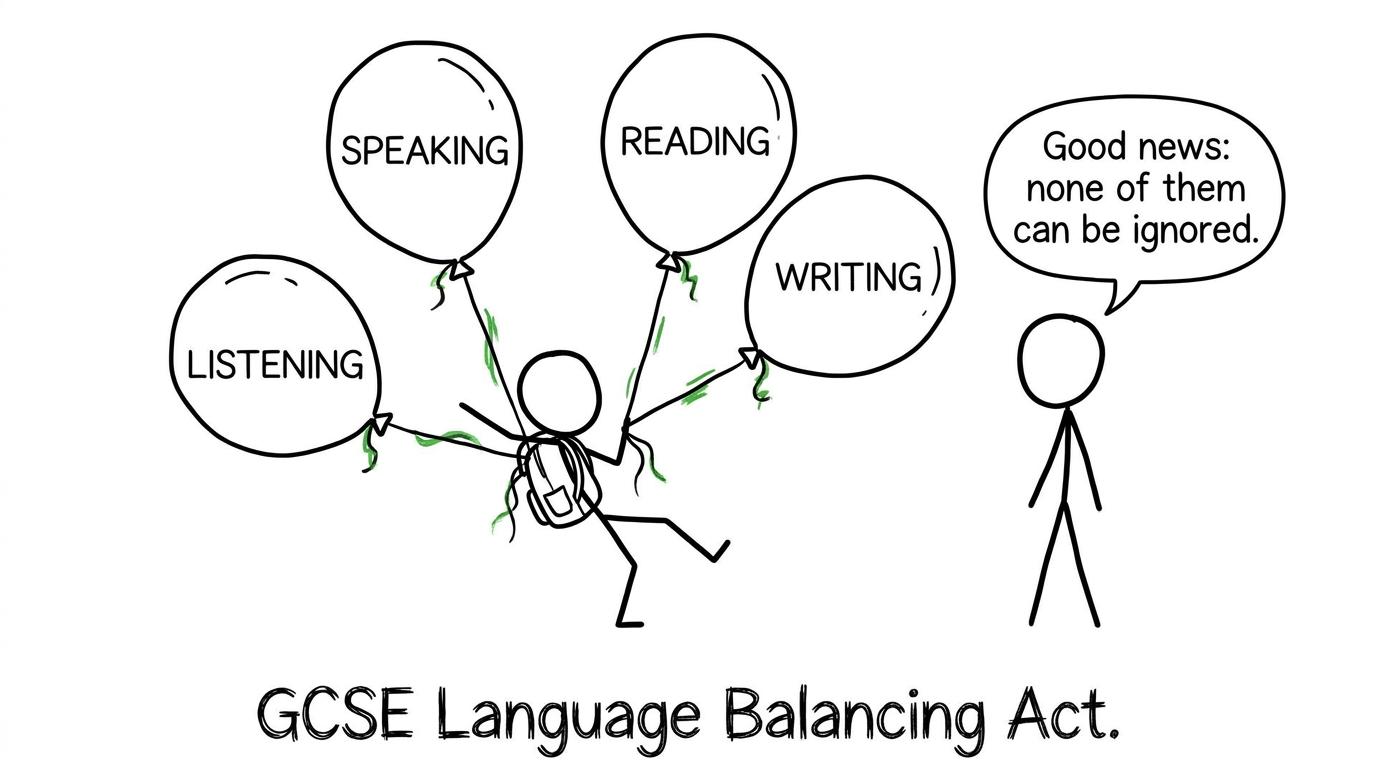 A student attempts to balance four equally important language skills
Common mistakes when choosing between the subjects
Assuming a home language guarantees a top grade
Listening and informal speaking are only part of the course. Reading accuracy, formal writing, translation and exam technique still require deliberate preparation.
Choosing according to which script looks easier
Both scripts become more manageable with practice. The more useful question is which one you can already read and produce accurately at speed.
Ignoring the exam board
Edexcel Arabic and AQA Modern Hebrew do not use identical papers. Revise from the correct specification, sample assessments and mark schemes.
Comparing friends' grades
A friend's result reflects their language background, teaching and preparation. It does not establish that one language is universally easier.
Failing to confirm speaking arrangements
Speaking contributes 25%25\%25% of either GCSE. Private candidates in particular should confirm that a centre can administer the complete qualification before committing to it.
Letting one option crowd out maths revision
A language GCSE can be rewarding, but it should sit inside a balanced timetable. Use MathsGenie's GCSE maths topics by board and tier to keep your maths work aligned with Edexcel, AQA, OCR or Eduqas rather than revising randomly.
Make the choice from evidence, not rumours
GCSE Arabic and GCSE Modern Hebrew demand the same four broad skills and give each equal weight. The meaningful differences are your starting knowledge, the script and grammar you can use accurately, the assessment details of Edexcel or AQA, and the support available to you.
Choose the language in which you can build balanced performance, not merely the one in which you know the most everyday phrases. Ask for a diagnostic, inspect the correct sample papers and confirm the entry arrangements with your centre.
Then protect the rest of your timetable. Start at MathsGenie's free GCSE and A Level maths revision hub and combine revision lessons with practice questions, past papers, predicted papers, mark schemes and video solutions. A sensible subject choice reduces uncertainty; a consistent revision system turns that clarity into marks.










