GCSE Arabic Note Taking: Notes You'll Actually Use
GCSE Arabic note taking made practical: build compact vocabulary, grammar and error notes, then review them using active recall and spaced practice.

A notebook can look productive while doing almost nothing for your memory. Pages fill up. Headings are underlined. Colours multiply. Then revision begins, and the notes are too long, too passive or too difficult to navigate.
Effective GCSE Arabic note taking solves a different problem: it creates material you can retrieve, speak, adapt and correct later. Your notes should not preserve every detail from a lesson. They should help you practise the language without needing the lesson in front of you.
The simplest approach is to keep four connected collections: vocabulary by theme, reusable grammar patterns, prompts for each assessed skill, and an error log. Turn every page into questions, revisit it over several sessions and remove anything that never helps you produce or understand Arabic.
Your GCSE Arabic note-taking checklist
Before exploring the method, here is the whole system in brief:
- Check your exam board, specification and tier.
- Organise notes around specification themes and language skills.
- Record useful phrases and patterns, not isolated words alone.
- Keep vocabulary entries compact and testable.
- Separate rules from exceptions and personal errors.
- Build listening, speaking, reading and writing prompts.
- Close the notes and retrieve before checking.
- Revisit difficult material across several days.
- Use mistakes to decide what enters your notebook next.
- Review notes by using them, not merely rereading them.
The principle resembles good maths revision. A page explaining a method has limited value until you attempt questions without help. MathsGenie's guide to turning GCSE notes into active recall applies the same useful distinction: notes are preparation for retrieval, not a substitute for it.
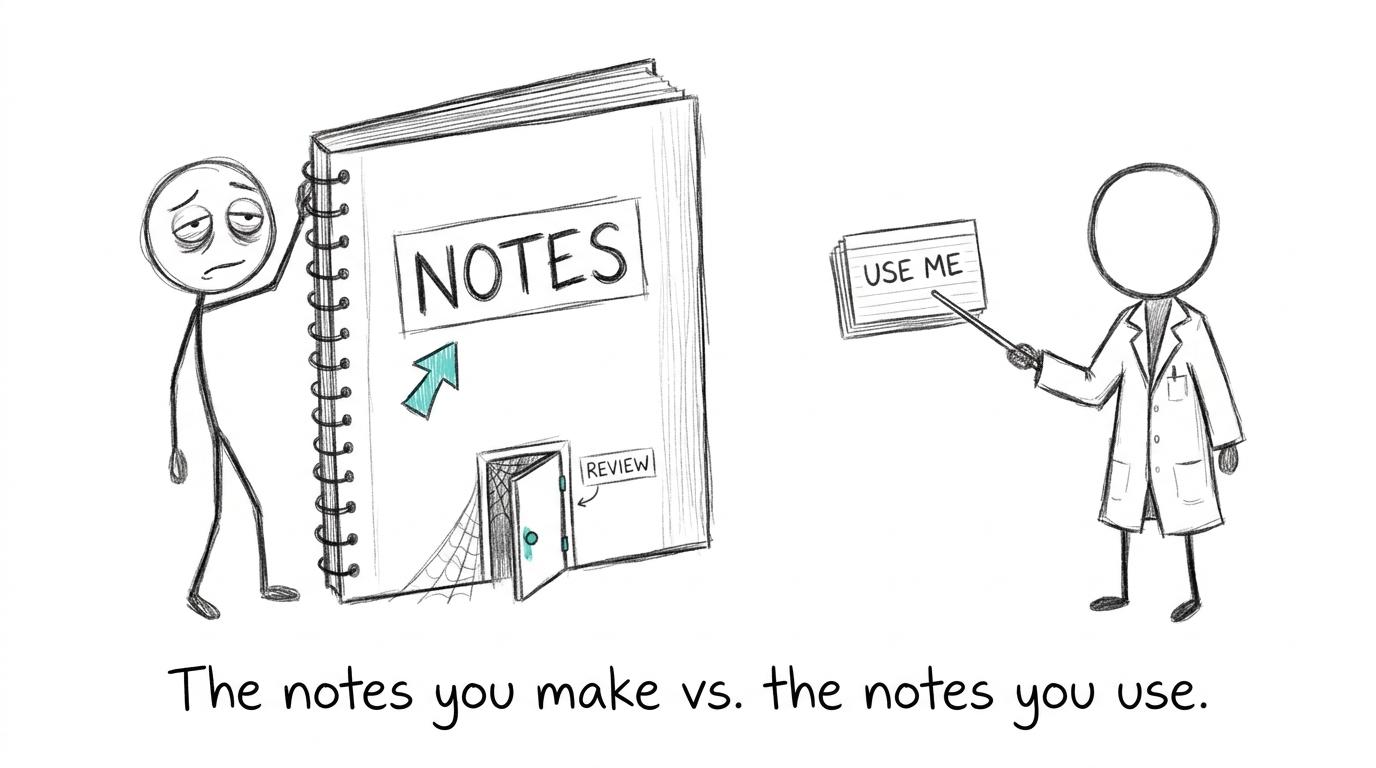 A student discovers that impressive notes still need to be used for revision
Start with the GCSE Arabic assessment
Notes become useful when they reflect what the examination asks you to do.
For students taking Pearson Edexcel GCSE Arabic, specification code 1AA0, the qualification assesses listening, speaking, reading and writing. Each skill contributes equally to the qualification. Papers are available at Foundation and Higher tier, and students are entered for the same tier across all four papers. The specification also states that dictionaries are not permitted in the assessments.
That matters. Notes designed only for recognition will not be enough when you must recall language independently in speaking or writing. Equally, a list of prepared paragraphs will not fully prepare you to understand unfamiliar spoken or written material.
Confirm your own specification with your teacher or awarding organisation before organising everything. Do not assume that a resource labelled simply “GCSE Arabic” matches your board, tier or qualification. International GCSE Arabic, including first-language qualifications, may assess different content and skills.
Once that is clear, create one section for each theme in your specification. Within every theme, leave space for:
- high-value vocabulary;
- verbs and tense patterns;
- opinions and reasons;
- questions you could be asked;
- listening and reading clues;
- writing and speaking prompts;
- recurring errors.
This gives every note an eventual destination. Loose pages stop becoming loose thinking.
Build vocabulary notes for retrieval
Long bilingual lists often feel reassuring because they are easy to copy. They are less reassuring when the English side is covered.
A useful vocabulary entry should contain only information that changes how you understand or use the item. Depending on the word, that might include:
- its meaning;
- gender or plural information;
- the relevant verb form;
- a common companion word;
- the theme in which it is useful;
- a short pronunciation reminder recorded in a form your teacher approves.
Avoid adding every possible detail to every entry. If a note becomes burdensome to review, it will quietly stop being reviewed.
Organise by purpose, not alphabet
Theme-based groups make it easier to retrieve language in an exam context. Within a theme, smaller functional groups are even better: describing, comparing, expressing preferences, giving reasons, referring to time or discussing future intentions.
This organisation also helps you spot gaps. You may know many nouns about school but have few verbs for describing what happens there. You may have several positive opinions but no way to qualify, contrast or justify them.
Make both directions testable
For each vocabulary set, prepare prompts that require recall from English into Arabic and from Arabic into English. The first supports production; the second supports recognition. Add occasional audio prompts recorded accurately by your teacher, course materials or an approved source so that vocabulary does not live only on the page.
Research on learning consistently supports retrieval practice and spacing over repeated passive review. For foreign-language vocabulary, varying the retrieval cue can also be useful. A word should therefore appear through more than one route: meaning, sound, theme, sentence function or question prompt.
Keep grammar notes small and reusable
Grammar notes often fail because they become miniature textbooks. The purpose of your notebook is not to explain the entire Arabic language. It is to help you notice and apply the structures required by your specification.
Give each grammar point a compact page containing:
- the rule in your own clear wording;
- the form or pattern you need to recognise;
- when you would use it;
- any important limitation or exception;
- two or three retrieval questions;
- a reference to an exercise where you applied it.
Do not copy a rule you cannot explain. Ask your teacher to resolve uncertainty before the wording settles into memory.
A separate “patterns I confuse” section is valuable. Arabic grammar involves relationships between words, so a correction should identify the relationship that went wrong rather than merely preserve the corrected answer. Label whether the issue involved agreement, tense, word order, spelling, register or another precise feature from your course.
The same diagnostic habit supports maths. MathsGenie's guide to finding your weakest GCSE topics shows why a precise label is more actionable than writing “revise more”.
Make notes for all four language skills
A balanced notebook should not become a writing folder with three neglected sections.
Listening notes
Record signals that help you follow meaning: time references, negatives, changes of opinion, contrasts, question words and sounds you repeatedly mishear. After listening practice, note the smallest cause of each mistake. “Did not know the word” and “knew it on paper but did not recognise the sound” require different fixes.
Speaking notes
Use cue cards containing questions, themes and brief planning prompts rather than complete scripts. Full memorised answers can become fragile when the examiner changes the wording. Your prompts should encourage you to retrieve an idea, select suitable language and respond naturally.
Include a small bank of repair strategies approved by your teacher, plus reminders to answer the actual question, justify opinions and use more than one time frame where the task requires it.
Reading notes
Collect useful clues rather than copying whole passages. These may include connectives, negatives, unfamiliar-word strategies and phrases that signal attitude or time. Record why an answer was wrong: vocabulary gap, overlooked detail, inference problem or misread instruction.
Writing notes
Keep planning checklists for content, accuracy and checking. Add flexible sentence structures and connective functions, but avoid stock paragraphs that do not adapt to the task. A useful writing note opens choices; it does not force every answer into the same shape.
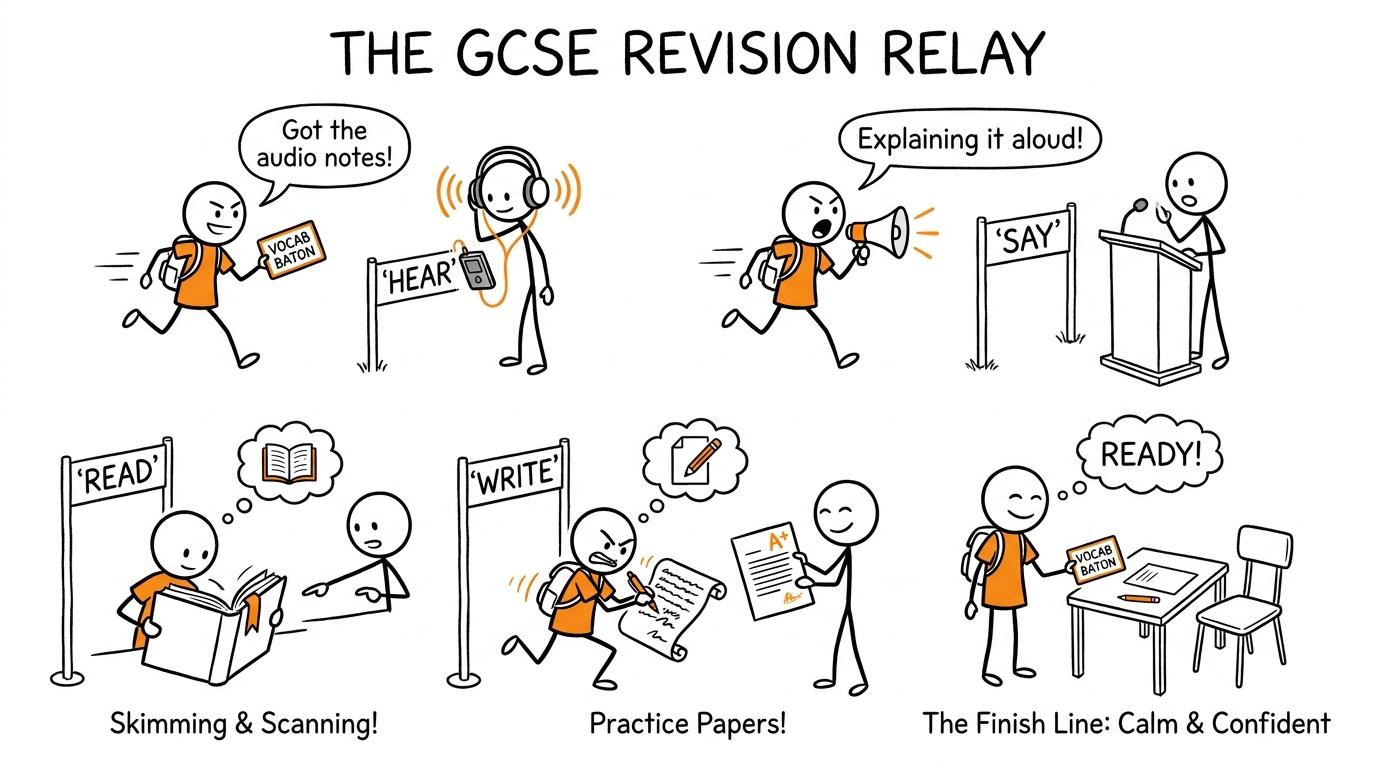 A vocabulary card travels through listening, speaking, reading and writing
Create an error log that changes your next session
Your most valuable notes may begin with something going wrong.
After a marked task, record:
- the theme or skill;
- the exact error;
- its likely cause;
- the corrected rule or form;
- a prompt for a later retest;
- the date you will revisit it.
Keep this brief. The log is not a diary of disappointment. It is a queue of repair jobs.
Look for repeated causes. If several mistakes arise because you overlook negatives in listening, the problem is no longer one question. It is a pattern that deserves focused practice. If the same spelling issue appears in several writing tasks, promote it to a recurring-check list.
This is also how a mark scheme should influence maths revision. On MathsGenie, students can complete Edexcel GCSE Maths past papers or AQA GCSE Maths past papers, mark their work and turn lost marks into specific next actions. Use the same feedback loop with Arabic tasks supplied by your school or awarding organisation.
Review notes with a simple weekly cycle
A note has not proved useful because you wrote it. It proves useful when you can retrieve and apply it later.
Use this cycle:
- Capture: after the lesson, reduce the material to essential words, patterns and questions.
- Retrieve: close the source and write or say what you remember.
- Check: compare carefully and correct inaccuracies.
- Apply: use the material in listening, speaking, reading or writing practice.
- Return: test it again after time has passed.
Short sessions are easier to repeat than an occasional notebook overhaul. You might review one older vocabulary set, one grammar page and two error-log prompts before completing fresh practice. Material that remains secure can appear less often; weak material should return sooner.
Use the MathsGenie revision planner to coordinate maths around your wider GCSE commitments, then place Arabic retrieval sessions into the available spaces. The advice in the GCSE maths revision timetable guide is especially transferable: choose a realistic rhythm, revisit weaknesses and leave room for marking and correction.
Common GCSE Arabic note-taking mistakes
Copying everything from the board
Transcription leaves little attention for understanding. Capture the rule, useful language and unresolved question. Ask whether each line will support a future retrieval prompt.
Making notes attractive but untestable
Colour can reveal categories, but decoration is not recall. Every page should contain questions, covered sections, cue cards or another way to test yourself.
Recording isolated vocabulary only
A translation may not tell you enough to use a word correctly. Add essential grammatical or contextual information, but keep the entry short enough to review.
Revising only your strongest skill
Students naturally return to comfortable tasks. Keep separate evidence for listening, speaking, reading and writing so that one skill cannot disappear behind general revision.
Memorising complete speaking and writing scripts
Scripts can produce familiarity without flexibility. Reduce them to adaptable prompts, structures and ideas, then practise responding to varied questions.
Keeping corrections without retesting them
A correction you merely read can feel obvious. Convert it into a closed-book prompt and schedule another attempt.
Mixing qualifications or outdated materials
Check the specification code, board, tier and assessment format. Use your teacher and current awarding-organisation materials for Arabic-specific examination details.
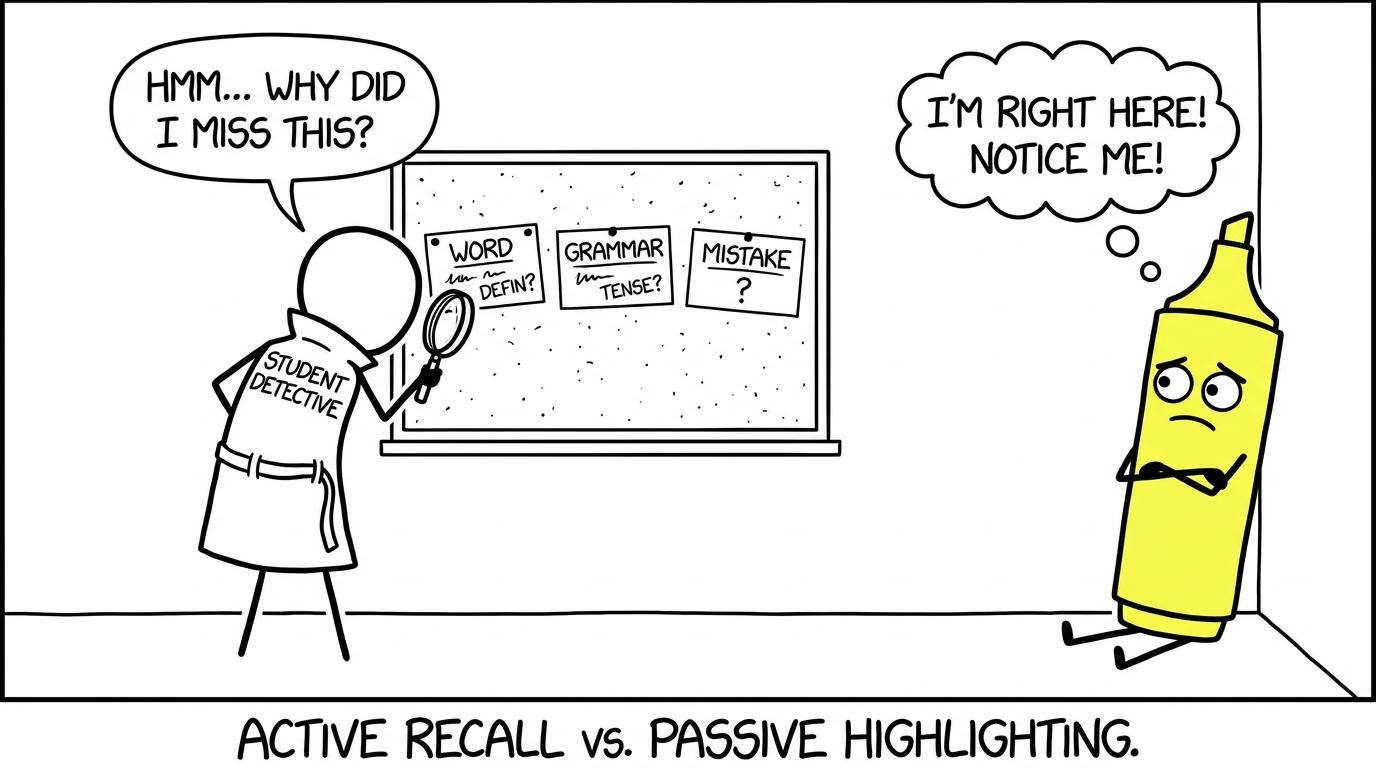 A revision detective studies useful clues while an abandoned highlighter looks offended
Notes should become actions
The best notebook is rarely the biggest. It is the one that tells you what to retrieve, reveals what you misunderstand and points towards the next piece of practice.
Begin with one theme. Condense its vocabulary, create a few grammar prompts and add recent mistakes. Close the notebook. Retrieve. Check. Then use the language in the skill you are preparing for.
Keep your wider exam preparation equally active with the free MathsGenie GCSE maths revision hub. Use revision lessons to rebuild weak methods, practice questions and mini tests to retrieve them, then past papers, predicted papers, mark schemes and video solutions to test what survives under exam conditions. Good notes do not merely document revision; they make the next useful action easier to begin.