GCSE Arabic Grade Sixth Form Entry: Does It Count?
GCSE Arabic grade sixth form entry explained: learn when your result counts, how much weight it carries and why maths and English often matter more.
A results sheet can make every grade look equally important. Admissions policies rarely work that way. If you searched for GCSE Arabic grade sixth form entry, the short answer is this: your Arabic grade may count towards a sixth form or college's overall GCSE requirement, but it is unlikely to outweigh the grades required in maths, English and your intended A Level subjects.
The detail depends on the provider. Some sixth forms count any accepted full-course GCSE among your best results. Others restrict which subjects count, exclude independently taken community-language qualifications, or calculate an average across a specified set of GCSEs. There is no single national admissions rule used by every sixth form and college.
That is why the prospectus matters more than rumours in the corridor.
The quick answer and application checklist
Before worrying about one result, check these five things:
- Does the provider accept GCSE Arabic as one of the qualifications used for general entry?
- Does it require a certain number of GCSEs at grade 444, 555 or 666 and above?
- Does it calculate an average from your best 666, 888 or another specified number of results?
- What grades are required in GCSE maths and English?
- Are there separate requirements for your intended A Level or vocational courses?
GCSE Arabic is a recognised GCSE qualification when awarded through an approved specification. That does not automatically mean every provider must include it in every admissions calculation. Sixth forms and colleges set their own published academic criteria, subject to the wider admissions rules applying to them.
If the wording is unclear, contact the admissions team and ask a precise question: Will my full-course GCSE Arabic result count towards the general entry total or average used for my programme? Keep any written reply.
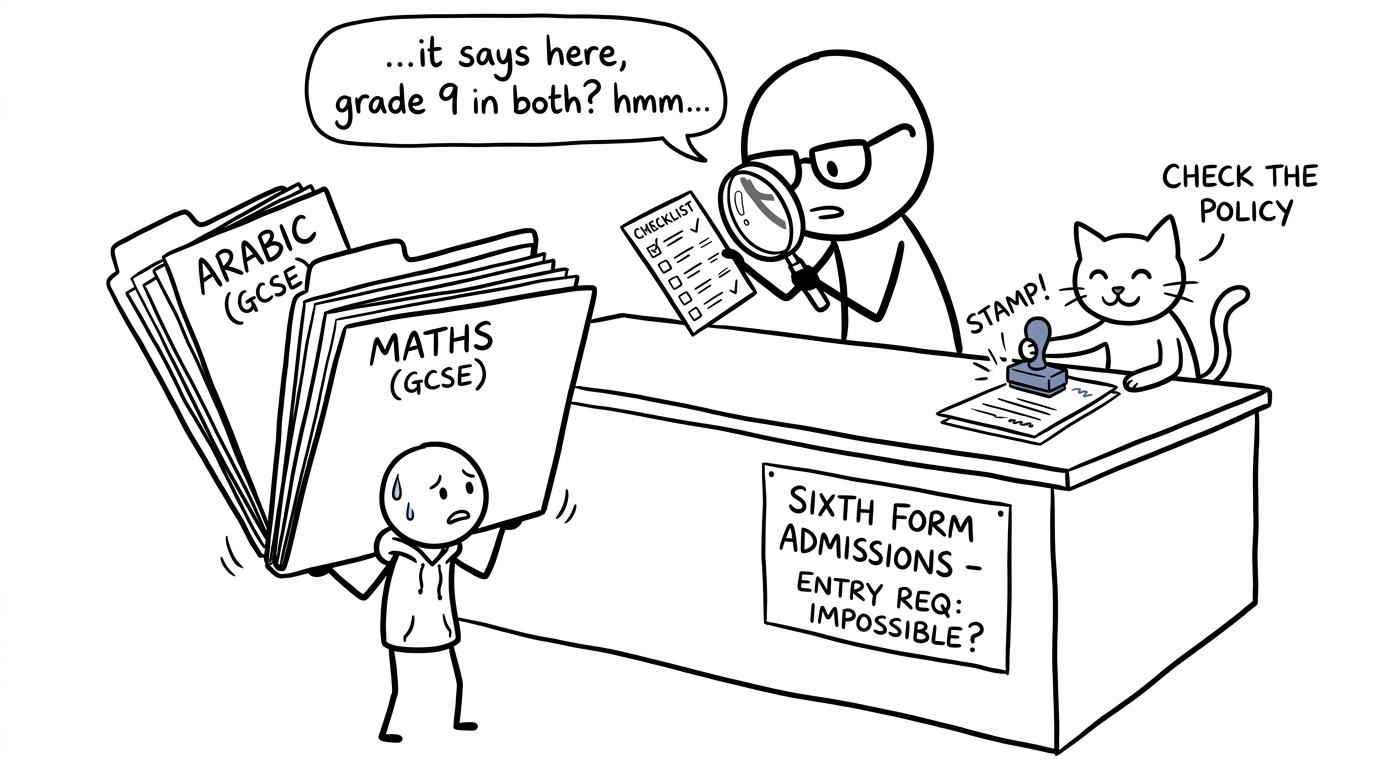 A student discovers that reading the admissions policy is more useful than guessing
How much weight does a GCSE Arabic grade carry?
In most applications, its weight falls into one of four patterns.
It counts as one GCSE in the general total
A provider might ask for a minimum number of GCSEs within a particular grade range. If GCSE Arabic is accepted, a strong result can help you reach that total just as another eligible GCSE could.
This can matter when you are close to the threshold. However, meeting the overall total does not cancel separate requirements. A high Arabic grade would not normally replace a missing required grade in maths, English, science or another named subject.
It contributes to a best-results average
Some selective sixth forms calculate an average or total from a student's best GCSE results. An accepted Arabic result may improve that calculation if it is among the results being counted.
Read the definition carefully. A policy may specify full-course GCSEs, qualifications completed through school, approved academic subjects or a particular list of eligible subjects. The calculation is only meaningful once you know what goes into it.
It is considered as supporting evidence
Even where Arabic is not central to the formal threshold, a good grade can still show linguistic knowledge, sustained preparation and the ability to perform in a formal assessment. That is positive evidence, particularly if your application or course choices have a relevant language or cultural connection.
Yet supporting evidence is not the same as a mandatory entry grade. Admissions decisions generally begin with the published criteria.
It may not be included
A minority of providers publish restricted subject lists or rules excluding some community-language GCSEs from their entry calculation. One provider may count Arabic fully while another does not count a language taken outside school or spoken within the family.
This is not a judgement about the value of speaking Arabic. It is an admissions calculation chosen by that institution. Never assume that a policy used by one sixth form applies to another.
Why maths and English usually carry more weight
Current sixth-form entry policies commonly name GCSE maths and English explicitly. Typical requirements vary: one provider may ask for grade 444, another grade 555, while a more selective programme may set a higher threshold.
There is also a national policy reason for their prominence. In England, students aged 161616 to 181818 on relevant publicly funded programmes who have not achieved grade 444 or above in GCSE maths and/or English, or an accepted equivalent, are generally expected to continue studying the missing subject. The detailed programme and funding rules can change, so applicants should check their provider's current arrangements.
Arabic does not substitute for either core qualification. A grade 999 in Arabic is an excellent result, but it does not become a grade 444 in GCSE maths or English.
For a student hoping to take A Level Maths, the maths requirement is usually higher than the general entry minimum. Published policies for current entry frequently ask for grade 666 or 777 in GCSE Maths, while Further Maths can require grade 777 or 888. Exact thresholds vary by institution.
That makes your next revision decision clearer. Start with the GCSE Maths Revision hub, choose the correct exam board and tier, and focus on the grade that your intended course actually requires.
Your intended courses can change the answer
General entry gets you through the college gate. Subject-specific entry determines which courses you can take once you are inside.
If you want to study A Level Maths, Physics, Chemistry, Computer Science, Economics or another numerate subject, the provider may specify a particular GCSE Maths grade. Sciences may also require certain results in Combined Science or the separate sciences. Essay-based courses can place greater emphasis on English or a relevant humanities subject.
An Arabic grade usually has greater direct relevance if you are applying for a language-related course. Even then, you should check whether the provider names GCSE Arabic, accepts another language qualification, conducts an assessment or applies a separate fluency policy.
The practical order is:
- confirm the general entry threshold;
- check every chosen course separately;
- identify the grades that appear in both sets of criteria;
- prioritise those grades in your revision plan;
- treat other strong results as valuable additions, not replacements.
For maths, use the GCSE past papers collection to test your current position. If you sit AQA, use the dedicated AQA GCSE Maths past papers; OCR students can use the OCR GCSE Maths past papers. Matching the correct board and tier prevents your revision evidence from becoming misleading.
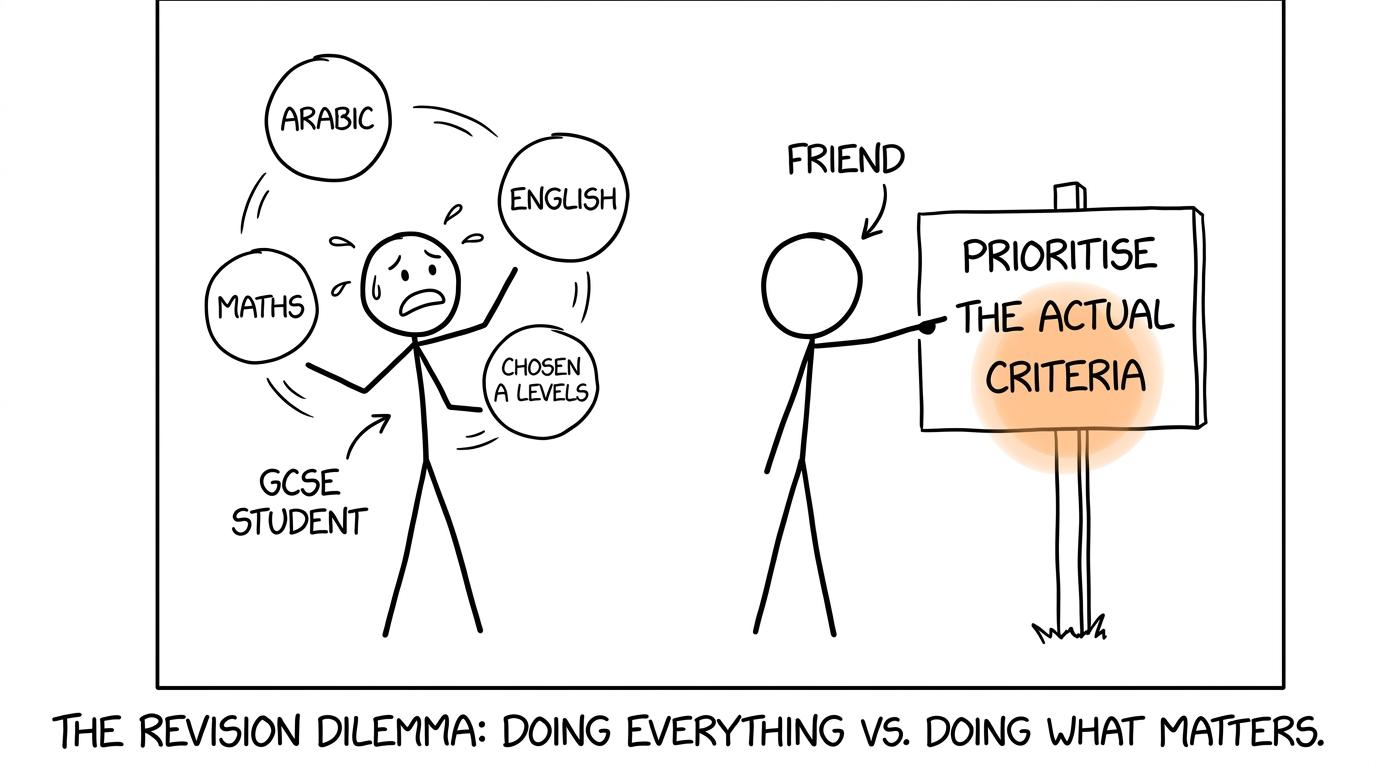 A student juggles several GCSE priorities while a friend points towards the actual criteria
What to do if Arabic is one of your strongest grades
Be pleased with it. A strong language result is real academic achievement, and it may strengthen your overall GCSE profile.
Then ask how it functions within each application. Create a small admissions record containing:
- the provider's general entry requirement;
- the rule for eligible GCSE subjects;
- the maths and English minimums;
- each course-specific requirement;
- the date on which you checked the policy;
- any clarification received from admissions staff.
Apply to more than one suitable provider where possible. Entry rules and available courses differ, so a sensible range of choices protects you from relying on one interpretation or one results-day outcome.
Do not reduce revision in other subjects merely because Arabic may raise your total. If maths is named as a compulsory requirement, improving that grade may create more options than adding another grade to an already strong total.
A calm revision timetable helps you protect both. The GCSE maths revision timetable guide explains how to combine topic work, marking and timed practice without allowing one subject to consume every evening.
What if your Arabic grade is lower than expected?
A lower Arabic result does not automatically block sixth-form or college entry. Its effect depends on whether it is included in the relevant total, whether your application still meets the overall threshold and whether Arabic is required for your intended course.
Check the policy before deciding that the application has failed. On or after results day, speak to the provider rather than withdrawing yourself. Some institutions consider applicants individually when they narrowly miss a threshold, but this is discretionary and should never be assumed.
Concentrate on what remains controllable. Before the exams, that means protecting compulsory and course-specific grades. After results, it means presenting accurate results, asking informed questions and considering alternative programmes where necessary.
If maths is the vulnerable grade, diagnose it rather than vaguely promising to work harder. Use Edexcel GCSE Maths mini tests for short, focused checks, or follow the guide to finding your weakest GCSE topics. A lost mark becomes useful when it tells you what to practise next.
A sensible revision priority for applicants
Admissions criteria can turn revision into a strategy rather than a contest to spend equal time everywhere.
Put your subjects into three groups:
- Essential: maths, English and any explicitly required subject grades.
- Threshold-supporting: accepted GCSEs that help you reach the required number or average.
- Additional strengths: results that enrich your profile but are not part of the formal threshold.
Arabic may sit in any of the last two groups, depending on the provider. Maths is often in the first.
This does not mean abandoning Arabic revision. It means allocating time according to consequences, current performance and realistic opportunities to improve. Keep preparing properly for every examination while giving extra attention to grades that unlock your intended programme.
When revising maths, follow a repeatable cycle: attempt questions, mark them, identify the exact error, revise that topic and retest it. The guide to using past papers properly shows how to turn papers and mark schemes into targeted action. Predicted papers are useful later as rehearsal, but they should complement rather than replace official past-paper practice.
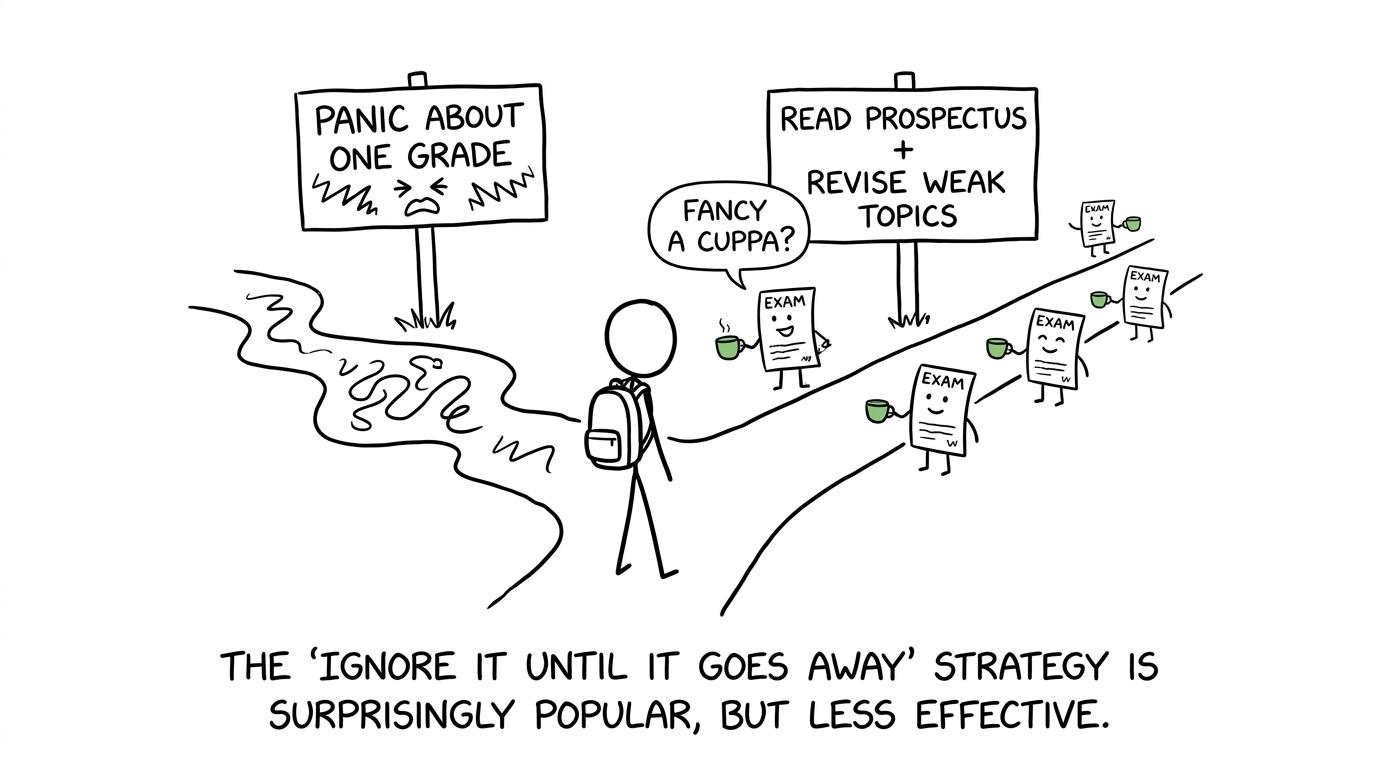 The calmer path involves checking the prospectus and revising weak topics
Common mistakes when judging your GCSE Arabic result
Assuming every GCSE is treated identically
Providers can define which qualifications count towards their totals and averages. Check the exact policy for your year of entry.
Confusing general entry with subject entry
Reaching the overall GCSE total does not guarantee access to every A Level. Maths, sciences and other courses often publish additional grade requirements.
Thinking Arabic can replace maths or English
A strong result may support your total, but it does not satisfy a separately stated maths or English condition.
Relying on another student's experience
Their provider, entry year, qualification route or chosen subjects may be different. Use the current official prospectus and confirm ambiguous wording directly.
Spending revision time according to anxiety
The grade causing the most worry is not always the grade carrying the most admissions weight. Read the criteria first, then use evidence from papers and mini tests to decide where your next hour belongs.
Turn uncertainty into a clear plan
Your GCSE Arabic grade can matter for sixth form entry. It may count as one of the GCSEs needed for general admission, improve a best-results calculation or support the wider picture of your achievement. But its weight is decided by the provider's published rules, and it will rarely override compulsory maths, English or course-specific requirements.
Check each sixth form or college separately. Ask admissions staff whether your exact qualification counts. Then put most revision effort where it protects the choices you genuinely want.
MathsGenie gives you a free place to run that plan: revision lessons for weak topics, practice questions and mini tests for quick feedback, past papers for exam realism, and mark schemes and video solutions for understanding lost marks. As the exams approach, add predicted papers as a final rehearsal. Start with the GCSE Maths Revision hub, choose your board and tier, and turn the next uncertain grade into a specific revision action.