GCSE Arabic Grade 9 Rate: How Many Students?
GCSE Arabic grade 9 rate: explore the latest 2025 figure, yearly trends, comparisons with maths and other GCSEs, and what it means for you today.
A grade can feel personal. A percentage feels objective. Yet the moment students see that a subject has a high proportion of top grades, it is easy to assume the exam must be easy, or that their own result should be guaranteed.
The latest GCSE Arabic grade 9 rate was 29.2%29.2\%29.2% in the Pearson Edexcel home cohort for June 202520252025. Pearson recorded 5,3255{,}3255,325 candidates, of whom 1,5571{,}5571,557 achieved grade 9. That is just under three in every ten entries.
It is a strikingly high rate compared with most large-entry GCSEs. But it needs careful interpretation. Grade statistics describe the students who entered a subject, not simply the difficulty of its papers.
The answer at a glance
Here is what the latest official data tells us:
- In June 202520252025, 1,5571{,}5571,557 of 5,3255{,}3255,325 Pearson Edexcel GCSE Arabic candidates achieved grade 9.
- The resulting grade 9 rate was 29.2%29.2\%29.2%.
- The rate has remained close to 30%30\%30% across the four most recent completed summer series.
- In Pearson's June 202520252025 results, the corresponding rate was 3.5%3.5\%3.5% for GCSE Mathematics and 9.0%9.0\%9.0% for GCSE French.
- A higher top-grade rate does not prove that Arabic is easier. Entry patterns, prior language experience and the characteristics of the candidate group matter.
- Grade 9 is available only on Higher tier in Edexcel GCSE Arabic.
The latest available completed summer series at the time of writing is June 202520252025. Results for summer 202620262026 have not yet been awarded.
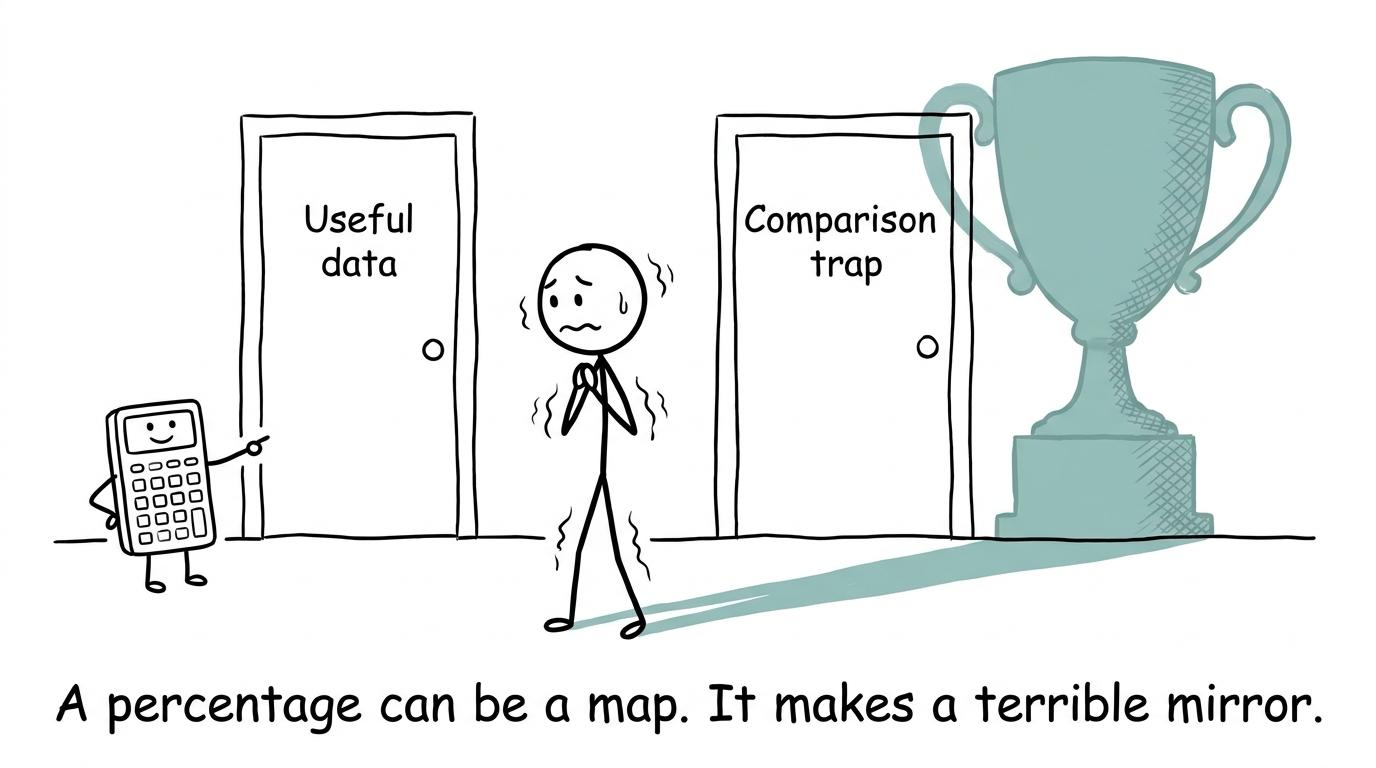 A student choosing useful data instead of the comparison trap
GCSE Arabic grade 9 rate by year
Pearson's official grade statistics provide both the number of candidates and the cumulative percentage achieving each grade. For grade 9, the cumulative percentage is simply the proportion receiving grade 9.
| Summer series | Candidates | Grade 9 candidates | Grade 9 rate |
|---|---|---|---|
| 202520252025 | 5,3255{,}3255,325 | 1,5571{,}5571,557 | 29.2%29.2\%29.2% |
| 202420242024 | 5,2575{,}2575,257 | 1,5391{,}5391,539 | 29.3%29.3\%29.3% |
| 202320232023 | 5,1735{,}1735,173 | 1,6471{,}6471,647 | 31.8%31.8\%31.8% |
| 202220222022 | 4,9484{,}9484,948 | 1,4951{,}4951,495 | 30.2%30.2\%30.2% |
The calculation behind a grade rate is:
Grade 9 rate=number awarded grade 9total number of candidates×100\text{Grade 9 rate}=\frac{\text{number awarded grade 9}}{\text{total number of candidates}}\times 100Grade 9 rate=total number of candidatesnumber awarded grade 9×100For the June 202520252025 cohort, this gives:
1,5575,325×100≈29.2%\frac{1{,}557}{5{,}325}\times 100\approx 29.2\%5,3251,557×100≈29.2%Across these four series, the rate moved within a fairly narrow range of 29.2%29.2\%29.2% to 31.8%31.8\%31.8%. That stability is more informative than any one year's movement. The rate fell by 2.62.62.6 percentage points between 202320232023 and 202520252025, but it returned to almost exactly its 202420242024 level.
These figures refer to Pearson Edexcel GCSE Arabic, specification 1AA01\text{AA}01AA0, in Pearson's home cohort. They should not be confused with Edexcel International GCSE Arabic (First Language), which is a different qualification with different papers, entries and statistics.
How does GCSE Arabic compare with other GCSEs?
A useful comparison should keep the awarding organisation and examination series consistent. Pearson's final June 202520252025 statistics allow GCSE Arabic to be compared with several Edexcel subjects on the same reporting basis.
| Pearson Edexcel subject | June 202520252025 grade 9 rate |
|---|---|
| Arabic | 29.2%29.2\%29.2% |
| French | 9.0%9.0\%9.0% |
| Mathematics | 3.5%3.5\%3.5% |
Arabic's rate was therefore more than three times the Edexcel French rate and over eight times the Edexcel Mathematics rate. Across all GCSE subject entries in England, JCQ's June 202520252025 data indicates that approximately 5.2%5.2\%5.2% of grades were grade 9, so Arabic was also far above the overall figure.
These are comparisons between cohorts, not a ranking of exam difficulty. GCSE Mathematics has hundreds of thousands of entries and is taken by almost the full age cohort. GCSE Arabic has a much smaller, more self-selecting group. Comparing their percentages as though the candidate groups were interchangeable would be like comparing the finishing times from a school fun run with those from a specialist athletics club.
For maths students, that distinction matters when reading grade statistics or GCSE maths grade-boundary history. The percentage of candidates receiving a grade and the raw-mark boundary required to receive it are different measurements.
Why is the Arabic grade 9 rate comparatively high?
The official statistics reveal the outcome, but they do not record each candidate's linguistic background or explain why the rate is high. Any explanation must therefore be cautious.
The entry group is specialised
Arabic is not entered by the broad population seen in compulsory subjects such as maths. Students choosing it may already have substantial familiarity with spoken or written Arabic through family, school, community or previous education. Others may have learnt it entirely as an additional language.
It would be unsafe to assume that every candidate is a fluent or heritage speaker. However, the possibility of significant prior experience means the cohort cannot be treated as a random sample of all GCSE students.
A percentage reflects who entered
Suppose a subject mainly attracts students who already have confidence in it. Its grade distribution may be high even when the assessment remains demanding. Conversely, a compulsory subject includes students across the full attainment range, so its top-grade proportion will usually be lower.
This is why the statistic answers one precise question: what share of entries received grade 9? It does not independently answer: how hard is the qualification?
Tier entry affects access to grade 9
Pearson Edexcel GCSE Arabic assesses listening, speaking, reading and writing. Candidates enter either Foundation or Higher tier across all papers.
Foundation tier offers grades 111 to 555. Higher tier offers grades 444 to 999, with a possible grade 333 for a narrowly missed grade 444 boundary. Therefore, a student aiming for grade 9 must be entered for Higher tier.
Maths students will recognise the same broad principle: grade 9 is not available on Foundation tier. Before choosing revision materials, check your board and tier through the GCSE Maths revision hub.
What the rate means for your own target
A rate of 29.2%29.2\%29.2% is encouraging, but it is not a prediction of your result. It does not mean that every student has a 29.2%29.2\%29.2% chance of receiving grade 9. Candidates have different starting points, levels of preparation and performances across the assessed skills.
The healthier use of the statistic is calibration. A grade 9 is clearly achievable for a substantial minority of GCSE Arabic candidates, but it still requires a performance meeting that year's grade boundary. Boundaries can change after examiners review the demand of the papers and the evidence from the series.
The same logic applies to maths. Do not turn a national percentage into a verdict about yourself. Turn your own practice into evidence. Start with a focused one-month GCSE maths revision plan, then measure what improves.
A better way to use grade data in maths revision
Students often spend too long asking what percentage of people obtain a grade and too little time examining where their own marks disappear. National data supplies context. Marked work supplies direction.
Diagnose with the correct paper
Choose your specification and tier. MathsGenie's collections include Edexcel GCSE Maths past papers, AQA GCSE Maths past papers and OCR GCSE Maths past papers, with mark schemes and worked solutions where available.
Complete a paper under timed conditions. Then classify each lost mark as a knowledge gap, an accuracy error, a misread question or a timing problem.
Repair the smallest useful skill
“Algebra” is too broad to revise effectively. “Rearranging formulae when the unknown appears in a denominator” is a usable target. Return to a revision lesson, complete practice questions and check the method against the solution.
Shorter GCSE maths mini tests can then show whether the repair has worked without requiring another full paper.
Rehearse before the examination
Once weaknesses are being corrected, use GCSE predicted papers as an extra rehearsal. Predicted papers are not promises about exact questions. Their value comes from unfamiliar exam-style practice, timing and honest marking.
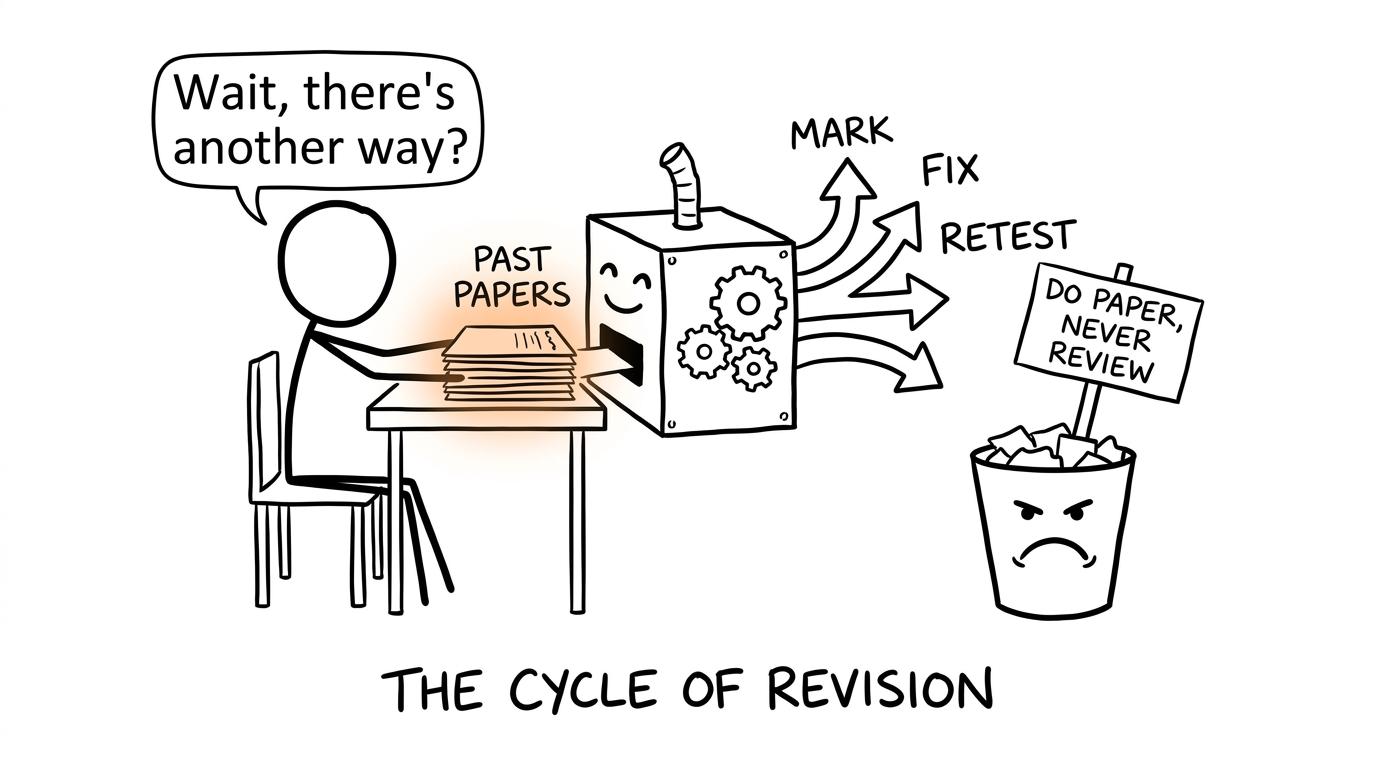 A revision machine turning past papers into marking, fixes and retesting
Common mistakes when interpreting the figures
Confusing grade rates with grade boundaries
A grade 9 rate is the percentage of candidates awarded grade 9. A grade boundary is the minimum mark required for that grade in a particular series. They measure different things.
Treating different qualifications as identical
GCSE Arabic and International GCSE Arabic (First Language) are separate qualifications. Statistics from one should not be presented as results for the other.
Assuming a high rate means an easy examination
The result distribution depends partly on the candidates who enter. Without controlling for prior attainment and language experience, the rate alone cannot measure difficulty.
Ignoring the year and awarding organisation
Always check whether a figure refers to Edexcel, AQA, OCR or Eduqas, which summer series it covers, and whether it is provisional or final. Mixing years or boards can create a comparison that looks precise but means very little.
Using population data as a personal forecast
The national or board-level rate is not your individual probability. Your marked papers, teacher feedback and performance across the specification provide much stronger evidence about your current position.
The number is context, not destiny
In June 202520252025, 1,5571{,}5571,557 of 5,3255{,}3255,325 Pearson Edexcel GCSE Arabic candidates achieved grade 9, producing a rate of 29.2%29.2\%29.2%. Recent results show that roughly three in ten candidates have reached the top grade each year; a much larger share than in maths, French or GCSE entries overall.
That is the complete statistical answer. The useful human answer is quieter: somebody else's grade does not take one away from you. Percentages can explain a cohort, but preparation changes an individual result.
For your maths exams, make that preparation visible. Use MathsGenie's free revision lessons to rebuild weak methods, practice questions and mini tests to develop fluency, and past papers to test your timing. Then add predicted papers, mark schemes and video solutions so every lost mark creates a clear next action. Choose one weak topic today, practise it, mark it and return to it; that is how a target grade gradually becomes evidence.