GCSE Arabic Grade 5 Meaning: What It Really Shows
GCSE Arabic grade 5 meaning explained: the ability it represents, its old letter-grade comparison, grade boundaries and sensible next steps.
A results sheet can make years of learning feel strangely small. One subject, one line, one number. If you are searching for the GCSE Arabic grade 5 meaning, the direct answer is reassuring: a grade 555 is a strong pass. It indicates a sound, functional command of Arabic across listening, speaking, reading and writing not perfection, but more than the minimum passing standard.
In old letter-grade terms, it sits within the broad territory previously covered by grades B and C, and is commonly described as roughly comparable to a high C or low B. That comparison is only approximate, however. The numerical grades were not created as exact replacements for individual letter grades.
For a student balancing Arabic with GCSE maths and other subjects, the result should be read as evidence of current performance, not a permanent label. Understanding what it measures helps you decide what to do next.
The quick meaning of a grade 5 in GCSE Arabic
Here is the essential checklist:
- Grade 555 is described as a strong pass in England.
- It is above grade 444, which is the standard-pass benchmark.
- It suggests competent performance across listening, speaking, reading and writing.
- It is broadly associated with the upper part of the old C grade and the lower part of the old B grade.
- It does not mean that every language skill was equally strong.
- It is not tied to one permanent percentage because grade boundaries can change between exam series.
- On Foundation tier, grade 555 is the highest available grade.
- Entry requirements are set by individual schools, colleges and courses, so they should always be checked directly.
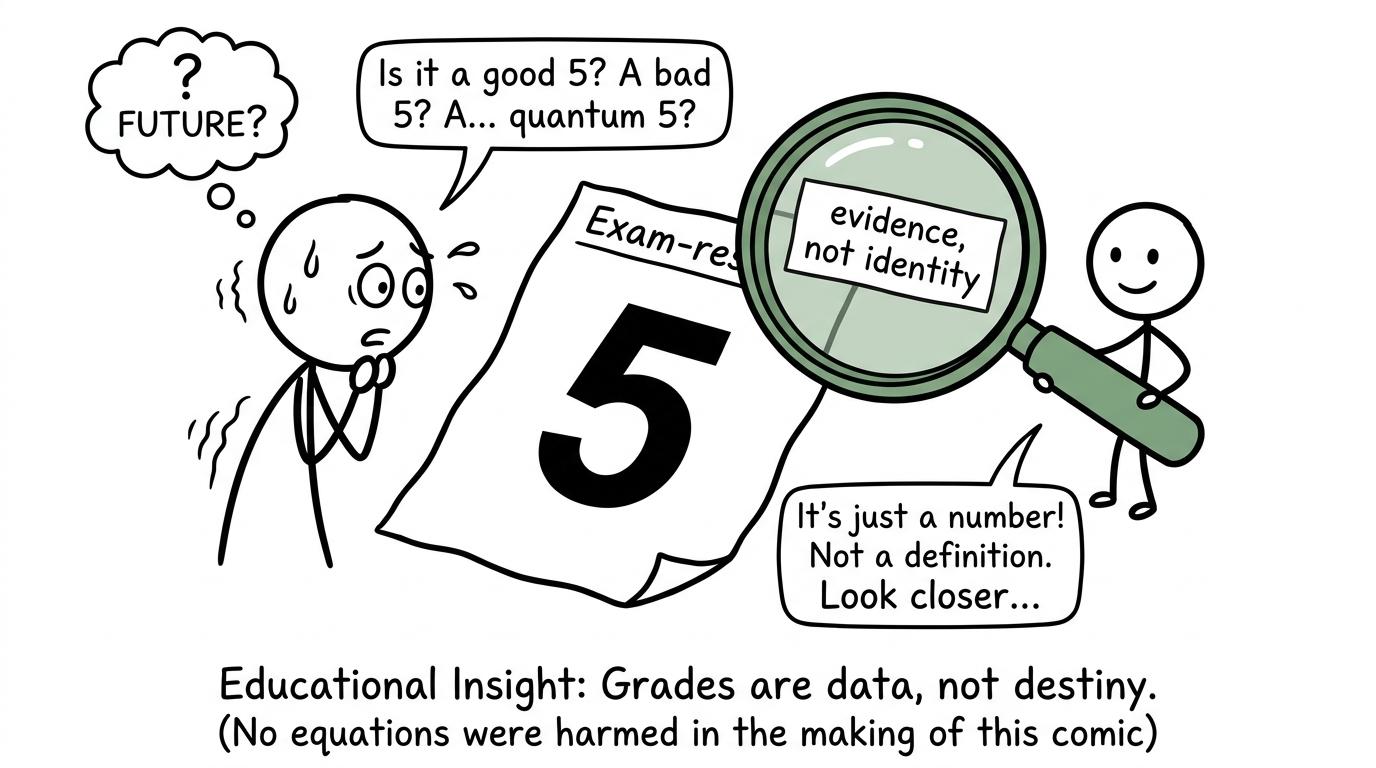 A student discovering that a grade is evidence, not identity
What ability does a grade 5 actually represent?
Official modern foreign language grade descriptors describe the likely overall performance of a student working at grade 555. They are guides to the standard, rather than mark schemes or lists that every individual student must satisfy perfectly.
Listening
A grade 555 student can generally understand spoken Arabic that includes some longer passages. They should be able to identify:
- the overall message;
- important details and key points;
- opinions expressed by speakers;
- information presented in familiar and less predictable contexts.
This does not mean understanding every word. Language comprehension often depends on recognising enough vocabulary, grammar and context to reconstruct the message. A student may miss an unfamiliar phrase yet still understand what the speaker thinks and why.
Speaking
At this standard, a student can develop a conversation rather than relying entirely on memorised statements. They can express opinions, respond appropriately to some unpredictable questions and manipulate familiar language with reasonable accuracy.
Pronunciation and intonation should generally make the intended meaning clear. Hesitation or grammatical errors can still occur. A grade 555 represents effective communication, not native-level fluency.
Reading
A student can understand written Arabic containing some extended material and identify overall messages, details, key points and opinions. They can use context to handle language that is not immediately familiar.
This is a meaningful skill. Reading successfully is not simply recognising isolated vocabulary. It involves following how ideas connect and deciding which details answer the question being asked.
Writing
Grade 555 performance involves writing clearly for different purposes, communicating ideas and opinions, and adapting vocabulary and grammar with reasonable accuracy. The message should remain understandable even when errors appear.
A student at this level is therefore doing more than producing disconnected sentences. They can select language to suit a task, refer to different ideas or time frames and express a personal viewpoint.
How GCSE Arabic is assessed
The current Pearson Edexcel GCSE Arabic qualification, specification code 1AA0, assesses four skills:
| Assessment | Qualification weighting |
|---|---|
| Listening | 25%25\%25% |
| Speaking | 25%25\%25% |
| Reading | 25%25\%25% |
| Writing | 25%25\%25% |
Each skill contributes equally to the final qualification, even though the papers have different raw-mark totals. The complete set is worth 280280280 raw marks: listening and reading are each marked out of 505050, speaking out of 707070, and writing out of 606060.
That balance matters when interpreting the result. A final grade 555 does not necessarily mean grade 555 performance in every paper. Stronger speaking could compensate for weaker reading, for example, because the final grade is based on the weighted total across the qualification.
Students must enter one tier across all four Edexcel papers. Foundation tier targets grades 111 to 555, while Higher tier principally targets grades 444 to 999. If you sat Foundation, achieving grade 555 means reaching the highest grade available on that tier.
Always confirm the qualification named on your statement of results. Pearson Edexcel GCSE Arabic is not the same qualification as International GCSE Arabic, and their structures and boundaries should not be mixed.
How a grade 5 compares with the old letter grades
The safest comparison begins with the official anchor points:
- the bottom of grade 777 is comparable to the bottom of the old grade A;
- the bottom of grade 444 is comparable to the bottom of the old grade C;
- the bottom of grade 111 is comparable to the bottom of the old grade G.
There is no official one-to-one anchor for grade 555. Grades 444, 555 and 666 collectively cover the broad performance territory previously represented by B and C grades. This is why grade 555 is often summarised as a high C or low B.
| Current grade | Careful comparison with the old scale |
|---|---|
| 777 | Bottom aligned with the bottom of old grade A |
| 666 | Within the broad old B/C range |
| 555 | Roughly high C to low B; a strong pass |
| 444 | Bottom aligned with the bottom of old grade C |
The wording roughly matters. A grade 555 is not simply an old C with a new name. The qualifications, assessments and distribution of grades changed. The comparison is useful for orientation, especially when explaining results to someone familiar with letters, but it should not be treated as an exact conversion.
Maths students face the same interpretation problem. The guide to the meaning of grade 5 in GCSE maths explains how the numerical scale applies in a different subject.
Does a grade 5 always require the same number of marks?
No. Grade boundaries are set for each exam series after the papers have been taken and reviewed. They reflect the demand of that particular set of assessments, so a boundary from an earlier year is evidence, not a guaranteed target for a future paper.
The latest published summer boundaries available at the time of writing are for June 2025. For Pearson Edexcel GCSE Arabic, grade 555 began at 164164164 out of 280280280 on Foundation tier and 134134134 out of 280280280 on Higher tier. The difference does not make Foundation the harder route. The tiers contain papers of different demand, so their raw marks cannot be compared as if the questions were identical.
You can inspect the recent figures on MathsGenie's Edexcel GCSE Arabic grade boundaries page. Use them to interpret a past paper or mock from the corresponding series, not to predict the exact boundary for your own results.
Is grade 5 good enough for your next step?
A strong pass is a respectable result. Whether it is sufficient depends on the decision you are making.
For a sixth-form course, apprenticeship or another programme, check the provider's published entry criteria. Requirements may refer to an overall GCSE profile, particular grades in English and maths, or a higher grade in a subject that will be continued. Do not assume that the phrase strong pass creates one universal admissions rule.
If you want to continue Arabic, ask a more useful question than “Is 555 good?” Ask whether your current speaking, reading and writing are secure enough for the demands of the next course. Your teacher can interpret your component performance and advise whether further preparation would help.
If Arabic is not part of your next stage, the grade still records something valuable: you communicated in another language across four distinct modes under examination conditions.
What maths students can learn from an Arabic result
A grade in one subject does not predict your grade in another. Arabic tests language communication; GCSE maths tests mathematical knowledge, reasoning and problem-solving. Yet the revision habits behind improvement overlap.
Both subjects reward active recall, regular practice and honest review. Reading vocabulary repeatedly can feel productive without proving that you can retrieve it. Watching a maths solution can create the same illusion. Performance changes when you attempt the task yourself, check it and return to the mistake later.
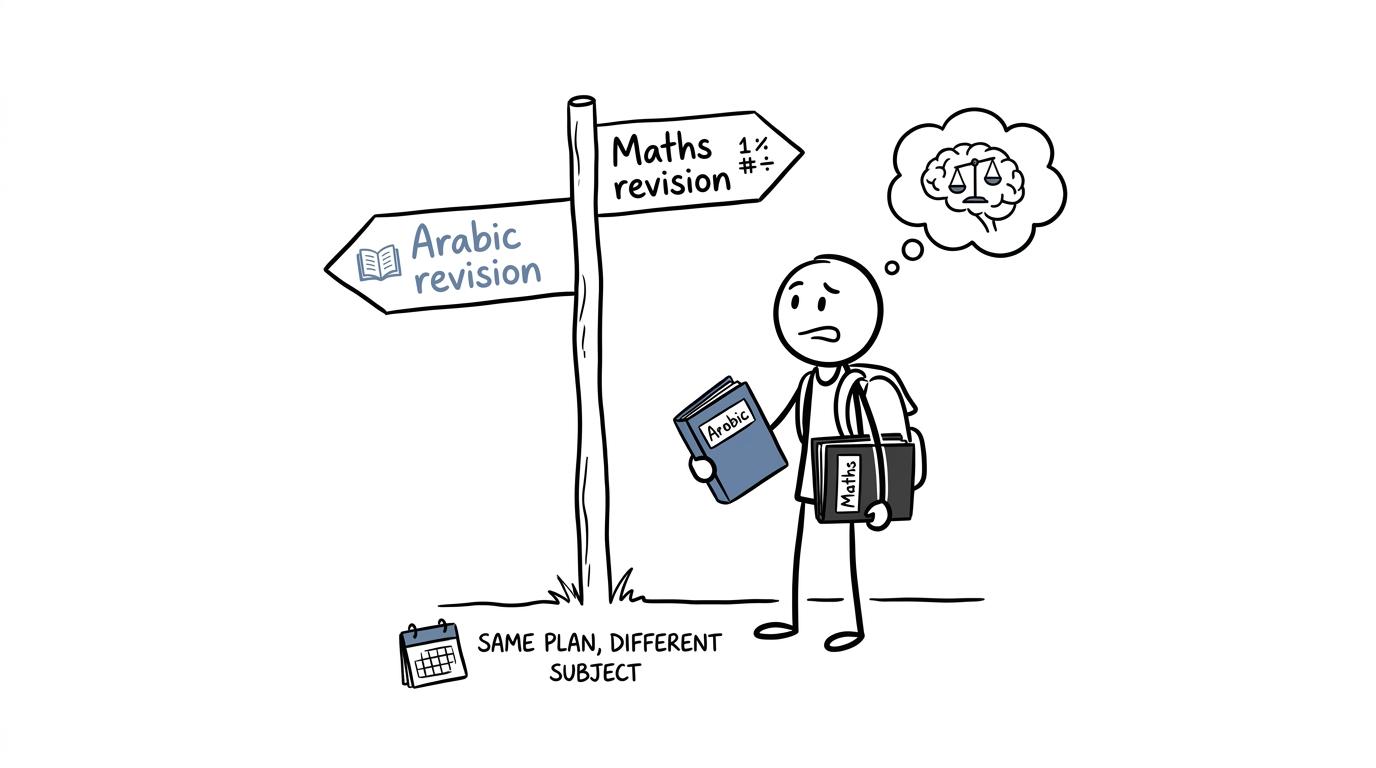 A student balancing Arabic and maths revision with one sensible plan
For maths, begin at the GCSE Maths revision hub, where you can select resources for Edexcel, AQA, OCR or Eduqas. Then follow a simple cycle:
- identify a weak topic;
- use a revision lesson to rebuild the method;
- answer practice questions without copying;
- check the mark scheme or video solution;
- record the reason each mark was lost;
- attempt the skill again after a short gap.
If a full paper feels too large, Edexcel GCSE Maths mini tests provide shorter, focused checks. Once your individual topics are more reliable, move to Edexcel GCSE Maths past papers or choose the correct board through the main revision hub.
A realistic GCSE maths revision timetable can help you protect time for Arabic without letting maths become a last-minute emergency. The purpose of a plan is not to fill every evening. It is to remove the daily decision about what to do next.
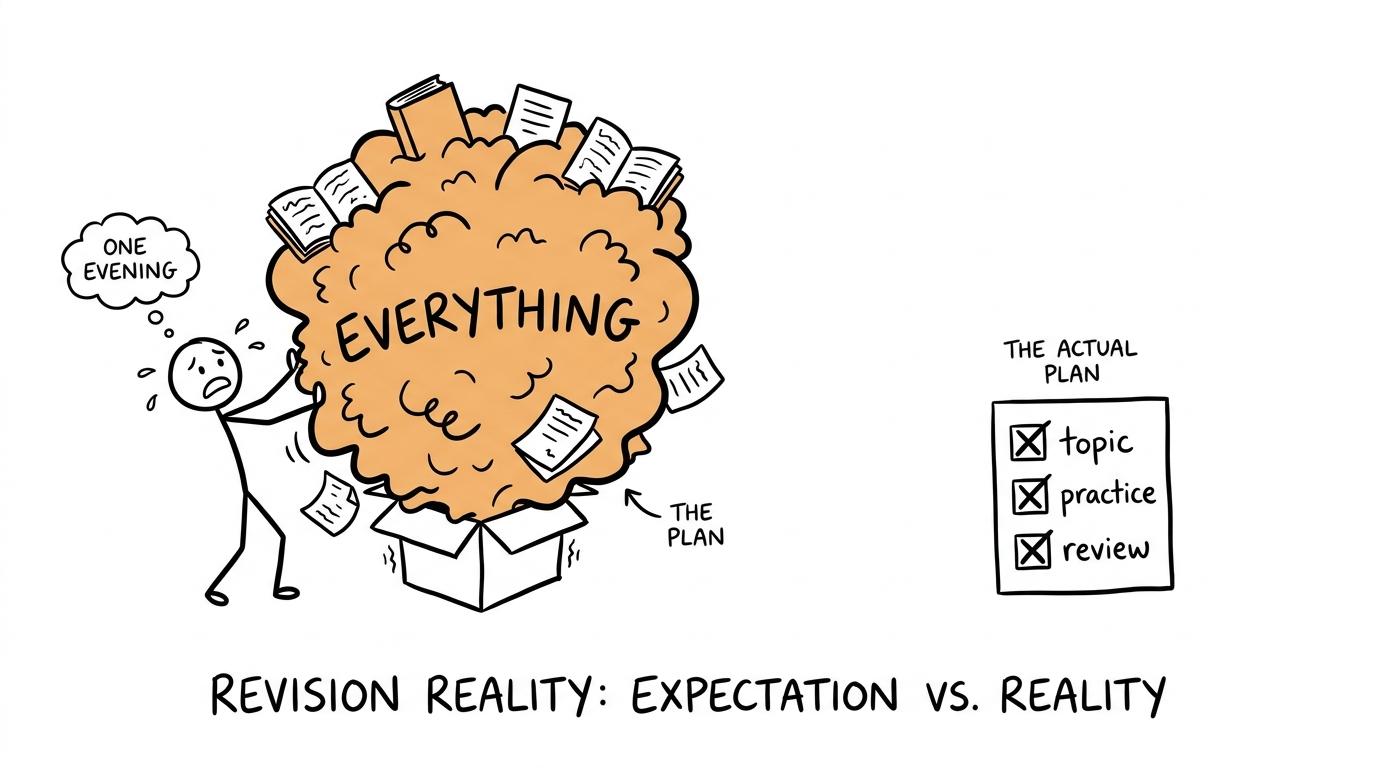 A giant revision pile losing an argument with a small sensible checklist
Common mistakes when interpreting a grade 5
Treating it as an exact old grade
Calling grade 555 “a B” or “a C” without qualification oversimplifies the grading reform. High C to low B is a useful approximation, not an official one-to-one equivalence.
Assuming it means the same percentage every year
Raw grade boundaries change between exam series. A mark associated with grade 555 in one year may sit in a different grade band in another.
Comparing Foundation and Higher raw marks directly
The papers are designed at different levels of demand. A lower raw boundary on Higher tier does not mean that it is easier to obtain the grade.
Thinking the result proves equal strength in all four skills
The final result combines listening, speaking, reading and writing. Students can reach the same overall grade through different profiles of strengths and weaknesses.
Letting one grade define every subject
A grade 555 in Arabic says nothing automatic about your eventual maths result. Use evidence from maths assessments to plan maths revision. The GCSE maths topics by exam board and tier guide can help you build an accurate topic checklist.
A grade is a starting point, not a verdict
The real GCSE Arabic grade 555 meaning is larger than the phrase strong pass but smaller than a judgement about your potential. It shows that, across four language skills, your performance met a solid national standard. It sits above the standard-pass threshold and broadly around the high-C-to-low-B region of the former scale.
Read the result carefully. Celebrate what it proves. Then use more detailed evidence to choose your next action.
For your maths exams, make that action concrete. Open MathsGenie's free GCSE resources, choose your exam board and start with one weak topic. Build through revision lessons and practice questions, test yourself with mini tests, and then use past papers and predicted papers under timed conditions. Mark schemes and video solutions will show where the next marks are hiding, and a calm, repeatable revision plan will help you collect them.