

GCSE Arabic Busy Schedule: A Survival Guide
GCSE Arabic busy schedule survival plan: use short revision blocks to improve listening, speaking, reading and writing while protecting maths time.
A busy evening rarely looks dramatic. It disappears quietly: training runs late, a work shift takes longer than expected, maths homework is waiting, and suddenly GCSE Arabic has been postponed again.
If you are trying to manage GCSE Arabic with a busy schedule, the answer is not to force another exhausting hour into every night. Use short, skill-specific sessions, practise from memory and protect one longer weekly slot for exam-style work. Even 101010 focused minutes can maintain vocabulary or speaking fluency when the alternative is doing nothing.
The aim is not a perfect timetable. It is a revision system that survives real life.
Your GCSE Arabic survival checklist
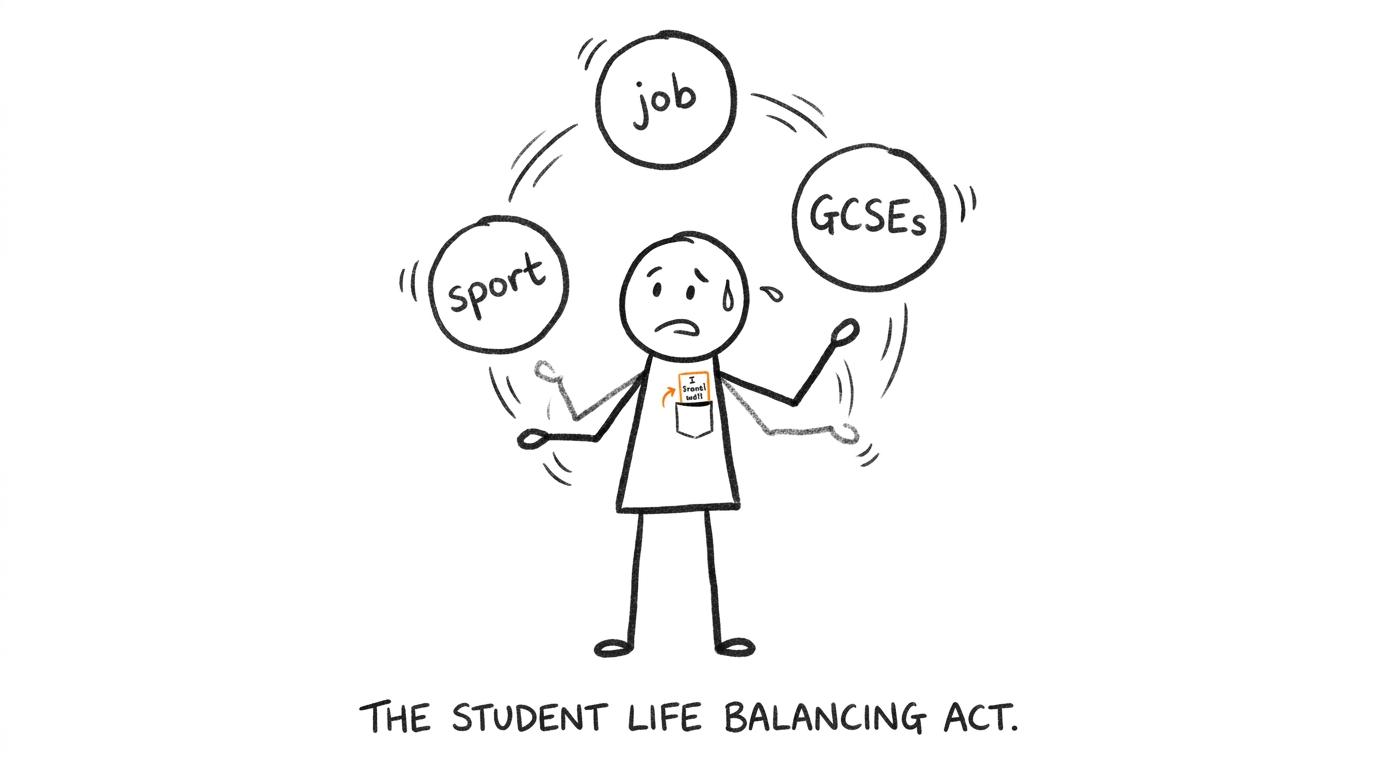
When sport, a job and other subjects are competing for your evenings, keep the plan simple:
- Confirm your exact qualification, specification and tier.
- Revise one language skill at a time.
- Use spare moments for vocabulary and retrieval.
- Complete one longer exam-style task each week.
- Mark or review every task rather than merely finishing it.
- Keep a short list of recurring errors.
- Protect maths with small, regular practice sessions.
- Ask your teacher for help before a weak skill becomes a crisis.
This is triage, not neglect. You are deciding what deserves attention now and what can safely wait.
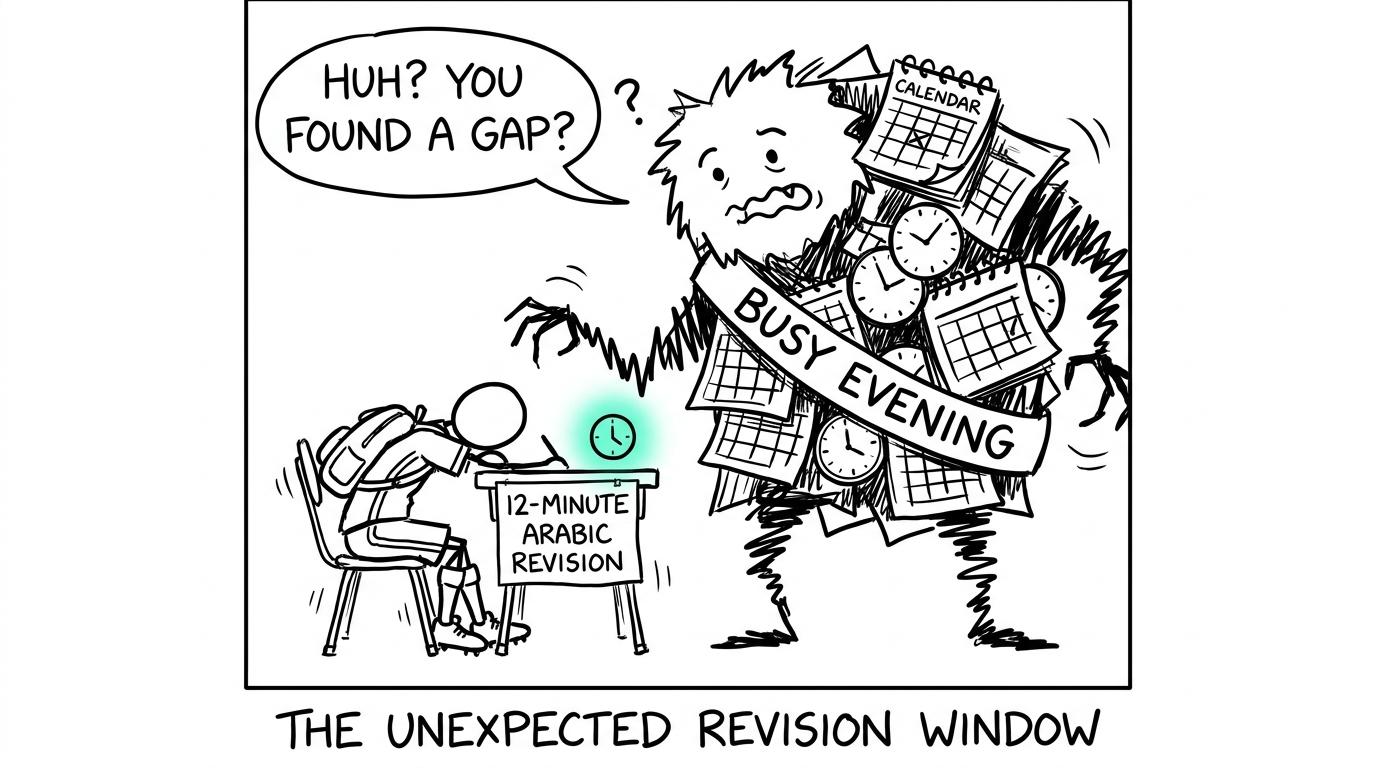 A student finding a tiny Arabic revision gap despite a busy evening
Know what your GCSE Arabic course assesses
Before planning revision, check the qualification code on your school materials or ask your teacher. GCSE Arabic and International GCSE Arabic are not interchangeable: their papers, content and assessment structures can differ.
For example, Pearson Edexcel GCSE Arabic, specification 1AA01\text{AA}01AA0, assesses four skills:
- listening;
- speaking;
- reading;
- writing.
Each skill contributes 25%25\%25% of the qualification. Students enter either foundation or higher tier and must take the same tier across all four papers. Dictionaries are not permitted, including during speaking preparation. The course assesses standard spoken and written Arabic, so familiarity with a family dialect does not automatically cover everything required in Modern Standard Arabic.
That structure gives a busy student a useful principle: do not spend all your limited time on the skill you already enjoy. Confident speakers may still need explicit work on formal writing, grammar and spelling. Strong readers may need timed listening practice. Because the four skills have equal weight, repeatedly avoiding one creates a predictable weakness.
Your own board or qualification may work differently. Use the current specification, your teacher's instructions and official assessment materials as the final authority.
Build a minimum viable revision week
A crowded calendar needs a floor, not an unrealistic ceiling. Your floor is the smallest amount of revision you can still complete during a difficult week.
A practical minimum might be:
- two 101010-minute vocabulary or grammar sessions;
- one 151515-minute listening or reading task;
- one 151515-minute speaking or writing task;
- one 303030-minute weekend review.
That produces 808080 minutes of purposeful Arabic revision without requiring a free evening. If more time appears, add to the plan. If the week becomes chaotic, preserve the minimum.
Attach each session to something that already happens. Review vocabulary after breakfast, record a speaking answer before training, or complete a short reading task while waiting for a shift to begin. The cue matters because a plan depending on "when I feel motivated" is fragile.
Use a phone only if it is genuinely acting as a revision tool. Open the required recording, vocabulary list or timer before the session begins. Notifications can turn a 101010-minute task into no task at all.
Match the task to the time available
Not every revision activity fits every gap. Choosing the right-sized task removes the wasted minutes spent deciding what to do.
When you have 555 minutes
Use active recall rather than rereading. Cover the answers and retrieve:
- a small set of high-frequency words;
- question words and connectives;
- one verb pattern or tense;
- phrases for giving and justifying opinions;
- yesterday's corrected spellings.
A tiny session should be narrow. Trying to "revise the environment topic" in 555 minutes is too vague; recalling eight useful words and using two aloud is measurable.
When you have 151515 minutes
Practise one exam action:
- listen to a short extract and note the essential details;
- read a short passage and identify its purpose, opinions and time frames;
- answer one speaking prompt without notes;
- plan and write one paragraph;
- translate a short passage in the direction required by your specification.
Finish by checking the response. Feedback is where practice becomes revision.
When you have 303030 minutes or more
Use a timed section from an official sample or past paper, rehearse part of the speaking assessment, or produce a longer written response. Then compare your work with the mark scheme, teacher guidance or model criteria.
Do not spend the entire block producing work and leave no time to inspect it. A useful split is roughly 202020 minutes attempting and 101010 minutes reviewing, adjusted to the task.
 A vocabulary card travelling calmly with a very busy student
Use a four-skill rotation
When time is limited, balance is easier if each session has a label. Rotate through listening, speaking, reading and writing rather than choosing whichever feels comfortable.
Listening
Listen for meaning before chasing every word. On the first attempt, identify the situation, speaker and overall opinion. On the next, focus on details such as reasons, negatives, dates and changes of tense.
Keep a short "misheard words" list. Repeatedly confusing the same sound or expression is more useful information than a raw score.
Speaking
Speaking revision can happen without a desk. Record a response, listen back and check whether you answered the precise question. Aim to include an opinion, a reason and more than one time frame where appropriate to the prompt and your tier.
Fluency does not mean speaking as quickly as possible. A controlled answer with clear meaning is more useful than a memorised paragraph delivered without responding naturally.
Reading
Train yourself to notice negatives, connectives and words showing whether an event happened in the past, happens now or will happen later. Do not stop because one word is unfamiliar. Use the surrounding sentence to infer what you can, then verify it during review.
Writing
Build flexible sentence patterns rather than memorising one complete essay. Practise adapting your vocabulary to school, family, travel, work and global themes. After writing, check agreement, verb forms, spelling and whether every bullet point has been addressed.
Protect maths without trying to revise everything nightly
Arabic may be the subject slipping through the cracks, but GCSE maths cannot be sustained by occasional panic either. The same small-session principle works well across Edexcel, AQA, OCR and Eduqas.
Start from the GCSE Maths revision hub, where you can choose your board and tier. On a busy weekday, one lesson followed by a handful of practice questions is more realistic than an entire paper.
If you need a quick diagnosis, use the GCSE Maths mini tests. Their short format makes them easier to place beside Arabic retrieval practice. Mark the test immediately, identify one weak skill and use the relevant revision lesson or video solution.
Keep board-specific work aligned with the paper you will sit:
- AQA GCSE Maths revision for foundation and higher resources;
- OCR GCSE Maths revision for OCR-aligned lessons and questions;
- Edexcel GCSE Maths past papers for timed practice, mark schemes and available solutions.
A sensible busy-week pattern is alternating subjects rather than forcing both into every evening. Arabic can use portable retrieval sessions; maths often benefits from a desk, written working and focused question practice. Give each subject the environment it needs.
The guide to finding weak GCSE topics quickly can help you decide where limited maths time should go. Nearer the exams, read when to start GCSE past papers so that full papers, mini tests and predicted papers each have a clear purpose.
Make feedback your revision shortcut
Busy students cannot afford low-information tasks. Copying vocabulary, highlighting notes and watching explanations passively may feel orderly, but they do not always reveal what you can produce independently.
Use this loop instead:
- attempt a small task without help;
- check it against reliable feedback;
- label the main problem;
- correct it;
- test the same skill again later.
For Arabic, your labels might include vocabulary, spelling, agreement, verb form, misunderstood instruction or missed listening detail. For maths, they might include knowledge, method, accuracy or exam technique.
Keep the error log brief. One line per recurring problem is enough. The purpose is to choose tomorrow's task, not create another beautiful document that takes an hour to maintain.
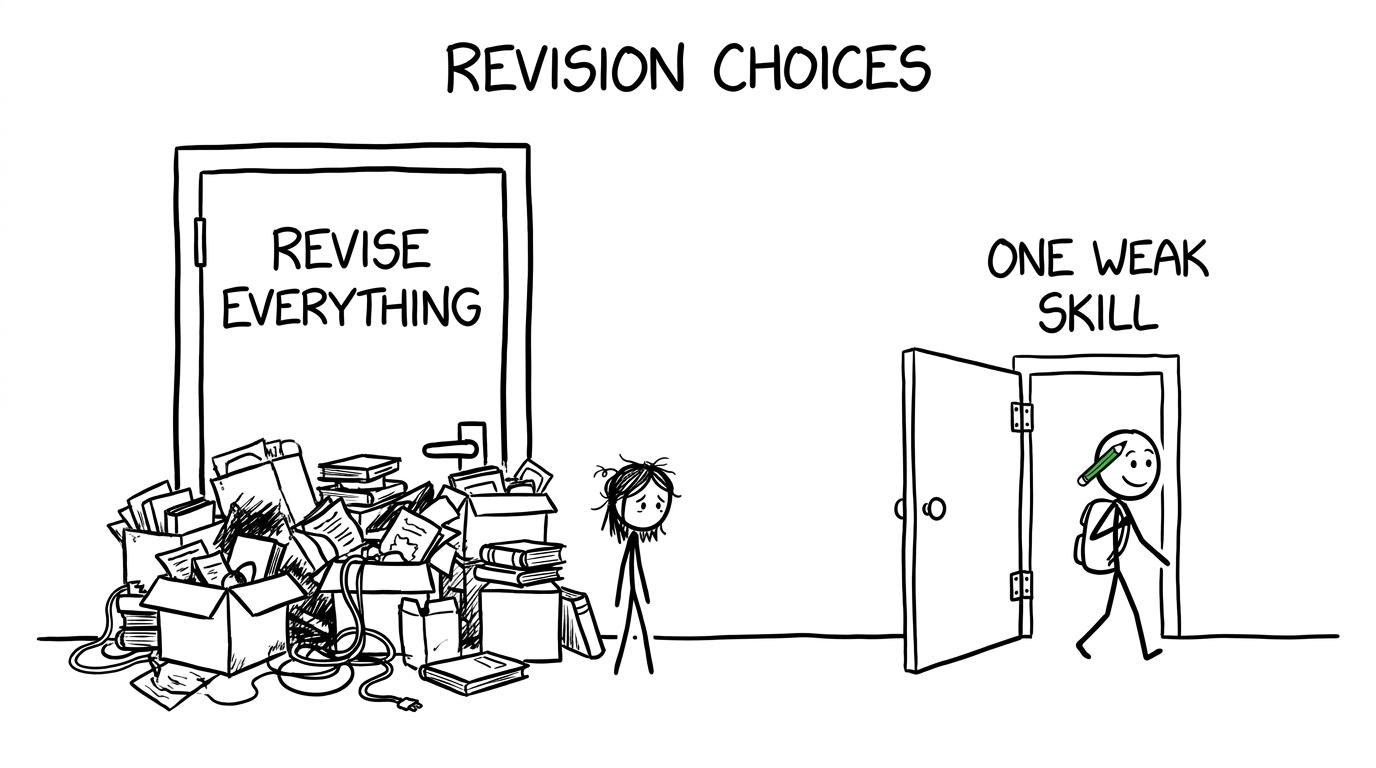 A student choosing one weak skill instead of trying to revise everything
Common mistakes when revision time is scarce
Waiting for a completely free evening
A free evening may never arrive. Put small tasks into existing gaps and reserve longer blocks for work that genuinely requires them.
Revising only vocabulary
Vocabulary matters, but knowing isolated words is not the same as understanding a recording or constructing an accurate response. Rotate through all assessed skills.
Memorising answers without learning to adapt them
A rehearsed phrase bank can help, but the examination question may change its focus. Practise reshaping familiar language around different prompts.
Ignoring Modern Standard Arabic
Home exposure or confidence in a regional dialect can be a strength, especially for listening and speaking. However, it does not replace specification vocabulary, formal grammar, accurate reading and written Modern Standard Arabic.
Completing tasks without checking them
Unreviewed practice can repeat an error until it feels normal. Leave time for a mark scheme, teacher feedback, a transcript or careful self-checking.
Sacrificing sleep to rescue the timetable
Late-night revision often creates a second problem: the next day's lessons become harder to use. Reduce the task before removing the sleep that supports attention and recall.
A calm plan for the final weeks
As the examination approaches, keep short retrieval sessions but make the weekly longer block more exam-specific. Alternate the focus: one week listening and reading, the next speaking and writing, while continuing to revisit recorded errors.
Confirm the speaking assessment arrangements with your school early. Unlike a written paper that arrives on the national timetable, speaking assessments are conducted within an official window organised by centres. Your teacher can tell you the relevant date, format and preparation rules.
For maths, progress from topic practice to timed sections and full papers. The one-month GCSE maths revision plan provides a structure when several subjects are competing for attention.
A busy schedule changes the shape of revision, not its value. Small sessions work when they are specific, active and followed by feedback. Open the MathsGenie GCSE hub today, choose one revision lesson or mini test, and put your next Arabic retrieval session beside it. Then build towards practice questions, mark schemes, video solutions, past papers and predicted papers: one manageable task at a time.










