GCSE Arabic 5 to 7: A Practical Grade Guide
GCSE Arabic 5 to 7 guidance: learn what separates the grades and improve listening, speaking, reading and writing with a focused revision plan.
A grade 555 in GCSE Arabic often means you can communicate clearly on familiar topics, understand the main message and express relevant opinions. A grade 777 demands something more deliberate: greater detail, wider vocabulary, stronger grammatical control and the ability to respond when the language becomes less predictable.
That is the practical answer to the gcse arabic 5 to 7 question. You do not need to abandon everything that earned the grade 555. You need to make your language more flexible, accurate and developed across listening, speaking, reading and writing.
One important point comes first. Under the current Pearson Edexcel GCSE Arabic specification, Foundation tier targets grades 111 to 555, while Higher tier targets grades 444 to 999. A student aiming for grade 777 must therefore be entered for Higher tier across all four papers. Confirm your tier and specification with your teacher before building your revision plan.
Your grade 555 to grade 777 checklist
Focus on these changes:
- move from recognising the main message to extracting precise details;
- replace short, safe answers with developed communication;
- use past, present and future time frames confidently;
- justify opinions rather than merely stating them;
- recognise unfamiliar vocabulary through context and word patterns;
- improve accuracy without avoiding ambitious structures;
- prepare for unpredictable speaking questions;
- practise all four skills rather than relying on your strongest one;
- mark work carefully and keep an error log;
- complete Higher-tier tasks under realistic time pressure.
The goal is not to sound perfect. It is to communicate convincingly while showing enough range and control for the higher grade band.
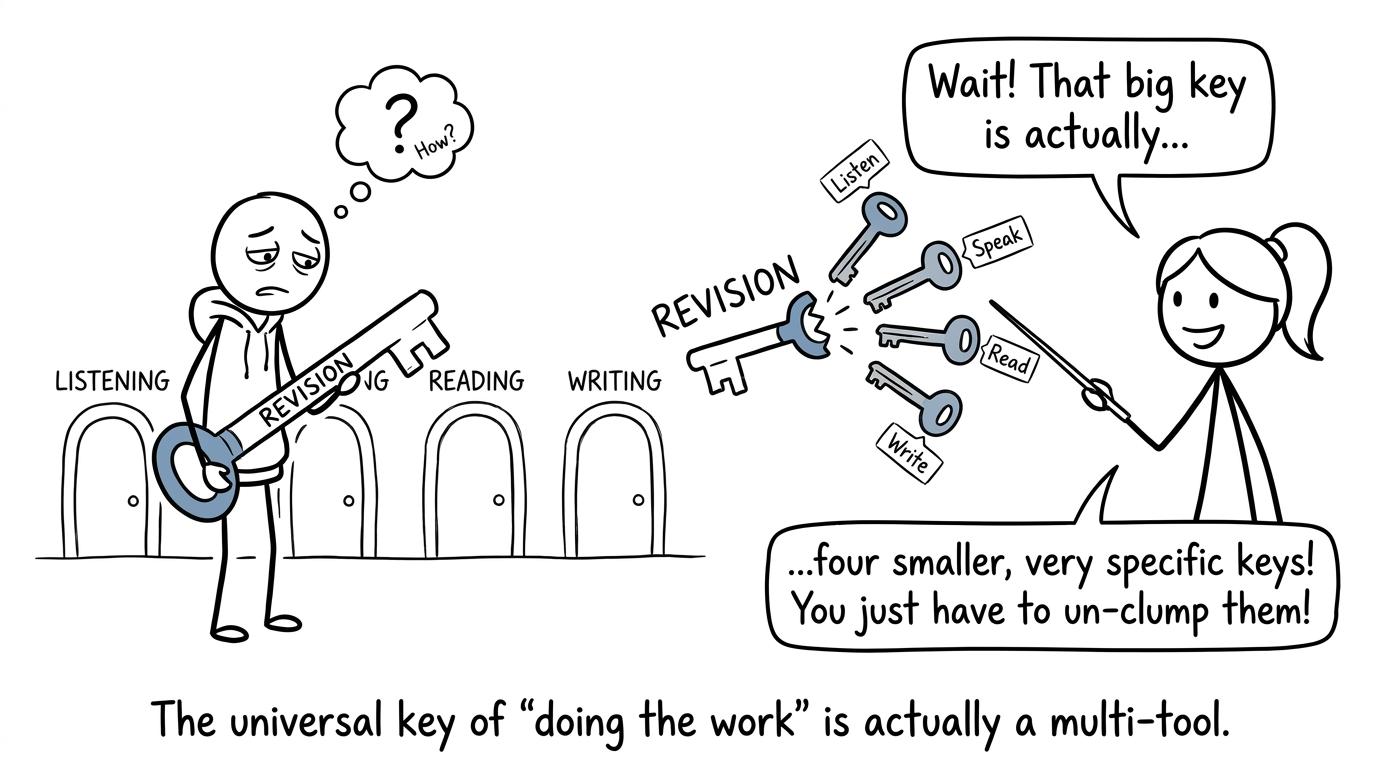 A student discovers that one revision key must become four skill keys
What separates a grade 555 from a grade 777 in GCSE Arabic?
Official GCSE modern foreign language grade descriptors explain that a grade 555 student can identify messages, details and opinions in some extended material. In speaking and writing, the student can manipulate language with reasonable accuracy and communicate ideas for different purposes.
There is no separate official grade 777 descriptor of the same kind. It is therefore better not to treat grade 777 as a fixed checklist. In practice, it sits between the published grade 555 and grade 888 standards. The movement is towards more sustained communication, more complex material, greater independence and more consistent accuracy.
| Grade 555 performance | Movement towards grade 777 |
|---|---|
| Understands main points and some details | Identifies precise details, viewpoints and changes of direction |
| Gives relevant but sometimes brief answers | Develops answers with reasons, examples and consequences |
| Uses familiar vocabulary securely | Selects broader vocabulary and paraphrases missing words |
| Uses some different time frames | Moves accurately between past, present and future references |
| Handles prepared material | Responds effectively to less predictable questions |
| Makes errors but usually communicates | Controls frequent structures and checks recurring errors |
| Completes tasks adequately | Covers every bullet and adapts language to purpose |
A grade rises when these improvements appear repeatedly. One impressive paragraph cannot compensate for neglected listening or unfinished speaking answers.
Understand how the qualification is assessed
Pearson Edexcel GCSE Arabic has four compulsory papers: listening, speaking, reading and writing. Each skill contributes 25%25\%25% of the qualification. There is no mixed-tier entry, so the same tier applies across all four papers.
That equal weighting changes the revision calculation. If your total revision time is TTT, a neutral starting allocation would be:
T4\frac{T}{4}4Tfor each skill. You should then adjust that allocation using evidence from marked work. A strong reader who struggles to speak spontaneously may need more speaking time, but reading should not disappear from the timetable.
Grade boundaries are set after each examination series and can change with paper demand. Do not turn a previous boundary into a permanent target. Build a margin by improving the quality of your performance across the whole qualification.
Make vocabulary active rather than decorative
Grade 555 students often know more vocabulary than they can use. A word looks familiar on a list, but it does not arrive when an answer must be spoken or written.
For each of the specification’s five broad themes, organise vocabulary by function:
- describing people, places and experiences;
- giving and justifying opinions;
- narrating past events;
- discussing plans and ambitions;
- comparing alternatives;
- explaining problems, causes and solutions.
Revise words inside short phrases and sentences rather than as isolated translations. Include verbs, connectors and opinion structures alongside topic nouns. Retrieval should work in both directions: recognise Arabic in listening and reading, then produce it in speaking and writing.
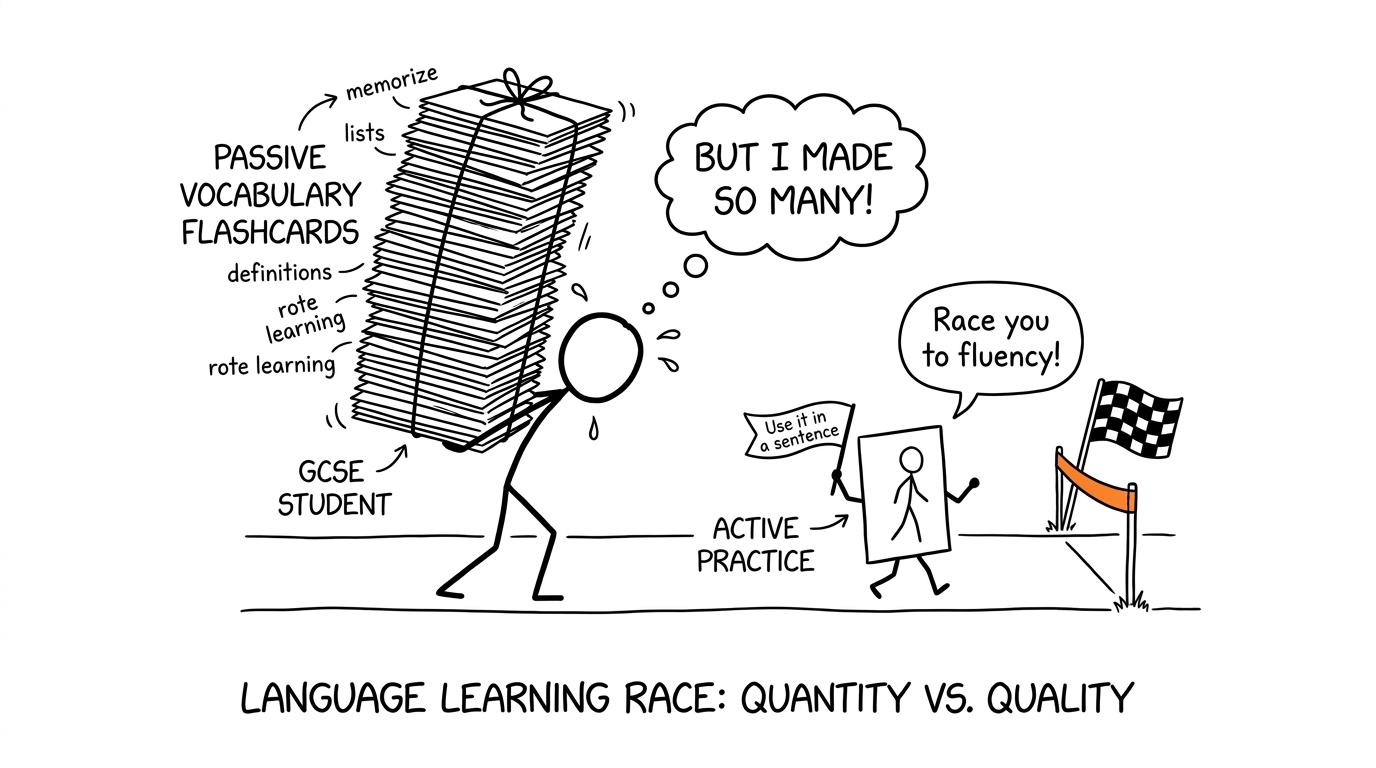 A tiny active sentence card overtakes an enormous pile of passive vocabulary cards
Improve each GCSE Arabic paper deliberately
Listening: listen for meaning that changes
Higher-tier listening is not simply faster Foundation material. It can involve longer passages, less familiar contexts and details that qualify or reverse an earlier idea.
Before the recording begins, read the question carefully and predict the type of information required. During the audio, listen for time references, negatives, opinions, contrasts and corrections. Do not select an answer because you heard one matching word.
After practice, use the transcript where available. Find the exact phrase that carried the answer and record why you missed it: unknown vocabulary, sound recognition, lost concentration or misunderstanding the question. That diagnosis is more valuable than replaying the whole recording without a purpose.
Speaking: develop rather than recite
The Edexcel speaking assessment includes a role play, a picture-based task and a conversation. At Higher tier, students must sustain communication and deal with questions that are not entirely predictable.
Build answers in layers:
- give a direct response;
- add a reason;
- supply a relevant detail;
- refer to another time frame where natural;
- be ready for a follow-up question.
Memorised material can provide useful structures, but a rigid script is fragile. Examiners assess communication and interaction, so practise changing the person, topic, tense or opinion within familiar language. Record yourself and check clarity, pronunciation, hesitation and whether you actually answered the question.
Reading: infer before reaching for a translation
Higher-tier reading rewards more than word recognition. Texts may include emails, articles, advertisements, letters and literary material, followed by questions in English or Arabic. The paper also includes translation from Arabic into English.
When a word is unfamiliar, examine its root, surrounding words and grammatical role. Ask whether the sentence is positive or negative and how it connects with the previous sentence. A student moving towards grade 777 can tolerate uncertainty without abandoning the entire passage.
For translation, preserve meaning rather than copying Arabic word order mechanically. Check tense, pronouns, possession, negatives and whether the English sentence sounds complete.
Writing: plan for coverage, range and accuracy
Higher-tier writing contains extended responses and translation into Arabic. Before writing, identify every required bullet and assign content to each one. Missing a bullet is avoidable; adding relevant development is valuable.
Aim to combine secure language with selective ambition. Use a range of time references, opinions, reasons and linking structures, but do not force complexity into every sentence. Reserve time to check verb forms, agreement, spelling, pronouns and whether your response answers the exact task.
A useful final check is simple: coverage, communication, range, accuracy. If one is missing, the response is less likely to sustain a grade 777 standard.
Use an evidence-led revision routine
Progress becomes easier when revision creates feedback. Use this weekly cycle:
- complete one timed task from each skill;
- mark it using the official mark scheme or teacher feedback;
- record the precise reason for every lost mark;
- practise the weakest language feature;
- repeat a similar task several days later;
- compare the new attempt with the first one.
MathsGenie’s guidance on finding your weakest GCSE topics explains how to turn lost marks into specific revision decisions. Its guide to using past papers properly and the advice on using mark schemes as a revision coach apply just as well to language practice: attempt, mark, diagnose, repair and retest.
Use the free MathsGenie revision planner to protect regular Arabic sessions alongside maths and your other GCSE subjects. Short, repeated practice usually gives you better evidence than occasional unfocused revision marathons.
A balanced weekly plan
A practical week could include:
- one listening session focused on detail and distractors;
- one recorded speaking session with follow-up questions;
- one reading and translation session;
- one planned Higher-tier writing task;
- one short vocabulary retrieval session on most days;
- one review of your error log at the end of the week.
Students preparing for maths exams can keep the same revision rhythm across subjects. The GCSE Maths revision hub provides structured lessons and question practice, while Edexcel GCSE Maths mini tests offer short diagnostic work. Nearer the exams, Edexcel GCSE Maths predicted papers can be used for timed practice. These are maths resources rather than Arabic materials, but the feedback loop is identical.
Common mistakes that hold students at grade 555
Revising only vocabulary lists
Vocabulary matters, but knowing a translation is not the same as understanding it in fast speech or using it accurately in a sentence. Move every important item into listening, speaking, reading and writing practice.
Giving opinions without development
A simple opinion may communicate, but higher-grade responses need sustained meaning. Add reasons, details, comparisons or consequences where the task allows.
Avoiding difficult grammar completely
Accuracy matters, yet permanently using only short present-tense statements limits range. Introduce more demanding structures gradually, then correct the errors that recur.
Memorising an inflexible speaking script
A script can collapse when the question changes. Memorise adaptable language patterns and practise responding to unexpected follow-ups.
Treating a completed paper as finished revision
The real improvement happens after marking. Record what went wrong, repair it and retest it. Otherwise, completing more papers may simply rehearse the same weaknesses.
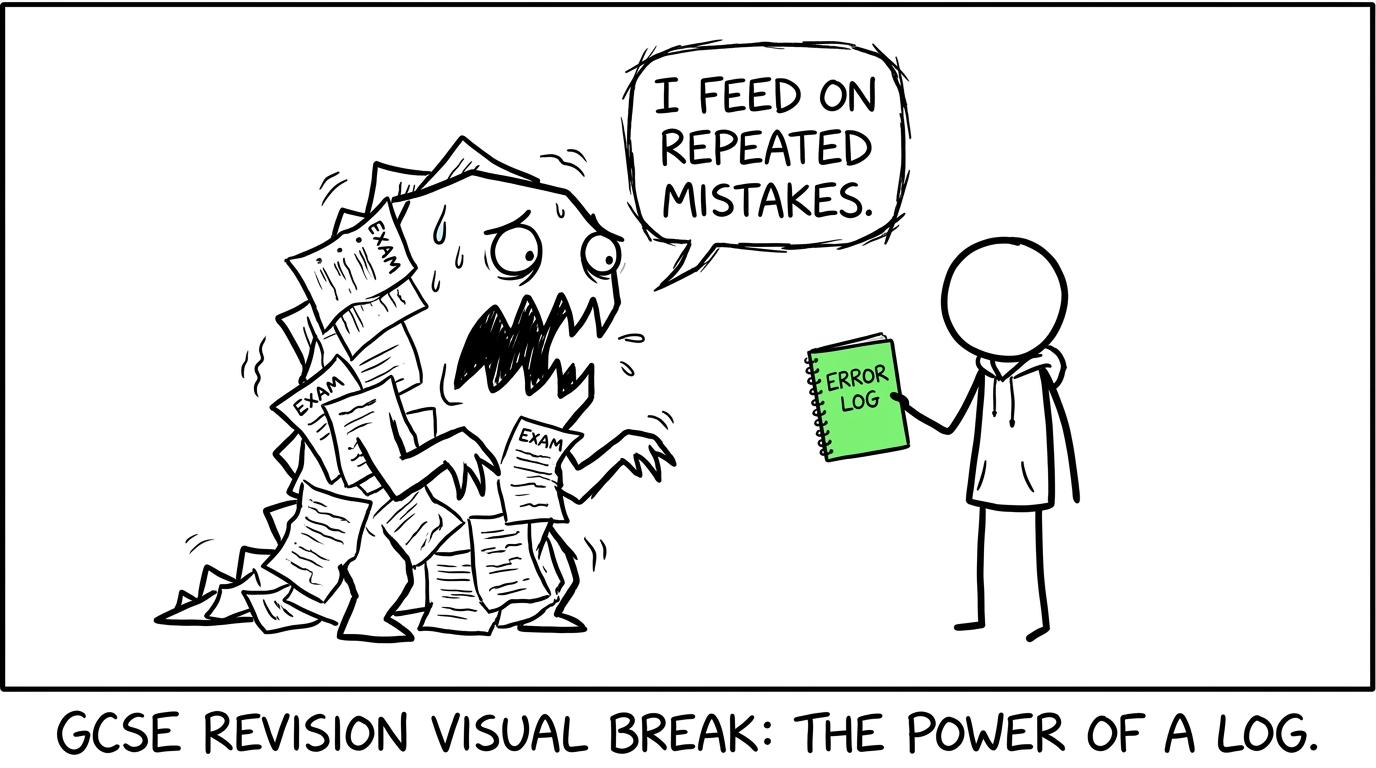 An exam-paper monster becomes nervous when a student opens an error log
Make the move measurable
Going from grade 555 to grade 777 in GCSE Arabic is not about collecting the longest possible vocabulary list. It is about becoming harder to unsettle: you understand more detail, sustain your answers, manipulate familiar language and recover when something unexpected appears.
Begin by confirming Higher-tier entry with your teacher. Then complete one task in each skill, identify where marks disappear and build your next week around those findings.
Keep MathsGenie open as your free maths revision base while you do it. Use its revision lessons and practice questions to strengthen weak maths topics, mini tests to check recall, and past papers, predicted papers, mark schemes and video solutions to build exam performance. One organised feedback system can support both subjects and turn revision from guesswork into evidence.