

GCSE Arabic 4 to 7: A Practical Revision Plan
GCSE Arabic 4 to 7: learn what separates the grades, improve speaking, listening, reading and writing, and build a focused weekly revision plan today.
Moving from a grade 4 to a grade 7 in GCSE Arabic is not mainly about memorising three times as many words. It is about changing what you can do with the language. A grade 4 response usually communicates familiar ideas with reasonable success. A grade 7 response is more developed, accurate and adaptable, showing that you can understand detail, justify opinions and handle less predictable language.
That is the central idea behind a gcse arabic 4 to 7 revision plan: keep the secure foundations, but add range, precision and independence. You also need to be entered for Higher tier because Foundation tier cannot award grade 7.
This guide focuses on the current Pearson Edexcel GCSE Arabic qualification, specification 1AA0. Confirm your specification, tier and exam arrangements with your school, as GCSE Arabic is different from International GCSE Arabic qualifications.
Your grade 4 to grade 7 checklist
Before changing your revision timetable, check that your plan includes all of these:
- Confirm that you are preparing for Higher tier.
- Diagnose listening, speaking, reading and writing separately.
- Learn vocabulary as phrases and sentence patterns, not isolated words.
- Develop opinions with reasons, examples and comparisons.
- become comfortable referring to past, present and future events.
- Practise responding without relying on a memorised script.
- Use official past papers and mark schemes from your exam board.
- Keep a record of recurring vocabulary, grammar and exam-technique errors.
- Reattempt difficult tasks after correcting them.
The four Edexcel skills each contribute 25%25\%25% of the qualification. A strong writing score cannot completely conceal neglected listening or speaking. Improvement needs to be balanced.
What separates a grade 4 from a grade 7 in GCSE Arabic?
Official language grade descriptors do not reduce each grade to a single trick. They describe a progression in the quality of communication.
At around grade 4, a student can normally understand longer passages on familiar subjects, identify key points and some details, and write short texts using common language. Familiar structures may be reasonably accurate, although ambiguity and noticeable errors remain.
By grade 7, the evidence needs to be securely above grade 6 performance and moving towards the qualities associated with grade 8. In practical terms, that means understanding more extended language, identifying opinions and reasons, coping with some unfamiliar contexts, developing ideas and using more complex language with greater control.
The difference can be summarised through five changes:
- From identifying to interpreting: you move beyond the main message and notice reasons, attitudes and implied meaning.
- From stating to developing: an opinion is followed by an explanation, example or consequence.
- From rehearsed to adaptable: you can modify familiar language when the question changes.
- From simple to varied: sentences include a controlled range of structures, time frames and connectives.
- From occasional accuracy to dependable accuracy: familiar grammar is usually secure, even when the content becomes more ambitious.
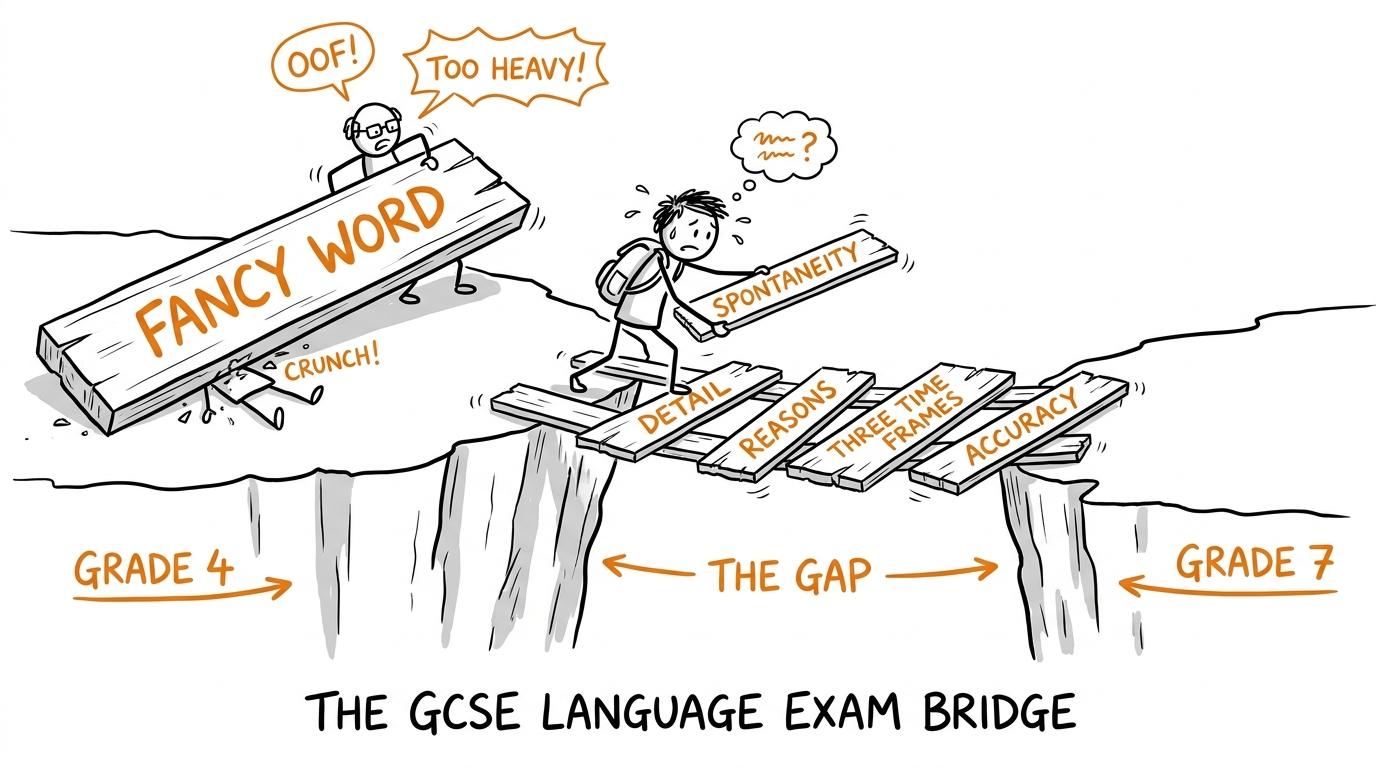 A student building a bridge from grade 4 to grade 7 with useful language skills
Make listening revision active
Grade 4 listening often depends on recognising familiar words. That works until a recording includes a distractor, a change of opinion or a phrase you have not memorised exactly.
Grade 7 listening is more selective. You need to follow the sentence as a whole and distinguish between what was considered, what actually happened and what the speaker now believes.
Build this skill through short, repeatable sessions:
- Listen once under exam conditions and answer without pausing.
- Listen again and note the precise phrase that supports each answer.
- Use the transcript, when available, to find missed vocabulary or grammar.
- Classify the mistake as vocabulary, sound recognition, attention or inference.
- Return to the same extract later without looking at your previous answers.
Do not treat every missed answer as a vocabulary problem. Sometimes the word was known, but a negative, tense change or contrasting phrase changed its meaning. Your correction must address the real cause.
Turn speaking answers into conversations
A student working at grade 4 may give relevant but brief answers. The examiner asks a question, the student answers, and the exchange stops. At grade 7, responses are more likely to be developed, spontaneous and naturally connected to the question.
For Edexcel, speaking includes a role play, a picture-based task and a conversation. The mark criteria reward communication, content, linguistic knowledge and accuracy. In the conversation, interaction and spontaneity also matter.
Improve by preparing flexible building blocks rather than memorising entire speeches. You should be able to:
- answer directly before adding detail;
- express and justify an opinion;
- narrate something that happened;
- discuss a future intention;
- compare two possibilities;
- ask or respond to an unpredictable question;
- repair an answer if you forget a word.
Record your responses and listen back with a checklist. Was the answer relevant? Did it contain a reason? Were verbs controlled? Was pronunciation clear enough to support communication? Could the same answer be adapted to a slightly different question?
A polished script can create false confidence. If changing one word in the prompt causes the whole answer to collapse, the language has been stored rather than mastered.
Read for structure, not just vocabulary
Reading at grade 7 involves more than translating each line. You must locate evidence, distinguish fact from opinion and sometimes infer meaning from context.
When reviewing a text, mark its structure:
- words introducing contrast or cause;
- references to past, present and future events;
- positive and negative opinions;
- pronouns and the nouns to which they refer;
- clues surrounding an unfamiliar word;
- evidence that directly answers the question.
Pay close attention to the language in which an answer is required. In Edexcel reading, questions can be set in English or Arabic. A correct idea written in the wrong language may not satisfy the instruction.
Translation also needs deliberate practice. Preserve the meaning, tense, person and level of certainty. Word-for-word substitution can produce an unnatural or inaccurate answer even when every individual word looks plausible.
Write with development and control
Higher-tier writing rewards relevant communication, expanded ideas, appropriate style, vocabulary range and grammatical accuracy. Ambition helps only when it remains understandable.
Before writing, turn every bullet point into a small content target. Then plan how you will show range across the response. Useful evidence includes:
- developed opinions rather than unsupported statements;
- references to different time frames;
- a mixture of shorter and extended sentences;
- accurate linking and sequencing;
- specific vocabulary suited to the topic;
- consistent agreement, spelling and verb formation;
- an appropriate register for the purpose.
Do not force obscure vocabulary into every sentence. Grade 7 writing is not a competition to sound unusual. A varied response with mostly secure language is stronger than an ambitious response whose errors repeatedly obscure the meaning.
After writing, proofread in passes. First check whether every task bullet has been answered. Then check verbs and time frames. Finally inspect agreement, spelling, connectives and repeated vocabulary. Trying to notice everything simultaneously makes proofreading shallow.
Build vocabulary that survives the exam
Long vocabulary lists feel productive because progress is easy to count. Unfortunately, recognition is not the same as recall, and recall is not the same as using a word accurately in a sentence.
Organise vocabulary by function as well as theme. Alongside school, travel and family language, build collections for:
- giving and qualifying opinions;
- explaining causes and consequences;
- comparing experiences;
- describing frequency;
- narrating events;
- discussing plans;
- expressing advantages and disadvantages.
Retrieve words from memory before checking them. Then use each item within a phrase and vary the person or time frame where appropriate. Revisit difficult language across several days instead of relearning a large set once.
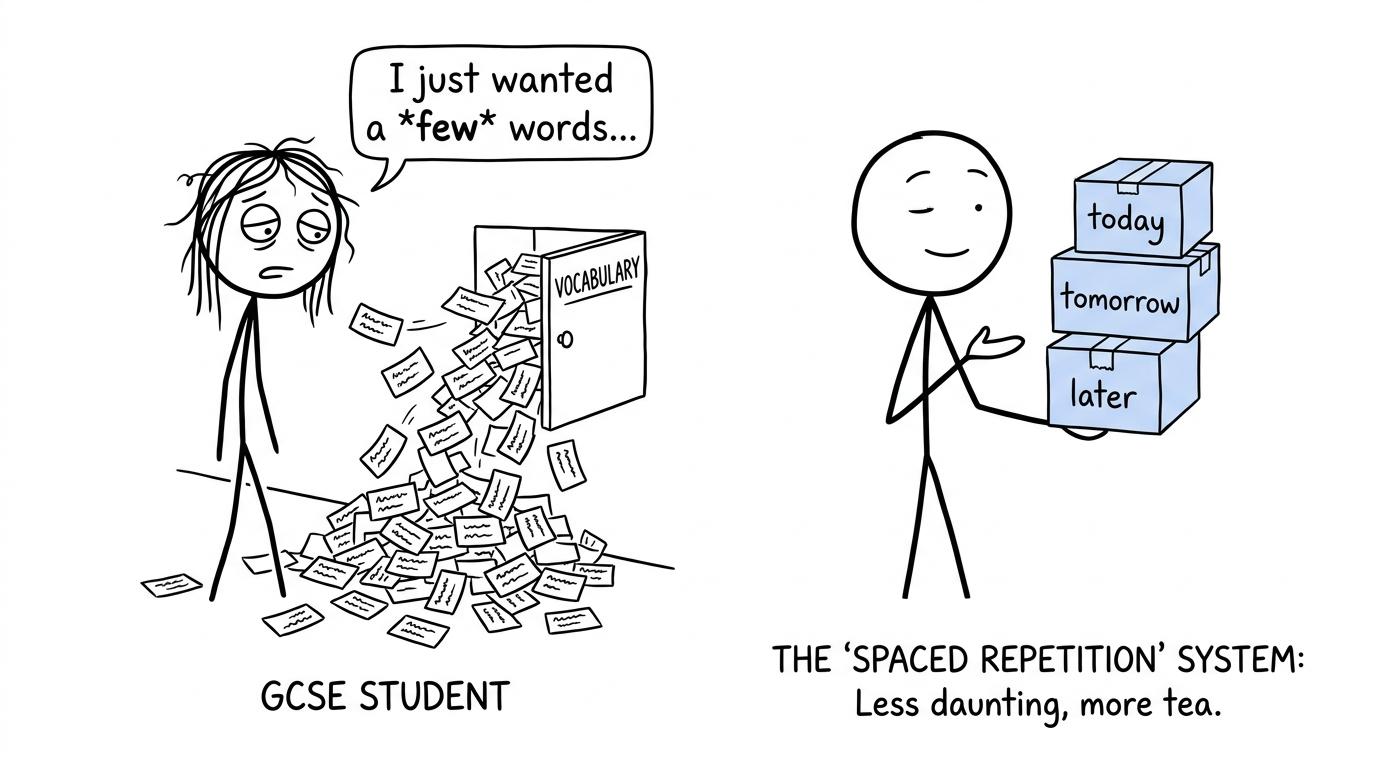 A student organising an avalanche of vocabulary cards into manageable revision boxes
Use a weekly revision cycle
A reliable grade-improvement plan alternates learning, testing and correction. Simply spending more time with notes does not guarantee better performance.
A balanced week could include:
- one listening session followed by transcript analysis;
- one recorded speaking session;
- one reading or translation task;
- one timed writing task;
- one short grammar and vocabulary review;
- one correction session devoted to previous mistakes.
Keep the sessions manageable enough to repeat. Maths students can use the same diagnostic habits across both subjects: attempt, mark, classify, correct and retest. The MathsGenie GCSE revision timetable guide explains how to build that cycle around school and other subjects.
If you are balancing Arabic with maths revision, use the GCSE Maths revision hub to avoid wasting time searching for separate lessons and questions. Short Edexcel GCSE Maths mini tests can also fit beside an Arabic speaking or vocabulary session without overwhelming your timetable.
Practise papers as diagnosis, not prediction
A past paper is useful because it reveals how you perform without support. Complete tasks using the correct tier, timing and permitted materials. Afterwards, do more than record the total mark.
For every lost mark, identify whether the cause was:
- missing vocabulary;
- insecure grammar;
- misunderstanding the instruction;
- insufficient detail;
- weak inference;
- poor time management;
- an avoidable accuracy error.
Then choose a specific repair task. This approach is explained further in MathsGenie's guide to using past papers properly. Although the examples concern maths, the principle transfers directly: a paper is not finished until its mistakes have changed your next revision session.
For your maths preparation, you can apply the same loop using Edexcel GCSE Maths past papers and Edexcel predicted papers. Predicted papers should add fresh practice, not replace official past papers.
Common mistakes when aiming for grade 7
Remaining on Foundation tier
Foundation tier offers grades 111 to 555. A student aiming for grade 7 must take Higher tier across all four Edexcel Arabic papers. Discuss tier entry with your teacher early rather than assuming it will change automatically.
Revising only the strongest skill
Reading may feel safer than speaking, but each skill contributes 25%25\%25%. Give weaker areas more attention while continuing to maintain your strengths.
Memorising answers word for word
Memorised material can help with useful structures, but complete scripts are fragile. Practise answering varied questions so that your language becomes adaptable.
Adding complexity without control
Long sentences do not automatically earn high marks. Build from accurate familiar structures, then add carefully chosen complexity.
Ignoring the task bullets
An elegant response cannot recover content that was never addressed. Check every bullet before writing and again before finishing.
Recording marks without fixing mistakes
A score tells you where you are, not what to do next. Keep an error log and revisit each weakness through focused practice.
Make the next revision session count
The distance between grade 4 and grade 7 is built from small changes repeated consistently: one answer developed, one tense corrected, one listening distractor understood and one speaking response made more spontaneous.
Start by confirming Higher tier and completing one honest diagnostic task in each skill. Use the results to choose a small number of priorities, then repeat the cycle of practice, marking, correction and retesting.
MathsGenie can keep the maths side of your GCSE timetable equally focused. Use its free revision lessons, practice questions, mini tests, past papers, predicted papers, mark schemes and video solutions to protect your time and target the marks you are currently losing. Better revision is rarely about doing everything. It is about noticing what matters, then returning to it until it becomes dependable.










