

Gamify Revision GCSE English Language: Does It Work?
Gamify revision GCSE English Language effectively with rewards that support real practice, feedback and progress rather than distracting from marks.
Revision has a strange temptation built into it: organising the work can feel more satisfying than doing the work. A colourful progress bar moves. A streak reaches ten days. Points accumulate. Meanwhile, the blank English Language response remains blank.
If you want to gamify revision GCSE English Language, the short answer is yes; it can help you begin, persist and see progress. But points, streaks and rewards do not improve your grade by themselves. Gamification works only when it leads to the activities the exam rewards: reading unseen texts, planning responses, writing under time pressure, checking against assessment objectives and acting on feedback.
The game should support the revision. It must not become the revision.
The quick verdict on gamified English revision
Use this checklist before adopting any revision game:
- Reward completed exam practice, not time spent looking at resources.
- Award more credit for difficult, useful tasks than easy ones.
- Include feedback from a teacher, mark scheme or model response.
- Track improvements in specific skills rather than app activity.
- Revisit mistakes after a delay.
- Keep rewards small enough that they do not dominate the work.
- Avoid public leaderboards if comparison makes you anxious or encourages rushing.
This distinction matters for students balancing English with GCSE maths. A shared revision system can organise both subjects, but the evidence of progress looks different. In maths, you may track correct methods and marks. In English Language, you also need to examine the quality of interpretation, analysis, organisation and technical accuracy.
What does it mean to gamify revision?
Gamification means adding selected game-like features to a non-game activity. Common features include:
- points for completing meaningful tasks;
- levels that represent increasing challenge;
- streaks for returning regularly;
- badges for reaching milestones;
- timed challenges;
- progress bars;
- rewards for correcting mistakes;
- optional competition or cooperation with others.
It is not the same as turning the entire subject into a game. Nor does it mean every revision session needs an app. A paper checklist with five boxes can be a better system than an elaborate digital dashboard if it gets you writing sooner.
Research reviews generally find that gamification can improve engagement and motivation, although results vary between learners and settings. The effects may also fade over time, and academic performance is not guaranteed simply because an activity feels enjoyable. Leaderboards can motivate some learners while frustrating or discouraging others.
That is why the most useful question is not, “Is gamification good?” It is, “What behaviour is this game encouraging?”
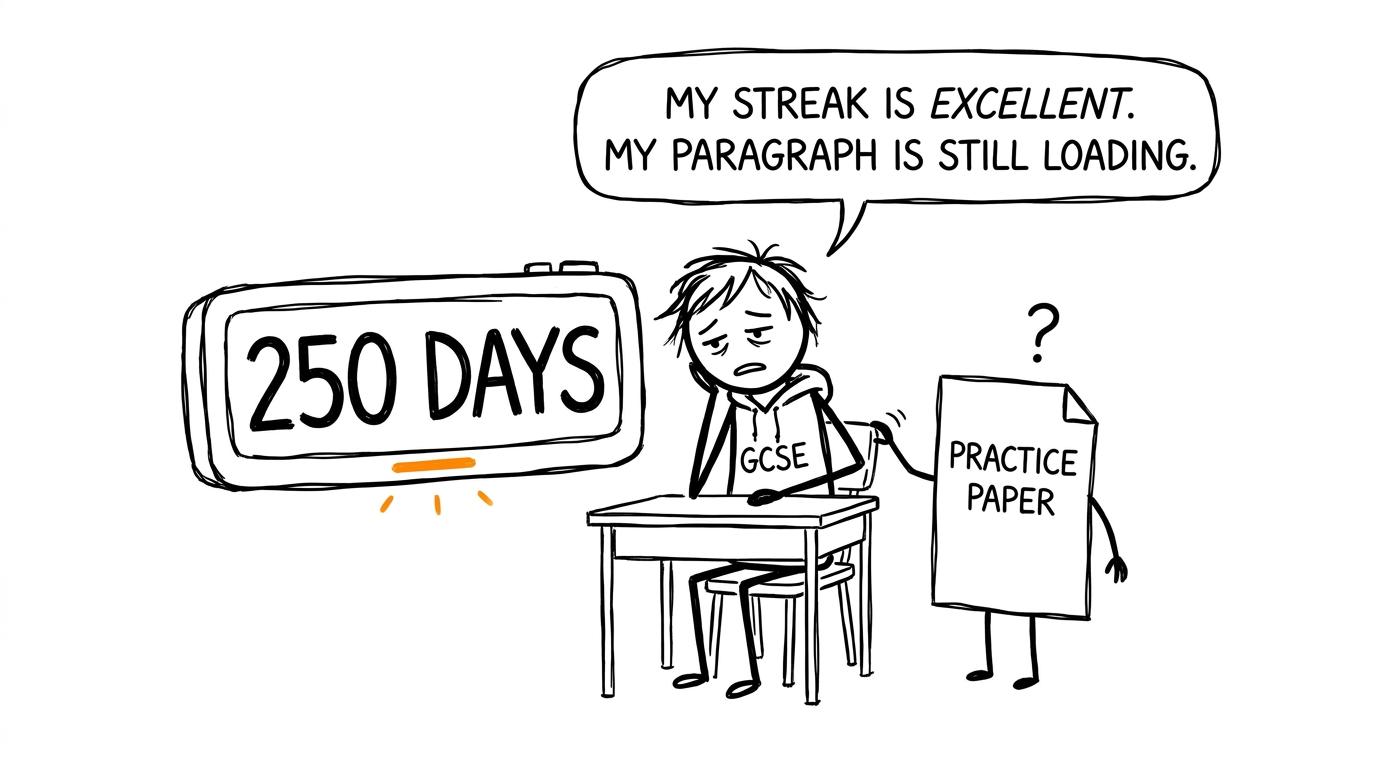 A student protects a revision streak while an untouched practice paper waits
Why English Language needs more than quizzes
GCSE English Language is a skills-based, untiered qualification. Unlike GCSE maths, there is no foundation or higher tier. Although paper structures differ across Edexcel, AQA, OCR and Eduqas, the national assessment objectives require students to demonstrate reading and writing skills.
These include identifying and interpreting information, analysing language and structure, comparing perspectives, evaluating texts, communicating for a particular audience and purpose, and writing accurately. Technical accuracy under AO6 accounts for 20%20\%20% of the qualification.
A vocabulary quiz or terminology streak may support some of this knowledge. It cannot, on its own, show whether you can select precise evidence, develop an interpretation or sustain a coherent response under examination conditions.
English revision therefore needs two kinds of practice:
Short retrieval tasks
These can check terminology, punctuation rules, structural methods, assessment objectives or features of different forms. Retrieval is more useful when you attempt to remember before consulting notes and then receive corrective feedback.
Extended performance tasks
These ask you to apply knowledge to unseen material. They include planning an answer, analysing an extract, comparing viewpoints, improving a paragraph or completing timed writing.
The second category is harder to gamify because it cannot always be marked instantly. It is also where much of the valuable learning happens.
Which game features genuinely help?
Points can make effort visible
Points are useful when they represent actions connected to the exam. Awarding the same credit for watching a video and completing a timed response distorts the game: the easier activity will usually win.
A better system gives credit for attempting, checking and improving. It should value a corrected response more than a perfect-looking first attempt copied from notes. This follows the same principle as MathsGenie’s twenty-minute GCSE revision routine: attempt useful work, mark it, record the error and choose the next action.
Streaks can protect consistency
A streak reduces the daily decision about whether to revise. That can be helpful when starting is the main barrier.
But a streak measures attendance, not learning. Five rushed minutes completed to preserve a symbol may produce less progress than one thoughtful response followed by feedback. Build a flexible rule: a missed day pauses the record rather than destroying it. Revision should train resilience, not punish ordinary life.
Levels can create sensible progression
Levels work well when each stage changes the difficulty. You might progress from recalling an assessment objective, to identifying evidence, to explaining an effect, and finally to completing a timed response.
The important feature is progression in skill. A level that rises merely because you repeatedly complete easy quizzes creates confidence without enough challenge.
Rewards can help you start
A small reward after a demanding task can make revision easier to begin. The reward should follow the task and remain proportionate. If choosing, designing and monitoring rewards takes longer than the English practice, the system has become a pleasant distraction.
Leaderboards need caution
Competition can add energy, particularly in a supportive group where everyone completes the same challenge. Yet public rankings may reward prior attainment, speed or confidence rather than improvement. They can also encourage students to select easy tasks to collect points.
A personal best is often more useful: fewer unsupported claims, more accurate punctuation, stronger use of evidence or better completion within the time available.
Build a revision game that produces evidence
The strongest design is a simple loop:
Attempt; feedback; fix; retest.
This reflects evidence-informed guidance on retrieval practice. The attempt should require genuine recall or application, feedback should correct errors, and important material should return after a delay. MathsGenie’s guide to using GCSE mark schemes to improve English Language explains how to turn a descriptor into a specific improvement rather than merely recording a score.
Your game can contain four task categories:
- Recall: retrieve terminology, punctuation rules or assessment objectives without notes.
- Apply: annotate unseen material or plan a response.
- Perform: complete a timed paragraph, section or longer answer.
- Repair: use feedback to rewrite weak material and retest the skill later.
Make repair tasks worth at least as much as first attempts. Otherwise, the game quietly teaches you to value completion over improvement.
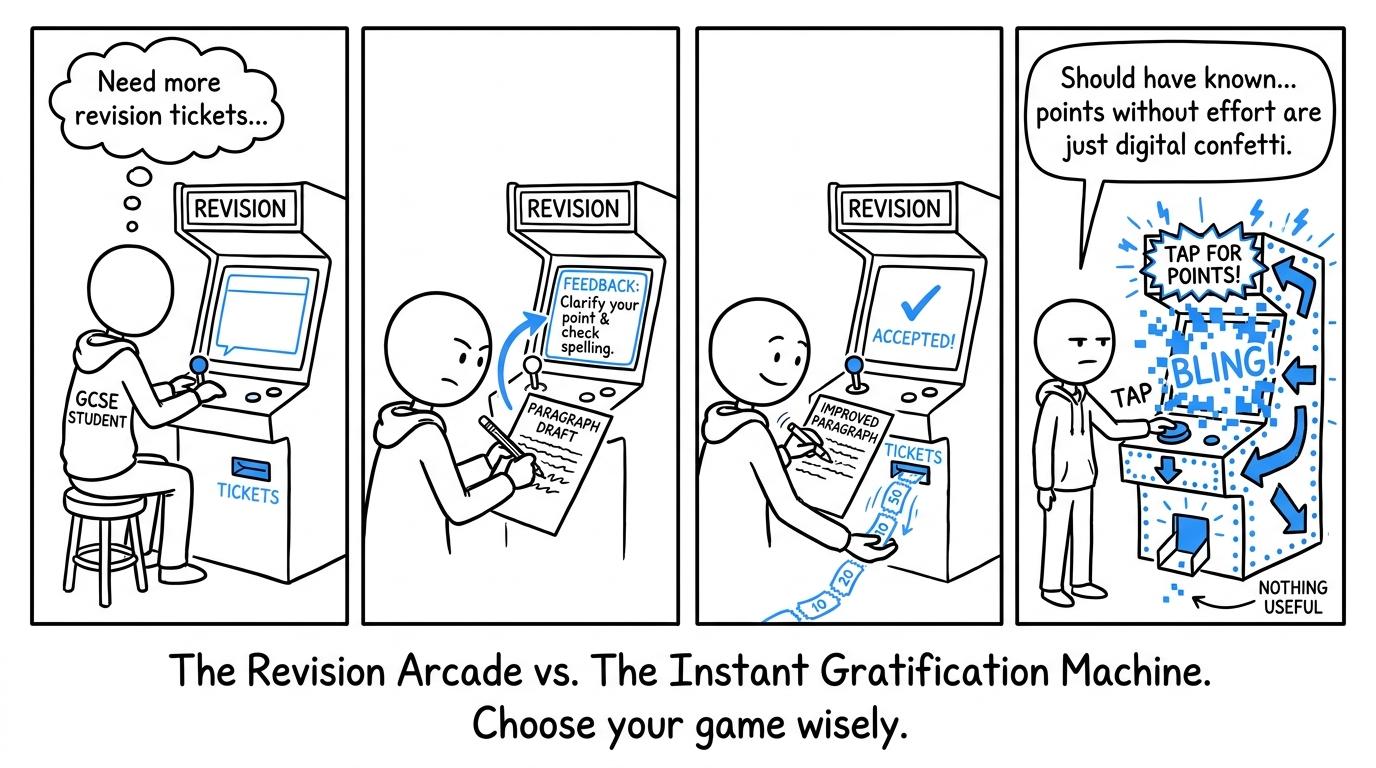 A useful revision arcade rewards writing, feedback and improvement
Measure what matters, not what is easy
Apps naturally count clicks, minutes and consecutive days because those are easy to measure. Exams do not award marks for any of them.
For English Language, useful progress measures include:
- whether evidence is relevant and integrated;
- whether analysis explains how a choice shapes meaning;
- whether comparisons address ideas and how they are conveyed;
- whether writing matches its audience, purpose and form;
- whether paragraphs are coherent;
- whether spelling, punctuation and grammar remain accurate under time pressure;
- whether repeated feedback is being acted upon.
Use your own exam board’s current specification and mark schemes because question formats and paper structures differ. A teacher is also better placed than an automatic quiz to judge the quality of interpretation or extended writing.
The same measurement principle improves maths revision. Start with the GCSE Maths revision hub, choose your board and tier, then use short tests to diagnose gaps. The Edexcel GCSE Maths mini tests provide quick challenges, while AQA GCSE Maths past papers, OCR GCSE Maths past papers and Edexcel GCSE Maths past papers provide more realistic evidence of performance.
A single revision game can hold both subjects, but the scoring criteria must respect what each examination assesses.
Common mistakes when you gamify revision
Rewarding passive activity
Watching explanations and reading notes can prepare you to practise, but they should not earn the highest reward. Give the greatest credit to recall, application, timed writing and correction.
Making the system too complicated
If you need a spreadsheet manual to understand your points, simplify it. A useful system should take seconds to update.
Protecting a streak at any cost
Streak anxiety can turn a motivational tool into another source of pressure. Build in rest days and recovery rules.
Using quizzes as the whole English strategy
Quick questions can strengthen knowledge. They cannot replace extended reading and writing. At least some sessions must resemble the work you will perform in the examination.
Marking only for a total
A score tells you where you are. Feedback tells you what to do next. Record one precise improvement after each substantial task and schedule a retest.
Comparing activity instead of improvement
The student with the most points may simply have completed the most easy tasks. Compare the quality of present work with earlier work instead.
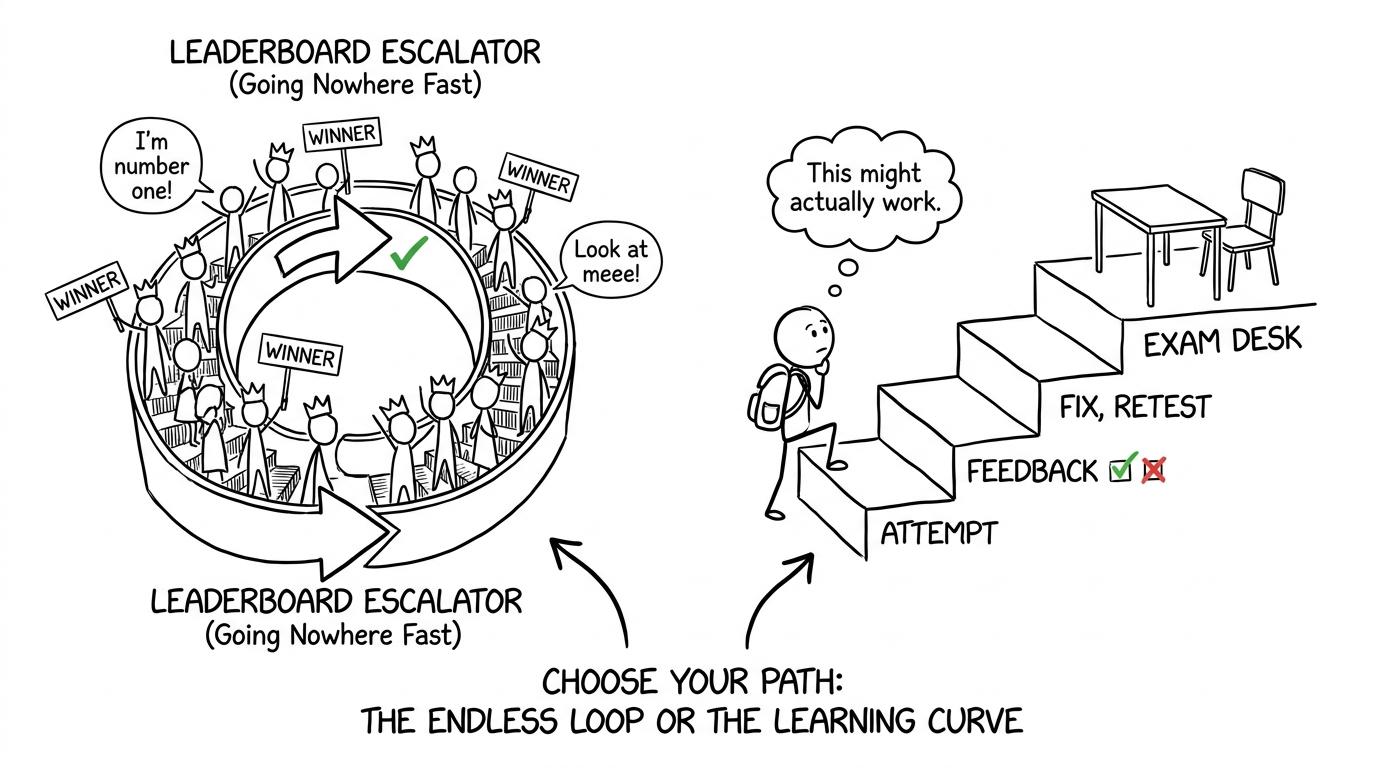 A feedback staircase leads forward while a leaderboard goes in circles
Make the game serve the grade
Gamification is most useful at the edge of revision: it helps you start, return and tolerate the discomfort of mistakes. The centre must remain real subject practice.
For English Language, that means unseen texts, purposeful writing, accurate technical control, timed responses and feedback linked to the assessment objectives. For maths, it means learning methods, answering exam-style questions, checking mark schemes and retesting weaknesses.
Use MathsGenie as the free home for the maths side of that routine. Begin with a GCSE one-month revision plan, then combine revision lessons and practice questions with mini tests, past papers, predicted papers, mark schemes and video solutions. Award yourself points if they help. Keep a streak if it makes starting easier. But let completed, corrected work be the achievement that matters.










