

From Mock to A*: An A-Level Maths Plan
From mock to A*: an A-Level Maths plan for diagnosing lost marks, targeting weak topics and building accurate, confident exam performance under pressure.
Mock results have a strange ability to feel permanent. One paper lands on a sixth-form desk, covered in annotations, and suddenly a student starts treating a snapshot as a forecast.
Imagine Maya, a hypothetical Year 13 student. She wants an A*, but her winter mock is below that standard. Her first instinct is to revise everything again. The better response is more precise: identify why each mark disappeared, repair the weakest skills, then practise choosing methods under timed conditions.
That is the heart of from mock to A: an A-Level Maths plan*. It is not a promise that one timetable guarantees a grade. It is a practical system for turning an A-Level maths mock into useful evidence.
Start with this checklist:
- Analyse every lost mark by cause, not just topic.
- Repair missing knowledge with focused practice.
- Mix topics so that method selection becomes part of the task.
- Complete timed sections before attempting frequent full papers.
- Revisit errors until the correct process can be reproduced unaided.
- Track raw marks, but do not treat an old grade boundary as a permanent target.
Treat the mock as evidence, not a verdict
Maya initially writes “calculus” beside several mistakes. That label is too broad to help. One error came from differentiating incorrectly. Another came from failing to recognise that a stationary point required setting the derivative equal to zero. A third was caused by rushing an interpretation in context.
These are different problems, even though they sit within the same chapter.
When reviewing A-Level maths mocks, place each lost mark into one of four categories:
- Knowledge: a formula, definition or method was not known.
- Execution: the right method was chosen but the algebra or arithmetic failed.
- Recognition: the knowledge existed, but the wording did not trigger the right approach.
- Exam control: time pressure, incomplete working or poor checking caused the loss.
This reflects how A Level Mathematics is assessed. The AQA specification, for example, distinguishes between standard techniques, mathematical reasoning and problem solving. Strong revision must therefore go beyond remembering procedures.
Use the relevant A Level Maths revision hub to match each error to its topic. Students following Pearson can go directly to the Edexcel A Level Maths revision resources, which organise pure maths, statistics and mechanics content in one place.
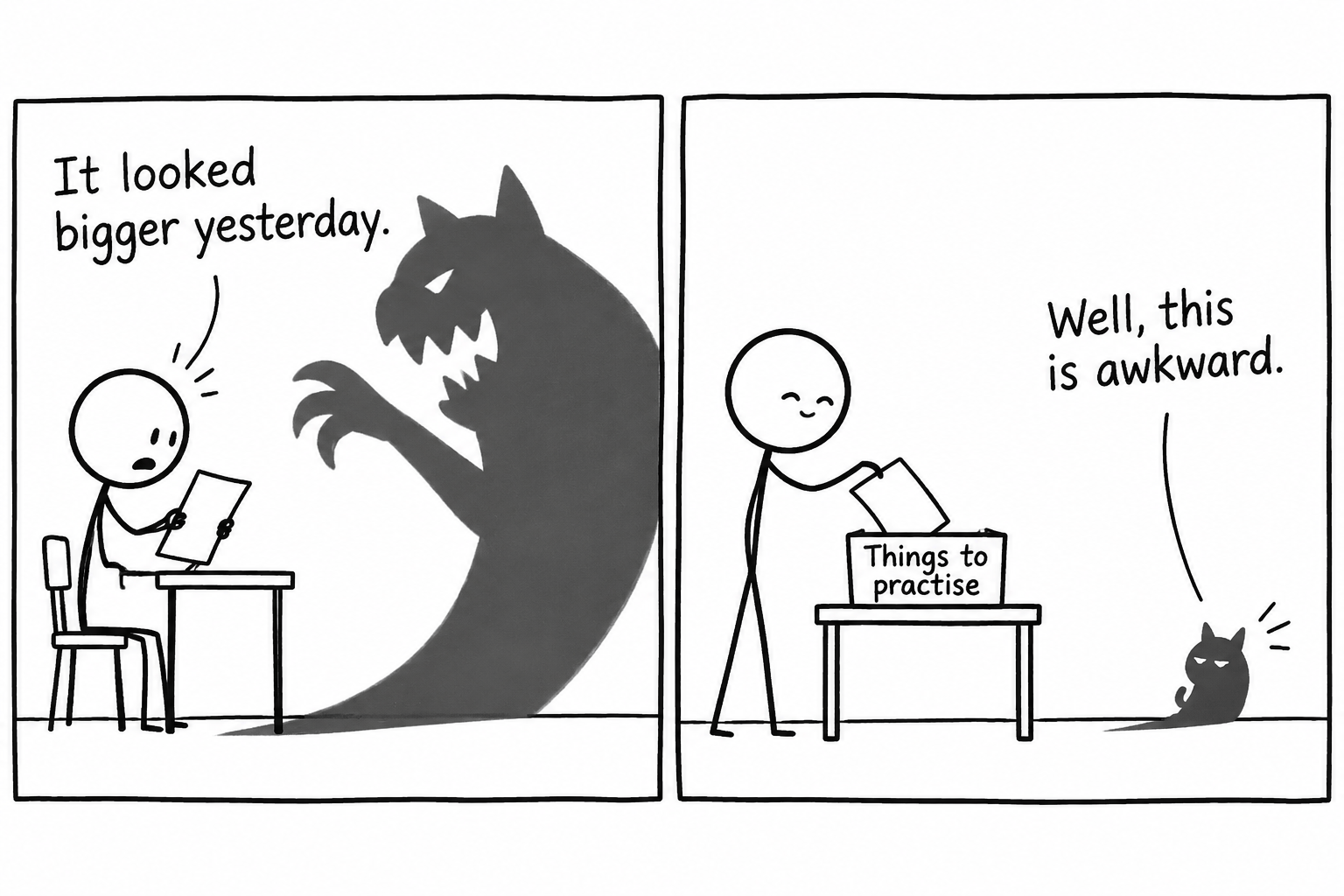 A mock paper loses its frightening shadow when placed in a practice tray
Repair one weakness completely
A common response to a disappointing mock is to answer hundreds of disconnected questions. Volume feels productive, but improvement depends on whether the same error disappears next time.
Maya chooses one calculus weakness and follows a short repair loop:
- Review the idea using A Level Maths video explanations.
- Complete several practice questions without time pressure.
- Mark every line against the solution or mark scheme.
- Close the solution and reproduce the method from memory.
- Test the same skill again several days later.
Worked example: classifying stationary points
Suppose Maya is given
y=x3−6x2+9x+2y=x^3-6x^2+9x+2y=x3−6x2+9x+2and asked to find and classify its stationary points.
She first differentiates:
dydx=3x2−12x+9\frac{dy}{dx}=3x^2-12x+9dxdy=3x2−12x+9At a stationary point,
dydx=0\frac{dy}{dx}=0dxdy=0so
3x2−12x+9=03x^2-12x+9=03x2−12x+9=0Dividing by 333 and factorising gives
x2−4x+3=0x^2-4x+3=0x2−4x+3=0 (x−1)(x−3)=0(x-1)(x-3)=0(x−1)(x−3)=0Therefore, x=1x=1x=1 or x=3x=3x=3. Substitution into the original equation gives the points (1,6)(1,6)(1,6) and (3,2)(3,2)(3,2).
To classify them, Maya finds the second derivative:
d2ydx2=6x−12\frac{d^2y}{dx^2}=6x-12dx2d2y=6x−12At x=1x=1x=1,
d2ydx2=−6\frac{d^2y}{dx^2}=-6dx2d2y=−6so (1,6)(1,6)(1,6) is a local maximum. At x=3x=3x=3,
d2ydx2=6\frac{d^2y}{dx^2}=6dx2d2y=6so (3,2)(3,2)(3,2) is a local minimum.
The important lesson is not merely differentiation. Maya needed to recognise three decisions: set the first derivative equal to zero, substitute into the original function, then use the second derivative to classify each point. Her error log should record the missed decision, not simply “stationary points”.
Build an A-Level maths revision week
Once immediate gaps are repaired, revision needs a repeatable rhythm. A realistic week might contain:
- Monday: one weak pure maths topic, followed by a short closed-book test.
- Tuesday: mixed pure questions requiring method selection.
- Wednesday: focused statistics or mechanics practice.
- Thursday: one timed exam section and detailed marking.
- Weekend: a longer mixed paper, followed by an error review.
The balance matters. Topic practice builds fluency because the method is known in advance. Mixed practice tests recognition because the method is hidden. Timed work adds the final pressure of deciding how long to persist and when to move on.
MathsGenie brings together revision lessons, practice questions, video solutions, mini tests, past papers and mark schemes. Predicted papers, where available, and the revision planner can then support the later stages of A-Level maths revision. The aim is not to use every resource at once. It is to choose the resource that answers the current problem.
Move from topics to timed papers
Maya does not begin by sitting a full paper every evening. That would repeatedly expose weaknesses without giving her enough time to repair them.
Instead, she progresses through three stages:
Untimed accuracy
She completes focused questions with full working. Her priority is selecting a valid method and communicating it clearly.
Timed sections
She combines several topics under a shorter time limit. This develops pace without the fatigue of a complete paper.
Full mock conditions
She completes papers without notes, interruptions or early access to the mark scheme. Afterwards, she marks them carefully and schedules every significant error for further practice.
The MathsGenie Mock Exam Builder is especially useful here because a custom mock can be built from exam-style questions. Students can then use the dedicated A Level Exam Builder to choose their subject and exam board.
If a completed paper needs structured feedback, the MathsGenie Paper Marker can mark uploaded work against the relevant mark scheme and provide a breakdown of where marks were gained or lost.
Common mistakes when aiming for an A*
Chasing a percentage instead of stronger mathematics
Grade boundaries can vary between exam series and exam boards. An old boundary may provide context, but it should not become a supposedly fixed target. Build a margin by improving accuracy across the specification.
Reading solutions without reproducing them
A worked solution often looks obvious after it has been read. Close it, wait briefly, then solve the question again from a blank page. Recognition is not the same as recall.
Avoiding statistics or mechanics
Students often devote most of their time to pure maths because its weaknesses feel more visible. A strong plan includes every assessed part of the course.
Counting papers rather than analysing them
Ten papers completed carelessly may teach less than three papers reviewed in depth. Record the cause of each error, correct it, and attempt a related question later.
Hiding working to save time
Compressed working makes slips harder to find and can prevent a valid method from being credited. Clear reasoning is not decoration. It is part of communicating mathematics.
Turn the next paper into a better experiment
By spring, Maya's mock is no longer something she wants to forget. It has become the first page of her revision plan. Each annotation points towards a skill to repair, a decision to practise or a habit to change.
That is the real journey from mock to A*. The grade remains an ambition, not a guarantee, but the process becomes controllable: diagnose carefully, practise deliberately, test under pressure and return to every recurring error.
Start by opening the A Level Mock Exam Builder. Build a targeted practice paper around the topics that cost you marks, sit it properly, and let the result decide what you revise next.















