

Fractional Indices GCSE Maths Explained
Fractional indices GCSE maths made clear with simple rules, worked examples, common mistakes and exam-style questions for confident revision.

A fractional index can make an ordinary number look unfamiliar. The fraction is small, but it changes the whole question. A student may remember something about roots, try dividing by the denominator, and discover from the mark scheme that the method has gone wrong.
That is where our student begins. They keep getting fractional indices GCSE maths questions wrong because they treat the fraction as an instruction to divide. The idea clicks when they learn to read the denominator as a root and the numerator as a power:
amn=(an)m=amna^{\frac{m}{n}}=\left(\sqrt[n]{a}\right)^m=\sqrt[n]{a^m}anm=(na)m=namOnce that translation becomes automatic, the notation stops being mysterious. It becomes a short way of writing a calculation you already know how to do.
Your fractional indices checklist
For an expression such as amna^{\frac{m}{n}}anm:
- the denominator nnn tells you which root to take;
- the numerator mmm tells you which power to use;
- you can usually take the root first or the power first;
- look for the order that keeps the numbers manageable;
- if the index is negative, find the reciprocal as well;
- show each stage clearly in an exam.
Before continuing, it is worth reviewing the ordinary GCSE index laws lesson, because fractional powers follow the same laws as integer powers.
What does a fractional index mean?
Start with a familiar fact:
a×a=a\sqrt{a}\times\sqrt{a}=aa×a=aUsing the multiplication law for indices, ap×aq=ap+qa^p\times a^q=a^{p+q}ap×aq=ap+q, this can be written as:
a12×a12=a12+12=aa^{\frac{1}{2}}\times a^{\frac{1}{2}}=a^{\frac{1}{2}+\frac{1}{2}}=aa21×a21=a21+21=aTherefore:
a12=aa^{\frac{1}{2}}=\sqrt{a}a21=aThe same reasoning gives the general rule:
a1n=ana^{\frac{1}{n}}=\sqrt[n]{a}an1=naSo a13a^{\frac{1}{3}}a31 is the cube root of aaa, while a14a^{\frac{1}{4}}a41 is the fourth root. When the numerator is greater than 111, it becomes a power:
amn=(an)ma^{\frac{m}{n}}=\left(\sqrt[n]{a}\right)^manm=(na)mThe student in our story had been reading 163416^{\frac{3}{4}}1643 as though the 444 meant “divide by 444”. Instead, the denominator says “fourth root” and the numerator says “cube”. That small change in language fixes the method.
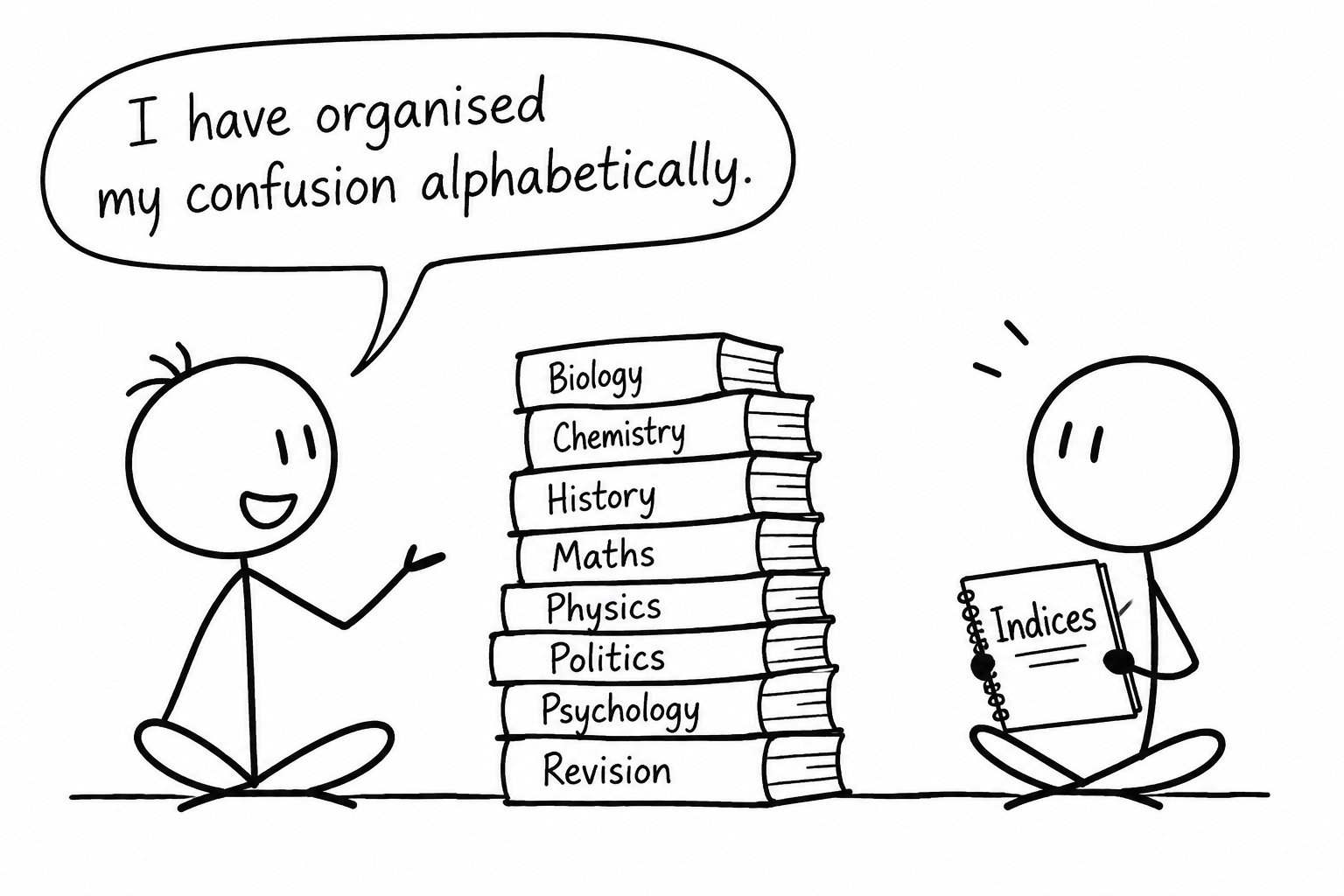 Two students bring different approaches to indices revision
Fractional indices worked examples
Example: a unit fraction
Evaluate:
811281^{\frac{1}{2}}8121The denominator is 222, so take the square root:
8112=81=981^{\frac{1}{2}}=\sqrt{81}=98121=81=9A denominator of 222 is often not written on a radical. In other words, 81\sqrt{81}81 means 812\sqrt[2]{81}281.
Example: a numerator greater than one
Evaluate:
272327^{\frac{2}{3}}2732The denominator 333 means cube root. The numerator 222 means square:
2723=(273)227^{\frac{2}{3}}=\left(\sqrt[3]{27}\right)^22732=(327)2Take the cube root first:
273=3\sqrt[3]{27}=3327=3Then square the result:
32=93^2=932=9Therefore:
2723=927^{\frac{2}{3}}=92732=9You could calculate 2723\sqrt[3]{27^2}3272 instead, but 27227^2272 creates a larger number. Root first is usually more efficient when the base is a recognisable perfect power.
Example: choosing the easier order
Evaluate:
163416^{\frac{3}{4}}1643Use the denominator first:
1634=(164)316^{\frac{3}{4}}=\left(\sqrt[4]{16}\right)^31643=(416)3Since 24=162^4=1624=16:
164=2\sqrt[4]{16}=2416=2Then:
23=82^3=823=8So:
1634=816^{\frac{3}{4}}=81643=8This is the moment it clicks for our student. The fraction is not one complicated instruction. It contains two ordinary instructions, root and power.
You can reinforce this exact translation method with the Maths Genie Indices lesson and questions, rather than rebuilding a practice set yourself.
Example: a negative fractional index
Evaluate:
25−3225^{-\frac{3}{2}}25−23A negative index means reciprocal:
a−p=1apa^{-p}=\frac{1}{a^p}a−p=ap1Therefore:
25−32=1253225^{-\frac{3}{2}}=\frac{1}{25^{\frac{3}{2}}}25−23=25231Now apply the fractional index:
2532=(25)3=53=12525^{\frac{3}{2}}=\left(\sqrt{25}\right)^3=5^3=1252523=(25)3=53=125Hence:
25−32=112525^{-\frac{3}{2}}=\frac{1}{125}25−23=1251The negative sign does not make the answer negative. It tells you to take the reciprocal. Maths Genie’s Indices revision guide helps connect this rule with zero, negative and fractional powers.
Applying the index laws
Fractional indices still obey the usual laws. When multiplying powers with the same base, add the indices:
ap×aq=ap+qa^p\times a^q=a^{p+q}ap×aq=ap+qFor example:
x12×x32=x12+32=x2x^{\frac{1}{2}}\times x^{\frac{3}{2}} =x^{\frac{1}{2}+\frac{3}{2}} =x^2x21×x23=x21+23=x2When dividing powers with the same base, subtract the indices:
ap÷aq=ap−qa^p\div a^q=a^{p-q}ap÷aq=ap−qFor example:
y53÷y23=y53−23=yy^{\frac{5}{3}}\div y^{\frac{2}{3}} =y^{\frac{5}{3}-\frac{2}{3}} =yy35÷y32=y35−32=yWhen raising a power to another power, multiply the indices:
(ap)q=apq\left(a^p\right)^q=a^{pq}(ap)q=apqFor example:
(z23)6=z23×6=z4\left(z^{\frac{2}{3}}\right)^6 =z^{\frac{2}{3}\times 6} =z^4(z32)6=z32×6=z4These rules concern the indices, not the bases. You may only add or subtract indices directly when the base is the same.
Try these fractional indices questions
Attempt these without a calculator, showing the root and power separately where appropriate.
- Evaluate 641264^{\frac{1}{2}}6421.
- Evaluate 12513125^{\frac{1}{3}}12531.
- Evaluate 642364^{\frac{2}{3}}6432.
- Evaluate 813481^{\frac{3}{4}}8143.
- Evaluate 16−3216^{-\frac{3}{2}}16−23.
- Simplify x25×x35x^{\frac{2}{5}}\times x^{\frac{3}{5}}x52×x53.
- Simplify y74÷y34y^{\frac{7}{4}}\div y^{\frac{3}{4}}y47÷y43.
- Simplify (a23)9\left(a^{\frac{2}{3}}\right)^9(a32)9.
Answers
- 888
- 555
- 161616
- 272727
- 164\frac{1}{64}641
- xxx
- yyy
- a6a^6a6
Do not only tick the final answers. If one is wrong, identify whether the error came from the root, the power, the reciprocal or an index law. Then try a similar question. The GCSE Indices practice booklet provides a longer set, while Maths Genie question 148 offers focused exam-style practice with a worked solution. Students following AQA can also use the matching AQA Indices lesson.
Common mistakes with fractional indices
Dividing by the denominator
The denominator names a root. It does not tell you to divide the base:
6413=643=464^{\frac{1}{3}}=\sqrt[3]{64}=46431=364=4It is not 64÷364\div 364÷3.
Swapping the numerator and denominator
In amna^{\frac{m}{n}}anm, nnn gives the root and mmm gives the power. Saying “bottom is root, top is power” can make this easier to recall.
Forgetting the numerator
For example:
823≠838^{\frac{2}{3}}\neq\sqrt[3]{8}832=38The complete calculation is:
823=(83)2=22=48^{\frac{2}{3}}=\left(\sqrt[3]{8}\right)^2=2^2=4832=(38)2=22=4Making a negative index into a negative answer
The rule is:
a−p=1apa^{-p}=\frac{1}{a^p}a−p=ap1The sign changes the position of the power, not the sign of its value.
Using index laws with different bases
You cannot simplify 212×3122^{\frac{1}{2}}\times 3^{\frac{1}{2}}221×321 by adding the indices as if both bases were the same. First check the base, then choose the law.
Turn the method into marks
Our student improved when they stopped guessing what the fraction meant and wrote two labels: denominator equals root, numerator equals power. Knowing that method is the first gap to close; following it reliably under exam pressure is the next.
Use the matching Maths Genie Indices lesson and Question Bank to practise the same steps with exam-style questions and worked solutions. Start the lesson, then answer a short set of fractional indices questions today.















