Foundation or Higher GCSE French: How to Choose
Foundation or higher GCSE French? Compare grade ranges, mock evidence and exam demands to choose the tier that best matches your current level.
Choosing an exam tier can feel strangely personal. Higher sounds ambitious; Foundation can sound like a judgement. Neither description is useful. If you are deciding between Foundation or Higher GCSE French, the best tier is the one that gives your current knowledge the fairest route to your realistic target grade.
The short answer is this: Foundation is usually appropriate if you are working towards grades 111 to 555, particularly if a secure grade 444 or 555 is the priority. Higher is appropriate if your recent evidence suggests that grade 666 or above is realistic. Your teacher makes the entry decision with you, but it should be based on repeated evidence across listening, speaking, reading and writing, not pride, fear or one difficult mock.
You can use the free GCSE French revision hub to find board-specific papers and revision resources while you work out where you genuinely stand.
The quick tier decision checklist
Before choosing, ask:
- What grade am I currently achieving, rather than hoping to achieve?
- Is that result consistent across several assessments?
- How do I perform separately in listening, speaking, reading and writing?
- Can I access enough of a Higher paper to collect marks steadily?
- Do I need a grade above 555 for my next step?
- Would Foundation make a secure grade 444 or 555 more likely?
- What does my French teacher recommend, and what evidence supports that view?
If your answers still feel unclear, complete current specimen or practice material at both tiers under controlled conditions. Mark it carefully, then compare not only the totals but also how successfully you understood and attempted each paper.
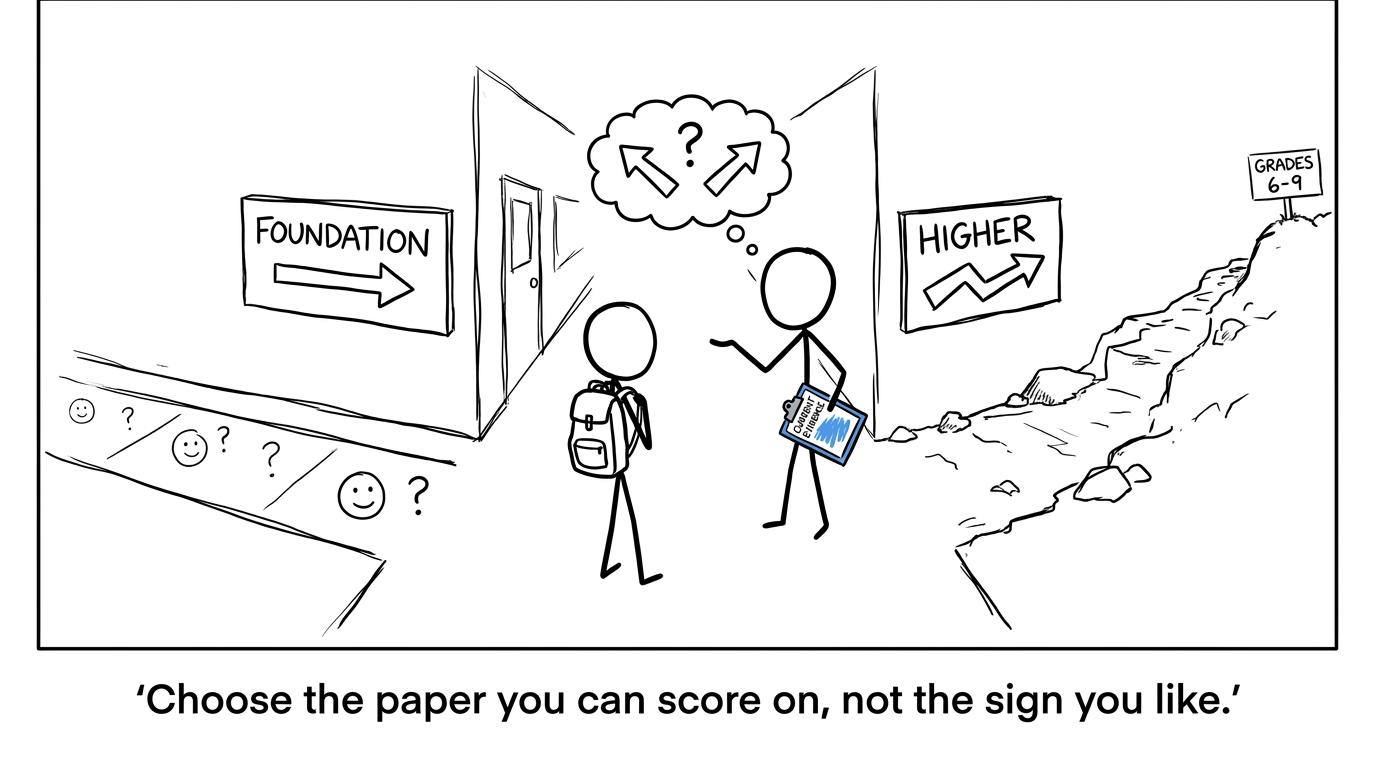 A student choosing between Foundation and Higher using current evidence
What grades are available at each GCSE French tier?
For the reformed French GCSEs first assessed in summer 202620262026, the national tier ranges are:
- Foundation tier: grades 111 to 555
- Higher tier: grades 444 to 999
A narrowly missed grade 444 on Higher may receive an allowed grade 333. This is only a limited safety net. A Higher-tier performance below that level is unclassified, so students should not treat grade 333 as a dependable target.
There are two particularly important details.
First, a grade 555 gained on Foundation is worth exactly the same as a grade 555 gained on Higher. Ofqual states that certificates do not show the tier and that achieving an overlapping grade should be no easier or harder on one tier than the other.
Second, Foundation caps the result at grade 555. If you have convincing evidence that grade 666 or above is within reach, you need Higher to access it.
All French assessments must be taken at one tier. You cannot, for example, sit Foundation listening and Higher writing. Current AQA and Pearson Edexcel specifications require one tier across the qualification, and the same principle applies under the national tiering rules. Always confirm the exact format with your school because paper structure and timings vary between exam boards.
Decide from where you are realistically sitting now
The most reliable decision uses a pattern of evidence. A single score is noisy. Perhaps the listening recording felt unusually fast, the speaking assessment landed on an awkward day, or one writing task happened to match your strongest topic. Several assessments reveal much more.
Use evidence from:
- your latest mock and an earlier mock;
- timed Foundation and Higher questions;
- class assessments completed without excessive support;
- teacher judgements about your spontaneous French;
- separate performance in each assessed skill;
- whether your marks are stable or improving.
The aim is not to ask, “Could I possibly get a grade 666?” Almost anything is possible. Ask instead, “Does my current work repeatedly show the vocabulary, grammar and comprehension needed for a grade above 555?”
When Foundation is likely to be the better choice
Foundation deserves serious consideration if:
- your recent performance sits mainly around grades 333 to 555;
- securing a grade 444 is more important than preserving a remote chance of grade 666;
- Higher listening and reading contain long sections you cannot meaningfully access;
- unfamiliar language causes you to guess rather than infer from context;
- your written French is clearer when tasks are shorter and more structured;
- your teacher sees a substantial risk of falling below the Higher safety net.
Official Ofqual guidance for 202620262026 says that a student expected to achieve grade 444 or 555 should be entered for Foundation. That does not make Foundation effortless. It means the questions are targeted at the appropriate grade range, allowing you to demonstrate what you know more consistently.
When Higher is likely to be the better choice
Higher is usually appropriate if:
- grade 666 or above is your realistic target;
- you already perform securely near the top of Foundation material;
- you can gain marks throughout Higher papers rather than relying on a few accessible questions;
- your grammar extends beyond short, memorised phrases;
- you can understand longer spoken and written passages despite unknown words;
- your performance remains credible across all four skills.
Higher should be challenging. The issue is whether it is productively challenging. If you understand the task, attempt most sections and can see how revision would recover lost marks, the difficulty may be right. If large parts are inaccessible even after careful review, that is different evidence.
Look across all four French skills
A tier choice should never be made from writing alone. AQA and Edexcel's current GCSE French qualifications assess listening, speaking, reading and writing, with each component worth 25%25\%25% of the qualification. Exact tasks differ by board, so use material matching your specification.
Visit the AQA GCSE French revision page if that is your board. Edexcel students can use the Edexcel GCSE French past papers to compare performance across complete assessments.
Consider each skill separately:
- Listening: Can you follow the central message, identify details and recover after missing a phrase?
- Speaking: Can you respond clearly without depending entirely on memorised paragraphs?
- Reading: Can you infer meaning, recognise time frames and avoid being misled by individual words?
- Writing: Can you answer every part of the task with relevant vocabulary and controlled grammar?
One weak skill does not automatically settle the decision because your final grade comes from the qualification as a whole. However, a serious weakness deserves attention, especially if it appears in repeated timed assessments.
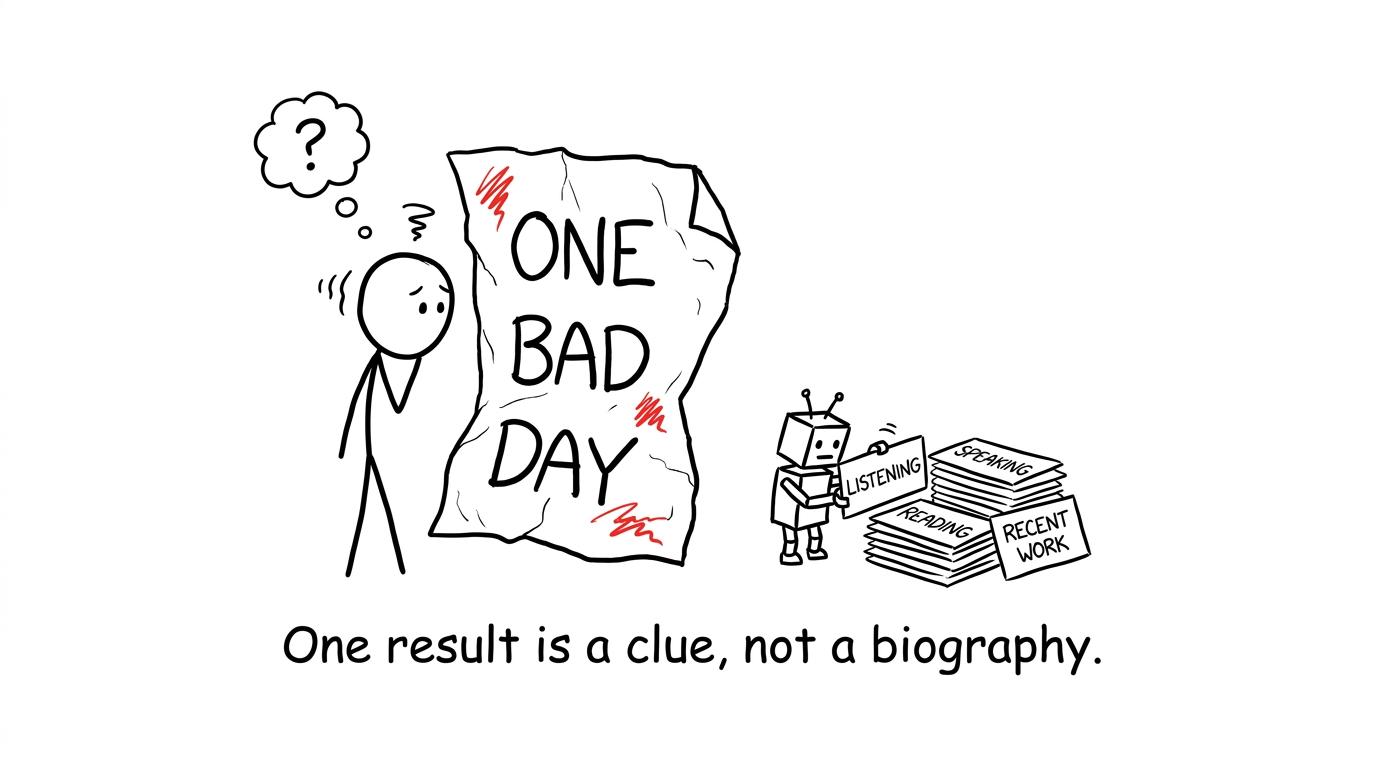 Several pieces of evidence outweighing one bad mock
Do not use an old grade boundary as a fixed target
Grade boundaries change between exam series because papers differ in difficulty. The French specifications first assessed in 202620262026 are also different from the previous courses, so boundaries from earlier specifications cannot tell you the exact mark needed on a new paper.
Historical information can provide context: MathsGenie's Edexcel French grade boundaries page shows how previous boundaries moved, but it should not become a prediction.
For current sample or mock papers, use your exam board's published material and any conversion guidance supplied by your school. More importantly, inspect the marks themselves. Ask where they came from, where they disappeared and whether the inaccessible questions were isolated or widespread.
Test your choice before the entry deadline
A sensible tier trial has three stages.
Sit comparable material
Complete a Foundation paper and a Higher paper under the correct conditions. Use the same level of preparation for both. Do not revise one set first and then compare it with an unprepared attempt.
Mark for diagnosis
Use the mark scheme and record errors by skill. Separate missing knowledge from misreading, timing, spelling, grammar and incomplete answers. The total matters, but the causes matter more.
MathsGenie's guidance on when to start GCSE past papers explains why papers are most valuable when there is still time to respond to the result.
Review the evidence with your teacher
Ask a precise question: “Which features of my work make Foundation or Higher the safer choice?” Your teacher can interpret school assessments, compare your performance with the specification and explain when entries must be finalised. If your evidence changes significantly, discuss the decision again before your school's deadline.
How to improve before the tier is confirmed
Tier decisions are not labels for your ability. They are snapshots taken before an administrative deadline. Your job is to make the evidence stronger.
Use a simple cycle:
- complete a short listening, speaking, reading or writing task;
- mark it or obtain specific feedback;
- identify one precise weakness;
- revise the relevant vocabulary, grammar or exam technique;
- retest it without notes;
- return to mixed, timed practice.
If you are behind across several subjects, the GCSE revision catch-up plan offers a manageable paper, mistake, practice routine. The same habit supports maths revision too: diagnose honestly, repair one weakness and test it again.
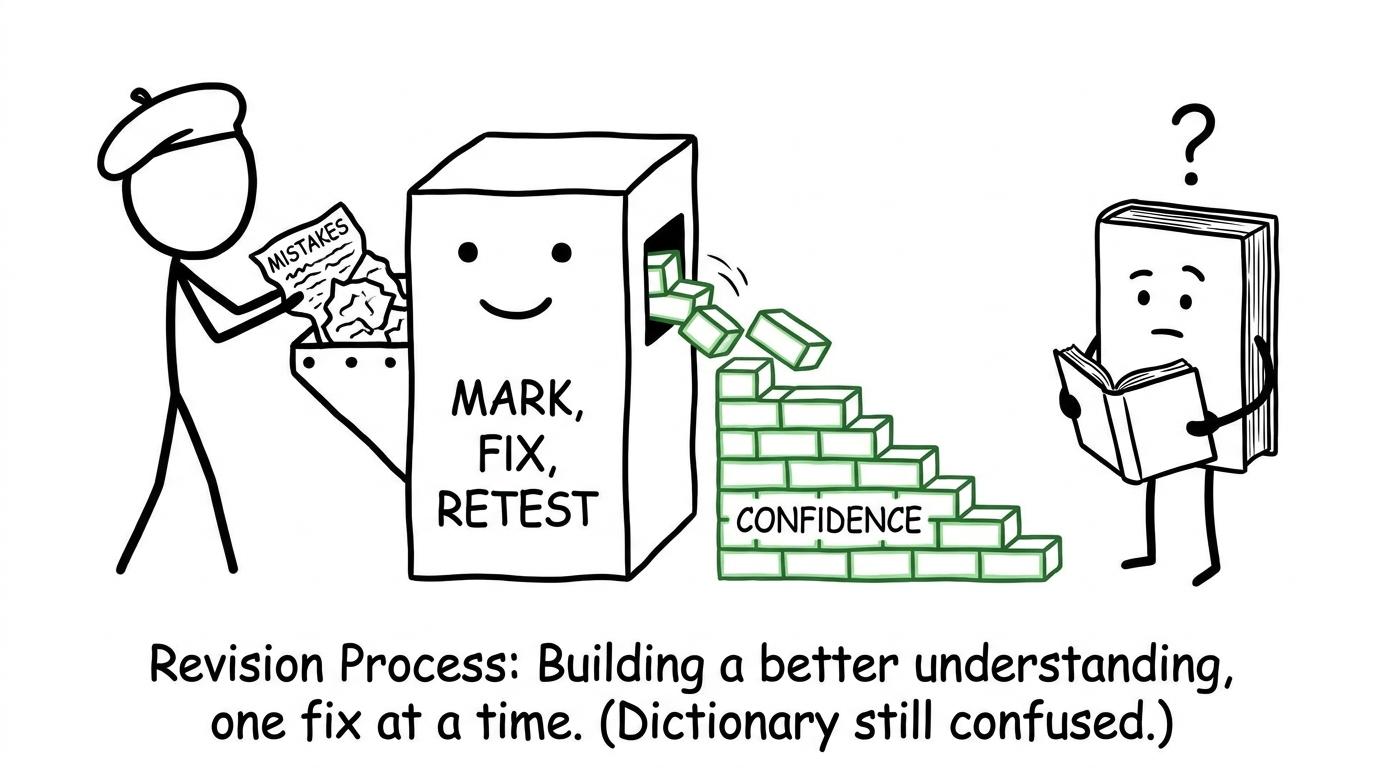 A revision machine turning corrected mistakes into confidence
Common mistakes when choosing Foundation or Higher
Choosing Higher because it sounds more impressive
The tier name is not printed on your certificate. A secure grade 555 on Foundation is better evidence of achievement than an avoidable unclassified Higher result.
Treating Foundation as an easy paper
Foundation still requires vocabulary recall, comprehension, grammar, accurate communication and exam technique. Choosing it should sharpen your revision, not reduce it.
Making the decision from one mock
One paper can expose a weakness, but repeated assessments establish whether it is a pattern. Include classwork, speaking evidence and recent improvement.
Comparing raw percentages from unlike papers
Foundation and Higher target different demands. A percentage on one tier is not automatically equivalent to the same percentage on the other. Use board or school guidance and examine which questions you could access.
Assuming every exam board uses identical tasks
AQA, Pearson Edexcel and Eduqas follow the same national grade ranges, but their paper structures are not interchangeable. Use the resources for the specification your school teaches.
Waiting too long to ask about your entry
Schools manage examination entries and internal deadlines. Ask your teacher early enough to understand the evidence and act on the feedback.
Choose the tier that turns knowledge into marks
The right decision is rarely the bravest-looking one. It is the one supported by your current work and realistic next step. If you are working towards a secure grade 444 or 555, Foundation may give you the fairest assessment. If your evidence consistently points beyond grade 555, Higher keeps grades 666 to 999 available.
Start at the MathsGenie GCSE French revision hub. Choose your exam board, complete suitable practice questions and past papers, then review every attempt with mark schemes and solutions where available. Revision lessons, predicted papers and mini tests can provide further focused practice when available for your course.
Use the resources to gather evidence rather than seek reassurance. Attempt, mark, fix and retest. That is how a tier decision becomes calmer, and how revision begins turning into marks.