Feeling Behind in GCSE Engineering? Start Here
Feeling behind GCSE Engineering? Learn why it happens, which maths skills matter most, and how to build a calm, practical catch-up plan today.
Feeling behind can begin with something small. Someone finishes a calculation before you have chosen a formula. Another student seems confident with the practical task. By the end of the lesson, their visible progress has become evidence, in your mind, that everyone understands GCSE Engineering except you.
If you are feeling behind GCSE Engineering, the short answer is yes: this feeling is understandable, and it does not prove that you cannot catch up. Engineering combines knowledge, practical decisions, mathematical methods and written evaluation. Students rarely develop all of those skills at the same speed.
The useful question is not, "Am I behind everyone?" It is, "Which specific skill is slowing me down, and what should I practise next?"
A quick catch-up checklist
Start here before attempting to revise the whole course:
- Confirm the exact qualification and specification taught by your school.
- Ask your teacher which content and assessment work remain unfinished.
- Separate engineering knowledge from underlying maths gaps.
- Prioritise units, ratio, formulae, area, volume and graphs.
- Learn one method, answer questions, mark them and retest it.
- Use short, regular sessions instead of one panicked weekend.
- Speak to a teacher or trusted adult if stress is affecting daily life.
That list is deliberately short. Panic asks you to repair everything at once. Progress usually begins when you repair one identifiable weakness.
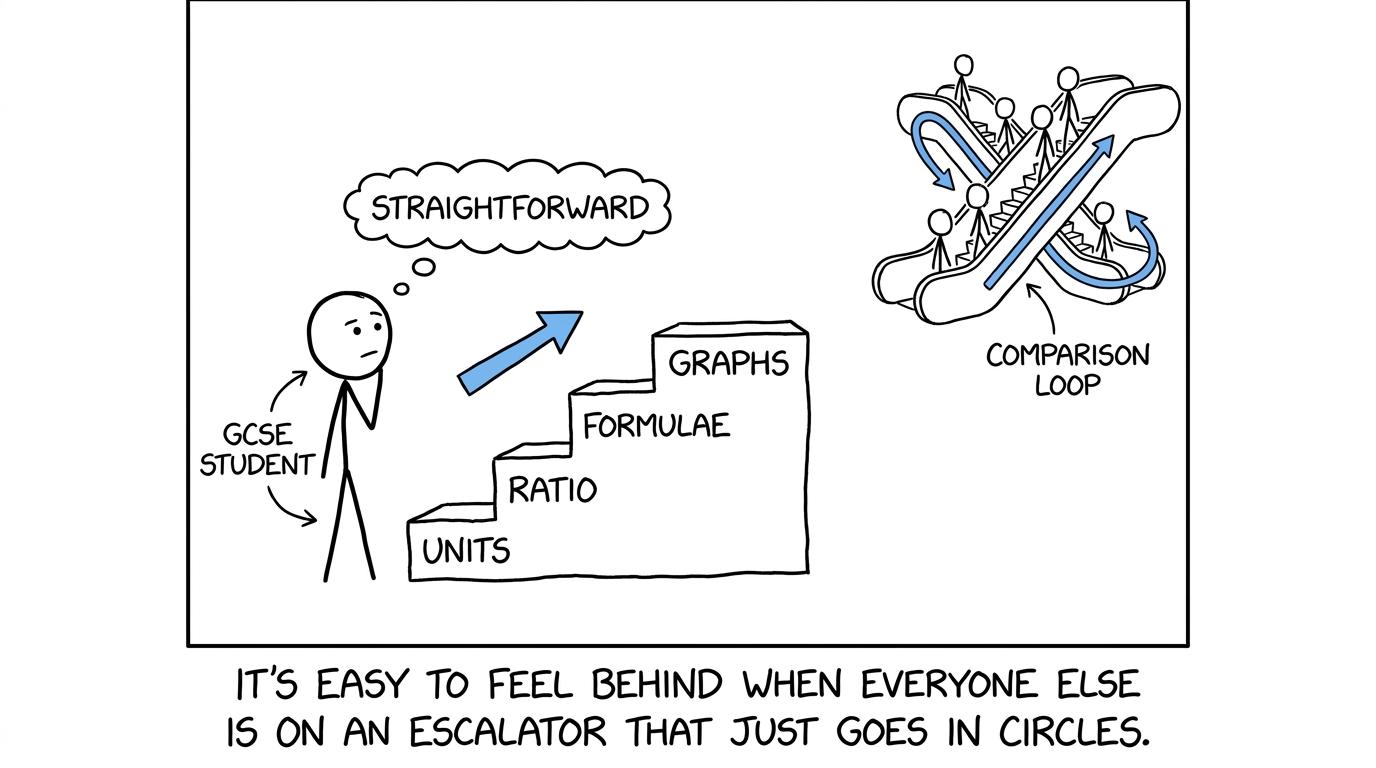 A student discovers that comparison is not a reliable map of progress
Why falling behind in GCSE Engineering can feel so dramatic
Engineering is a layered subject. A question about a component may require you to recognise a material property, select a relationship, convert units, rearrange a formula and explain whether the result is suitable.
One missing layer can therefore make the entire question look unfamiliar. You may understand the engineering principle but lose confidence when algebra appears. Alternatively, your calculation may be accurate while your evaluation lacks the precise explanation required.
Comparison makes this worse because you see other students' finished work, not the help, earlier practice or mistakes behind it. A classmate who is comfortable with practical manufacturing may still find graphs difficult. Someone who calculates quickly may be less certain when analysing a design decision.
Being behind is not one condition. It is usually a collection of smaller gaps, and smaller gaps can be treated separately.
Check which Engineering qualification you are taking
Before building a revision plan, confirm the title, awarding organisation and specification with your teacher. Schools may offer GCSE Engineering or a different technical or vocational engineering qualification. Their content, grading and assessment arrangements are not interchangeable.
For the regulated GCSE in Engineering in England, Ofqual's current conditions require a written examination worth 60%60\%60% of the qualification and non-exam assessment worth 40%40\%40%. The assessment objectives cover knowledge and understanding, application, and analysis and evaluation. Ofqual also requires at least 20%20\%20% of the examination marks to reward mathematical skills used in an engineering context.
The AQA GCSE Engineering specification, for example, includes engineering materials, manufacturing processes, systems, testing and investigation, modern technologies and practical engineering skills. It also requires mathematical understanding in engineering contexts.
Those details matter because "revise Engineering" is too vague. Your plan should reflect your actual specification and teacher guidance rather than a generic online checklist. Edexcel, AQA, OCR and Eduqas are familiar GCSE Maths boards, but do not assume that your Engineering course uses the same awarding organisation as your Maths course.
The maths that makes Engineering feel easier
Official GCSE Engineering subject content includes arithmetic, ratio, percentages, standard form, significant figures, algebra, graphs, Pythagoras' theorem and trigonometry. It also includes engineering relationships involving area, volume, density, stress, strain, pressure, electrical quantities and mechanical systems.
You do not need to attack these simultaneously. Build from the skills that support several others.
Units and conversions
Engineering calculations depend on consistent units. Length may be recorded in millimetres or metres, while area and volume involve squared or cubed units. Converting a length is not the same process as converting an area or volume.
For instance, if a length scale changes by a factor of kkk, the corresponding area factor is k2k^2k2 and the volume factor is k3k^3k3. This is why copying a length conversion into a volume calculation can produce a dramatically incorrect result.
Use MathsGenie's Conversions and Units revision to strengthen the conversion process. The mathematical skill transfers across exam boards, although you should select resources matching your GCSE Maths board and tier where available.
Ratio, proportion and scale
Ratio appears in mixtures, dimensions, gear relationships, scale drawings and comparisons between quantities. The important habits are to keep quantities in the stated order and make their units consistent before simplifying.
If that foundation feels uncertain, revisit the GCSE Ratio revision guide. Do not dismiss an accessible topic because it looks too basic. Reliable foundations reduce the mental effort needed in longer engineering questions.
Substitution and rearranging formulae
Engineering uses relationships such as
ρ=mV\rho = \frac{m}{V}ρ=Vmfor density and
P=FAP = \frac{F}{A}P=AFfor pressure. Depending on the information supplied, you may need to substitute values directly or change the subject first.
The same principle applies throughout: identify the required quantity, select the relevant relationship, make the subject clear, substitute consistent units and then calculate. If algebra is the obstacle, use Rearranging Formulae revision for focused lessons and practice rather than repeatedly struggling with complete engineering questions.
Area, volume and geometry
Dimensions influence material use, capacity, mass and manufacturing decisions. Useful relationships include
A=πr2A = \pi r^2A=πr2and
V=ALV = A LV=ALfor a cylinder when AAA is its circular cross-sectional area and LLL is its length.
Geometry questions may also depend on right-angled triangles. Pythagoras' theorem,
a2+b2=c2,a^2+b^2=c^2,a2+b2=c2,and trigonometric ratios can be used to determine unknown lengths or angles. MathsGenie's 3D Pythagoras and Trigonometry revision is useful when diagrams feel harder than the calculation itself. For scale factors, use Similar Shapes, Area and Volume.
Graphs and data
GCSE Engineering mathematical content includes plotting variables, drawing an appropriate trend line, interpreting graphical information and determining a graph's slope. These are not decorative presentation skills. A graph can reveal whether an observed relationship is approximately linear, whether a result appears anomalous and how quickly one variable changes relative to another.
When revising graphs, practise moving in both directions: from a table to a graph, and from a graph back to a numerical or engineering conclusion.
A calm plan for catching up
A useful catch-up plan has three phases: diagnose, repair and test.
Diagnose the real gaps
Ask your teacher for the specification checklist or current class topics. Then sort each item into three categories:
- secure enough to answer without notes;
- partly understood but unreliable;
- not yet understood or missed.
Next, complete a short set of questions without looking at notes. Record the reason for each lost mark: missing knowledge, wrong formula, unit error, algebra error, unclear explanation or rushed reading.
This turns "I am bad at Engineering" into a workable list such as "I need to convert volume units" or "I cannot rearrange equations containing fractions".
Repair one link at a time
Use a repeatable revision block:
- recall the method from memory;
- read or watch a short revision lesson;
- complete focused practice questions;
- check the mark scheme or solution;
- write one precise correction;
- retest the skill on another day.
The NHS recommends realistic revision schedules, manageable chunks, regular breaks and past-paper practice. That advice matters here because an ambitious plan that collapses after two days is less useful than a modest routine you can repeat.
MathsGenie's guide to the best order for learning GCSE Maths topics can help if several foundations need rebuilding.
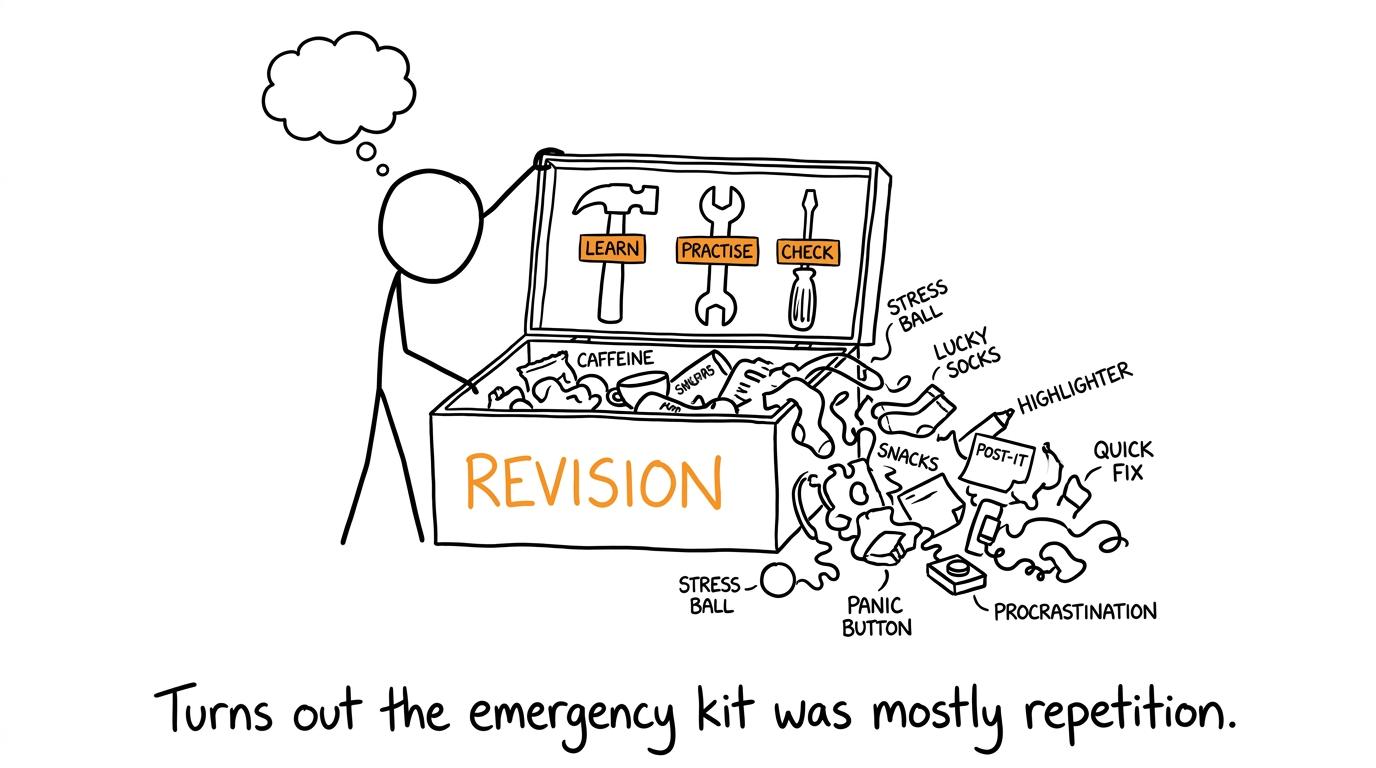 A GCSE revision toolbox containing the three tools that matter
Test without turning every score into a judgement
Once individual skills are more stable, introduce mixed questions. A test is valuable because it shows whether you can choose a method without being told the topic.
For your Maths preparation, use GCSE past papers with mark schemes. Choose the correct board and foundation or higher tier. Start with a section or mini test if a full paper would create more anxiety than useful evidence.
Later, GCSE predicted papers can provide fresh exam-style Maths practice. They should supplement official past papers, not replace them. After marking, return to revision lessons and topic questions for the skills responsible for repeated lost marks.
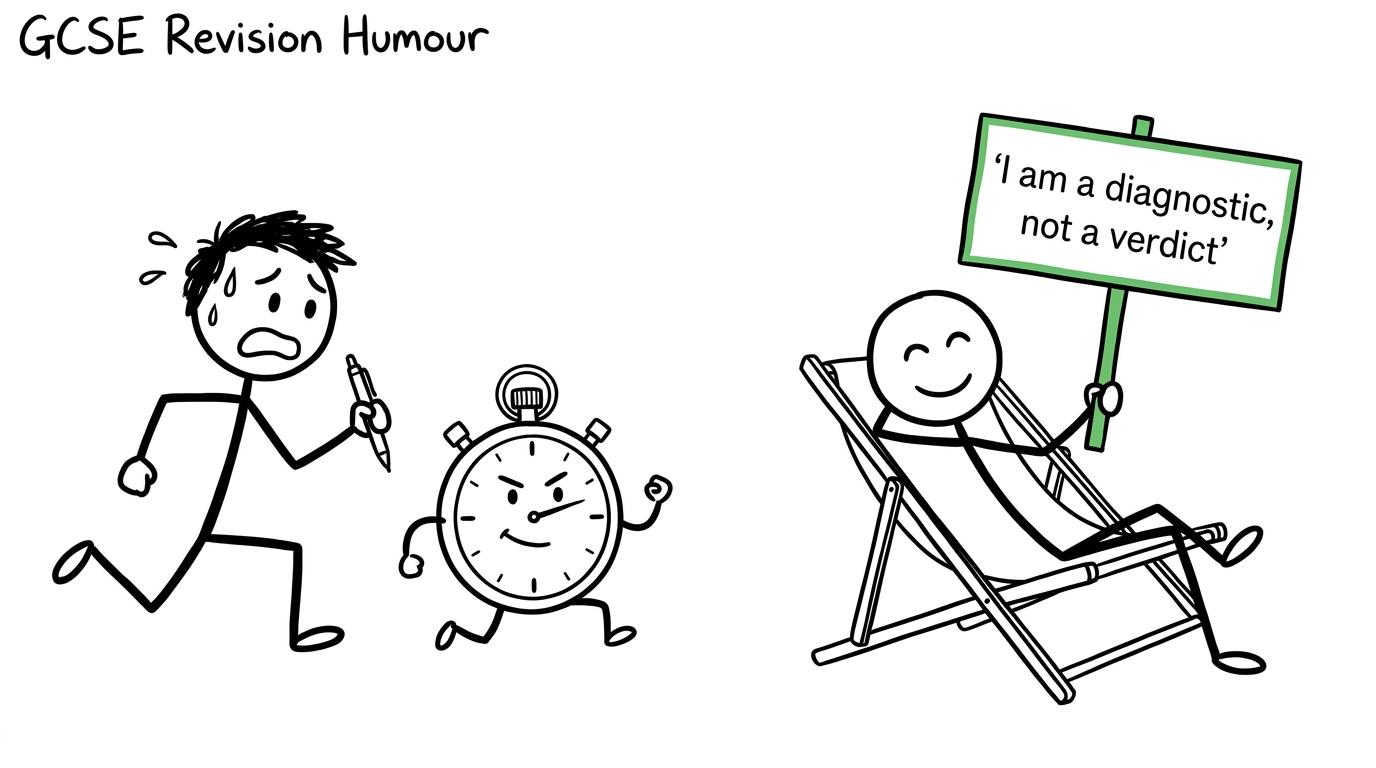 A past paper reminds a student that a score is information rather than identity
Common mistakes when trying to catch up
Revising the whole subject at once
Broad sessions produce vague notes. Choose a narrow outcome such as unit conversions, interpreting gradients or selecting a formula.
Watching solutions without answering questions
A clear explanation can feel like mastery because it makes sense while it is in front of you. Close the solution and reproduce the method independently. Practice is where recognition becomes recall.
Ignoring units until the final line
Units help you decide whether quantities are compatible and whether an answer is sensible. Write them during the calculation, not as decoration afterwards.
Rounding too early
Keep full calculator values through intermediate steps and round only when the question requests it or on the final line. Early rounding can distort a multi-stage result.
Treating every poor score as proof
A score is a snapshot produced by particular questions on a particular day. Its useful content is the pattern of lost marks. Extract that pattern, repair it and test again.
Hiding the problem from your teacher
Your teacher can clarify priorities, missing coursework or non-exam assessment requirements and the exact specification. Asking early is an engineering decision in itself: identify a fault before it becomes expensive to repair.
You do not have to catch up in one leap
Feeling behind GCSE Engineering is uncomfortable because the subject displays progress publicly: products take shape, calculations fill pages and confident answers arrive quickly. Yet visible speed is not the same as secure understanding.
Confirm your qualification. Identify the smallest genuine gap. Repair the supporting maths, then test it in context. Repeat that cycle often enough and "behind" stops being an identity. It becomes a temporary description of a few skills you are already working on.
Start with MathsGenie's free revision lessons and practice questions, then use mini tests to check fluency. Build towards past papers, mark schemes and video solutions, adding predicted papers when you need fresh exam-style Maths practice. Open one topic today and complete the first honest step, not everything, just the next thing.