Expanding Triple Brackets Exam Questions | GCSE
Expanding triple brackets exam questions explained with three GCSE worked examples, method-mark guidance, common mistakes and targeted GCSE practice.

Triple brackets often look worse than they are. A student sees three pairs of brackets, several negative signs and the possibility of an x3x^3x3 term. The temptation is to multiply everything at once and hope the algebra settles itself.
The reliable way to answer expanding triple brackets exam questions is much calmer: expand two brackets, simplify the quadratic, then multiply that result by the third bracket. Clear working matters because it reduces errors and can provide evidence for method marks, even if the final expression is not completely correct.
In this guide, we will follow a hypothetical GCSE student through three exam-style questions of rising difficulty. You will see the method, the likely marking points and the mistakes worth checking before moving on.
The triple brackets checklist
For an expression such as
(x+a)(x+b)(x+c), (x+a)(x+b)(x+c), (x+a)(x+b)(x+c),use this routine:
- Choose any two brackets to expand first.
- Multiply every term in one bracket by every term in the other.
- Collect like terms to form a quadratic.
- Multiply the quadratic by the remaining bracket.
- Collect the cubic, quadratic, linear and constant terms.
- Write the final expression in descending powers of xxx.
The safest principle is simple: do not try to expand all three brackets in one jump. The Maths Genie expanding triple brackets lesson teaches the same two-stage structure through short practice activities.
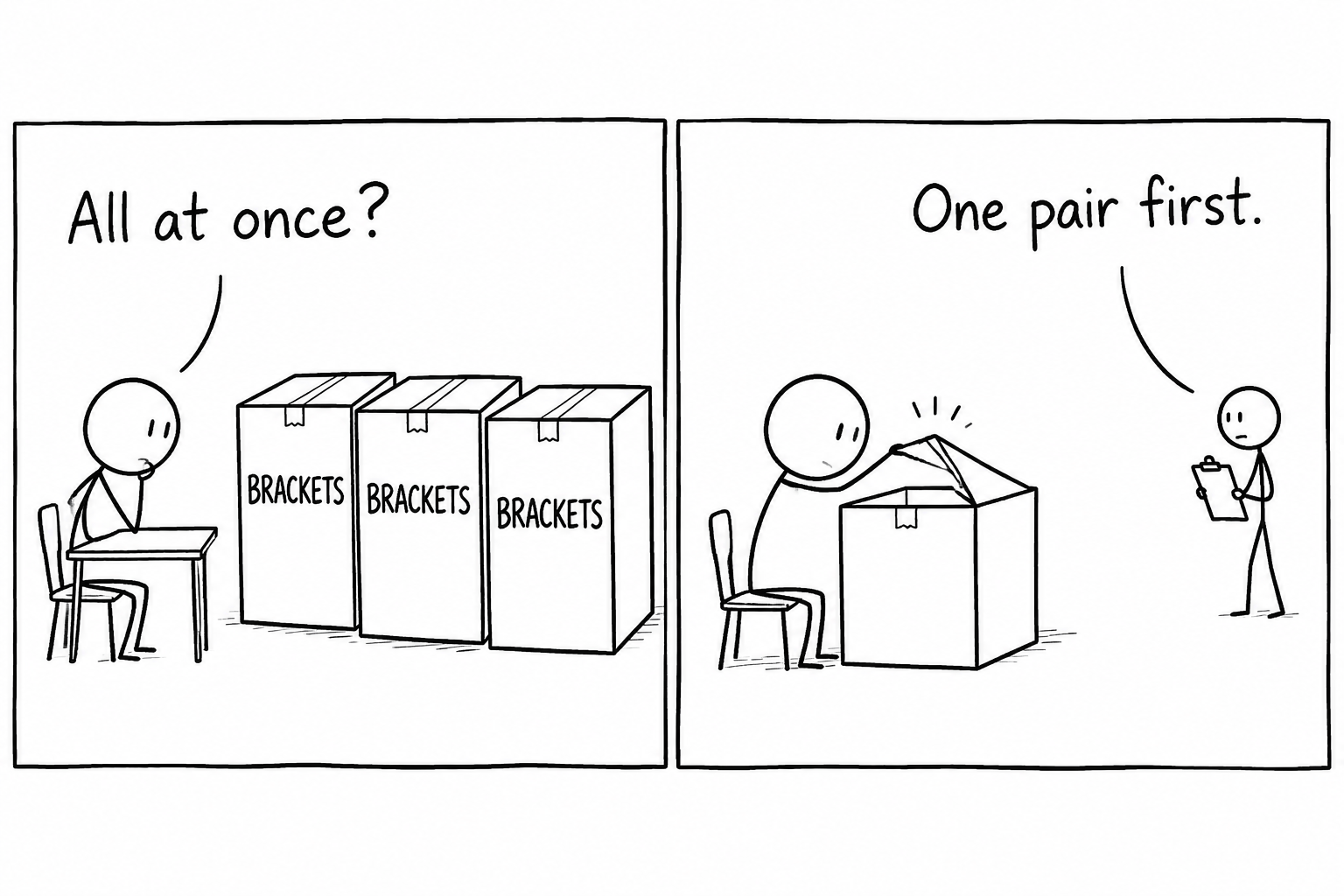 A student deciding whether to open three bracket boxes at once
Question one: three positive brackets
Picture a student beginning with a friendly version of the topic.
Expand and simplify:
(x+1)(x+2)(x+3). (x+1)(x+2)(x+3). (x+1)(x+2)(x+3).The student chooses the first two brackets:
(x+1)(x+2)=x2+2x+x+2. (x+1)(x+2)=x^2+2x+x+2. (x+1)(x+2)=x2+2x+x+2.Collecting like terms gives
x2+3x+2. x^2+3x+2. x2+3x+2.The question has now become
(x2+3x+2)(x+3). (x^2+3x+2)(x+3). (x2+3x+2)(x+3).Multiply the quadratic by xxx:
x3+3x2+2x. x^3+3x^2+2x. x3+3x2+2x.Then multiply it by 333:
3x2+9x+6. 3x^2+9x+6. 3x2+9x+6.Add the two rows and collect like terms:
x3+6x2+11x+6. x^3+6x^2+11x+6. x3+6x2+11x+6.So the answer is
x3+6x2+11x+6. \boxed{x^3+6x^2+11x+6}. x3+6x2+11x+6.Where the method marks may come from
An exam mark scheme might reward:
- correctly expanding two brackets to obtain a quadratic;
- correctly multiplying the quadratic by the remaining bracket;
- accurately simplifying the final cubic.
Exact mark allocations depend on the paper and exam board, so this is indicative rather than a substitute for the relevant mark scheme. The important lesson is that the intermediate quadratic should be visible. A correct method cannot earn credit if it never reaches the page.
Question two: introducing negative terms
The next expanding triple brackets GCSE exam question contains two negative terms:
Expand and simplify:
(2x−3)(x+4)(x−1). (2x-3)(x+4)(x-1). (2x−3)(x+4)(x−1).The student expands the simpler pair first:
(x+4)(x−1)=x2−x+4x−4. (x+4)(x-1)=x^2-x+4x-4. (x+4)(x−1)=x2−x+4x−4.Therefore,
(x+4)(x−1)=x2+3x−4. (x+4)(x-1)=x^2+3x-4. (x+4)(x−1)=x2+3x−4.Now multiply by the remaining bracket:
(2x−3)(x2+3x−4). (2x-3)(x^2+3x-4). (2x−3)(x2+3x−4).Multiplying every term by 2x2x2x gives
2x3+6x2−8x. 2x^3+6x^2-8x. 2x3+6x2−8x.Multiplying every term by −3-3−3 gives
−3x2−9x+12. -3x^2-9x+12. −3x2−9x+12.Collect like terms:
2x3+3x2−17x+12. 2x^3+3x^2-17x+12. 2x3+3x2−17x+12.The final answer is
2x3+3x2−17x+12. \boxed{2x^3+3x^2-17x+12}. 2x3+3x2−17x+12.The easy-to-miss calculation is (−3)(−4)=12(-3)(-4)=12(−3)(−4)=12. The student protects that sign by writing two separate multiplication rows rather than attempting the whole expansion mentally.
Use the Expanding Triple Brackets Lesson, then apply this two-row method directly in the Expanding Triple Brackets Question Bank.
Question three: a harder exam-style expansion
The third question has coefficients in every stage and produces several negative terms.
Expand and simplify:
(3x−2)(2x+5)(x−4). (3x-2)(2x+5)(x-4). (3x−2)(2x+5)(x−4).Begin with the final two brackets:
(2x+5)(x−4)=2x2−8x+5x−20. (2x+5)(x-4)=2x^2-8x+5x-20. (2x+5)(x−4)=2x2−8x+5x−20.Simplify:
2x2−3x−20. 2x^2-3x-20. 2x2−3x−20.The expression is now
(3x−2)(2x2−3x−20). (3x-2)(2x^2-3x-20). (3x−2)(2x2−3x−20).Multiply the quadratic by 3x3x3x:
6x3−9x2−60x. 6x^3-9x^2-60x. 6x3−9x2−60x.Multiply it by −2-2−2:
−4x2+6x+40. -4x^2+6x+40. −4x2+6x+40.Now collect like terms carefully:
6x3−13x2−54x+40. 6x^3-13x^2-54x+40. 6x3−13x2−54x+40.Therefore,
6x3−13x2−54x+40. \boxed{6x^3-13x^2-54x+40}. 6x3−13x2−54x+40.A likely method-mark trail is the correct quadratic 2x2−3x−202x^2-3x-202x2−3x−20, followed by evidence that both 3x3x3x and −2-2−2 have been multiplied across all three terms. The accuracy marks would usually depend on correct simplification, although the precise scheme varies.
The Maths Genie revision guide for expanding triple brackets is useful when you want to revisit the written method before attempting more questions.
How to check an expanded cubic
A quick substitution check can expose an error. It does not prove that every coefficient is correct, but it is a useful warning system.
For the third question, substitute x=1x=1x=1 into the original expression:
(3−2)(2+5)(1−4)=1(7)(−3)=−21. (3-2)(2+5)(1-4)=1(7)(-3)=-21. (3−2)(2+5)(1−4)=1(7)(−3)=−21.Now substitute x=1x=1x=1 into the expanded answer:
6−13−54+40=−21. 6-13-54+40=-21. 6−13−54+40=−21.Both forms give the same value. If they did not match, the expansion would need checking.
You can also inspect the first and last terms. In the original expression, multiplying the leading terms gives
(3x)(2x)(x)=6x3, (3x)(2x)(x)=6x^3, (3x)(2x)(x)=6x3,while multiplying the constants gives
(−2)(5)(−4)=40. (-2)(5)(-4)=40. (−2)(5)(−4)=40.Those should match the cubic and constant terms in the final answer.
Common mistakes in triple bracket questions
Expanding all three brackets simultaneously
This creates too many products to track. Turn the expression into a double-bracket problem first, as shown in the worked examples.
Forgetting one multiplication
When expanding
(3x−2)(2x2−3x−20), (3x-2)(2x^2-3x-20), (3x−2)(2x2−3x−20),each term in the first bracket must multiply all three terms in the quadratic. Six products are required altogether.
Losing a negative sign
Place negative products on their own line. In particular, remember that multiplying two negative values gives a positive value.
Collecting unlike terms
Terms such as x3x^3x3, x2x^2x2, xxx and constants are not like terms. Arrange the working in columns if that makes the powers easier to track.
Stopping at the intermediate quadratic
The first expansion is only the halfway point. Re-read the question and make sure all three brackets have been used.
Exam-style practice
Try these without looking at the answers. Show the intermediate quadratic in each case so that your method is clear.
- Expand and simplify (x+2)(x+4)(x−3)(x+2)(x+4)(x-3)(x+2)(x+4)(x−3).
- Expand and simplify (2x+1)(x−5)(x+3)(2x+1)(x-5)(x+3)(2x+1)(x−5)(x+3).
- Expand and simplify (3x−4)(2x−1)(x+2)(3x-4)(2x-1)(x+2)(3x−4)(2x−1)(x+2).
Answers
- x3+3x2−10x−24x^3+3x^2-10x-24x3+3x2−10x−24
- 2x3−3x2−32x−152x^3-3x^2-32x-152x3−3x2−32x−15
- 6x3+x2−18x+86x^3+x^2-18x+86x3+x2−18x+8
For a longer set that can be marked against worked solutions, use the expanding triple brackets exam booklet. Students following another specification can also use the AQA expanding triple brackets revision page, while the underlying algebraic method remains the same.
Turn the method into exam marks
The student in our example did not need a shortcut. The improvement came from leaving a visible quadratic, separating the two multiplication rows and checking the signs before simplifying. Knowing that routine is the first step; following it accurately under exam conditions requires focused practice.
Start the Expanding Triple Brackets Lesson, then answer the next set in the Maths Genie Question Bank.