- How to expand two brackets confidently before moving to three.
- How to keep signs organised when brackets contain negatives.
- How to handle squared brackets like (x−2)2\left(x - 2\right)^2(x−2)2.
- How to answer “show that” questions using clear algebra steps.
Expand and simplify
To expand means to remove brackets by multiplying everything out. To simplify means to collect like terms, which are terms with the same variable part, such as 3x23x^23x2 and −5x2-5x^2−5x2.
Before triple brackets, you need to be comfortable multiplying a single term into a bracket and collecting like terms.
For example:
2x(x+4)=2x2+8x2x(x + 4) = 2x^2 + 8x2x(x+4)=2x2+8x
The term 2x2x2x multiplies both terms inside the bracket.
Collecting like terms
Simplify 4x2+7x−2x2+5x−34x^2 + 7x - 2x^2 + 5x - 34x2+7x−2x2+5x−3.

-
Group the like terms together:
4x2−2x2+7x+5x−34x^2 - 2x^2 + 7x + 5x - 34x2−2x2+7x+5x−3
-
Combine the x2x^2x2 terms, then the xxx terms:
2x2+12x−32x^2 + 12x - 32x2+12x−3
-
The simplified expression is:
2x2+12x−32x^2 + 12x - 32x2+12x−3
Combining unlike terms
You cannot combine x2x^2x2 terms with xxx terms. For example, 3x2+4x3x^2 + 4x3x2+4x does not become 7x37x^37x3.
A double bracket expression has two brackets multiplied together, such as (x+3)(x+5)\left(x + 3\right)\left(x + 5\right)(x+3)(x+5).
Every term multiplies every term
When expanding brackets, each term in one bracket must multiply each term in the other bracket.
A neat method is FOIL:
- First terms
- Outside terms
- Inside terms
- Last terms
Expanding two brackets
Expand and simplify (x+6)(x−2)\left(x + 6\right)\left(x - 2\right)(x+6)(x−2).

-
Multiply the first terms:
x×x=x2x \times x = x^2x×x=x2
-
Multiply the outside terms:
x×−2=−2xx \times -2 = -2xx×−2=−2x
-
Multiply the inside terms:
6×x=6x6 \times x = 6x6×x=6x
-
Multiply the last terms:
6×−2=−126 \times -2 = -126×−2=−12
-
Collect the terms:
x2−2x+6x−12=x2+4x−12x^2 - 2x + 6x - 12 = x^2 + 4x - 12x2−2x+6x−12=x2+4x−12
Sign check
When multiplying signs: positive times negative is negative, and negative times negative is positive.
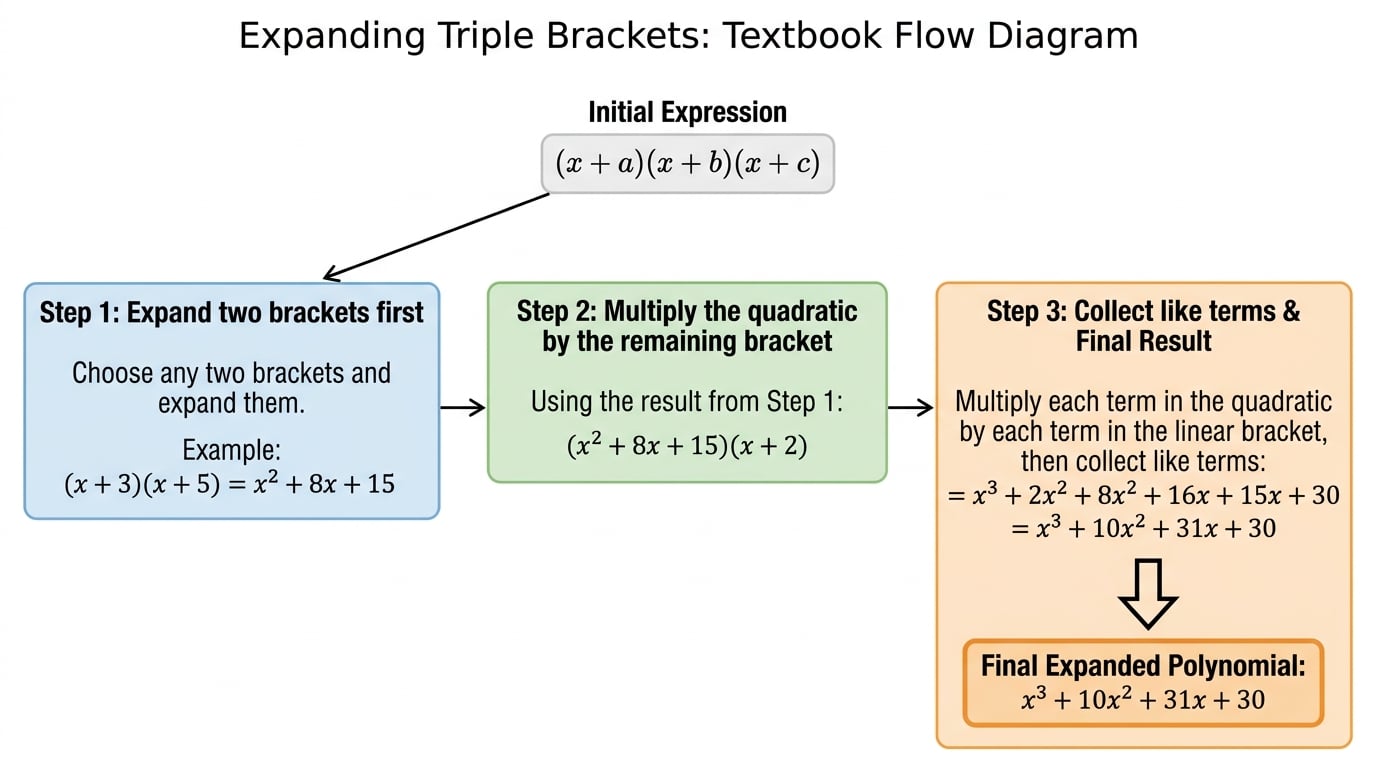
A triple bracket expression has three brackets multiplied together, such as (x+1)(x+2)(x+3)\left(x + 1\right)\left(x + 2\right)\left(x + 3\right)(x+1)(x+2)(x+3).
You do not expand all three at once. The safest method is:
- Expand two brackets first.
- Simplify them.
- Multiply the result by the remaining bracket.
- Simplify again.
Do it in stages
Triple brackets are just double brackets followed by one more bracket expansion.
Expanding three simple brackets
Expand and simplify (x+3)(x+5)(x+2)\left(x + 3\right)\left(x + 5\right)\left(x + 2\right)(x+3)(x+5)(x+2).

-
Expand the first two brackets:
(x+3)(x+5)=x2+5x+3x+15\left(x + 3\right)\left(x + 5\right) = x^2 + 5x + 3x + 15(x+3)(x+5)=x2+5x+3x+15
-
Simplify the double bracket result:
x2+8x+15x^2 + 8x + 15x2+8x+15
-
Now multiply this by the remaining bracket:
(x2+8x+15)(x+2)\left(x^2 + 8x + 15\right)\left(x + 2\right)(x2+8x+15)(x+2)
-
Multiply each term in x2+8x+15x^2 + 8x + 15x2+8x+15 by each term in x+2x + 2x+2:
x3+2x2+8x2+16x+15x+30x^3 + 2x^2 + 8x^2 + 16x + 15x + 30x3+2x2+8x2+16x+15x+30
-
Collect like terms:
x3+10x2+31x+30x^3 + 10x^2 + 31x + 30x3+10x2+31x+30
You can choose any pair of brackets first, but it is usually easiest to start with two simple brackets like (x+a)(x+b)\left(x + a\right)\left(x + b\right)(x+a)(x+b).
Choosing a helpful pair
Expand and simplify (x−4)(x+2)(x+7)\left(x - 4\right)\left(x + 2\right)\left(x + 7\right)(x−4)(x+2)(x+7).

-
Start with the first two brackets:
(x−4)(x+2)\left(x - 4\right)\left(x + 2\right)(x−4)(x+2)
-
Expand and simplify:
x2+2x−4x−8=x2−2x−8x^2 + 2x - 4x - 8 = x^2 - 2x - 8x2+2x−4x−8=x2−2x−8
-
Multiply by the third bracket:
(x2−2x−8)(x+7)\left(x^2 - 2x - 8\right)\left(x + 7\right)(x2−2x−8)(x+7)
-
Expand term by term:
x3+7x2−2x2−14x−8x−56x^3 + 7x^2 - 2x^2 - 14x - 8x - 56x3+7x2−2x2−14x−8x−56
-
Collect like terms:
x3+5x2−22x−56x^3 + 5x^2 - 22x - 56x3+5x2−22x−56
Forgetting the third bracket
After expanding two brackets, you are not finished. You must still multiply the quadratic by the remaining bracket.
Coefficient
A coefficient is the number multiplying a variable. In 3x3x3x, the coefficient of xxx is 3.
Some triple bracket questions include terms like 2x−12x - 12x−1 or 3x+43x + 43x+4. The method is the same, but the arithmetic needs more care.
Expanding with coefficients
Expand and simplify (2x+3)(x−1)(x+4)\left(2x + 3\right)\left(x - 1\right)\left(x + 4\right)(2x+3)(x−1)(x+4).

-
Expand the two simpler brackets first:
(x−1)(x+4)\left(x - 1\right)\left(x + 4\right)(x−1)(x+4)
-
Simplify the result:
x2+4x−x−4=x2+3x−4x^2 + 4x - x - 4 = x^2 + 3x - 4x2+4x−x−4=x2+3x−4
-
Now multiply by the remaining bracket:
(2x+3)(x2+3x−4)\left(2x + 3\right)\left(x^2 + 3x - 4\right)(2x+3)(x2+3x−4)
-
Multiply 2x2x2x by every term in the quadratic:
2x3+6x2−8x2x^3 + 6x^2 - 8x2x3+6x2−8x
-
Multiply 3 by every term in the quadratic:
3x2+9x−123x^2 + 9x - 123x2+9x−12
-
Add and collect like terms:
2x3+9x2+x−122x^3 + 9x^2 + x - 122x3+9x2+x−12
Highest power check
When multiplying three linear brackets, your answer should usually start with an x3x^3x3 term. If it only has x2x^2x2, something has been missed.
Squared bracket
A squared bracket such as (x−3)2\left(x - 3\right)^2(x−3)2 means the bracket is multiplied by itself: (x−3)(x−3)\left(x - 3\right)\left(x - 3\right)(x−3)(x−3).
Do not square each term separately. For example, (x+5)2\left(x + 5\right)^2(x+5)2 is not x2+25x^2 + 25x2+25.
Using a squared bracket
Expand and simplify (x+4)(x−2)2\left(x + 4\right)\left(x - 2\right)^2(x+4)(x−2)2.

-
Rewrite the squared bracket:
(x+4)(x−2)(x−2)\left(x + 4\right)\left(x - 2\right)\left(x - 2\right)(x+4)(x−2)(x−2)
-
Expand the repeated brackets first:
(x−2)(x−2)=x2−2x−2x+4\left(x - 2\right)\left(x - 2\right) = x^2 - 2x - 2x + 4(x−2)(x−2)=x2−2x−2x+4
-
Simplify:
x2−4x+4x^2 - 4x + 4x2−4x+4
-
Multiply by the remaining bracket:
(x+4)(x2−4x+4)\left(x + 4\right)\left(x^2 - 4x + 4\right)(x+4)(x2−4x+4)
-
Expand and collect:
x3−4x2+4x+4x2−16x+16=x3−12x+16x^3 - 4x^2 + 4x + 4x^2 - 16x + 16 = x^3 - 12x + 16x3−4x2+4x+4x2−16x+16=x3−12x+16
Squaring only the ends
Remember that (x−2)2\left(x - 2\right)^2(x−2)2 gives three terms after expansion, not just x2+4x^2 + 4x2+4. The middle term matters.
Identity
An identity is an equation that is true for all values of the variable. In a “show that” question, you prove both sides match by expanding and simplifying one side.
For these, expand the bracket side carefully until it matches the expression given.
Showing an identity
Show that (2x−1)(x+3)(4x−5)=8x3+10x2−43x+15\left(2x - 1\right)\left(x + 3\right)\left(4x - 5\right) = 8x^3 + 10x^2 - 43x + 15(2x−1)(x+3)(4x−5)=8x3+10x2−43x+15 for all values of xxx.

-
Expand two brackets first:
(x+3)(4x−5)\left(x + 3\right)\left(4x - 5\right)(x+3)(4x−5)
-
Simplify the result:
4x2−5x+12x−15=4x2+7x−154x^2 - 5x + 12x - 15 = 4x^2 + 7x - 154x2−5x+12x−15=4x2+7x−15
-
Multiply by the remaining bracket:
(2x−1)(4x2+7x−15)\left(2x - 1\right)\left(4x^2 + 7x - 15\right)(2x−1)(4x2+7x−15)
-
Expand using 2x2x2x first, then −1-1−1:
8x3+14x2−30x−4x2−7x+158x^3 + 14x^2 - 30x - 4x^2 - 7x + 158x3+14x2−30x−4x2−7x+15
-
Collect like terms:
8x3+10x2−37x+158x^3 + 10x^2 - 37x + 158x3+10x2−37x+15
Check the final expression
If your simplified answer does not match the expression you were asked to show, do not just write “shown”. Go back and check signs and arithmetic carefully.
For longer expansions, you can write the multiplication in two chunks:
- Multiply the first term of the linear bracket by the whole quadratic.
- Multiply the second term of the linear bracket by the whole quadratic.
- Add the two results.
This keeps your working neat and helps you avoid missing terms.
Neat chunking method
Expand and simplify (3x−2)(x2+5x−6)\left(3x - 2\right)\left(x^2 + 5x - 6\right)(3x−2)(x2+5x−6).

-
Multiply 3x3x3x by the quadratic:
3x3+15x2−18x3x^3 + 15x^2 - 18x3x3+15x2−18x
-
Multiply −2-2−2 by the quadratic:
−2x2−10x+12-2x^2 - 10x + 12−2x2−10x+12
-
Add the two lines together:
3x3+15x2−18x−2x2−10x+123x^3 + 15x^2 - 18x - 2x^2 - 10x + 123x3+15x2−18x−2x2−10x+12
-
Collect like terms:
3x3+13x2−28x+123x^3 + 13x^2 - 28x + 123x3+13x2−28x+12
In the exam
- Expand only two brackets first, then clearly multiply by the third.
- Keep negative signs attached to their terms, especially when multiplying by a negative number.
- Check that your final answer is in descending powers: x3x^3x3, then x2x^2x2, then xxx, then the constant.
Check yourself
- Can you explain why (x−3)2\left(x - 3\right)^2(x−3)2 is not the same as x2−9x^2 - 9x2−9?
- When expanding three linear brackets, what power of xxx should the first term usually have?
- Can you spot where like terms should be collected in a long expansion?