Expanding Single Brackets GCSE Maths: Examples
Expanding single brackets GCSE maths made clear with step-by-step worked examples, negative signs, common mistakes and exam-style questions with answers.
Expanding single brackets: make the multiplier reach every term
If your answers keep losing a term or changing a sign, expanding single brackets GCSE maths questions can feel strangely unreliable. The rule is simple: multiply every term inside the bracket by the term outside it, keeping each sign attached to its term.
Imagine a student who repeatedly writes 3(x+4)=3x+43(x+4)=3x+43(x+4)=3x+4. They understand that multiplication is involved, but stop after multiplying the first term. The breakthrough comes when they start treating the outside number as having a job to finish: it must reach everything inside.
We will follow that hypothetical student through the mistakes, the method and some exam-style practice. You can use the same routine whenever a bracket appears.
Your quick checklist
Before moving on from an answer, check that you have:
- Multiplied every term inside the bracket.
- Included the sign of the outside multiplier.
- Multiplied letters correctly when the outside term contains a variable.
- Collected like terms if the question asks you to simplify.
What does expanding a bracket mean?
Expanding means rewriting an expression without its brackets while keeping its value unchanged. It uses the distributive law:
a(b+c)=ab+aca(b+c)=ab+aca(b+c)=ab+acThe expression outside the bracket multiplies the whole bracket. That is why it must multiply both terms, rather than just the first.
Subtraction follows the same principle:
a(b−c)=ab−aca(b-c)=ab-aca(b−c)=ab−acOur imagined student had been reading the bracket as a container whose first item needed multiplying. A better reading is an instruction: multiply the entire contents.
Before practising, make sure you can distinguish terms and recognise multiplication written without a multiplication sign. If algebra notation still feels unfamiliar, MathsGenie's guide to understanding GCSE algebra offers a useful starting point.
A method you can repeat
Use three steps: identify, multiply, check.
First, identify the complete outside multiplier, including its sign. Next, multiply it by each term inside the bracket, writing the products separately. Finally, check the signs and whether any like terms can be collected.
You can draw an arrow from the multiplier to each term while learning. The arrows are a reminder, so remove them once you can reliably account for every term without them.
For guided practice with this routine, start with the expanding and factorising lesson, then use the Question Bank to practise applying it yourself.
Expanding single brackets worked examples
A positive multiplier
Expand:
4(x+3)4(x+3)4(x+3)Multiply the outside number by each term:
4×x+4×34\times x+4\times34×x+4×3Simplify the products:
4x+12\boxed{4x+12}4x+12This is where our student pauses to check the second term. Writing 4x+34x+34x+3 would leave part of the bracket untouched. The extra line makes that omission visible before it becomes a habit.
Subtraction inside the bracket
Expand:
5(2x−7)5(2x-7)5(2x−7)Treat the second term as negative:
5×2x+5×(−7)5\times2x+5\times(-7)5×2x+5×(−7)Therefore:
10x−35\boxed{10x-35}10x−35Notice that expanding does not automatically change a subtraction sign. The signs come from the multiplication being performed. Here, a positive number multiplied by a negative number gives a negative result.
A negative multiplier
Expand:
−3(2x−5)-3(2x-5)−3(2x−5)The whole multiplier is −3-3−3, so use it twice:
(−3)×2x+(−3)×(−5)(-3)\times2x+(-3)\times(-5)(−3)×2x+(−3)×(−5)This gives:
−6x+15\boxed{-6x+15}−6x+15Our student initially writes a negative constant here. The useful correction is to return to the multiplication: a negative multiplied by a negative gives a positive. Saying “change the signs” without doing the products makes the method harder to trust.
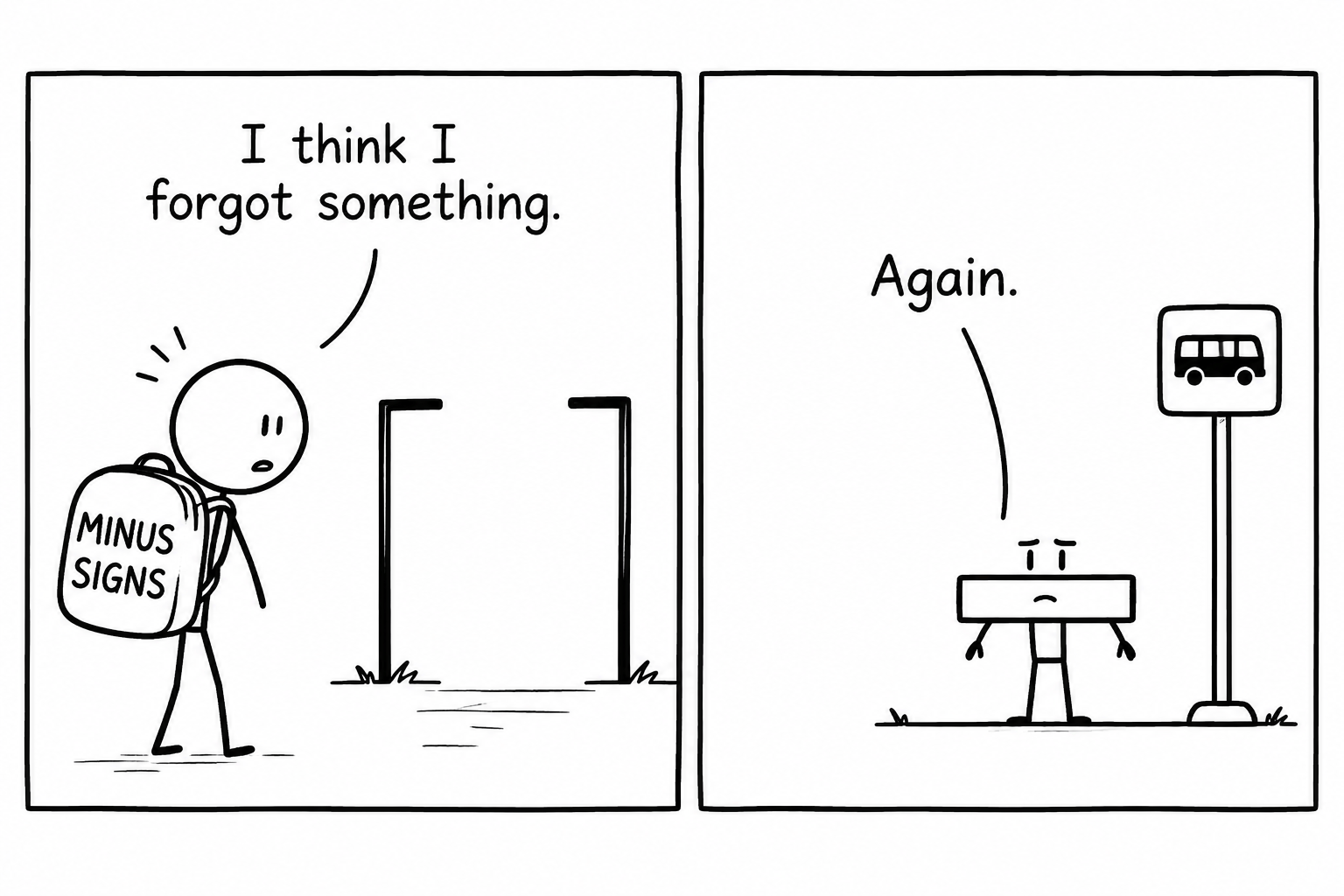 A minimalist stick-figure comic about a student accidentally leaving a minus sign behind
A letter outside the bracket
Expand:
2x(3x+4)2x(3x+4)2x(3x+4)Multiply the complete outside term by both inside terms:
2x×3x+2x×42x\times3x+2x\times42x×3x+2x×4Since x×x=x2x\times x=x^2x×x=x2:
6x2+8x\boxed{6x^2+8x}6x2+8xThe rule has not changed. The multiplication now involves letters as well as numbers. Remember that x+x=2xx+x=2xx+x=2x, whereas x×x=x2x\times x=x^2x×x=x2.
Expand, then simplify
Expand and simplify:
3(x+4)+2x3(x+4)+2x3(x+4)+2xExpand the bracket first, leaving the separate term in place:
3x+12+2x3x+12+2x3x+12+2xThen collect the like terms:
5x+12\boxed{5x+12}5x+12Only the terms inside the bracket receive the multiplier. The separate 2x2x2x does not. Keeping expansion and collection on separate lines helps you see which operation you are doing.
Common mistakes and how to catch them
Multiplying only the first term
The incorrect answer 2(x+6)=2x+62(x+6)=2x+62(x+6)=2x+6 usually means the multiplication stopped too early. Check each original term against your answer: both should have been multiplied by the outside number.
Forgetting the negative outside
In −4(x+3)-4(x+3)−4(x+3), the multiplier is −4-4−4, not 444. Both resulting terms must be negative:
−4(x+3)=−4x−12-4(x+3)=-4x-12−4(x+3)=−4x−12Circle the multiplier with its sign before starting if this is your recurring mistake.
Combining unlike terms
You cannot simplify 5x+125x+125x+12 to 17x17x17x. One term contains a variable and the other is a constant. Expansion can leave you with more than one term, and that can be a complete answer.
Expanding when the question asks you to factorise
Expanding removes brackets. Factorising introduces brackets by taking out a common factor. Read the instruction before calculating, especially when both skills appear together in a worksheet.
Moving on without checking why an answer was wrong
A correction helps most when you name the error: missed second term, wrong sign, or incorrect letter multiplication. If several basic skills are getting mixed together, the guide to building GCSE maths foundations can help you decide what to revisit first.
Expanding single brackets questions
Try these without looking at the examples. Write an intermediate multiplication line whenever you feel uncertain.
| Question | Expression | Instruction |
|---|---|---|
| A | 6(x+2)6(x+2)6(x+2) | Expand |
| B | 3(4y−5)3(4y-5)3(4y−5) | Expand |
| C | −2(a+7)-2(a+7)−2(a+7) | Expand |
| D | −5(2t−3)-5(2t-3)−5(2t−3) | Expand |
| E | 3x(2x−5)3x(2x-5)3x(2x−5) | Expand |
| F | 4(x−2)+3x4(x-2)+3x4(x−2)+3x | Expand and simplify |
Answers and checks
| Question | Answer | What to check |
|---|---|---|
| A | 6x+126x+126x+12 | Both terms were multiplied. |
| B | 12y−1512y-1512y−15 | The constant remains negative. |
| C | −2a−14-2a-14−2a−14 | The negative multiplier reaches both terms. |
| D | −10t+15-10t+15−10t+15 | Multiplying two negatives gives a positive. |
| E | 6x2−15x6x^2-15x6x2−15x | Multiplying the letters produces a squared term. |
| F | 7x−87x-87x−8 | Expand before collecting like terms. |
You can also check an expansion by substituting a convenient value into the original expression and your answer. Different results prove that something went wrong. Matching results are reassuring, although one matching value does not prove two expressions are identical.
For a longer practice set, use the expanding and factorising exam booklet. Once the multiplication feels secure, the forming and solving equations revision guide shows where this skill leads next.
Turn the method into a habit
For our imagined student, the click comes when every term receives its multiplication and every correction has a reason. You now have that method; the next step is using it independently until missed terms and signs become easier to catch. Your turn: start with MathsGenie's Lessons and Question Bank to practise expanding single brackets, checking every term before you move on.