

Exchange Rates GCSE Maths: Examples and Questions
Exchange rates GCSE maths explained with clear worked examples, common mistakes and exam-style questions. Learn when to multiply or divide with confidence.
Exchange rates GCSE maths questions often go wrong before the calculator comes out. You see pounds and euros, remember that multiplication is involved somewhere, and choose an operation. The reliable method is to read the rate as a relationship: identify what one unit buys, then convert in the direction the question asks.
Imagine a student who keeps multiplying every amount by the exchange rate. Converting pounds to euros works, so the rule seems sensible. Then a question asks them to change euros back into pounds, and the same rule fails.
The turning point is writing the currencies beside the numbers. Once the student can explain what the rate means, choosing between multiplication and division becomes much easier.
Exchange rates GCSE maths: the basic method
An exchange rate tells you how much one currency is worth in another currency. For example,
£1=€1.20\pounds 1 = \text{€}1.20£1=€1.20means that each pound buys 1.201.201.20 euros. This is an illustrative rate, not a live travel quote. In an exam, use the rate supplied in the question.
Before calculating, use this checklist:
- Identify the currency you have.
- Identify the currency you need.
- Read which currency has a value of one in the given rate.
- Write the calculation with currency labels.
- Check the answer and round as instructed.
For this particular rate, the relationship is:
pounds→×1.20euros\text{pounds} \xrightarrow{\times 1.20} \text{euros}pounds×1.20euros euros→÷1.20pounds\text{euros} \xrightarrow{\div 1.20} \text{pounds}euros÷1.20poundsThe reverse journey uses the inverse operation. There is no universal rule that says “always multiply when changing money abroad”: the operation depends on how the rate is written.
Start with MathsGenie's exchange rates Lessons and use the Question Bank on the exchange rates topic page to practise choosing the direction yourself.
Exchange rates worked examples
Converting pounds to euros and back
A question gives the rate:
£1=€1.20\pounds 1 = \text{€}1.20£1=€1.20How many euros does a student receive for £250\pounds 250£250?
Read the relationship. Each pound buys 1.201.201.20 euros, so multiply the number of pounds by 1.201.201.20.
250×1.20=300250 \times 1.20 = 300250×1.20=300The student receives €300\text{€}300€300.
Now suppose they return with €78\text{€}78€78 and exchange it at the same rate, with no fee.
Reverse the relationship. Each group of 1.201.201.20 euros is worth one pound, so divide.
78÷1.20=6578 \div 1.20 = 6578÷1.20=65They receive £65\pounds 65£65.
Our imagined student initially calculates 78×1.2078 \times 1.2078×1.20. The useful correction is to return to the meaning: €1.20\text{€}1.20€1.20 must become £1\pounds 1£1. Division makes that happen.
For these rates, the euro amount is numerically larger than the pound amount. That gives a useful check, but always check against the supplied rate rather than assuming this is true for every currency.
Converting between two foreign currencies
Sometimes both rates are given against pounds, even though the question asks you to convert between other currencies:
£1=€1.20\pounds 1 = \text{€}1.20£1=€1.20 £1=US$1.50\pounds 1 = \text{US}{\char36}1.50£1=US$1.50Convert €180\text{€}180€180 into US dollars.
First, convert euros to pounds.
180÷1.20=150180 \div 1.20 = 150180÷1.20=150Then, convert pounds to dollars.
150×1.50=225150 \times 1.50 = 225150×1.50=225Therefore, €180\text{€}180€180 is worth US$225\text{US}{\char36}225US$225 at these rates.
Pounds act as a bridge between the two currencies. Writing both stages makes the route clear and helps you spot a calculation going in the wrong direction.
If that route still feels difficult, the exchange rates revision guide provides another way to revisit the topic before attempting questions independently.
Comparing offers with a commission fee
A higher exchange rate does not automatically give the better deal when fees apply.
Suppose you have £200\pounds 200£200 to exchange. Company A offers €1.18\text{€}1.18€1.18 per pound with no fee. Company B offers €1.22\text{€}1.22€1.22 per pound but deducts a £5\pounds 5£5 fee from your money before converting it.
Company A:
200×1.18=€236200 \times 1.18 = \text{€}236200×1.18=€236Company B:
(200−5)×1.22=€237.90(200 - 5) \times 1.22 = \text{€}237.90(200−5)×1.22=€237.90Company B gives more euros. The difference is:
237.90−236=€1.90237.90 - 236 = \text{€}1.90237.90−236=€1.90The wording matters: this question specifically says the fee is deducted before conversion. A fee charged afterwards must be handled at that later stage, using the currency stated.
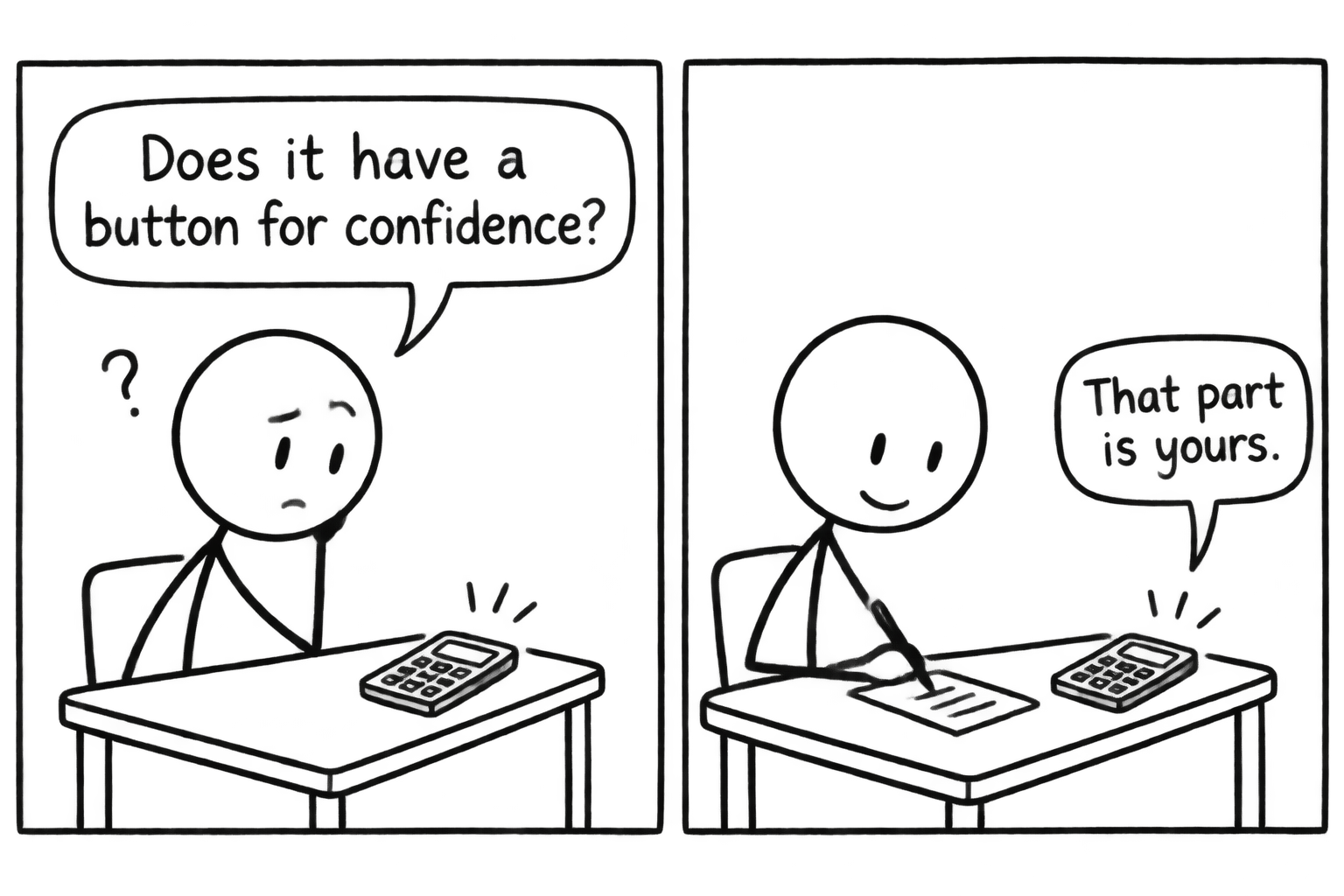 A stick-figure student asks whether a calculator has a confidence button; the calculator points them towards writing their working.
Common mistakes and how to catch them
Multiplying in both directions. Write a currency arrow before entering anything into your calculator. Reversing a conversion requires reversing the operation.
Treating the rate as an amount to add. An exchange rate describes a multiplicative relationship. Doubling the starting money doubles the converted amount when the rate is fixed and there are no fees.
Rounding halfway through. Keep the calculator's full value during a calculation with several stages. Round the final answer as instructed, usually to two decimal places for pounds, euros or dollars.
Comparing different currencies directly. You cannot decide which price is cheaper just by choosing the smaller number. Convert both prices into the same currency first, then compare them.
Ignoring the question's final instruction. Finding an exchange amount may be only part of the task. You might also need to state which offer is better, calculate a difference, or explain a decision.
Our imagined student's improvement comes from noticing these decisions before calculating. If you need to see a method unfold, the exchange rates video explanations offer another way to follow the working.
Exam-style exchange rates questions
Try these without looking back at the examples. Write a currency label beside each answer and show your calculation.
Question A: The exchange rate is £1=€1.16\pounds 1 = \text{€}1.16£1=€1.16. Convert £350\pounds 350£350 into euros.
Question B: The exchange rate is £1=US$1.25\pounds 1 = \text{US}{\char36}1.25£1=US$1.25. Convert US$460\text{US}{\char36}460US$460 into pounds.
Question C: You are given £1=€1.15\pounds 1 = \text{€}1.15£1=€1.15 and £1=US$1.40\pounds 1 = \text{US}{\char36}1.40£1=US$1.40. Convert €230\text{€}230€230 into US dollars.
Question D: A jacket costs £72\pounds 72£72 in the UK and €85\text{€}85€85 abroad. The exchange rate is £1=€1.20\pounds 1 = \text{€}1.20£1=€1.20. Which is cheaper, and by how much in euros? Ignore any extra charges.
Check your answers
- A: 350×1.16=€406350 \times 1.16 = \text{€}406350×1.16=€406.
- B: 460÷1.25=£368460 \div 1.25 = \pounds 368460÷1.25=£368.
- C: 230÷1.15×1.40=US$280230 \div 1.15 \times 1.40 = \text{US}{\char36}280230÷1.15×1.40=US$280.
- D: The UK price converts to 72×1.20=€86.4072 \times 1.20 = \text{€}86.4072×1.20=€86.40. The jacket abroad is cheaper by 86.40−85=€1.4086.40 - 85 = \text{€}1.4086.40−85=€1.40.
When checking, identify the first incorrect decision rather than simply replacing your answer. Was it the conversion direction, the arithmetic or the final comparison? That tells you what to practise next.
Turn the method into a habit
The goal is to see a rate and know what it means before touching your calculator. Our imagined student now has a repeatable approach, but making it reliable takes independent practice across different question wordings. Your turn: start with MathsGenie's exchange rates Lessons, then apply the method in the exchange rates Question Bank.















