Exam Anxiety and Revision Planning: A Calmer Plan
Exam anxiety and revision planning made practical: build a realistic schedule, choose effective tasks and help GCSE or A Level students feel calmer each day.
Exam anxiety and revision planning often pull in opposite directions. Anxiety says everything must be done immediately. A useful plan identifies the next manageable task.
Start with a flexible schedule based on exam dates, weak topics and available time. Give each session a specific purpose, such as answering algebraic fractions questions, rather than simply writing “revise maths”. Include rest, protect sleep and leave space for sessions that need rearranging.
Imagine a student called Sam, a hypothetical example. Sam spends Sunday evening designing a colour-coded timetable, but finishes without answering a question. Planning has become another source of pressure. A better timetable answers three questions: what comes next, how long will it take, and how will I check my understanding?
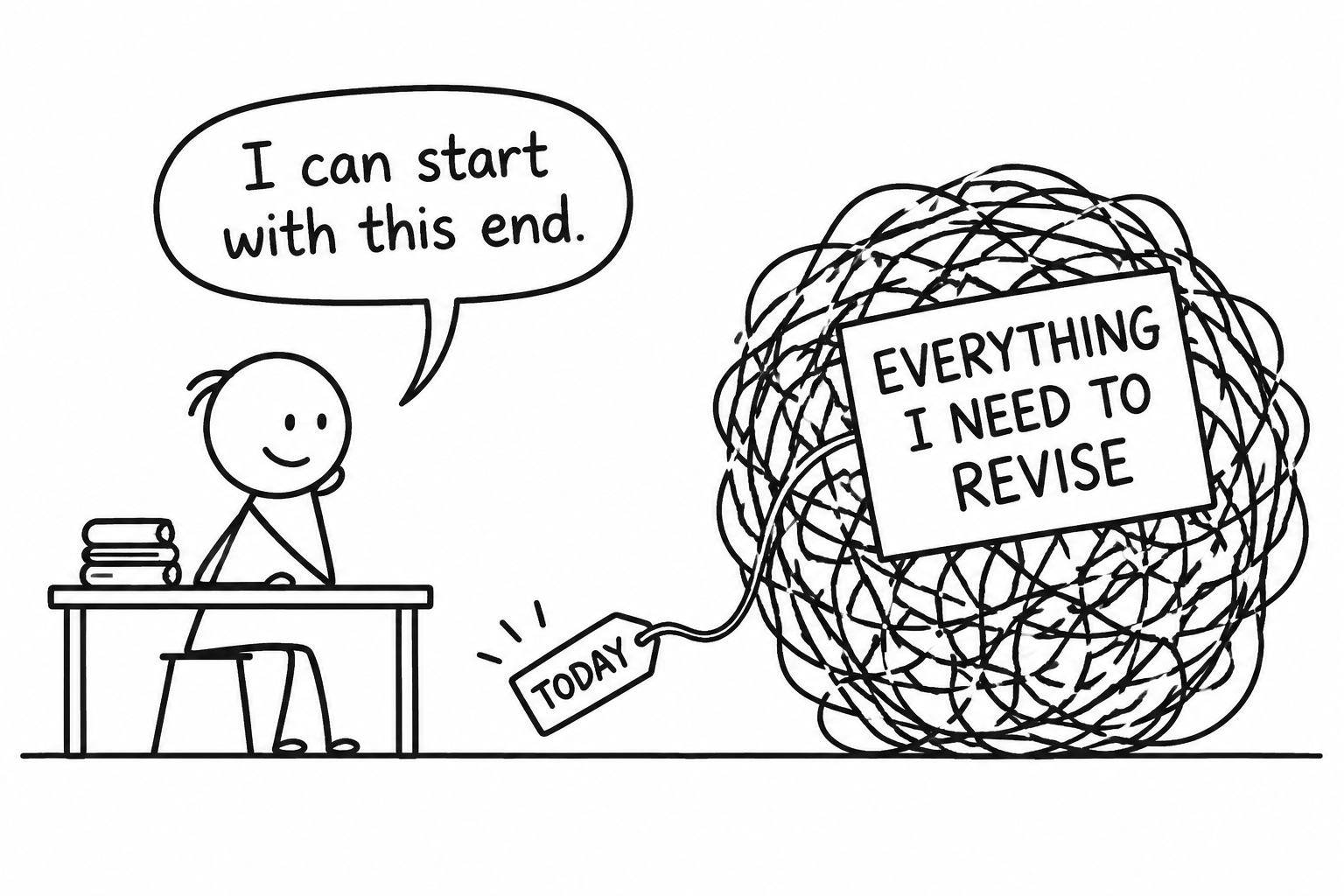 A student finds the manageable end of a tangled revision problem
A quick revision planning checklist
Build your plan in this order:
- Put confirmed exam dates on one calendar.
- Check subjects, papers, exam boards and tiers.
- Identify weak or frequently avoided topics.
- Choose realistic revision times around existing commitments.
- Give each session a precise task.
- Include questions, recall and feedback.
- Leave room for breaks and unexpected changes.
- Review the plan weekly.
For help arranging sessions, use the GCSE maths revision timetable guide. The aim is a schedule that makes starting easier.
How exam anxiety affects revision
Anxiety can make ordinary decisions feel difficult. Students may avoid starting, switch tasks repeatedly or spend hours making notes because answering questions feels uncomfortable.
A plan helps by removing decisions before revision begins. It becomes less useful when treated as an unbreakable contract. Missing Tuesday’s session should prompt an adjustment, rather than two evenings of work squeezed into Wednesday night.
Protect sleep and allow time to wind down. Tiredness makes concentration harder, and late-night revision can displace the rest you need for the following day.
If anxiety persists, disrupts sleep or daily life, or causes panic, speak to a parent, teacher, pastoral lead or GP. Revision planning can support wellbeing, but significant distress deserves appropriate support.
Build a plan that lowers pressure
Start with fixed facts
Record each exam date, subject and paper. For GCSE maths, confirm foundation or higher tier and your exam board, such as Edexcel, AQA, OCR or Eduqas. A Level students should check how Pure Mathematics, Statistics and Mechanics appear in their specification.
Then look at the time available around lessons, travel, meals and other commitments. The guide to daily GCSE revision time helps you consider a realistic workload. Avoid building a schedule around an ideal week you rarely experience.
Sort topics by need
Use three categories:
- Secure: you answer questions accurately without prompts.
- Developing: you understand the method but need reminders or make mistakes.
- Priority: you struggle to begin typical questions independently.
Give developing and priority topics regular attention, while briefly revisiting secure material. Use recent marked work to make these judgements rather than relying only on how familiar a topic feels.
Find suitable resources through the GCSE maths revision area or the Edexcel A Level maths revision collection, according to your qualification and specification.
Turn subjects into actions
“Do maths” leaves another decision waiting when revision starts. A clearer task is to answer a short set of quadratic equation questions, mark them and retry any errors independently.
Make the task small enough to finish in the available time. If you regularly run out of time before marking, reduce the number of questions. Checking your understanding belongs inside the session.
Once dates, priorities and tasks are clear, use the MathsGenie Revision Planner to organise your schedule.
Give each session a clear structure
A useful revision block follows a simple sequence:
- Recall: write what you remember before opening notes.
- Practise: answer focused questions independently.
- Check: compare your work with solutions or a mark scheme.
- Record: identify the specific error or missing idea.
- Return: attempt the difficult material again later.
Revisiting material across separate sessions gives you opportunities to retrieve it again. Keep your error notes precise: “forgot to reverse the inequality after dividing by a negative” tells you more than “bad at inequalities”.
When topic knowledge is established, use Edexcel GCSE past papers and mark schemes for broader practice. Build towards timed sections and complete papers gradually.
How parents can help
Parents can make revision easier without becoming subject teachers. Ask what would help the student start, check that resources match their course, and protect meals, breaks and sleep.
Agree on reminders together. Some students appreciate a quiet prompt; others prefer one weekly conversation. Involve the student in decisions so the timetable feels like something they can use.
Praise useful actions, including honest marking and returning to mistakes. These reveal more about progress than the number of hours spent sitting at a desk.
Common mistakes with exam anxiety and revision planning
Planning every available minute. Leave spare time for homework, tiredness and unexpected events. Otherwise, one disruption can make the whole week feel unmanageable.
Starting with an overwhelming task. Begin with a brief, approachable activity, then move into the priority work. Keep the first step clear.
Measuring effort only in hours. Record what you completed and what needs another attempt. Time alone cannot show whether understanding improved.
Using full papers before addressing major gaps. Topic questions can help rebuild methods before you combine them under timed conditions.
Treating a missed session as failure. Ask whether the timing, workload or task was unrealistic, then adjust the next session.
Take the next manageable step
Sam’s useful change is replacing the perfect timetable with a clear next task and a planned return to difficult material. Nerves may remain, but fewer decisions stand between sitting down and beginning.
Choose one priority topic, find suitable MathsGenie revision lessons and practice questions, and mark your work carefully. Then build your revision schedule around tasks you can realistically complete.