

Evening Classes GCSE Design and Technology: Worth It?
Evening classes GCSE Design and Technology guide: compare tuition, NEA support, workshop access and self-study costs before choosing your route.
A course can look manageable on paper: one evening each week, some independent revision and an exam at the end. Then you discover the workshop sessions, portfolio, prototype, travel and deadlines hiding behind that simple timetable.
So, are evening classes GCSE Design and Technology courses worth it? For many adult learners, yes, particularly when the course provides an approved exam entry, supervised non-exam assessment, specialist equipment and regular feedback. Pure self-study may cost less, but GCSE Design and Technology is unusually difficult to complete alone because half of the qualification is normally assessed through a practical design-and-make project.
The decision is therefore not simply teacher versus textbook. It is about whether the course gives you access to things that are hard to create at home.
The short answer: when is an evening class worth it?
An adult evening class is likely to offer good value if it includes:
- tuition matched to your exam board and current specification;
- registration with an approved exam centre;
- supervision and assessment of the non-exam assessment, or NEA;
- safe access to suitable tools, machinery, materials and software;
- structured portfolio and prototype feedback;
- written-exam preparation and past-paper practice;
- a timetable you can attend consistently.
Self-study may be more suitable if you already have strong technical knowledge, access to a workshop and an approved centre willing to manage every part of your NEA. That final condition matters. Watching lessons independently does not remove the need for supervised, authenticated and assessed project work.
Before paying anything, ask the provider for written confirmation of exactly what the fee includes.
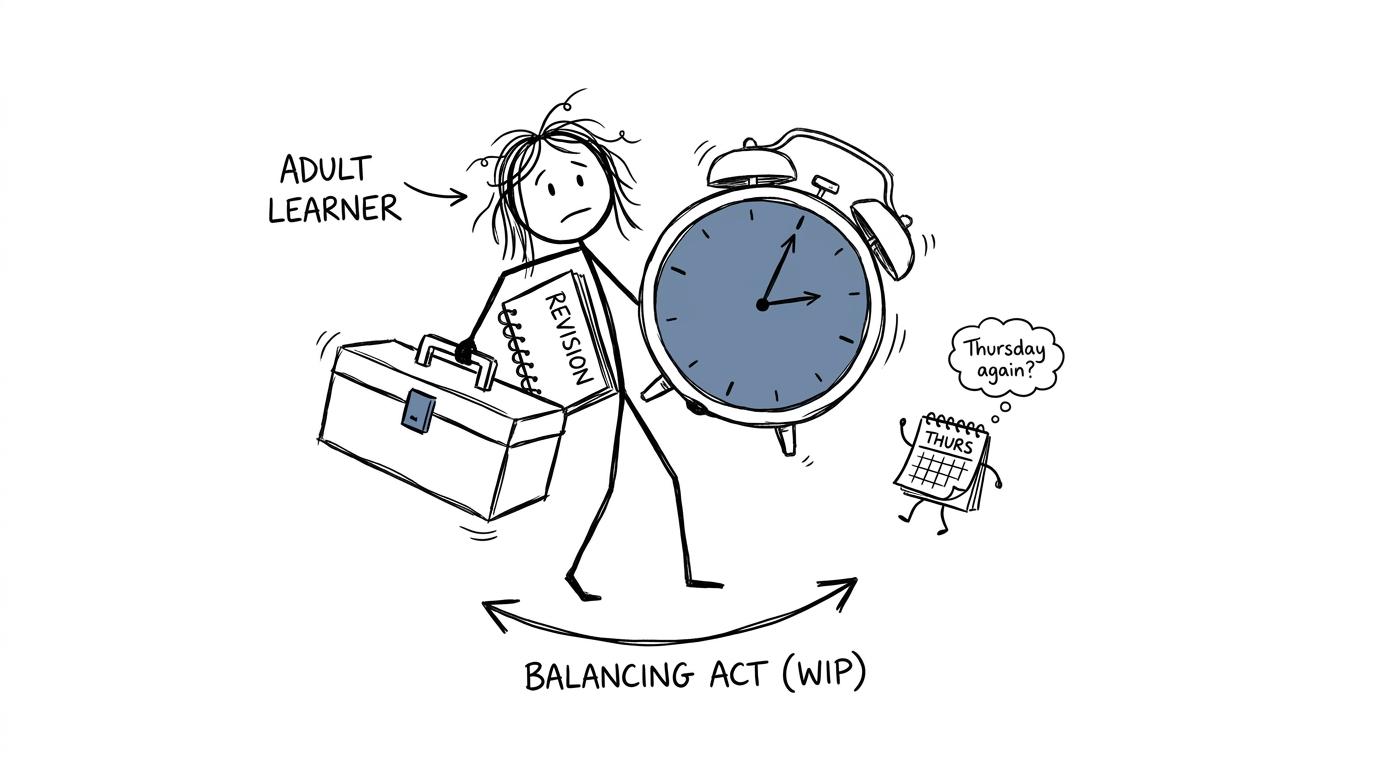 An adult learner balancing a toolbox, sketchbook and evening timetable
Why GCSE Design and Technology is difficult to self-study
GCSE Design and Technology is not an exam-only subject. Across AQA, Edexcel, OCR and Eduqas, the established assessment structure gives 50%50\%50% of the qualification to a written examination and 50%50\%50% to NEA.
The exact terminology and requirements vary by exam board, but the project generally involves investigating a contextual challenge, developing a specification, generating and refining ideas, manufacturing a prototype, and evaluating the outcome. AQA indicates approximately 303030 to 353535 hours for its NEA, while other specifications also require a substantial supervised project.
An approved centre must take responsibility for the assessment. For private candidates, that can include supervising and authenticating the work, marking it, completing the administration and providing the examination arrangements. A centre should not accept an entry involving NEA unless it is prepared to provide the required assessment opportunity.
This is the central weakness of a self-study-only plan. You may be able to learn material properties, manufacturing processes and sustainability independently, but knowledge is only one part of the qualification. You still need a legitimate route through the assessed project.
What a good evening class should provide
Not every course called “GCSE Design and Technology” provides the same service. Some are complete qualification programmes. Others offer tuition but leave exam entry and NEA arrangements to the learner.
A clear exam-board route
The provider should identify whether it teaches AQA, Edexcel, OCR or Eduqas and explain the specialist material area being covered. GCSE Design and Technology does not have foundation and higher tiers in the way GCSE Maths does, so a vague promise to teach “GCSE level” is not enough.
If your course follows Edexcel, the free Edexcel GCSE Design and Technology revision hub can support your independent work with lessons, questions and past-paper resources. Learners following another board should use their provider’s specification and assessment plan as the final authority.
Practical access that self-study cannot easily replace
Workshop access is often the strongest reason to pay for a class. Suitable tools and machinery can be expensive, while safe use requires proper instruction, risk management and supervision. A course may also provide CAD facilities, modelling resources, consumable materials and storage for unfinished work.
Ask which processes are genuinely available. A room containing computers and craft knives is not equivalent to a properly equipped workshop if your planned prototype requires more specialised manufacturing.
Feedback during an iterative process
Design work improves through testing and revision. Good feedback does not tell you what to design or complete assessed work for you. It helps you recognise when evidence is weak, a specification is not measurable, development has stalled or testing does not answer the original design problem.
That feedback is most valuable while there is still time to act on it.
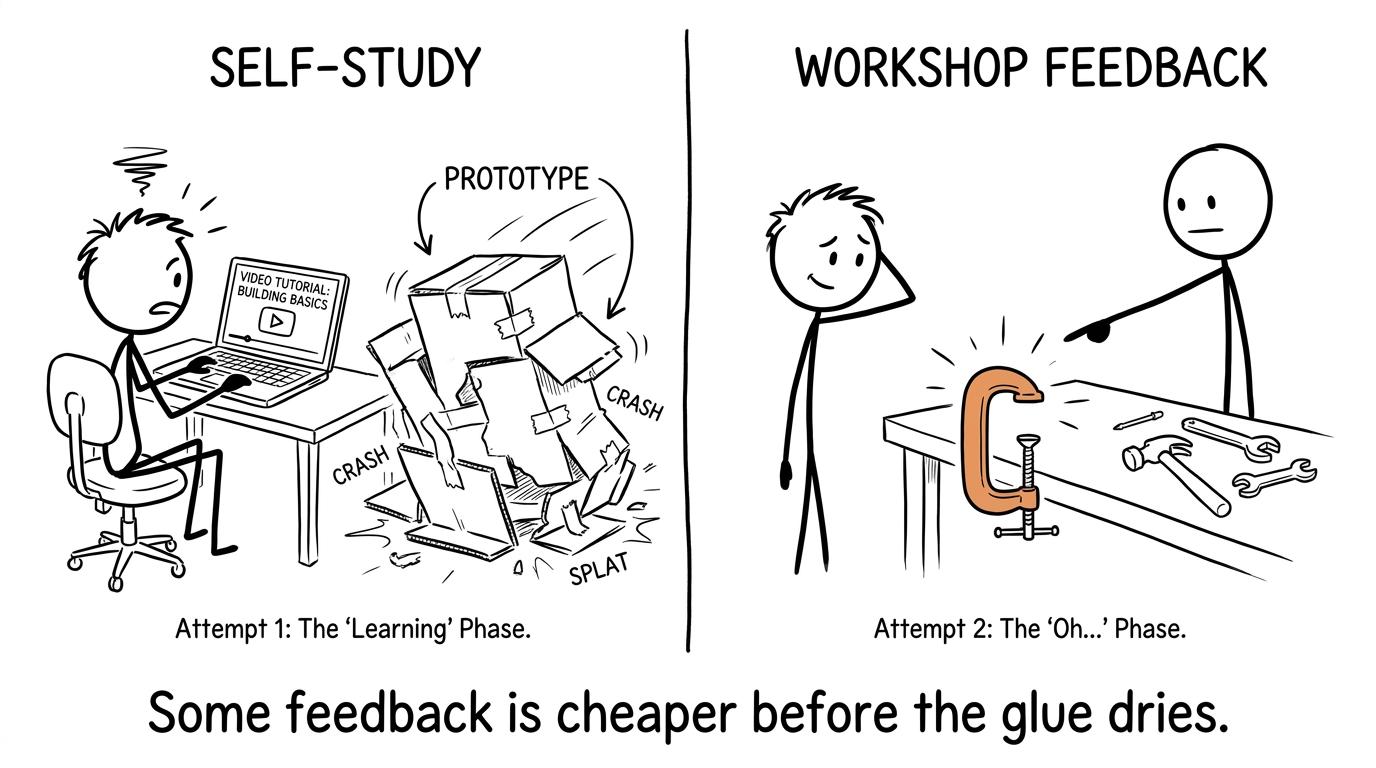 A tutor notices the missing clamp before the glue dries
Evening classes versus self-study
Choose an evening class when structure is the scarce resource
A weekly class creates an external deadline. That may sound like a small benefit, but adult revision often competes with work, caring responsibilities and ordinary tiredness. A fixed session protects time that would otherwise be repeatedly postponed.
A class is especially useful when you:
- are returning to education after a long gap;
- have limited experience of designing and manufacturing;
- need regular access to equipment;
- want direct clarification of assessment criteria;
- find it difficult to plan a long project independently;
- do not yet have an exam centre that can manage the NEA.
Choose self-study when you already have the infrastructure
Independent revision can work when you have the discipline, subject knowledge and practical access to make it realistic. It lets you revisit difficult topics, move quickly through familiar content and arrange revision around changing work patterns.
However, self-study should usually complement a centre-based assessment arrangement rather than replace it. Confirm the centre and NEA process before spending months learning the specification. The official private-candidate search service can help candidates locate potential centres, but individual arrangements and charges must be confirmed directly.
A hybrid route is often the sensible middle ground: use a centre or evening course for supervised practical work and assessment, then use free online resources for much of the written-paper revision.
How to judge the real cost
The advertised tuition fee is only one part of the decision. A more honest comparison is:
total cost=tuition+centre fees+materials+travel+other costs\text{total cost} = \text{tuition} + \text{centre fees} + \text{materials} + \text{travel} + \text{other costs}total cost=tuition+centre fees+materials+travel+other costsOther costs might include childcare, parking or income lost by leaving work early. Equally, check whether the course fee already includes exam-board entry, centre administration and materials rather than counting them twice.
Awarding organisations charge centres entry fees, but a private candidate’s final charge may be higher because the centre is also providing administration, facilities, invigilation and NEA support. Fees and adult-funding eligibility vary between providers, regions and personal circumstances. Do not assume that a Design and Technology course will be free simply because some adult GCSE Maths and English programmes are funded.
You can also consider value per supported hour:
cost per supported hour=total course costhours of tuition and supervised workshop access\text{cost per supported hour} = \frac{\text{total course cost}}{\text{hours of tuition and supervised workshop access}}cost per supported hour=hours of tuition and supervised workshop accesstotal course costThis is not about choosing the smallest number automatically. A cheaper course that cannot assess the NEA may provide little route to the final qualification.
The maths inside GCSE Design and Technology
Design and Technology contains more maths than its creative reputation suggests. AQA, Edexcel and OCR specifications state that at least 15%15\%15% of the written examination assesses mathematical skills in a Design and Technology context. Relevant skills include:
- decimals, fractions and percentages;
- ratios and scale drawings;
- unit conversion and standard form;
- area, surface area and volume;
- angles and geometrical representation;
- graphs, tables and interpretation of data;
- calculating material quantities and costs.
These topics overlap directly with GCSE Maths. The difference is context: instead of meeting a calculation as an isolated exercise, you may use it to determine dimensions, compare costs or interpret product-testing data.
Use the GCSE Maths topics by exam board and tier guide to identify gaps. The similar shapes, area and volume revision guide is particularly useful when scaling designs or thinking about how dimensions affect material requirements.
If you are preparing for GCSE Maths at the same time, the best order for learning GCSE Maths topics offers a manageable sequence. Secure number, percentages, ratio and measures before moving towards more demanding geometry.
Questions to ask before enrolling
Contact the provider and ask:
- Which exam board and specification do you teach?
- Is this a complete GCSE qualification or an unaccredited introductory course?
- Are exam entry and centre charges included?
- Can the centre supervise, authenticate and mark the NEA?
- Which workshop tools, materials and CAD facilities are available?
- Are materials included, capped or charged separately?
- How many taught and supervised hours are provided?
- What happens if I miss a practical session?
- Does the timetable cover the full project and examination cycle?
- What independent work is expected each week?
The quality of the answers matters as much as the price. A reliable provider should explain the route clearly rather than suggesting that the administrative details can be sorted out near the examination.
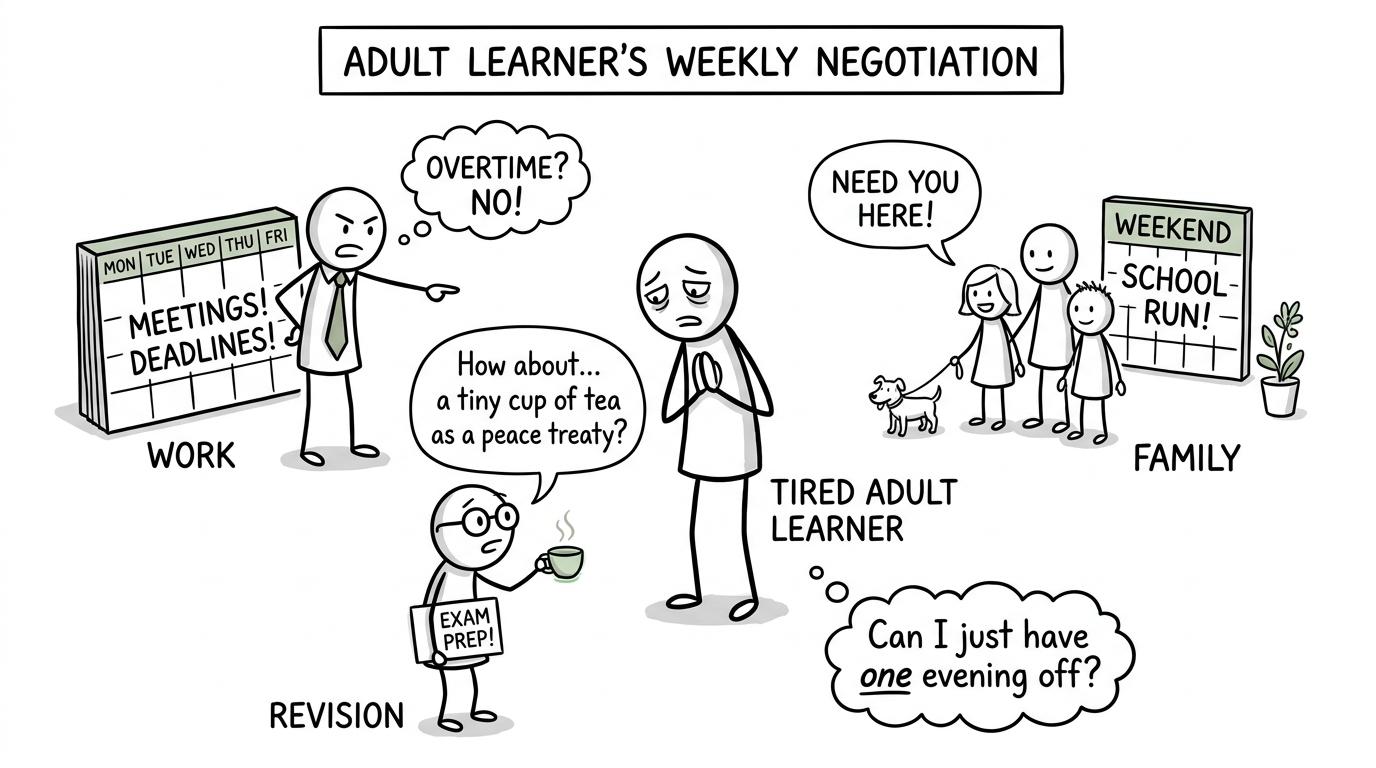 Work, family and revision negotiate over the weekly calendar
Common mistakes when choosing a course
Paying before confirming the NEA arrangements
This is the most serious mistake. Tuition alone does not guarantee entry for a qualification containing controlled project work. Obtain written confirmation that the centre will manage the relevant NEA requirements.
Comparing tuition fees rather than complete costs
Include entry, centre services, materials and travel. A higher headline fee may be better value if it covers the full qualification route.
Ignoring the exam board
AQA, Edexcel, OCR and Eduqas share broad subject aims, but their specifications and assessment details are not interchangeable. Revision must match the board used by your centre.
Underestimating independent work
One evening lesson rarely represents the entire weekly commitment. Portfolio development, theory revision and written-paper practice still require protected time outside class.
Treating attendance as revision
Being present is not the same as learning. After each lesson, retrieve key knowledge without notes, answer questions and correct mistakes. The GCSE Maths topics that come up regularly guide explains how topic practice, mark schemes and mixed papers can be combined effectively.
Leaving written-exam preparation too late
Practical work can consume attention because its deadlines feel immediate. Protect regular time for technical principles and mathematical skills. If time becomes tight, the principles in the three-day GCSE Maths revision guide are useful: diagnose weaknesses, practise actively and correct errors rather than rereading everything.
A sensible final decision
Evening classes are worth paying for when they solve the difficult parts of the qualification: approved assessment, workshop access, safe practical instruction, sustained feedback and reliable structure. They are less compelling when they merely reproduce information you could learn independently while leaving you to arrange the NEA and exam entry yourself.
Start by confirming your centre, exam board and total cost. Then decide which parts genuinely require face-to-face support. Use the course for equipment, supervision and feedback; use MathsGenie to strengthen the numerical skills and exam habits that support both Design and Technology and GCSE Maths.
Visit MathsGenie’s free GCSE and A Level revision platform for revision lessons, practice questions, mini tests, mark schemes, video solutions, past papers, predicted papers and the revision planner. A class can provide the timetable. Careful practice is what turns that timetable into progress.











