

Estimation Exam Questions: GCSE Worked Examples
Estimation exam questions made clear with three GCSE worked examples, mark-by-mark methods, common mistakes and focused practice on Maths Genie for free.
A calculator can produce ten decimal places in a moment. That is why estimation exam questions can feel strange. They ask you to replace awkward values with manageable ones, preserve the calculation's structure and reach a sensible approximate answer.
The reliable GCSE method is simple: round each value, usually to one significant figure, rewrite the complete calculation, and calculate. Written substitutions can earn method marks even if the final arithmetic goes wrong.
Imagine a student called Sam tackling three exam-style questions using this method.
The estimation method to remember
Use this checklist:
- Round each value, normally to one significant figure unless instructed otherwise.
- Rewrite the entire expression with your rounded values.
- Calculate from the rewritten expression.
- Check whether your answer is reasonable.
For one significant figure, find the first non-zero digit and inspect the next digit. If it is 555 or more, round up. Otherwise, keep the first digit unchanged.
For example:
47.8≈50 47.8 \approx 50 47.8≈50 3.12≈3 3.12 \approx 3 3.12≈3 0.0836≈0.08 0.0836 \approx 0.08 0.0836≈0.08The first significant figure in 0.08360.08360.0836 is 888. Zeros that only position the decimal point are not significant.
If this feels uncertain, review the GCSE rounding lesson.
Three estimation exam questions worked step by step
The mark allocations below are illustrative. Exact decisions depend on the official mark scheme for each paper.
Question one: a straightforward estimate
Sam begins with:
31.2×4.879.76 \frac{31.2 \times 4.87}{9.76} 9.7631.2×4.87Estimate the value of
Round every number to one significant figure:
31.2≈30 31.2 \approx 30 31.2≈30 4.87≈5 4.87 \approx 5 4.87≈5 9.76≈10 9.76 \approx 10 9.76≈10Rewrite the full calculation:
31.2×4.879.76≈30×510 \frac{31.2 \times 4.87}{9.76} \approx \frac{30 \times 5}{10} 9.7631.2×4.87≈1030×5Now calculate:
30×510=15010=15 \frac{30 \times 5}{10}=\frac{150}{10}=15 1030×5=10150=15A possible three-mark allocation would be:
M1for suitable roundingM1for substituting into the correct calculationA1for obtaining 151515
The rewritten expression matters. If Sam calculated 150÷10150 \div 10150÷10 incorrectly, the earlier working could still demonstrate a valid method.
Question two: decimals on both sides of the fraction
The next question looks less friendly:
0.487×19.62.04 \frac{0.487 \times 19.6}{2.04} 2.040.487×19.6Estimate the value of
Apply the same process:
0.487≈0.5 0.487 \approx 0.5 0.487≈0.5 19.6≈20 19.6 \approx 20 19.6≈20 2.04≈2 2.04 \approx 2 2.04≈2Substitute the rounded values:
0.487×19.62.04≈0.5×202 \frac{0.487 \times 19.6}{2.04} \approx \frac{0.5 \times 20}{2} 2.040.487×19.6≈20.5×20Work through the numerator first:
0.5×20=10 0.5 \times 20=10 0.5×20=10Then divide:
10÷2=5 10 \div 2=5 10÷2=5Therefore:
0.487×19.62.04≈5 \frac{0.487 \times 19.6}{2.04} \approx 5 2.040.487×19.6≈5Method marks may reward appropriate approximations and substitution, with an accuracy mark for the estimate.
This question tests place value. Rounding 0.4870.4870.487 to 555 would make the rounded value ten times too large. Remember that 0.4870.4870.487 is close to one half.
Use the Maths Genie Estimating Lesson and Estimating Question Bank to practise this method.
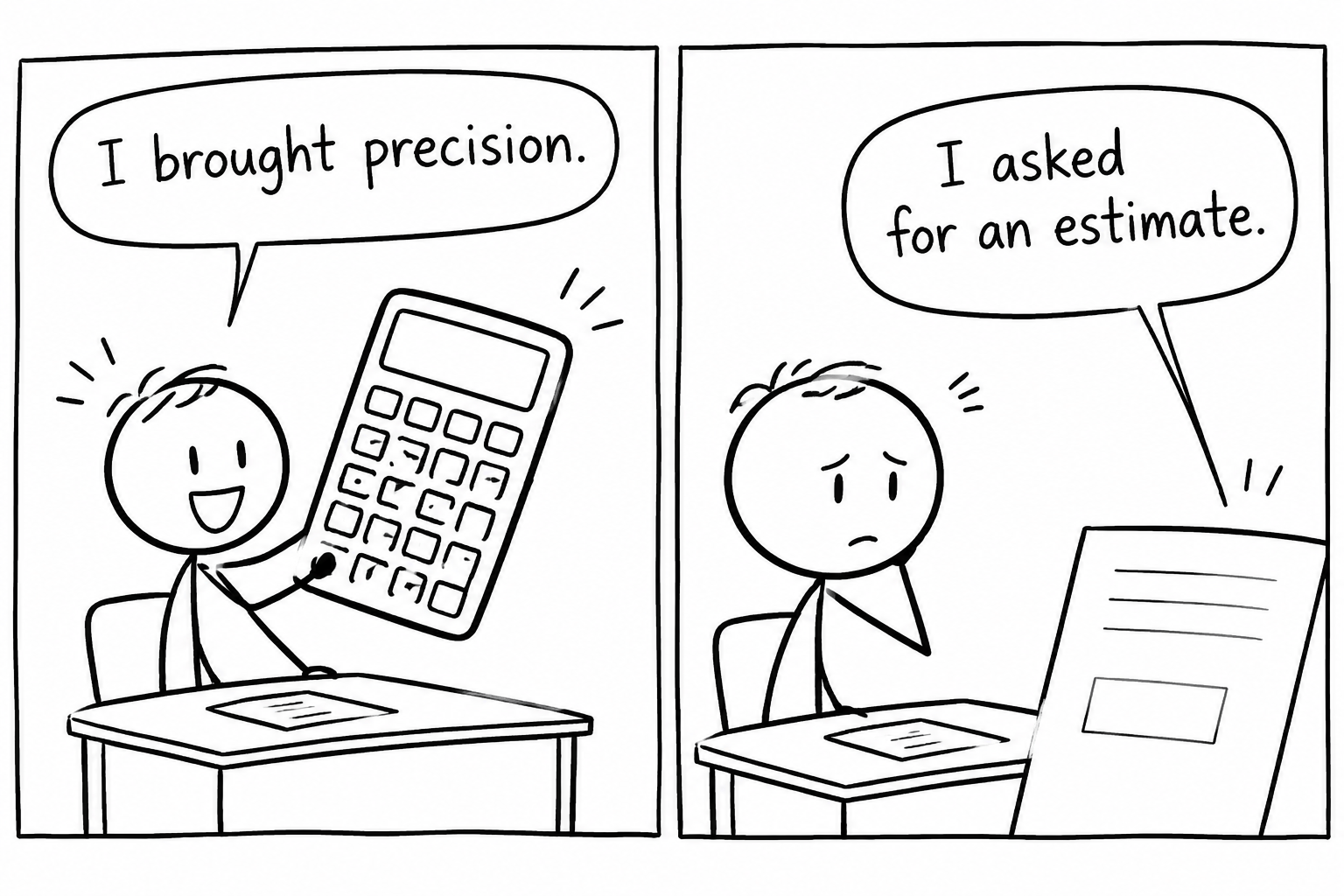 A student brings excessive precision to an estimation question
Question three: estimating with a power
Sam's final question adds a square:
39.620.198×81.2 \frac{39.6^2}{0.198 \times 81.2} 0.198×81.239.62Estimate the value of
Round the values first:
39.6≈40 39.6 \approx 40 39.6≈40 0.198≈0.2 0.198 \approx 0.2 0.198≈0.2 81.2≈80 81.2 \approx 80 81.2≈80The square must remain attached to the rounded version of 39.639.639.6:
39.620.198×81.2≈4020.2×80 \frac{39.6^2}{0.198 \times 81.2} \approx \frac{40^2}{0.2 \times 80} 0.198×81.239.62≈0.2×80402Evaluate the numerator and denominator separately:
402=1600 40^2=1600 402=1600 0.2×80=16 0.2 \times 80=16 0.2×80=16Therefore:
160016=100 \frac{1600}{16}=100 161600=100The estimate is 100100100. Suitable rounding and correct substitution may earn method marks; the final allocation depends on the question's mark scheme.
Writing only 100100100 does not show how it was found. The expression
4020.2×80 \frac{40^2}{0.2 \times 80} 0.2×80402makes the estimation method clear.
Compare this approach with an OCR estimating question and worked solution, or try the printable Estimating Exam Booklet.
How to recognise what the question wants
Look for phrases such as:
- “Estimate the value of”
- “By rounding each number to one significant figure”
- “Use suitable approximations”
- “Show that an estimate is”
If the question specifies one significant figure, follow that instruction. If it asks for suitable approximations, you may choose nearby numbers that are especially convenient. They should remain close to the originals and simplify the calculation.
Context questions may involve weekly pay, total cost or travel time. The process remains the same, but your answer may need units or interpretation. Try the weekly pay estimation question for practice.
Checking whether an estimate is sensible
A useful check starts with the size of your rounded values. Each should be close to the number it replaces. Then inspect the arithmetic separately. This helps distinguish a rounding mistake from a calculation mistake, so you know which part to correct.
Be careful when deciding whether your answer is an overestimate or an underestimate. Increasing the numerator increases a positive fraction, while increasing its denominator decreases it. When several values change in different directions, the overall effect needs further reasoning. An estimate is not automatically an upper or lower bound, and you should not label it as one without justification.
Common mistakes in estimation past paper questions
Calculating exactly before rounding
Entering the original expression into a calculator and rounding the result demonstrates rounding an answer, rather than estimating a calculation. Approximate the individual values first.
Confusing decimal places and significant figures
These are different instructions. Although 0.4870.4870.487 rounds to 0.50.50.5 both to one decimal place and to one significant figure, this coincidence does not hold for every number. Read carefully.
Losing the expression's structure
Brackets, powers and operations must survive rounding. If the original value is squared, its rounded replacement must also be squared.
Choosing awkward values
Rounding 39.639.639.6 to 39.539.539.5 gives a close value but leaves an awkward square. Both closeness and usefulness matter.
Giving no working
Show your approximations or write the complete rounded calculation. A bare answer hides the decisions that could earn method marks.
Practise the method on Maths Genie
Complete one question without notes, then check every rounded value and operation against the solution. Use the mark scheme to identify whether an error came from your setup or arithmetic, and retry the question independently.
For a short revision session, choose questions with different features: whole numbers, small decimals and powers. Before calculating, write the rounded expression for each. Checking these setups together helps you notice recurring errors without letting arithmetic distract you from the estimation method.
Once your substitutions are reliable, complete the calculations without looking at the solutions. Keep a brief record of mistakes using specific descriptions, such as incorrect decimal place value or a missing square. Revisit those questions in a later session. Being able to explain why each rounded value is suitable gives you a clearer measure of progress than simply recognising an answer you have already seen.
Across these examples, Sam uses the same decisions: round, rewrite, calculate and check. Practising that sequence helps you recognise the method when a question looks unfamiliar.
Start with the Maths Genie Estimating Lessons, then tackle the linked question bank. Use the worked solutions to check your reasoning before moving to another question.















