Equations with Fractions GCSE Maths: Worked Examples
Equations with fractions GCSE maths explained through clear worked examples, common mistakes and exam-style questions to help you solve and check answers.

Imagine a student who can solve ordinary equations but keeps losing their way when a fraction appears. They multiply one part, forget another, and finish with an answer that almost looks right. If that sounds familiar, the key to equations with fractions GCSE maths is simple: multiply every term on both sides by a common denominator, then solve the equation that remains.
We will follow this hypothetical student's sticking points through worked examples. The moment it clicks is when they stop treating the fraction bar as a special algebra rule and recognise it as division that multiplication can undo.
The method at a glance
For equations with numerical denominators:
- Find the lowest common multiple of the denominators.
- Multiply every term on both sides by that number.
- Simplify the fractions, keeping brackets around any numerator containing several terms.
- Expand brackets, collect like terms and isolate the unknown.
- Substitute your answer into the original equation to check it.
Simple linear equations belong in foundation and higher tier revision. More complex algebraic fractions, particularly those with the unknown in the denominator, extend into higher tier work. Here, we will first make the numerical-denominator method secure.
Why multiplying removes fractions
A fraction bar means division. In x3\frac{x}{3}3x, the unknown is divided by 333. Multiplying by 333 reverses that operation:
3×x3=x3\times\frac{x}{3}=x3×3x=xAn equation stays balanced when you apply the same operation to both sides. With several denominators, choose a number divisible by all of them. Their lowest common multiple usually keeps the arithmetic smallest.
For denominators of 333 and 444, that number is 121212. Multiplying the whole equation by 121212 removes both denominators in one step.
Our imagined student's first useful question is therefore: “What must I multiply the whole equation by?” That question gives them a reliable starting point before they attempt any rearranging.
Start practising this routine with the Lessons and Question Bank on MathsGenie's Solving Equations topic page so you can focus on applying the same operation to every term.
Equations with fractions worked examples
A fraction and a whole-number term
Solve:
x3+2=7\frac{x}{3}+2=73x+2=7Multiply every term by 333:
3×x3+3×2=3×73\times\frac{x}{3}+3\times2=3\times73×3x+3×2=3×7Simplify:
x+6=21x+6=21x+6=21Subtract 666 from both sides:
x=15x=15x=15Check in the original equation:
153+2=5+2=7\frac{15}{3}+2=5+2=7315+2=5+2=7The mistake our student might make is changing the fraction but leaving the added number alone. Writing out all three multiplications makes that omission easier to spot.
You could also subtract 222 first and then multiply by 333. Both methods are valid. Clearing denominators becomes especially useful when several fractions appear.
Two different denominators
Solve:
x+13+x4=5\frac{x+1}{3}+\frac{x}{4}=53x+1+4x=5The lowest common multiple of 333 and 444 is 121212. Multiply every term by 121212:
12×x+13+12×x4=12×512\times\frac{x+1}{3}+12\times\frac{x}{4}=12\times512×3x+1+12×4x=12×5Simplify each multiplier:
4(x+1)+3x=604(x+1)+3x=604(x+1)+3x=60Expand the bracket:
4x+4+3x=604x+4+3x=604x+4+3x=60Collect like terms and subtract 444:
7x=567x=567x=56Divide by 777:
x=8x=8x=8Check:
8+13+84=3+2=5\frac{8+1}{3}+\frac{8}{4}=3+2=538+1+48=3+2=5This is the student's turning point. The numerator x+1x+1x+1 stays together because the fraction bar divides the whole expression by 333. Once the denominator disappears, the multiplier applies to everything inside the bracket.
For more questions to attempt on paper, use the Solving Equations practice booklet.
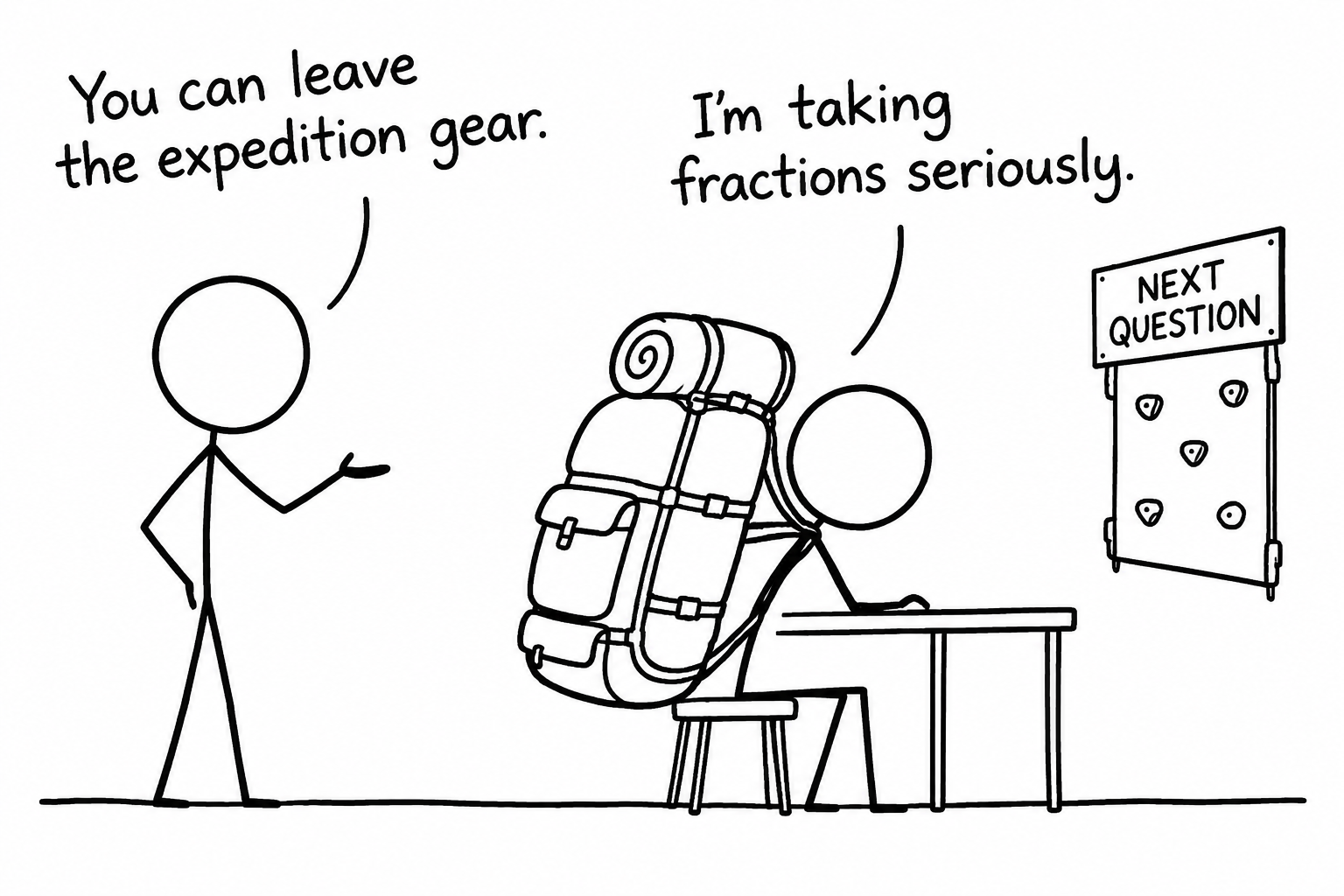 A stick-figure student prepares for the next revision question with an oversized mountaineering backpack
Subtraction and an unknown on both sides
Solve:
2x−13−x+24=x6\frac{2x-1}{3}-\frac{x+2}{4}=\frac{x}{6}32x−1−4x+2=6xThe lowest common multiple of 333, 444 and 666 is 121212. Multiply through:
4(2x−1)−3(x+2)=2x4(2x-1)-3(x+2)=2x4(2x−1)−3(x+2)=2xExpand carefully. The negative multiplier affects both terms in the second bracket:
8x−4−3x−6=2x8x-4-3x-6=2x8x−4−3x−6=2xCollect like terms:
5x−10=2x5x-10=2x5x−10=2xSubtract 2x2x2x, then add 101010:
3x=103x=103x=10Divide by 333:
x=103x=\frac{10}{3}x=310A fractional answer is perfectly valid. Keep it exact rather than rounding a recurring decimal.
To check, substitute into each side separately:
Left side=179−43=59\text{Left side}=\frac{17}{9}-\frac{4}{3}=\frac{5}{9}Left side=917−34=95 Right side=103÷6=59\text{Right side}=\frac{10}{3}\div6=\frac{5}{9}Right side=310÷6=95Both sides agree. If expanding or rearranging still feels uncertain, the Solving Equations video lessons provide another way to revisit those steps.
Common mistakes and how to catch them
Multiplying only the fractions
The multiplier must reach whole-number terms too. In the second example, the right-hand side becomes 606060, because 12×5=6012\times5=6012×5=60.
Before simplifying, point to each term and check that it received the multiplier. This small pause prevents an entire solution from drifting off course.
Losing part of a numerator
The expression x+13\frac{x+1}{3}3x+1 divides all of x+1x+1x+1 by 333. After multiplying by 121212, it becomes 4(x+1)4(x+1)4(x+1).
Keep the brackets until you expand. Writing 4x+14x+14x+1 instead would multiply only part of the numerator.
Mishandling a minus sign
In the final example:
−3(x+2)=−3x−6-3(x+2)=-3x-6−3(x+2)=−3x−6Write the negative multiplier beside the bracket before expanding. Treating it as part of the multiplier helps you remember that both signs must change.
Checking only your rearranged equation
A mistake might happen while you clear the fractions. Checking your answer in that incorrect rearrangement will not reveal it.
Always return to the original equation. Our hypothetical student's progress comes from this feedback: they can identify whether the error happened when multiplying, expanding or collecting terms.
Equations with fractions questions
Try these original exam-style practice questions without looking at the answers. Show the multiplication step and keep exact answers.
| Question | Equation |
|---|---|
| A | x5+3=7\frac{x}{5}+3=75x+3=7 |
| B | x+24=3\frac{x+2}{4}=34x+2=3 |
| C | x3+x6=5\frac{x}{3}+\frac{x}{6}=53x+6x=5 |
| D | x+12−x−23=4\frac{x+1}{2}-\frac{x-2}{3}=42x+1−3x−2=4 |
| E | 3x−24=x+56\frac{3x-2}{4}=\frac{x+5}{6}43x−2=6x+5 |
Answers and first-step checks
| Question | After clearing denominators | Answer |
|---|---|---|
| A | x+15=35x+15=35x+15=35 | x=20x=20x=20 |
| B | x+2=12x+2=12x+2=12 | x=10x=10x=10 |
| C | 2x+x=302x+x=302x+x=30 | x=10x=10x=10 |
| D | 3(x+1)−2(x−2)=243(x+1)-2(x-2)=243(x+1)−2(x−2)=24 | x=17x=17x=17 |
| E | 3(3x−2)=2(x+5)3(3x-2)=2(x+5)3(3x−2)=2(x+5) | x=167x=\frac{16}{7}x=716 |
If your answer differs, compare your first step before reading further through your working. A correct first line narrows the problem to expanding or solving. An incorrect first line tells you to revisit the denominator multiplier.
When these feel secure, distinguish them from equations containing an unknown in a denominator. Those require restrictions because division by zero is undefined. MathsGenie's Algebraic Fractions revision guide explains that broader topic.
Turn the method into a habit
Our imagined student now has a repeatable starting point: clear every denominator, preserve each numerator and check the original equation. Your next step is to make that routine reliable without a worked solution beside you. Start with the Lessons, then practise independently in the Question Bank on MathsGenie's Solving Equations page.