

Dividing Fractions Exam Questions for GCSE
Dividing fractions exam questions explained through three GCSE examples, with clear steps, method marks, common mistakes and practice advice.
Dividing fractions can feel like one of those GCSE topics where a tiny lapse changes the whole answer. You remember that something must be turned upside down, but which fraction? Do whole numbers need changing? What happens when mixed numbers appear?
The reliable answer to dividing fractions exam questions is simple: convert every value into a fraction, keep the first fraction, replace division with multiplication, reciprocate the second fraction, then calculate and simplify. This method works whether the question contains proper fractions, whole numbers or mixed numbers.
In this guide, we will follow a student through three questions of rising difficulty. The examples also show where method marks may be available, although the exact allocation always depends on the exam board's mark scheme.
The dividing fractions checklist
Before working through the questions, learn this short routine:
- Convert whole numbers and mixed numbers into fractions.
- Keep the first fraction unchanged.
- Change division to multiplication.
- Turn the second fraction upside down by finding its reciprocal.
- Cancel common factors where possible.
- Multiply the numerators and denominators.
- Simplify the final fraction.
- Convert to a mixed number if the question or context requires it.
A useful memory phrase is keep, change, flip. Keep the first fraction, change division to multiplication, and flip the second fraction. The phrase helps, but understanding the reciprocal is safer than relying on memory alone.
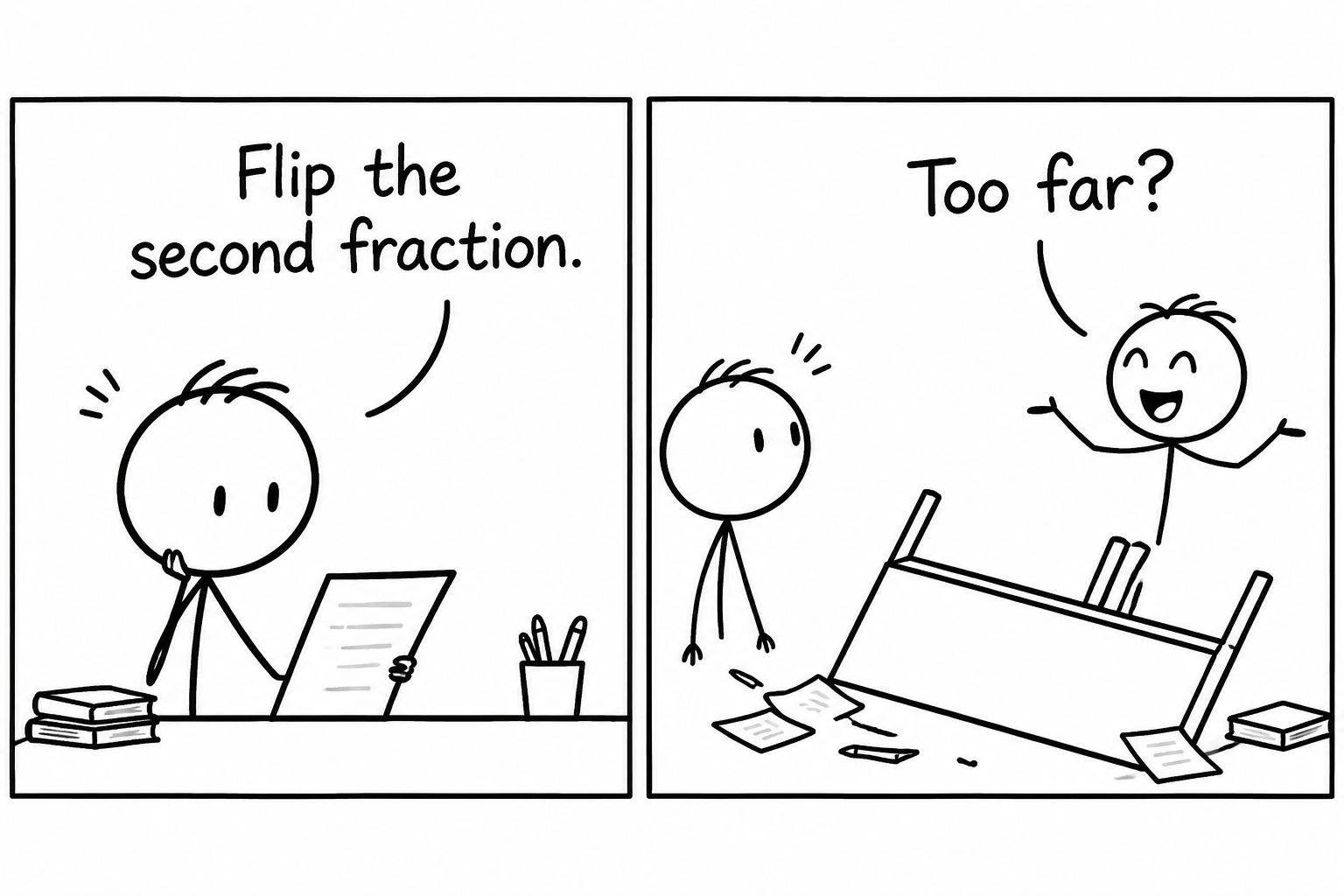 A stick-figure student takes the instruction to flip the second fraction too literally
Why the reciprocal method works
Dividing by a number is equivalent to multiplying by its reciprocal. The reciprocal of a non-zero fraction is found by exchanging its numerator and denominator:
ab⟶ba\frac{a}{b} \longrightarrow \frac{b}{a}ba⟶abFor example, the reciprocal of 35\frac{3}{5}53 is 53\frac{5}{3}35. This is useful because their product is 111:
35×53=1\frac{3}{5}\times\frac{5}{3}=153×35=1Therefore,
ab÷cd=ab×dc\frac{a}{b}\div\frac{c}{d}=\frac{a}{b}\times\frac{d}{c}ba÷dc=ba×cdThis explanation matters in a GCSE dividing fractions exam because it turns a remembered trick into a dependable method. If nerves make the phrase disappear, the idea remains: division by a fraction becomes multiplication by its reciprocal.
Once this method is familiar, use the Maths Genie GCSE Maths revision lessons and Question Bank to practise recognising it in different forms.
Question one: dividing two proper fractions
A student begins with:
34÷25\frac{3}{4}\div\frac{2}{5}43÷52The first fraction stays unchanged. Division becomes multiplication, and the second fraction is replaced by its reciprocal:
34×52\frac{3}{4}\times\frac{5}{2}43×25Now multiply the numerators and denominators:
3×54×2=158\frac{3\times5}{4\times2}=\frac{15}{8}4×23×5=815The answer may be left as an improper fraction unless the question asks for a mixed number. As a mixed number,
158=178\frac{15}{8}=1\frac{7}{8}815=187Where the method marks may come from
A typical mark scheme could reward a correct reciprocal-and-multiply step before awarding an accuracy mark for the final answer. Writing
34×52\frac{3}{4}\times\frac{5}{2}43×25is therefore much safer than writing only 158\frac{15}{8}815. Exact marking varies by paper, so treat clear working as protection rather than as a guarantee of a particular mark.
The student checks whether the answer is sensible. Dividing by 25\frac{2}{5}52 means asking how many groups of 25\frac{2}{5}52 fit into 34\frac{3}{4}43. Since the divisor is below 111, an answer greater than 34\frac{3}{4}43 is reasonable.
Question two: dividing a fraction by a whole number
The next question changes one detail:
79÷3\frac{7}{9}\div397÷3The whole number must first be written as a fraction:
3=313=\frac{3}{1}3=13The calculation becomes
79÷31\frac{7}{9}\div\frac{3}{1}97÷13Keep, change, flip:
79×13=727\frac{7}{9}\times\frac{1}{3}=\frac{7}{27}97×31=277The final answer is already in its simplest form.
Where the method marks may come from
The important evidence is the conversion of 333 to 31\frac{3}{1}13 and the correct reciprocal:
79×13\frac{7}{9}\times\frac{1}{3}97×31A common wrong route is to calculate 79×31\frac{7}{9}\times\frac{3}{1}97×13. That multiplies by 333 rather than dividing by 333. A quick estimate catches the mistake: dividing a positive amount by 333 must make it smaller, and 727\frac{7}{27}277 is smaller than 79\frac{7}{9}97.
The method is now in place. The next step is to make it automatic by completing short sets of GCSE maths practice questions in which whole numbers, fractions and mixed numbers are deliberately combined.
Question three: dividing mixed numbers
The student's final question looks harder:
214÷1122\frac{1}{4}\div1\frac{1}{2}241÷121The division rule has not changed. The extra work comes before it: both mixed numbers must become improper fractions.
For the first mixed number,
214=2×4+14=942\frac{1}{4}=\frac{2\times4+1}{4}=\frac{9}{4}241=42×4+1=49For the second,
112=1×2+12=321\frac{1}{2}=\frac{1\times2+1}{2}=\frac{3}{2}121=21×2+1=23Now divide:
94÷32\frac{9}{4}\div\frac{3}{2}49÷23Keep the first fraction, change the operation and reciprocate the second:
94×23\frac{9}{4}\times\frac{2}{3}49×32Cancel common factors before multiplying. The 999 and 333 simplify to 333 and 111, while the 222 and 444 simplify to 111 and 222:
32=112\frac{3}{2}=1\frac{1}{2}23=121Where the method marks may come from
This longer question contains several visible stages that a mark scheme may recognise:
- converting the mixed numbers to 94\frac{9}{4}49 and 32\frac{3}{2}23;
- changing the division to 94×23\frac{9}{4}\times\frac{2}{3}49×32;
- reaching the simplified answer 32\frac{3}{2}23 or 1121\frac{1}{2}121.
If the final arithmetic goes wrong, correct intermediate steps can still show valid progress. That is why students should avoid squeezing an entire calculation into one line.
What these questions are really testing
Dividing fractions past paper questions often test more than one skill at once. A straightforward calculation checks the reciprocal rule. A more demanding question may also require conversion between mixed and improper fractions, cancellation, simplification or interpretation within a worded context.
The core method remains unchanged:
first fraction÷second fraction=first fraction×reciprocal of second fraction\text{first fraction}\div\text{second fraction} = \text{first fraction}\times\text{reciprocal of second fraction}first fraction÷second fraction=first fraction×reciprocal of second fractionOn a worded question, identify the division before calculating. If 2142\frac{1}{4}241 litres is shared into portions of 1121\frac{1}{2}121 litres, the required calculation is
214÷1122\frac{1}{4}\div1\frac{1}{2}241÷121The context helps you interpret the result, but it does not alter the fraction method.
Common mistakes in dividing fractions exam questions
Flipping the first fraction
Only the divisor, which is the second fraction, is reciprocated. In
47÷23,\frac{4}{7}\div\frac{2}{3},74÷32,the correct multiplication is
47×32.\frac{4}{7}\times\frac{3}{2}.74×23.Flipping both fractions
Reciprocating both fractions creates a different calculation. Write the unchanged first fraction before doing anything else.
Treating a whole number as though its denominator were itself
A whole number such as 555 is 51\frac{5}{1}15, not 55\frac{5}{5}55. The second expression equals 111.
Leaving mixed numbers unchanged
Do not try to multiply mixed numbers directly. Convert them to improper fractions first so that the numerators and denominators are clear.
Multiplying before cancelling
Multiplying first can produce unnecessarily large values. Cancelling common factors diagonally after changing to multiplication makes arithmetic quicker and reduces errors.
Forgetting to simplify
An unsimplified fraction may not satisfy an instruction to give the answer in its simplest form. Check the numerator and denominator for common factors before moving on.
Exam-style practice routine
Use this sequence when practising:
- Complete several questions involving two proper fractions.
- Add questions containing a whole number.
- Progress to improper fractions and mixed numbers.
- Finish with worded and non-calculator questions.
- Mark each set and rewrite every incorrect reciprocal step correctly.
- Return to the same skill several days later without looking at notes.
Past papers are most useful after the basic method is secure because they test whether you can recognise the skill without being told which rule to use. Use Maths Genie's GCSE past papers alongside their mark schemes and video solutions, then record reciprocal errors separately from arithmetic errors. That distinction tells you what to revise next.
Turn the method into exam marks
The student in these examples did not need three different tricks. They used one dependable method, showed each conversion and checked whether each answer made sense. Knowing that routine is the first step; following it accurately under exam pressure requires focused practice.
Start the matching fraction Lessons and Question Bank practice now, work from proper fractions to mixed numbers, and write every keep-change-flip step clearly.















