Dividing Decimals Exam Questions: GCSE Guide
Dividing decimals exam questions made clear with a reliable method, three GCSE worked examples, method-mark advice, common errors and practice questions.
A decimal division question can look harmless until the divisor is something like 0.150.150.15. Then the decimal points seem to take over the page, and a calculation you understood in class suddenly feels uncertain.
The reliable approach to dividing decimals exam questions is simple: make the number you are dividing by into a whole number. Multiply both numbers by the same power of 101010, then complete an ordinary division. This preserves the value of the calculation and gives you working that an examiner can follow.
Below, we will follow a hypothetical student through three GCSE questions of rising difficulty. The aim is not merely to reach each answer. It is to show enough method to protect the marks available.
The dividing decimals checklist
Before attempting the questions, learn this short routine:
- Identify the divisor, which is the number after the division sign.
- Multiply both numbers by 101010, 100100100 or 100010001000 until the divisor is a whole number.
- Write the equivalent division clearly.
- Use short division or another reliable division method.
- Check the size of your answer using estimation or multiplication.
For example, multiplying both numbers in a division by 101010 does not change the quotient:
8.4÷0.7=84÷78.4 \div 0.7 = 84 \div 78.4÷0.7=84÷7This works because the equivalent fraction has been scaled equally on its top and bottom:
8.40.7=847\frac{8.4}{0.7} = \frac{84}{7}0.78.4=784You can revise the full technique in the Multiplication and Division lesson, which brings together explanations, questions and supporting resources.
Question one: dividing by one decimal place
Imagine a student named Maya opening her first question:
Work out 8.4÷0.78.4 \div 0.78.4÷0.7. You must show your working.
Maya notices that the divisor, 0.70.70.7, has one decimal place. She multiplies both numbers by 101010:
8.4÷0.7=84÷78.4 \div 0.7 = 84 \div 78.4÷0.7=84÷7She then completes the whole-number division:
84÷7=1284 \div 7 = 1284÷7=12Therefore:
8.4÷0.7=128.4 \div 0.7 = 128.4÷0.7=12Where the marks may come from
On a typical 222-mark GCSE question, one mark may be awarded for a correct method, such as changing the calculation to 84÷784 \div 784÷7. The second may be for the accurate answer of 121212.
Exact marking depends on the exam board and the particular mark scheme, but official GCSE mark schemes regularly distinguish between method marks and accuracy marks. That is why Maya writes the equivalent whole-number division rather than placing only 121212 on the answer line.
A quick check confirms the result:
12×0.7=8.412 \times 0.7 = 8.412×0.7=8.4The answer is also sensible because dividing by a number smaller than 111 should make a positive number larger.
Once this method feels clear, the Maths Genie multiplication and division booklet lets you practise it against answers and mark-scheme guidance.
Question two: when both numbers have several digits
Maya's next question is less inviting:
Work out 4.095÷0.154.095 \div 0.154.095÷0.15. Show each stage of your calculation.
The divisor has two decimal places, so Maya multiplies both numbers by 100100100:
4.095÷0.15=409.5÷154.095 \div 0.15 = 409.5 \div 154.095÷0.15=409.5÷15Now she separates the division into manageable parts. First:
405÷15=27405 \div 15 = 27405÷15=27There is 4.54.54.5 left to divide:
4.5÷15=0.34.5 \div 15 = 0.34.5÷15=0.3Combining the parts gives:
409.5÷15=27.3409.5 \div 15 = 27.3409.5÷15=27.3Therefore:
4.095÷0.15=27.34.095 \div 0.15 = 27.34.095÷0.15=27.3Where the marks may come from
If this were worth 222 or 333 marks, the conversion to 409.5÷15409.5 \div 15409.5÷15 could provide evidence of the main method. Correct division could earn a further method or accuracy mark, depending on the published scheme.
Maya checks by reversing the operation:
27.3×0.15=4.09527.3 \times 0.15 = 4.09527.3×0.15=4.095She also estimates before moving on:
4.095÷0.15≈4.2÷0.14=304.095 \div 0.15 \approx 4.2 \div 0.14 = 304.095÷0.15≈4.2÷0.14=30An exact answer of 27.327.327.3 is close enough to make sense. An answer such as 2.732.732.73 or 273273273 would deserve another look.
You now have the complete method, and the Maths Genie Lessons and Question Bank provides a quicker route from understanding it to practising it repeatedly.
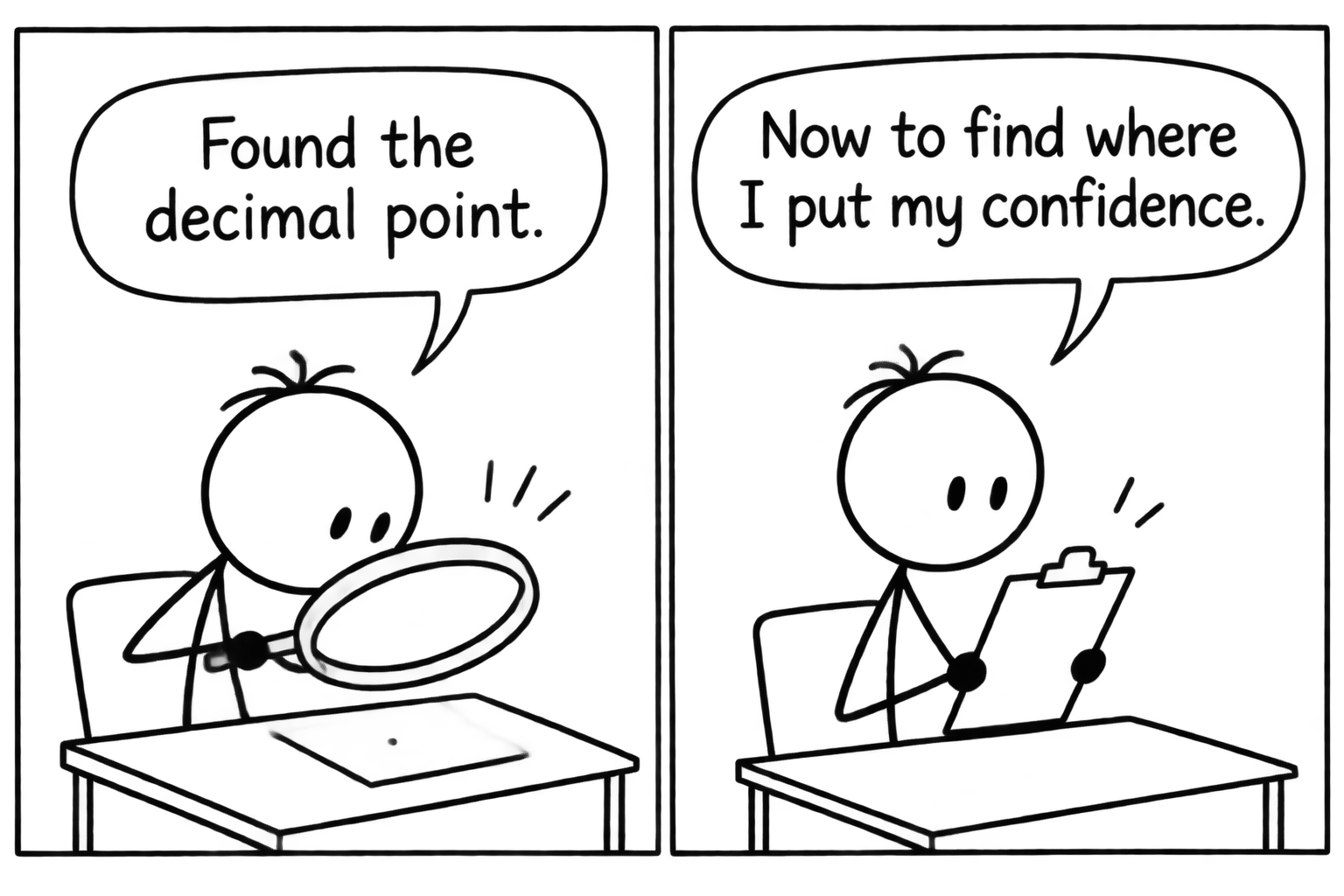 A student uses an enormous magnifying glass to find a decimal point, then looks for their confidence
Question three: decimal division in context
The final question hides the division inside a short problem:
A roll contains 12.9612.9612.96 metres of ribbon. Each bow requires 0.240.240.24 metres. The bows are placed into boxes of 999. How many complete boxes can be filled?
Maya first decides what the calculation means. She needs the number of bows:
12.96÷0.2412.96 \div 0.2412.96÷0.24The divisor has two decimal places, so she multiplies both numbers by 100100100:
12.96÷0.24=1296÷2412.96 \div 0.24 = 1296 \div 2412.96÷0.24=1296÷24She uses a known multiple:
24×50=120024 \times 50 = 120024×50=1200The remainder is:
1296−1200=961296 - 1200 = 961296−1200=96Then:
96÷24=496 \div 24 = 496÷24=4So the roll makes:
50+4=5450 + 4 = 5450+4=54bows. The question asks for boxes, not bows, so Maya continues:
54÷9=654 \div 9 = 654÷9=6Therefore, 666 complete boxes can be filled.
Where the marks may come from
A multi-step question may reward several pieces of reasoning. Likely evidence includes:
- forming the correct calculation 12.96÷0.2412.96 \div 0.2412.96÷0.24;
- converting it to 1296÷241296 \div 241296÷24 and obtaining 545454;
- dividing by 999 and giving the answer in context as 666 boxes.
The exact allocation can vary. The important habit is to leave a visible trail. If Maya made a small arithmetic error near the end, correct earlier working might still receive credit where the mark scheme allows follow-through or method marks.
For more questions presented in this style, use the GCSE Maths exam booklets and compare your solutions carefully with the supplied answers.
Common mistakes in a dividing decimals GCSE exam
Moving only one decimal point
A common incorrect step is:
8.4÷0.7=8.4÷78.4 \div 0.7 = 8.4 \div 78.4÷0.7=8.4÷7The divisor has been multiplied by 101010, but the dividend has not. Both numbers must be multiplied by the same amount:
8.4÷0.7=84÷78.4 \div 0.7 = 84 \div 78.4÷0.7=84÷7Multiplying by the wrong power of 101010
For 0.150.150.15, multiplying by 101010 gives 1.51.51.5, which is still not a whole number. Multiply both numbers by 100100100 instead.
Assuming division always makes a number smaller
Dividing by a positive number below 111 makes the result larger. For instance:
6÷0.5=126 \div 0.5 = 126÷0.5=12This is sensible because there are twelve halves in 666.
Ignoring what the question asks for
In the ribbon problem, 545454 was the number of bows, not the final answer. Underline the requested unit or quantity before calculating.
Hiding every step in a calculator
A calculator may produce the correct number, but a question that says “show your working” requires mathematical evidence. Writing the transformed division is quick and may be important if the final answer is wrong.
The Maths Genie multiplication and division videos can help you compare your written method with a model solution.
Exam-style practice
Try these without looking at the answers first:
- Work out 7.2÷0.67.2 \div 0.67.2÷0.6.
- Work out 5.46÷0.215.46 \div 0.215.46÷0.21.
- A container holds 8.648.648.64 litres. Each bottle holds 0.180.180.18 litres. How many bottles can be filled?
- A wire is 15.7515.7515.75 metres long. It is cut into equal pieces of 0.250.250.25 metres. The pieces are packed in groups of 777. How many complete groups are made?
The answers are:
12,26,48,912,\quad 26,\quad 48,\quad 912,26,48,9For the final question, the wire makes 636363 pieces, and:
63÷7=963 \div 7 = 963÷7=9Do not just mark each answer right or wrong. Compare the line where you changed the divisor into a whole number. That is the decision which makes the rest of the calculation manageable. You can also strengthen the connected skills using the Fractions, Decimals and Percentages revision guide.
Turn the method into reliable exam marks
Maya's progress was not a matter of becoming faster at guessing where the decimal point belongs. She used the same routine each time: scale both numbers equally, divide using whole numbers, then check the context.
Knowing that routine is the first step. Following it under exam pressure takes deliberate practice with questions that gradually become less familiar. Start the Maths Genie dividing decimals Lessons and Question Bank and turn this method into a dependable exam habit.