

Direct Proportion GCSE Maths: Examples and Questions
Direct proportion GCSE maths explained with clear worked examples, common mistakes and exam-style questions. Learn to find the constant and check answers.
A direct proportion question can look straightforward until your answer comes back wrong. You spotted that both quantities increased. You even found a pattern. The missing detail was which pattern mattered. In direct proportion GCSE maths, two quantities change by the same scale factor, so their ratio stays constant. The usual equation is y=kxy=kxy=kx, where kkk is the constant of proportionality.
Imagine a student who keeps adding the same amount whenever a question changes one of its values. Their breakthrough comes when they stop asking, “How much was added?” and start asking, “What was it multiplied by?” Follow that shift through the explanation, worked examples and practice below.
Direct proportion: the essentials
Before calculating, check that you can identify these features:
- Same scale factor: doubling one quantity doubles the other.
- Constant ratio: dividing yyy by xxx gives the same value whenever x≠0x\ne0x=0.
- Equation: y=kxy=kxy=kx, with a fixed value of kkk.
- Graph: a straight line through the origin, (0,0)(0,0)(0,0).
Direct proportion appears in GCSE numerical problems, equations and graphs. If scaling quantities still feels uncertain, the GCSE proportion lesson covers that foundation.
What does directly proportional mean?
Suppose identical notebooks have a fixed price, with no discount or delivery charge. Buying twice as many costs twice as much. Buying half as many costs half as much.
The total cost divided by the number of notebooks stays constant. That constant is the price per notebook.
In algebra, the statement “yyy is directly proportional to xxx” is written:
y∝xy\propto xy∝xReplace the proportionality symbol with an equals sign and a constant:
y=kxy=kxy=kxTo find that constant, rearrange:
k=yxk=\frac{y}{x}k=xyOur imagined student had been watching the difference between the quantities. Now they have something more useful to check: their ratio.
There is also a graphical test. For y=kxy=kxy=kx, the gradient is kkk and the line passes through the origin. A straight line with a non-zero intercept does not represent direct proportion between yyy and xxx.
A method you can repeat
For an algebraic direct proportion question, use this sequence:
- Write the relationship stated in the question.
- Substitute the given pair of values to find kkk.
- Write the complete equation with your value of kkk.
- Substitute the new information and solve.
- Check your answer against the original relationship.
Keep the complete equation visible. It separates finding the relationship from using it, which makes your working easier to follow and check.
Start with the Direct and Inverse Proportion Lessons and Question Bank when you want to practise this same sequence with another question.
Direct proportion worked examples
Finding a missing value
Question: yyy is directly proportional to xxx. When x=4x=4x=4, y=18y=18y=18. Find yyy when x=10x=10x=10.
Write the model:
y=kxy=kxy=kxUse the given values:
18=4k18=4k18=4k k=184=4.5k=\frac{18}{4}=4.5k=418=4.5Write the complete equation:
y=4.5xy=4.5xy=4.5xSubstitute the new value:
y=4.5×10=45y=4.5\times10=45y=4.5×10=45The answer is 454545.
Here is where the student's earlier approach would fail. The change from 444 to 101010 is an increase of 666, but adding 666 to 181818 does not preserve the ratio. The scale factor is 10÷4=2.510\div4=2.510÷4=2.5, so the corresponding value must also be multiplied by 2.52.52.5:
18×2.5=4518\times2.5=4518×2.5=45Both methods agree. That is a useful check.
Finding the other variable
Question: A ribbon has a constant cost per metre. A length of 333 metres costs £7.20\pounds7.20£7.20. How much ribbon can you buy for £18\pounds18£18?
Let CCC be the cost in pounds and LLL the length in metres:
C=kLC=kLC=kLFind the constant:
7.20=3k7.20=3k7.20=3k k=2.40k=2.40k=2.40So:
C=2.40LC=2.40LC=2.40LNow substitute the known cost:
18=2.40L18=2.40L18=2.40L L=182.40=7.5L=\frac{18}{2.40}=7.5L=2.4018=7.5You can buy 7.57.57.5 metres. The constant represents a cost of £2.40\pounds2.40£2.40 per metre, so dividing the available money by that rate gives the length.
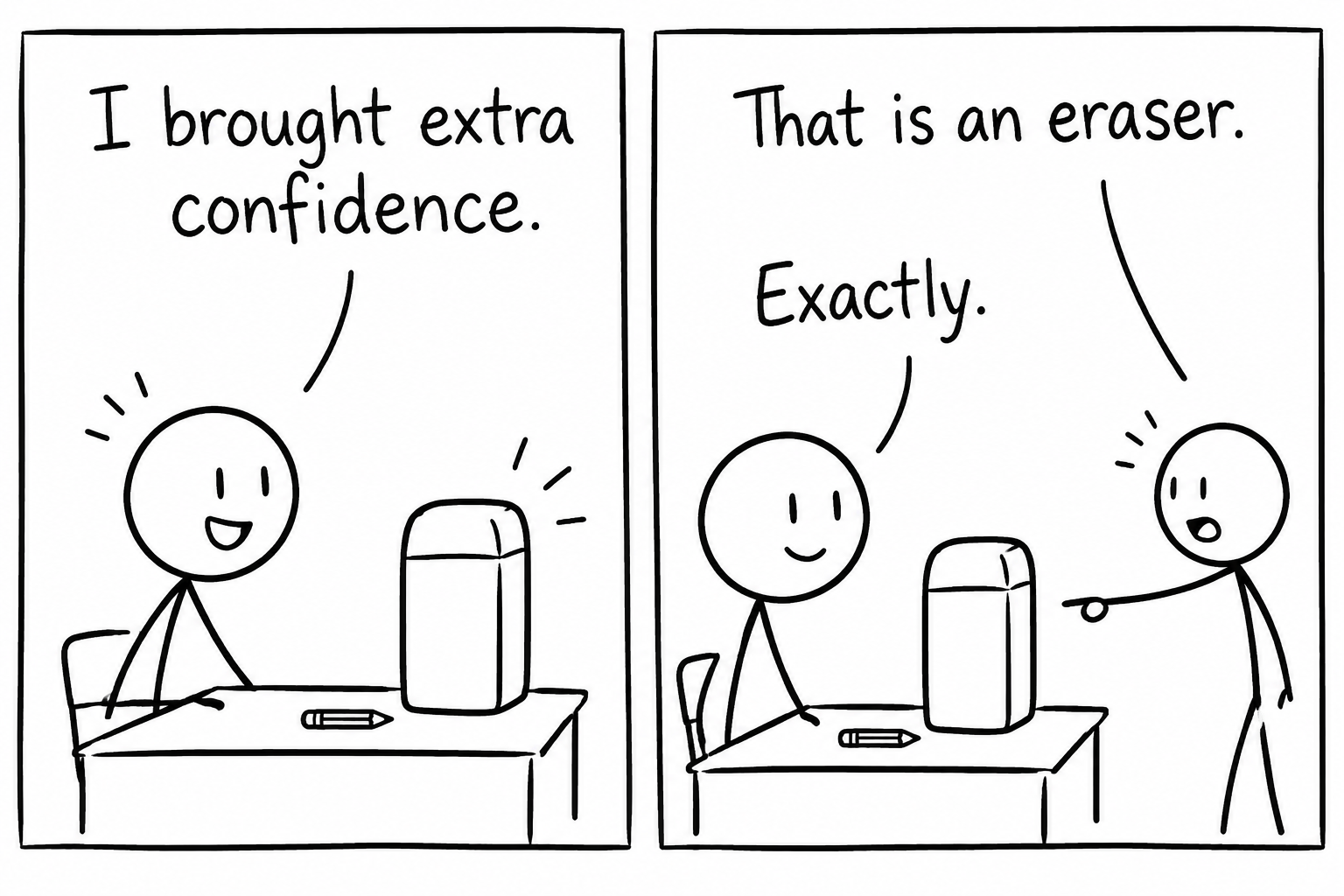 A stick-figure student brings an enormous eraser to revision and calls it extra confidence.
When the question mentions a square
Question: yyy is directly proportional to x2x^2x2. When x=3x=3x=3, y=45y=45y=45. Find yyy when x=5x=5x=5.
Read the relationship carefully. This time, write:
y=kx2y=kx^2y=kx2Substitute the known values:
45=k×32=9k45=k\times3^2=9k45=k×32=9k k=5k=5k=5The complete equation is:
y=5x2y=5x^2y=5x2Therefore:
y=5×52=125y=5\times5^2=125y=5×52=125Here, yyy is proportional to x2x^2x2, so it is the ratio yx2\frac{y}{x^2}x2y that stays constant. Doubling xxx would multiply yyy by 444.
The student's new habit now matters even more: write exactly what the question says before calculating. The proportion revision guide provides further support with these relationships.
Common mistakes and how to catch them
Adding instead of scaling. Direct proportion preserves a ratio. Check whether you have multiplied both quantities by the same factor.
Dividing in the wrong order. From y=kxy=kxy=kx, the constant is k=yxk=\frac{y}{x}k=xy. Substitute your constant back into the original equation to test it.
Stopping after finding the constant. Finding kkk is often an intermediate step. Read the final instruction again and identify the quantity requested.
Ignoring a power. If the question says y∝x2y\propto x^2y∝x2, use y=kx2y=kx^2y=kx2. Underline the full expression after “proportional to”.
Assuming any rising graph shows direct proportion. A graph of yyy against xxx must be a straight line through the origin to represent y=kxy=kxy=kx.
Losing track of units. Convert quantities into consistent units before finding a rate, and include the requested unit in your answer.
Exam-style direct proportion questions
Try these without looking back at the worked examples. Write the equation as well as the answer.
- Question A: y∝xy\propto xy∝x. When x=6x=6x=6, y=21y=21y=21. Find an equation connecting yyy and xxx, then find yyy when x=14x=14x=14.
- Question B: At a constant price per ticket, 555 tickets cost £32.50\pounds32.50£32.50. Find the cost of 888 tickets.
- Question C: y∝x2y\propto x^2y∝x2. When x=4x=4x=4, y=48y=48y=48. Find yyy when x=7x=7x=7.
- Question D: A student says that y=3x+2y=3x+2y=3x+2 represents direct proportion because its graph is straight. Explain their mistake.
Answers: A: y=3.5xy=3.5xy=3.5x, giving y=49y=49y=49. B: £52\pounds52£52. C: y=3x2y=3x^2y=3x2, giving y=147y=147y=147. D: the graph does not pass through the origin; when x=0x=0x=0, y=2y=2y=2.
When checking, locate the first line where your reasoning went wrong. Was it the model, the substitution or the arithmetic? That tells you what to practise next. Students using other specifications can find matching resources through the AQA proportion lesson or OCR proportion lesson.
Turn the method into a habit
For our imagined student, the click is a repeatable question: “What stays constant?” You now have the method, but using it independently takes practice with unfamiliar wording. Your turn: start the Lessons and Question Bank and practise writing the relationship before you calculate.















