

Direct Proportion Exam Questions: GCSE Methods
Direct proportion exam questions explained with three GCSE worked examples, clear method-mark guidance and practice to help you tackle unfamiliar problems.
Direct proportion exam questions: start with the relationship
Direct proportion exam questions become easier when you identify the relationship before reaching for your calculator. For ordinary direct proportion, one quantity is a constant multiple of another: y=kxy = kxy=kx. Find that constant, then use the relationship to calculate the missing value.
The difficulty is often recognising the same idea beneath different wording. A question about ticket prices can feel unrelated to one about a variable proportional to a square. Yet both ask you to establish a relationship and use it consistently.
Imagine a student working through three questions. These are original exam-style examples, not reproduced past paper questions. We will follow their decisions, including the working that makes their method visible. Exact mark allocations depend on the question's mark scheme.
Your direct proportion checklist
Before calculating, ask:
- Which quantities are connected?
- Is one proportional to the other quantity, its square or another stated power?
- What information lets me find the constant?
- Am I calculating forwards or working backwards?
- Does my answer fit the relationship and the units?
For ordinary direct proportion, the ratio stays constant:
yx=k\frac{y}{x} = kxy=kDoubling xxx doubles yyy. The graph of yyy against xxx is a straight line through the origin. A straight line alone is not enough: a fixed starting charge would prevent ordinary direct proportion.
If you need to revisit scaling first, MathsGenie's proportion lesson and proportion revision guide provide a useful starting point.
Question one: find the cost of one item
Question: Five identical notebooks cost £8.50\pounds 8.50£8.50. The total cost is directly proportional to the number bought. Find the cost of eight notebooks.
Our student first considers adding the price of three more notebooks. But that requires knowing what one notebook costs. Finding the unit price gives them a reliable starting point.
Find one, then find the required amount
Divide the total cost by the number of notebooks:
Cost per notebook=8.505=£1.70\text{Cost per notebook} = \frac{8.50}{5} = \pounds 1.70Cost per notebook=58.50=£1.70Then multiply by the required number:
Cost of eight notebooks=8×1.70=£13.60\text{Cost of eight notebooks} = 8 \times 1.70 = \pounds 13.60Cost of eight notebooks=8×1.70=£13.60This is the unitary method: find one unit, then scale up.
Where method credit can come from: the written division and multiplication show a valid route. Writing only the final price hides that reasoning. The precise credit available must be checked against the relevant mark scheme.
A quick check helps: eight notebooks should cost more than five, but less than ten. The answer fits.
Question two: turn words into an equation
Question: yyy is directly proportional to xxx. When x=6x = 6x=6, y=21y = 21y=21. Find yyy when x=14x = 14x=14.
There are no notebooks now, so the question looks more abstract. Our student pauses. Then they recognise that the constant is still the amount of yyy for each unit of xxx.
Write the relationship
Translate the wording into:
y=kxy = kxy=kxHere, kkk is the constant of proportionality. It stays unchanged throughout this relationship.
Find the constant
Substitute the known pair of values:
21=6k21 = 6k21=6k k=216=3.5k = \frac{21}{6} = 3.5k=621=3.5The complete equation is therefore:
y=3.5xy = 3.5xy=3.5xUse the equation
Substitute the new value:
y=3.5×14=49y = 3.5 \times 14 = 49y=3.5×14=49Where method credit can come from: establishing y=kxy = kxy=kx, substituting the known values and using the resulting equation make the mathematical process clear. Do not assume every line earns a separate mark; mark schemes differ.
The reusable routine is short: write the relationship, find the constant, substitute the new value. It works even when scaling mentally would be awkward.
Practise that routine through MathsGenie's direct and inverse proportion lesson, then use the Question Bank to try another question without the worked solution beside you.
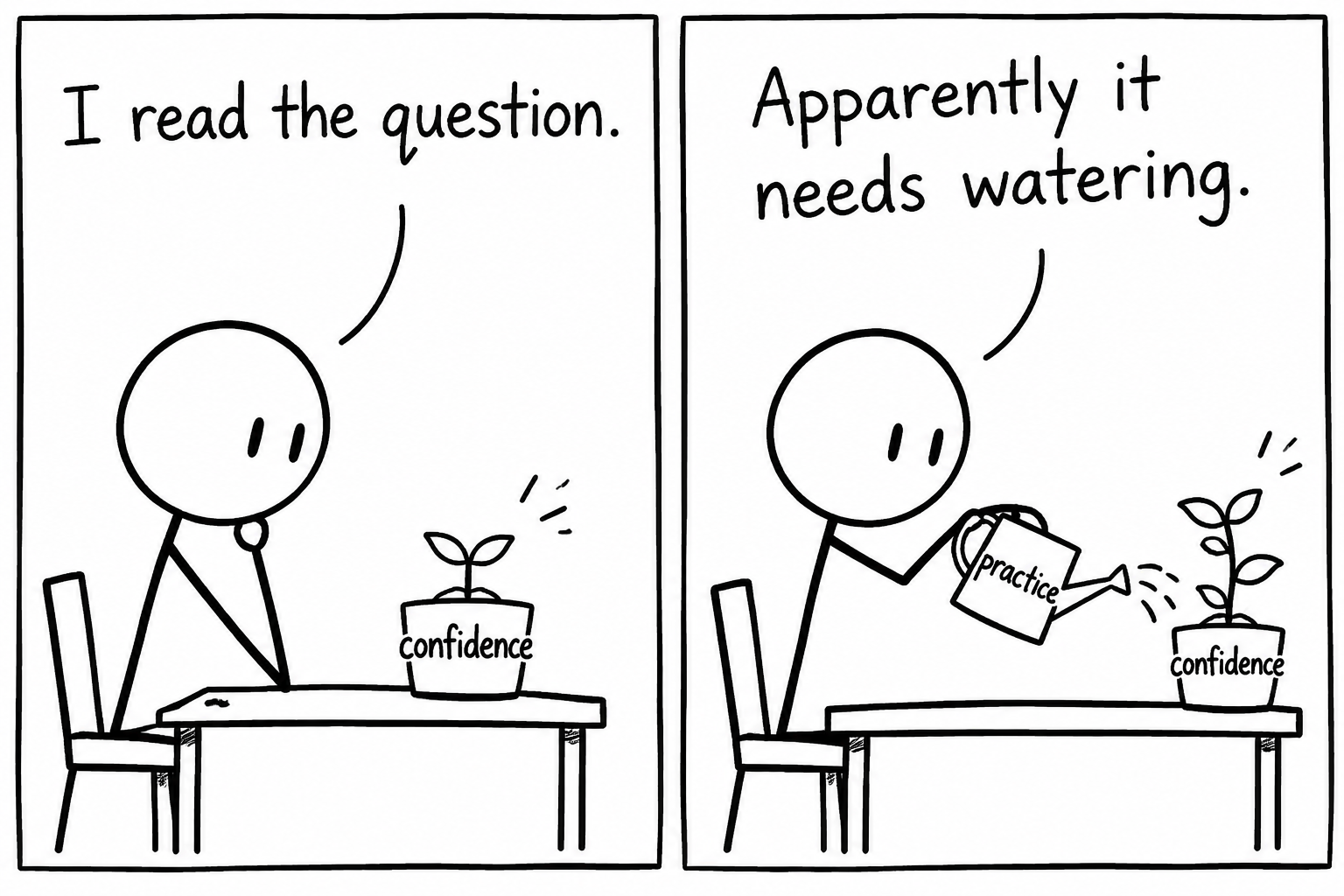 A minimalist stick-figure comic about watering confidence with practice
Question three: direct proportion to a square
Question: yyy is directly proportional to the square of xxx. When x=3x = 3x=3, y=45y = 45y=45. Find the positive value of xxx when y=180y = 180y=180.
Our student nearly writes the familiar equation again. This time, however, the words “the square of” change the relationship.
Keep the stated power
The correct model is:
y=kx2y = kx^2y=kx2It is x2x^2x2, rather than xxx, that is directly proportional to yyy.
Substitute the known values:
45=k×3245 = k \times 3^245=k×32 45=9k45 = 9k45=9k k=5k = 5k=5Therefore:
y=5x2y = 5x^2y=5x2Work backwards carefully
The question gives the new value of yyy, so substitute it into the equation:
180=5x2180 = 5x^2180=5x2Divide before taking the square root:
x2=36x^2 = 36x2=36 x=6x = 6x=6The question requests the positive value. Without that restriction, the equation would have both positive and negative solutions.
Where method credit can come from: retaining the square, finding the constant and rearranging the correct equation all demonstrate relevant method. A correct calculation using the wrong relationship does not answer the stated question.
There is also a useful check. The value of yyy increased by a factor of 444, so positive xxx should increase by a factor of 222. It does, from 333 to 666.
MathsGenie's revision guide on proportion involving powers helps you distinguish these relationships rather than treating every proportion question identically.
Common mistakes in a direct proportion GCSE exam
Adding instead of scaling
Direct proportion preserves a multiplier, not a difference. If one quantity triples, the other triples in ordinary direct proportion. Adding the same amount to both quantities does not generally preserve the relationship.
Finding the constant the wrong way round
From y=kxy = kxy=kx, the constant is k=yxk = \frac{y}{x}k=xy. Instead of remembering an isolated division rule, substitute into your equation and rearrange it.
Losing a power
If the question states y∝x2y \propto x^2y∝x2, write y=kx2y = kx^2y=kx2 immediately. Keeping the power visible prevents an ordinary scaling method from slipping into a different relationship.
Rounding too early
Keep fractions or full calculator values during intermediate steps. Round the final answer only as requested, and include units where appropriate.
Treating guidance as an official mark scheme
Showing your working gives an examiner evidence of your method. It does not guarantee a fixed number of marks for each step. Use the matching mark scheme when reviewing direct proportion past paper questions.
Exam-style practice: try the method unaided
Cover the worked examples and attempt these questions. Write the relationship before calculating.
- Unitary method: Seven identical pens cost £4.20\pounds 4.20£4.20. Assuming direct proportion, find the cost of twelve pens.
- Algebraic relationship: ppp is directly proportional to qqq. When q=8q = 8q=8, p=30p = 30p=30. Find ppp when q=20q = 20q=20.
- Squared relationship: AAA is directly proportional to r2r^2r2. When r=4r = 4r=4, A=48A = 48A=48. Find the positive value of rrr when A=147A = 147A=147.
Answers: the pens cost £7.20\pounds 7.20£7.20; p=75p = 75p=75; and r=7r = 7r=7.
If an answer differs, locate the first incorrect line. Was it the relationship, the constant or the final substitution? That diagnosis tells you what to practise next. The direct proportion revision guide gives you somewhere focused to revisit the method.
Turn a recognised method into a reliable one
Our imagined student's progress was not a sudden leap: they learned to pause, translate the wording and keep the relationship visible. You now have that routine, but recognising it while reading is different from choosing it independently under exam conditions.
Start with MathsGenie's Lessons, then use the Question Bank to practise direct proportion exam questions without looking back at the method.















