

Decimals to Fractions Exam Questions: GCSE Guide
Decimals to fractions exam questions explained with three GCSE worked examples, method marks, common mistakes and focused practice from Maths Genie.
A decimal can look harmless until an exam question asks for an exact fraction. Then the familiar digits suddenly feel less certain, especially when a recurring bar appears.
The reliable way to answer decimals to fractions exam questions is to identify whether the decimal terminates or recurs. For a terminating decimal, write it over a power of 101010 and simplify. For a recurring decimal, use algebra to eliminate the repeating digits.
We will follow a hypothetical student, Sam, through three exam-style questions of rising difficulty. Each solution shows the working that could earn method marks. Exact allocations vary between exam boards and papers, so always read the published mark scheme when checking genuine past paper questions.
The method at a glance
Use this checklist before beginning:
- Decide whether the decimal terminates or recurs.
- For a terminating decimal, use a denominator of 101010, 100100100, 100010001000 or another appropriate power of 101010.
- For a recurring decimal, let xxx equal the decimal.
- Multiply by powers of 101010 until the recurring parts align.
- Subtract the equations to remove the recurring digits.
- Solve for xxx.
- Simplify the final fraction fully.
- Keep your working visible because a correct method may earn marks even after an arithmetic slip.
You can review the underlying skills in the Fractions, Decimals and Percentages lesson before moving to the Recurring Decimals to Fractions lesson.
A terminating decimal
Sam's first question asks:
Write 0.360.360.36 as a fraction in its simplest form.
There are two digits after the decimal point, so Sam writes the number over 100100100:
0.36=361000.36=\frac{36}{100}0.36=10036Both 363636 and 100100100 are divisible by 444:
36100=925\frac{36}{100}=\frac{9}{25}10036=259Therefore,
0.36=9250.36=\frac{9}{25}0.36=259A typical two-mark question might award a method mark for writing an equivalent fraction such as 36100\frac{36}{100}10036 and an accuracy mark for the simplified answer 925\frac{9}{25}259. If Sam wrote only 36100\frac{36}{100}10036, the fraction would be equivalent but not in its simplest form.
The useful idea is place value. The decimal 0.360.360.36 means 363636 hundredths, so the denominator is not a guess. It comes directly from what the digits represent.
A single recurring digit
The second question looks similar, but its structure is different:
Write 0.7‾0.\overline{7}0.7 as a fraction.
The bar means that the digit 777 repeats forever:
0.7‾=0.777…0.\overline{7}=0.777\ldots0.7=0.777…Sam starts by defining the decimal:
x=0.777…x=0.777\ldotsx=0.777…Only one digit repeats, so multiplying by 101010 shifts one complete recurring block:
10x=7.777…10x=7.777\ldots10x=7.777…Now Sam subtracts the original equation from the new equation:
10x−x=7.777…−0.777…10x-x=7.777\ldots-0.777\ldots10x−x=7.777…−0.777…The repeating parts cancel:
9x=79x=79x=7Dividing by 999 gives:
x=79x=\frac{7}{9}x=97Therefore,
0.7‾=790.\overline{7}=\frac{7}{9}0.7=97In a typical three-mark structure, marks might be available for forming an appropriate multiplied equation, subtracting to eliminate the recurring part, and reaching the correct fraction. Writing x=0.777…x=0.777\ldotsx=0.777… is also valuable because it makes the algebra understandable.
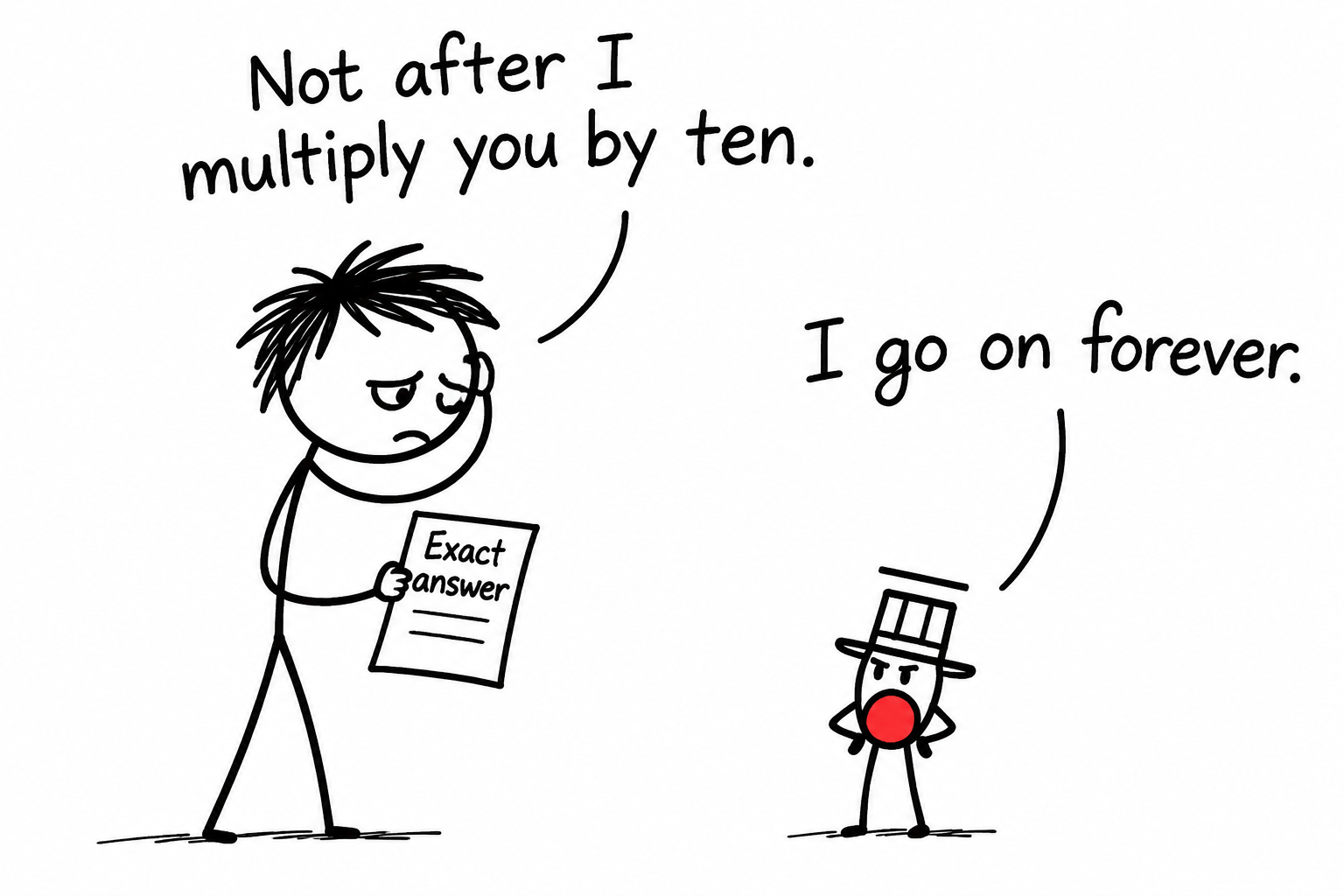 A recurring decimal tells a GCSE student it goes on forever, and the student prepares to multiply it by ten
If setting out these equations still feels unfamiliar, use the matching Maths Genie lesson and Question Bank to practise the same method until choosing the multiplier becomes automatic.
A decimal with a non-recurring part
Sam's third question is more demanding:
Write 0.218‾0.2\overline{18}0.218 as a fraction in its simplest form.
This notation means
0.218‾=0.2181818…0.2\overline{18}=0.2181818\ldots0.218=0.2181818…The digit 222 does not repeat. The block 181818 does.
Sam writes:
x=0.2181818…x=0.2181818\ldotsx=0.2181818…The aim is to create two equations whose decimal parts are identical. Multiplying by 101010 moves beyond the non-recurring digit:
10x=2.181818…10x=2.181818\ldots10x=2.181818…The recurring block contains two digits, so Sam moves forward another two places by multiplying the original equation by 100010001000:
1000x=218.181818…1000x=218.181818\ldots1000x=218.181818…Now the decimal parts match. Subtracting gives:
1000x−10x=218.181818…−2.181818…1000x-10x=218.181818\ldots-2.181818\ldots1000x−10x=218.181818…−2.181818…Therefore,
990x=216990x=216990x=216Sam divides both sides by 990990990:
x=216990x=\frac{216}{990}x=990216The numerator and denominator are both divisible by 181818:
x=1255x=\frac{12}{55}x=5512So the exact answer is
0.218‾=12550.2\overline{18}=\frac{12}{55}0.218=5512A four-mark question could reward the correct aligned equations, valid subtraction, solving for xxx, and a fully simplified answer. The decisive step is not the subtraction itself. It is choosing 1000x1000x1000x and 10x10x10x so that both equations end in the same recurring decimal.
You can practise this harder form using the Recurring Decimals to Fractions exam booklet, which includes questions and answers for checking your method.
What GCSE questions are testing
Terminating and recurring decimals belong to the same broad topic, but they require different decisions. The examiner is testing whether you recognise the structure before calculating.
For terminating decimals, place value is enough:
0.125=1251000=180.125=\frac{125}{1000}=\frac{1}{8}0.125=1000125=81For recurring decimals, an approximate calculator display is not enough because the question requires an exact value. The algebra proves which fraction generates the infinite decimal.
On the AQA specification, working interchangeably with terminating decimals and fractions appears within the core number content, while changing recurring decimals into fractions is identified as Higher-only content. Check your own exam board's specification because content placement can differ. Maths Genie provides board-specific revision, including AQA recurring decimals revision, OCR recurring decimals revision guides and Eduqas recurring decimals lessons.
Common mistakes in decimals to fractions questions
Using the wrong power of ten
For 0.470.470.47, the appropriate starting fraction is 47100\frac{47}{100}10047, not 4710\frac{47}{10}1047. Count the decimal places carefully.
With recurring decimals, count the digits in the repeating block. A one-digit block usually requires a shift by one place; a two-digit block requires a shift by two places once any non-recurring digits have been passed.
Misreading the recurring bar
The position of the bar changes the number. For example,
0.24‾=0.242424…0.\overline{24}=0.242424\ldots0.24=0.242424…but
0.24‾=0.24444…0.2\overline{4}=0.24444\ldots0.24=0.24444…Copy the notation carefully before beginning.
Subtracting equations that do not align
The recurring tails must be identical. If one equation ends in 0.181818…0.181818\ldots0.181818… and the other ends in 0.818181…0.818181\ldots0.818181…, subtraction will not cancel them correctly.
Omitting the algebra
Writing down a remembered fraction may earn the answer mark, but it can lose method marks when the question asks you to show that a recurring decimal equals a given fraction. Define xxx, form the equations and show the subtraction.
Forgetting to simplify
An answer such as 216990\frac{216}{990}990216 is correct in value, but it is not in its simplest form. Look for common factors before finishing.
How to practise exam-style questions
Begin with terminating decimals, then practise one recurring digit before attempting mixed decimals with a non-recurring opening digit. After each question, compare your working with the solution rather than checking only the final fraction.
When using decimals to fractions past paper questions, ask three things:
- Did I choose the correct power of 101010?
- Did I align the recurring parts before subtracting?
- Did I simplify the fraction completely?
That short review turns each mistake into a specific action for the next question.
Continue with Lessons and Question Bank
Sam's progress came from separating the question into decisions: classify the decimal, choose the multiplier, align the recurring digits and simplify. Knowing those steps is useful; following them accurately under exam conditions requires practice. Start the Decimals to Fractions lesson and Question Bank, then work through the questions with every algebraic step visible.















