Comparing GCSE Food and Nutrition Progress With Friends
Comparing GCSE Food and Nutrition progress with friends can distort revision. Learn what to track instead while protecting GCSE maths time and confidence.
A friend finishes an impressive practical dish. Someone else says their non-exam assessment is nearly complete. You look at your own work and suddenly feel behind.
If you are comparing GCSE Food and Nutrition progress with friends, the short answer is this: comparison is usually unhelpful when it becomes a judgement about your ability. Your classmates may have different tasks, strengths, feedback, facilities and starting points. Their visible progress tells you remarkably little about what you should do next.
A better approach is to compare your present work with your previous work, use teacher feedback as evidence, and protect enough revision time for your other subjects, especially GCSE maths.
A quick checklist for healthier progress
Focus on these questions instead of asking whether you are ahead of your friends:
- Do I understand the requirements for my exam board and current task?
- Have I acted on my teacher's latest feedback?
- Can I explain the food science and nutrition behind my decisions?
- Are my practical skills becoming safer, more accurate and more independent?
- Do I know my next small action?
- Am I leaving realistic time for GCSE maths and my other subjects?
- Can I show progress using marked work rather than feelings?
That final distinction matters. Feelings are real, but they are not always reliable measurements.
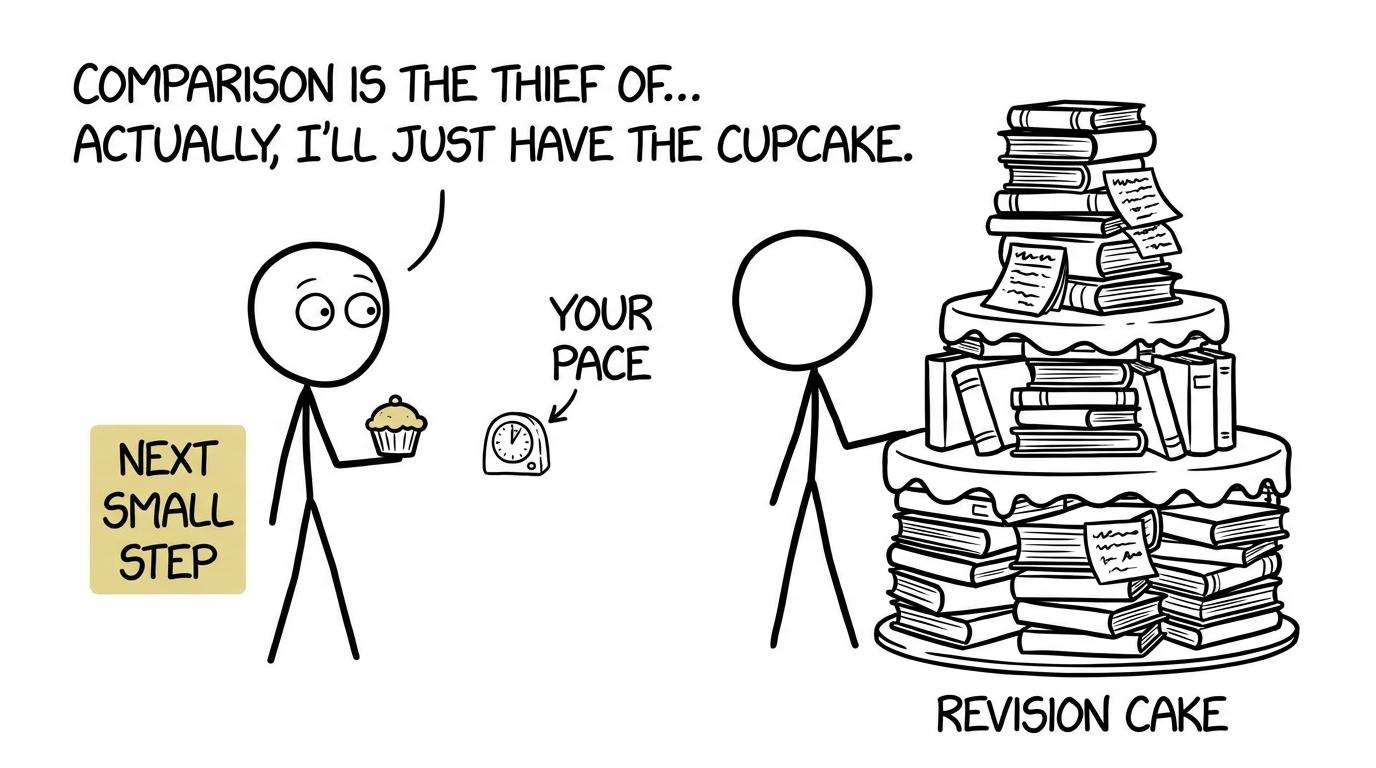 A student compares a sensible revision cupcake with a friend's towering revision cake
Why comparing progress with friends is misleading
Comparison feels useful because it offers a quick answer. If your friend has written more or cooked something more elaborate, it can appear that they are doing better.
But you are comparing visible output without seeing the conditions behind it.
Food and Nutrition progress has several dimensions
GCSE Food Preparation and Nutrition is not simply a race to produce the longest folder or most complicated dish. Official specifications assess a mixture of theoretical knowledge, food science, nutrition, food safety, planning, practical preparation and evaluation.
Assessment arrangements vary by exam board, so always follow the specification and instructions given by your school. For example, current AQA and OCR specifications divide assessment equally between a written examination and non-exam assessment, but their component structures and examination lengths are not identical. Eduqas also combines an examination with non-exam assessment.
This means one classmate might currently look stronger in practical work while another has better recall of nutrition or food provenance. Neither snapshot reveals the final outcome.
You cannot see another student's whole process
You may notice the polished final photograph but not the unsuccessful trial beforehand. You may hear that someone revised for three hours without knowing how focused those hours were. You may see a completed page without knowing how much teacher support was needed.
The comparison therefore uses incomplete data. In maths language, it is like drawing a conclusion from a graph when half the axes and values are missing.
Comparison can redirect effort towards the wrong task
The real cost is not simply feeling uncomfortable. It is choosing revision based on another person's situation.
You might spend an evening making notes look more impressive when your actual weakness is explaining the functional properties of ingredients. You might rush practical planning because somebody else seems further ahead. Or you might give Food and Nutrition every spare hour, leaving too little time for the maths paper that also needs attention.
Useful revision begins with diagnosis. MathsGenie's guide to finding your weakest GCSE topics applies the same principle: identify the precise gap, practise it and then check whether it has improved.
When comparison can be useful
Not all comparison is harmful. The difference lies in what you do with it.
Healthy comparison asks, "What can I learn from this approach?" Unhealthy comparison concludes, "Their progress proves that I am failing."
A classmate may remind you about a deadline, demonstrate an efficient organisation system or help you notice that your revision lacks retrieval practice. That is information, not a ranking.
Use peer comparison only when it is:
- specific rather than personal;
- based on a shared requirement;
- focused on strategy rather than status;
- checked against teacher guidance;
- followed by a practical action of your own.
You can borrow a useful method without borrowing somebody else's timetable, target or definition of success.
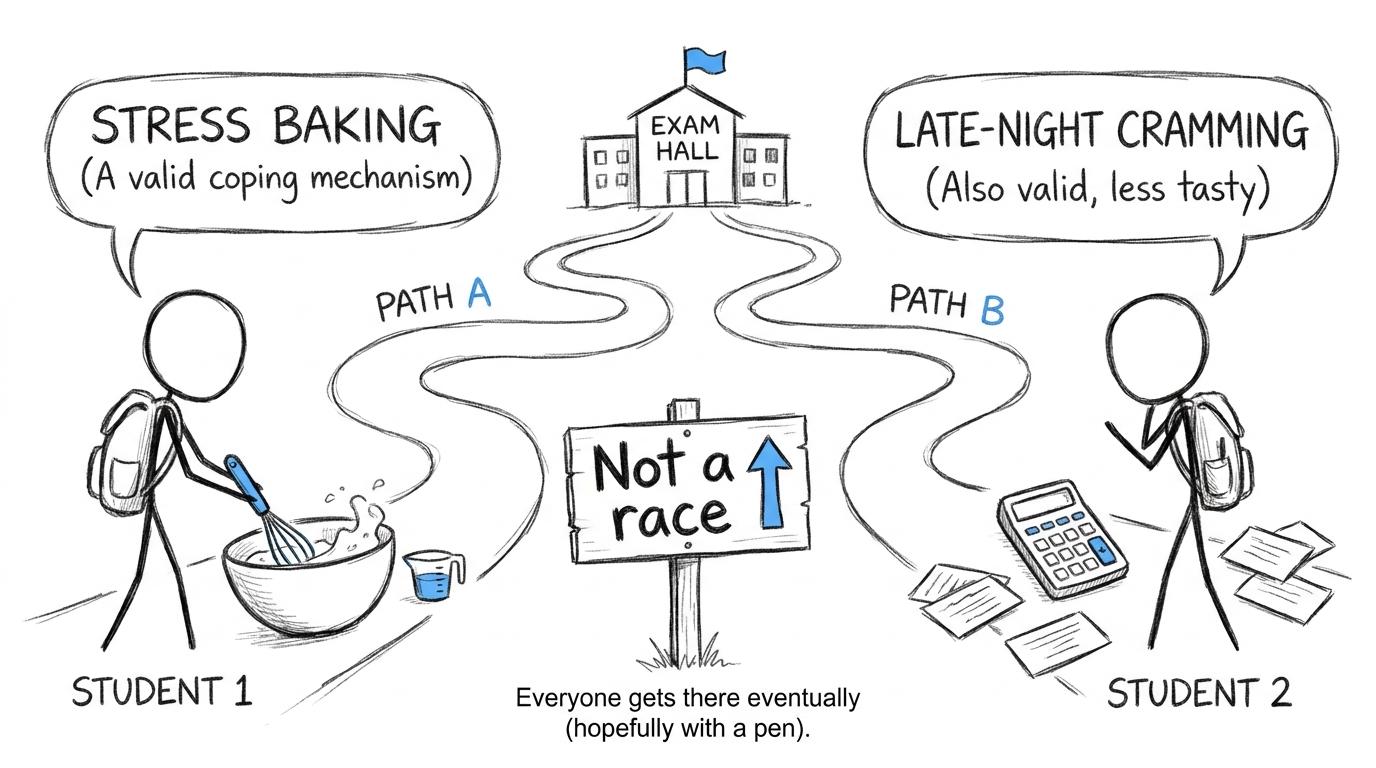 Two students follow different winding revision paths towards the same exam hall
What to focus on instead
The best replacement for social comparison is not vague positivity. It is better evidence.
Track task completion carefully
Write down the specific tasks required for your current stage. These might include reviewing teacher feedback, revising a food science process, practising a preparation skill or completing a planned section of revision.
You can measure completion using:
Completion rate=completed planned taskstotal planned tasks×100%\text{Completion rate} = \frac{\text{completed planned tasks}}{\text{total planned tasks}} \times 100\%Completion rate=total planned taskscompleted planned tasks×100%The percentage is not a judgement of intelligence. It simply answers whether your plan was realistic and followed. If the rate is repeatedly low, reduce the size of each task or ask for help identifying priorities.
This is more informative than counting how many pages somebody else has produced.
Track understanding, not presentation
For each theory topic, test whether you can:
- recall the important facts without notes;
- explain a process in a logical sequence;
- apply knowledge to an unfamiliar food or situation;
- analyse evidence and justify a decision;
- use subject terminology accurately.
These skills reflect the demands found across GCSE Food Preparation and Nutrition specifications. Highlighting a textbook can feel productive, but closed-book recall and exam-style questions reveal more about what you can actually retrieve.
Turn feedback into a next action
Teacher feedback is valuable because it relates to your work and the relevant assessment criteria. Convert every useful comment into an action that begins with a verb:
- explain;
- justify;
- compare;
- label;
- evaluate;
- practise;
- check.
"Improve evaluation" is broad. "Add evidence explaining why the chosen cooking method suited the ingredient" is actionable. If feedback is unclear, ask your teacher what an improved response should demonstrate without asking them to complete assessed work for you.
Measure progress over time
Keep a short weekly record with four headings:
- knowledge secured;
- practical skill improved;
- feedback acted upon;
- next priority.
Your best comparison is between two versions of your own performance. Can you now explain something that confused you last week? Are you making fewer food-safety errors? Can you plan a sequence more independently?
That is progress, even when it is not dramatic enough to become classroom conversation.
Protecting your GCSE maths revision
Food and Nutrition can expand to occupy every available evening, particularly during non-exam assessment periods. A calm plan places boundaries around it.
Start with fixed commitments and deadlines. Then allocate short, specific blocks to each subject. The GCSE maths revision timetable guide explains how to prioritise personal weaknesses, revisit topics and leave room for rest.
For maths, use evidence in a repeatable cycle:
- choose one weak topic;
- use a revision lesson or guide;
- answer practice questions;
- mark the work honestly;
- record the exact error;
- return to the skill later.
The MathsGenie GCSE maths revision hub brings together free revision lessons, questions, worksheets, flashcards and papers for boards including Edexcel, AQA, OCR and Eduqas. Choose resources that match your board and your Foundation or Higher tier entry.
Food contexts can also reveal useful maths gaps. Recipes and ingredient quantities involve proportion; nutrition information may use percentages; practical planning requires time and measurement. If these skills feel uncertain, revisit GCSE proportion revision and the GCSE ratio revision guide.
Do not assume that confidence in a kitchen context automatically transfers to an exam question. Practise the mathematical skill in several forms.
A calmer weekly review
At the end of each week, spend a few minutes answering five questions:
- What did I complete?
- What can I now do without help?
- Where did I lose marks or become stuck?
- What feedback have I not yet used?
- What is the smallest useful task for next week?
For maths, a short assessment is often enough to generate useful evidence. Edexcel GCSE Maths mini tests provide focused timed practice, while the MathsGenie revision resources and self-assessments help identify weaknesses.
Later in your preparation, use GCSE predicted papers alongside past papers. Mark schemes and video solutions matter as much as the paper itself because they reveal where your method, accuracy or interpretation needs attention.
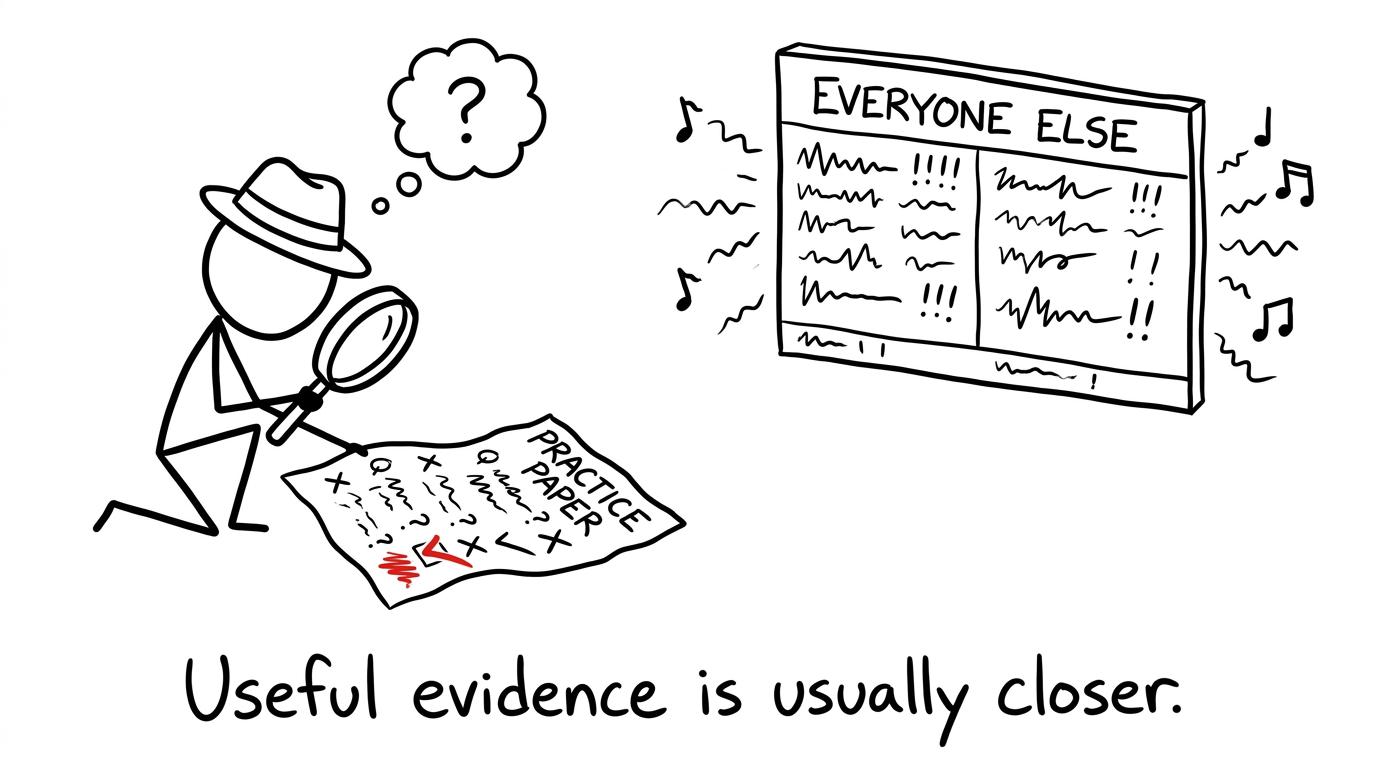 A student detective studies their own marked paper instead of an everyone-else scoreboard
Common mistakes when judging your progress
Treating busyness as achievement
Long revision sessions, elaborate notes and large folders are visible. Understanding is quieter. Test what you can recall and apply rather than measuring hours alone.
Comparing different tasks or stages
Two students may be working under different deadlines, teacher plans or exam-board requirements. Check your own specification and school instructions before drawing conclusions.
Letting one strong classmate define "normal"
The fastest or most vocal person in a class is not a reliable benchmark for everyone. Use assessment criteria, marked work and teacher feedback instead.
Changing plans whenever somebody mentions their revision
Constantly replacing your plan prevents any method from having time to work. Review your plan at a set point each week, not after every conversation.
Ignoring stress signals
Persistent comparison can feed exam stress. If worry is affecting sleep, eating, concentration or everyday life, speak to a parent, carer, teacher, school pastoral lead or another trusted adult. Asking for support is a sensible response, not evidence that you are behind.
Make your next step smaller and more useful
Your friends' progress can be interesting, but it is not your measuring instrument. Their work cannot tell you which knowledge gap to close, which feedback to apply or how to divide tonight between Food and Nutrition and maths.
Your own evidence can.
Choose one Food and Nutrition action, then choose one maths action. Open MathsGenie's free revision lessons, practise the topic, check your answers with the mark scheme and record what needs another attempt. As exams approach, build towards mini tests, past papers and predicted papers, using video solutions whenever a method remains unclear.
Progress rarely looks as dramatic from the inside as it does across a classroom. Keep following the evidence. The next mark is earned by improving the next decision, not by winning an imaginary race.