

Common Unit Conversion Mistakes in GCSE Maths
Common mistakes with unit conversions in GCSE Maths explained through worked examples, practical checks and exam-style questions to protect your marks.
A unit conversion can look almost too easy. Multiply by 100100100, divide by 1,0001{,}0001,000, write down the answer and move on. Yet these questions regularly cost marks because one small decision, often made too quickly, changes the answer completely.
The common mistakes with unit conversions in GCSE Maths are usually not caused by difficult arithmetic. Students reverse conversion factors, treat area like length, treat time like a decimal system or forget to make units consistent before using a formula.
Imagine a student reviewing a marked paper. The method is mostly right, but the units tell another story. By correcting each error carefully, the student builds a routine that can be used across Edexcel, AQA, OCR and Eduqas papers.
The unit conversion checklist
Before calculating, ask:
- What unit do I have?
- What unit does the question require?
- Am I converting length, area, volume, mass or time?
- Should the numerical value become larger or smaller?
- Do all measurements use compatible units?
- Have I written the final unit?
The central idea is simple: converting a measurement changes its numerical representation, not the actual quantity. A length of 2 m2\text{ m}2 m and a length of 200 cm200\text{ cm}200 cm describe the same distance.
You can review that principle in the Metric Conversions lesson or use the Metric Conversions revision guide alongside these examples.
Mistake: using the conversion factor backwards
The student wants to convert 3.6 m3.6\text{ m}3.6 m into centimetres. They remember the number 100100100, but divide:
3.6÷100=0.0363.6 \div 100 = 0.0363.6÷100=0.036Why it happens
A remembered conversion factor is not a complete method. You must also decide which operation makes sense.
Since
1 m=100 cm,1\text{ m}=100\text{ cm},1 m=100 cm,one metre contains many centimetres. The number of centimetres should therefore be larger than the number of metres.
Correct method
3.6×100=3603.6 \times 100=3603.6×100=360Therefore,
3.6 m=360 cm.3.6\text{ m}=360\text{ cm}.3.6 m=360 cm.Use direction as a check:
- larger unit to smaller unit: the numerical value normally increases;
- smaller unit to larger unit: the numerical value normally decreases.
This check is often faster than trying to remember an arrow diagram under exam pressure.
Mistake: applying a length conversion to area
Next, the student converts 2.4 m22.4\text{ m}^22.4 m2 into square centimetres. They multiply by 100100100 and obtain 240 cm2240\text{ cm}^2240 cm2.
Why it happens
The conversion 1 m=100 cm1\text{ m}=100\text{ cm}1 m=100 cm concerns one-dimensional length. Area has two dimensions, so the conversion factor must be squared.
Correct method
Start with the length conversion:
1 m=100 cm.1\text{ m}=100\text{ cm}.1 m=100 cm.Square both sides:
1 m2=(100 cm)2=10,000 cm2.1\text{ m}^2=(100\text{ cm})^2=10{,}000\text{ cm}^2.1 m2=(100 cm)2=10,000 cm2.Now convert:
2.4×10,000=24,000.2.4 \times 10{,}000=24{,}000.2.4×10,000=24,000.Therefore,
2.4 m2=24,000 cm2.2.4\text{ m}^2=24{,}000\text{ cm}^2.2.4 m2=24,000 cm2.The exponent belongs to the conversion factor as well as the unit. The Conversions and Units revision guide gives further support with length, area, volume and related conversions.
Mistake: forgetting to cube a volume conversion
The same student sees 0.5 m30.5\text{ m}^30.5 m3 and again reaches for 100100100. Even squaring it would not be enough.
Why it happens
Volume has three dimensions. If each dimension is converted from metres to centimetres, the factor 100100100 is used three times.
Correct method
1 m3=(100 cm)3=1,000,000 cm3.1\text{ m}^3=(100\text{ cm})^3=1{,}000{,}000\text{ cm}^3.1 m3=(100 cm)3=1,000,000 cm3.Then
0.5×1,000,000=500,000.0.5 \times 1{,}000{,}000=500{,}000.0.5×1,000,000=500,000.So
0.5 m3=500,000 cm3.0.5\text{ m}^3=500{,}000\text{ cm}^3.0.5 m3=500,000 cm3.A useful pattern is:
| Measurement | Conversion factor |
|---|---|
| Length | Use the factor once |
| Area | Square the factor |
| Volume | Cube the factor |
This is one of the most important distinctions in unit conversions GCSE questions.
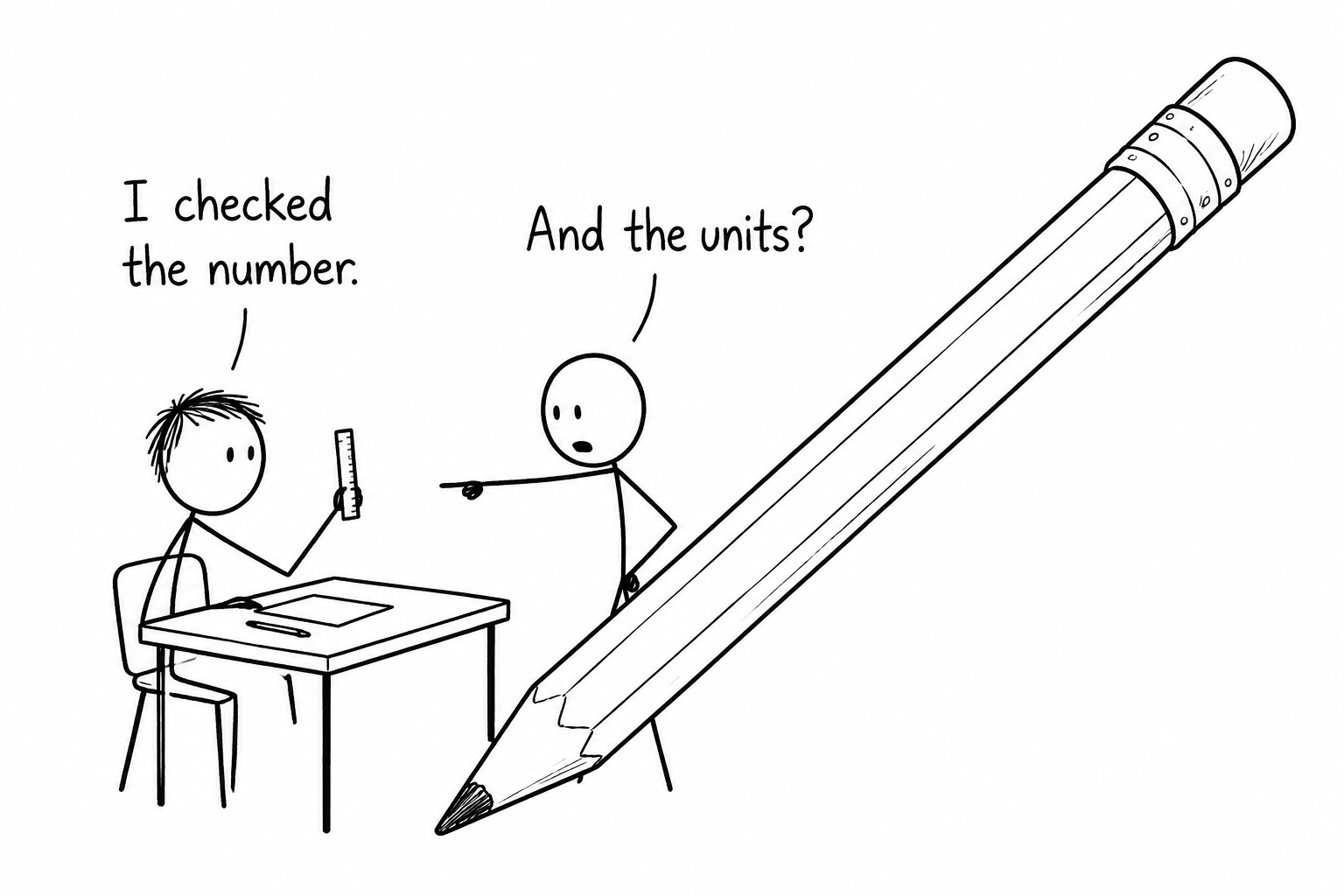 A student checks a giant pencil with a tiny ruler while another asks whether they checked the units
Mistake: treating time as base ten
The student writes 1.51.51.5 hours as 111 hour 505050 minutes. It feels natural because 0.50.50.5 resembles fifty hundredths.
Why it happens
Most metric conversions use powers of ten, but hours and minutes do not. One hour contains 606060 minutes.
Correct method
Keep the whole hour, then convert the decimal part:
0.5×60=30.0.5 \times 60=30.0.5×60=30.Therefore,
1.5 hours=1 hour 30 minutes.1.5\text{ hours}=1\text{ hour }30\text{ minutes}.1.5 hours=1 hour 30 minutes.For 222 hours 181818 minutes as decimal hours, divide the minutes by 606060:
18÷60=0.3.18 \div 60=0.3.18÷60=0.3.Therefore,
2 hours 18 minutes=2.3 hours.2\text{ hours }18\text{ minutes}=2.3\text{ hours}.2 hours 18 minutes=2.3 hours.The reverse check is valuable:
0.3×60=18.0.3 \times 60=18.0.3×60=18.Now that you have the method, use the Conversions and Units lesson and its practice cards to make spotting these errors more automatic.
Mistake: calculating with mixed units
The student is asked for the area of a rectangle measuring 1.8 m1.8\text{ m}1.8 m by 40 cm40\text{ cm}40 cm. They multiply immediately:
1.8×40=72.1.8 \times 40=72.1.8×40=72.The arithmetic is correct, but the calculation combines metres and centimetres. The result has no useful standard area unit.
Correct method
Convert before applying the area formula. In centimetres,
1.8 m=180 cm.1.8\text{ m}=180\text{ cm}.1.8 m=180 cm.Then
area=180×40=7,200 cm2.\text{area}=180 \times 40=7{,}200\text{ cm}^2.area=180×40=7,200 cm2.Alternatively, convert 40 cm40\text{ cm}40 cm to metres:
40 cm=0.4 m,40\text{ cm}=0.4\text{ m},40 cm=0.4 m,so
area=1.8×0.4=0.72 m2.\text{area}=1.8 \times 0.4=0.72\text{ m}^2.area=1.8×0.4=0.72 m2.These answers agree because
0.72 m2=7,200 cm2.0.72\text{ m}^2=7{,}200\text{ cm}^2.0.72 m2=7,200 cm2.The habit to remember is: convert first, substitute second.
Mistake: converting only part of a compound unit
Suppose a car travels at 72 km/h72\text{ km/h}72 km/h and the question asks for metres per second. The student converts kilometres to metres but leaves hours unchanged.
Why it happens
A compound unit contains more than one unit. Both parts must match the requested form.
Correct method
Use
1 km=1,000 m1\text{ km}=1{,}000\text{ m}1 km=1,000 mand
1 hour=3,600 s.1\text{ hour}=3{,}600\text{ s}.1 hour=3,600 s.Then
72 km/h=72×1,0003,600 m/s=20 m/s.72\text{ km/h}=\frac{72\times1{,}000}{3{,}600}\text{ m/s}=20\text{ m/s}.72 km/h=3,60072×1,000 m/s=20 m/s.Notice that the time conversion appears in the denominator. Writing the fraction explicitly helps prevent an accidental multiplication by 3,6003{,}6003,600.
For broader practice with conversion graphs and speed units, visit the Conversions and Units topic page. OCR students can use the matching OCR Conversions and Units lesson.
Common mistakes to check before moving on
The student's lost marks can now be reduced to six checks:
- Do not multiply or divide until you know whether the answer should grow or shrink.
- Do not use a length factor unchanged for area or volume.
- Do not treat minutes as hundredths of an hour.
- Do not substitute mixed units into a formula.
- Do not convert only one part of a compound unit.
- Do not leave the final number without its unit.
An answer of 500500500 is incomplete if the question requires 500 g500\text{ g}500 g. Units are part of the mathematical meaning, not decoration added afterwards.
Exam-style practice
Try these without looking back. Show each conversion step and include the final unit.
- Convert 4.7 km4.7\text{ km}4.7 km to metres.
- Convert 36,000 cm236{,}000\text{ cm}^236,000 cm2 to square metres.
- Convert 0.08 m30.08\text{ m}^30.08 m3 to cubic centimetres.
- Write 3.253.253.25 hours in hours and minutes.
- A rectangle measures 2.5 m2.5\text{ m}2.5 m by 60 cm60\text{ cm}60 cm. Find its area in square metres.
- Convert 54 km/h54\text{ km/h}54 km/h to metres per second.
Answers
- 4,700 m4{,}700\text{ m}4,700 m
- 3.6 m23.6\text{ m}^23.6 m2
- 80,000 cm380{,}000\text{ cm}^380,000 cm3
- 333 hours 151515 minutes
- 1.5 m21.5\text{ m}^21.5 m2
- 15 m/s15\text{ m/s}15 m/s
When checking, do not look only at the final number. Identify the conversion factor, operation and unit. That is where most unit conversions mistakes begin.
Turn the checks into reliable marks
The student in this article did not need a new trick. They needed a repeatable sequence: name the units, choose the factor, account for dimensions, calculate and check whether the answer is sensible. Knowing that sequence helps, but following it consistently takes practice.
Your turn. Start the matching Maths Genie Metric Conversions lesson, then use the topic Question Bank to practise recognising and fixing the unit conversion errors that cost marks.















