Common Expanding Brackets Mistakes in GCSE Maths
Common mistakes with expanding brackets in GCSE Maths explained through clear worked examples, corrections and exam-style practice questions.
A bracket can look harmless. Then one missed multiplication or negative sign changes the whole expression.
The common mistakes with expanding brackets in GCSE Maths usually come from rushing one of three things: multiplying only the first term, mishandling a negative sign, or collecting terms that are not alike. The reliable solution is simple: multiply every term, write each product clearly, and simplify only after the brackets have disappeared.
Imagine a student checking a marked question. Their method looks almost right, but the answer is wrong. That is frustrating, yet useful. Expanding brackets mistakes are rarely random. Once you can name each error, you can build a habit that prevents it.
Your expanding brackets checklist
Use this short process every time:
- Identify the term or bracket multiplying everything inside.
- Multiply it by every term in the bracket.
- Write each product, including its sign.
- Expand all brackets before collecting like terms.
- Check negative multiplication separately.
- If there are two brackets, make sure every term in the first bracket multiplies every term in the second.
The central idea is the distributive law:
a(b+c)=ab+aca(b+c)=ab+aca(b+c)=ab+acThe multiplier outside the bracket belongs to both terms. It cannot stop after the first one.
Mistake: multiplying only the first term
Suppose the question is to expand:
3(x+5)3(x+5)3(x+5)A common incorrect answer is:
3x+53x+53x+5Why it happens
The student sees the multiplication beside xxx, completes 3×x3\times x3×x, and then copies the 555. But the bracket means that 333 multiplies the entire expression inside it.
Correct method
Write both multiplications:
3(x+5)3(x+5)3(x+5) =(3×x)+(3×5)=(3\times x)+(3\times 5)=(3×x)+(3×5) =3x+15=3x+15=3x+15A quick visual habit helps: draw one small line from the outside term to each term inside the bracket. If there are two terms inside, there must be two multiplications.
You can review this idea through the Expanding and Factorising revision lesson, which explains why brackets represent multiplication.
Mistake: losing a negative sign
Negative multipliers create many expanding brackets mistakes because two decisions are happening at once. You must multiply the terms and determine the signs.
Expand:
−4(x−3)-4(x-3)−4(x−3)An incorrect answer might be:
−4x−12-4x-12−4x−12Why it happens
The first product is handled correctly, but the student treats a negative multiplied by a negative as another negative.
Remember:
−×−=+-\times -=+−×−=+Correct method
Deal with each product separately:
−4(x−3)-4(x-3)−4(x−3) =(−4×x)+(−4×−3)=(-4\times x)+(-4\times -3)=(−4×x)+(−4×−3) =−4x+12=-4x+12=−4x+12Do not try to hold both products in your head. Written working feels slower, but it often saves the time that would otherwise be spent finding an invisible sign error.
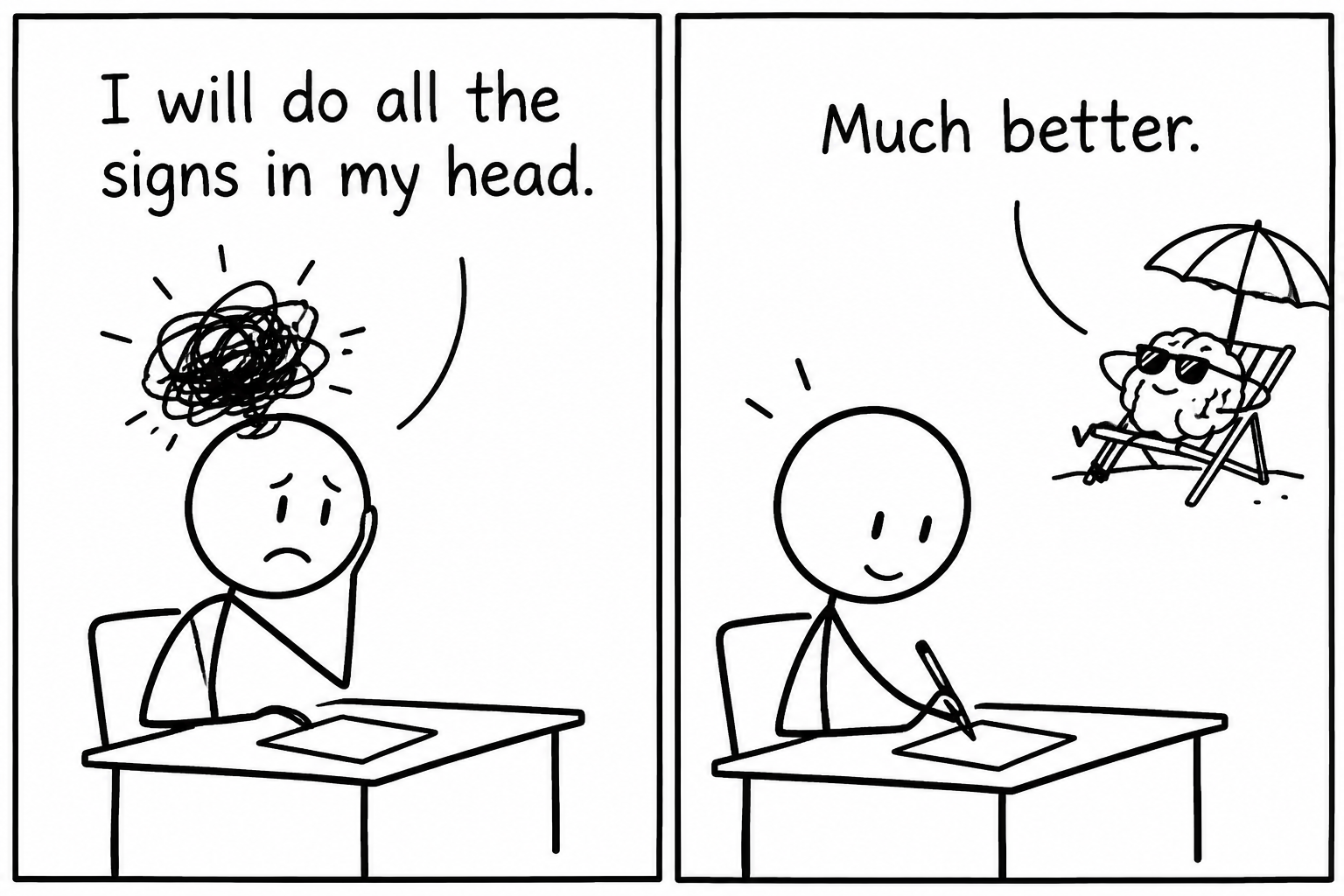 A stick-figure student's brain relaxes after signs are written down instead of held in their head
Mistake: confusing subtraction before a bracket
Now consider:
7−(2x+3)7-(2x+3)7−(2x+3)A student may write:
7−2x+37-2x+37−2x+3Why it happens
The subtraction sign affects the whole bracket, not just its first term. One way to make that visible is to treat the sign as multiplication by −1-1−1:
7−(2x+3)=7+(−1)(2x+3)7-(2x+3)=7+(-1)(2x+3)7−(2x+3)=7+(−1)(2x+3)Correct method
Multiply every term inside the bracket by −1-1−1:
7−(2x+3)7-(2x+3)7−(2x+3) =7−2x−3=7-2x-3=7−2x−3Now collect the constant terms:
=4−2x=4-2x=4−2xA useful check is to ask, “Did every sign inside the subtracted bracket change?” Here, +2x+2x+2x becomes −2x-2x−2x, while +3+3+3 becomes −3-3−3.
You now have the core method in hand; use the Maths Genie expanding and factorising lesson and its Question Bank to turn each correction into a repeatable habit.
Mistake: collecting terms that are not alike
Expanding and simplifying are connected, but they are not the same step.
Expand and simplify:
5(x+2)+3x5(x+2)+3x5(x+2)+3xA student might incorrectly give:
8x+10x8x+10x8x+10xWhy it happens
After expanding 5(x+2)5(x+2)5(x+2), the student tries to combine 101010 with 3x3x3x. But 101010 is a constant and 3x3x3x is an xxx term. They are not like terms.
Correct method
Expand first:
5(x+2)+3x=5x+10+3x5(x+2)+3x=5x+10+3x5(x+2)+3x=5x+10+3xThen collect only the xxx terms:
5x+3x=8x5x+3x=8x5x+3x=8xTherefore:
5(x+2)+3x=8x+105(x+2)+3x=8x+105(x+2)+3x=8x+10Terms are alike when their variable parts match exactly. For example, 5x5x5x and 3x3x3x are like terms, but 5x5x5x and 3x23x^23x2 are not.
Mistake: missing products in double brackets
On higher tier papers, you may need to expand two brackets. Every term in the first bracket must multiply every term in the second.
Expand:
(x+4)(x+2)(x+4)(x+2)(x+4)(x+2)An incomplete answer is:
x2+8x^2+8x2+8Why it happens
The student multiplies the first terms and the last terms, but misses the two cross-products. There should be four products before simplification.
Correct method
Multiply xxx by both terms in the second bracket:
x(x+2)=x2+2xx(x+2)=x^2+2xx(x+2)=x2+2xThen multiply 444 by both terms:
4(x+2)=4x+84(x+2)=4x+84(x+2)=4x+8Put the results together:
x2+2x+4x+8x^2+2x+4x+8x2+2x+4x+8Collect the like terms:
x2+6x+8x^2+6x+8x2+6x+8Writing the middle line matters. It proves that all four products have been considered and makes any mistake easier to locate.
Mistake: mishandling two negative terms
Expand:
(x−5)(x−3)(x-5)(x-3)(x−5)(x−3)A common incorrect answer is:
x2−8x−15x^2-8x-15x2−8x−15Why it happens
The middle terms are negative, but the final product comes from multiplying two negative numbers. That product must be positive.
Correct method
List all four products:
x×x=x2x\times x=x^2x×x=x2 x×(−3)=−3xx\times(-3)=-3xx×(−3)=−3x (−5)×x=−5x(-5)\times x=-5x(−5)×x=−5x (−5)×(−3)=15(-5)\times(-3)=15(−5)×(−3)=15Now combine them:
x2−3x−5x+15x^2-3x-5x+15x2−3x−5x+15 =x2−8x+15=x^2-8x+15=x2−8x+15Notice how the sign check is separated from collecting like terms. Trying to perform every step at once makes an otherwise manageable question fragile.
How to check an expanded expression
Substitution provides a strong check. It does not replace the algebra, but it can reveal whether an expansion is wrong.
For example, consider:
2(x+3)=2x+62(x+3)=2x+62(x+3)=2x+6Choose x=1x=1x=1. The original expression gives:
2(1+3)=82(1+3)=82(1+3)=8The expanded expression also gives:
2(1)+6=82(1)+6=82(1)+6=8Because the values agree, the expansion passes this check. If the values were different, the expressions could not be equivalent.
For double brackets, also inspect the structure of your result. Multiplying an xxx term by another xxx term should produce an x2x^2x2 term. The constant term comes from multiplying the constants.
Exam-style practice
Try these without looking back at the examples. Show every multiplication and simplify where possible.
- Expand 6(x+4)6(x+4)6(x+4).
- Expand −3(x−7)-3(x-7)−3(x−7).
- Expand and simplify 4(x+5)+2x4(x+5)+2x4(x+5)+2x.
- Expand and simplify 9−(3x+2)9-(3x+2)9−(3x+2).
- Expand (x+3)(x+7)(x+3)(x+7)(x+3)(x+7).
- Expand (x−4)(x−6)(x-4)(x-6)(x−4)(x−6).
- Find and correct the error: 5(2x−3)=10x−35(2x-3)=10x-35(2x−3)=10x−3.
- Find and correct the error: (x−2)(x+5)=x2+10(x-2)(x+5)=x^2+10(x−2)(x+5)=x2+10.
Answers
- 6x+246x+246x+24
- −3x+21-3x+21−3x+21
- 6x+206x+206x+20
- 7−3x7-3x7−3x
- x2+10x+21x^2+10x+21x2+10x+21
- x2−10x+24x^2-10x+24x2−10x+24
- The −3-3−3 must also be multiplied by 555, so the answer is 10x−1510x-1510x−15.
- Four products are required, so the answer is x2+3x−10x^2+3x-10x2+3x−10.
After checking these, work through the Expanding and Factorising exam booklet. It provides further questions with answers, while the main topic page brings the lesson and practice together. If you later meet three multiplied brackets, the Expanding Triple Brackets revision guide develops the same bracket-by-bracket discipline.
Turn corrected errors into secure marks
Knowing why an answer went wrong is different from remembering the correct method under exam pressure. The gap is deliberate practice: multiply every term, write the signs, and simplify only after expanding. Start the Maths Genie expanding and factorising lesson and Question Bank, then correct each missed product before attempting the next question.