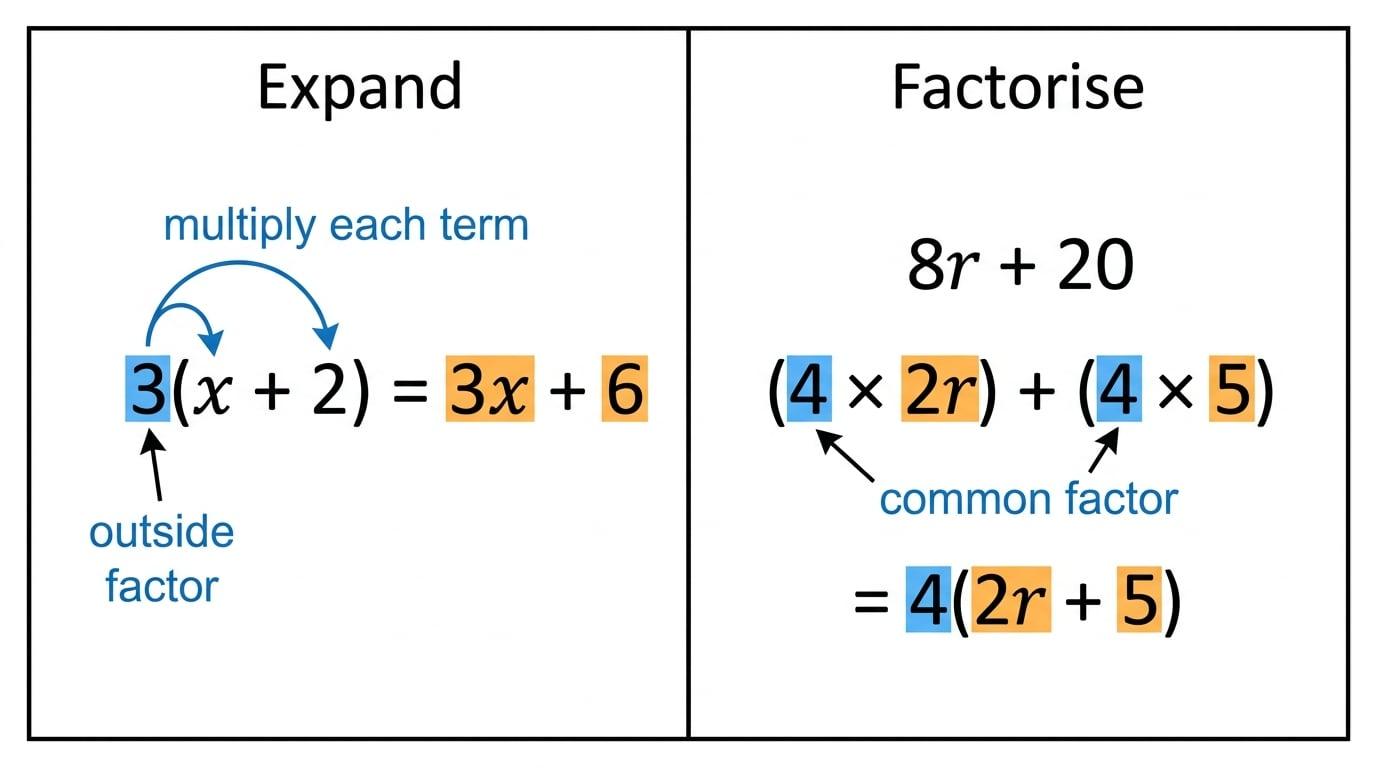
- How brackets such as 3(x+2)3(x+2)3(x+2) show multiplication.
- How to expand: remove brackets by multiplying.
- How to factorise: put brackets back in by taking out something all parts share.
- How to simplify an expression and solve an equation with brackets.
Before you start expanding and factorising, make sure the algebra words feel familiar.
Key algebra words
-
An expression is algebra with no equals sign, such as 4x+74x+74x+7.
-
A variable is a letter that stands for a number, such as xxx or yyy.
-
A term is one part of an expression, separated by plus or minus signs. Include the sign in front.
-
A coefficient is the number multiplying a variable. In 6a6a6a, the coefficient is 6.
-
A constant is a term with no variable, such as 9.
-
A factor is something being multiplied. In 5(t+2)5(t+2)5(t+2), 5 and t+2t+2t+2 are factors.
-
A power tells you repeated multiplication: x2x^2x2 means x×xx \times xx×x.
Like terms have the same variable part, such as 3x3x3x and 8x8x8x. You can collect like terms by adding or subtracting their coefficients.
Collecting like terms
-
Start with 8x+5x−48x + 5x - 48x+5x−4.
-
The like terms are 8x8x8x and 5x5x5x because both have xxx.
-
Add the coefficients:
8x+5x=13x8x + 5x = 13x8x+5x=13x
-
The constant stays separate, so the simplified expression is 13x−413x - 413x−4.
Expand
To expand means to remove brackets by multiplying the factor outside the bracket by every term inside the bracket.
This rule is called the distributive law: the outside factor is distributed to each term inside the bracket.
Brackets mean multiply
In a(b+c)a(b+c)a(b+c), the outside factor aaa multiplies both bbb and ccc, not just the first term.

Expanding a simple bracket
- Start with 6(3x+4)6(3x + 4)6(3x+4). The outside factor is 6.

-
Multiply 6 by each term inside the bracket.
6(3x+4)=6×3x+6×46(3x + 4)=6 \times 3x + 6 \times 46(3x+4)=6×3x+6×4
-
Work out each multiplication.
6(3x+4)=18x+246(3x + 4)=18x+246(3x+4)=18x+24
Only multiplying the first term
Do not leave the second term unchanged: 6(3x+4)6(3x+4)6(3x+4) is not 18x+418x+418x+4. The 6 multiplies the 4 as well.

The outside factor might include a letter, such as 3p3p3p. Multiply it by each term in the bracket.
Expanding with a letter outside
- Start with 3p(p−5)3p(p - 5)3p(p−5). The outside factor is 3p3p3p.

-
Multiply 3p3p3p by ppp.
3p×p=3p23p \times p = 3p^23p×p=3p2
-
Multiply 3p3p3p by −5-5−5.
3p×(−5)=−15p3p \times (-5) = -15p3p×(−5)=−15p
-
Put the two results together: 3p2−15p3p^2 - 15p3p2−15p.
Factorise
To factorise means to write an expression using brackets by taking out a common factor. It is the reverse of expanding.
A common factor is a number, letter, or expression that is a factor of every term. The highest common factor, or HCF, is the largest common factor you can take out.
Factorising a simple expression
- Start with 8r+208r + 208r+20.

-
The HCF of 8 and 20 is 4.
-
Rewrite each term using 4.
8r+20=4(2r)+4(5)8r+20=4(2r)+4(5)8r+20=4(2r)+4(5)
-
Put the common factor outside the bracket.
8r+20=4(2r+5)8r+20=4(2r+5)8r+20=4(2r+5)
Check by expanding
To check factorising, expand your answer. If 4(2r+5)4(2r+5)4(2r+5) gives 8r+208r+208r+20, your brackets are correct.
To factorise fully means take out the biggest common factor, including any letters that appear in every term.
Factorising fully
- Start with 14a2b+21ab214a^2b + 21ab^214a2b+21ab2.

-
The HCF of 14 and 21 is 7.
-
Both terms contain aaa and bbb, so the letter part of the common factor is ababab.
-
The full common factor is 7ab7ab7ab. Divide each term by 7ab7ab7ab.
14a2b÷7ab=2a21ab2÷7ab=3b\begin{aligned}
14a^2b \div 7ab &= 2a\\
21ab^2 \div 7ab &= 3b
\end{aligned}14a2b÷7ab21ab2÷7ab=2a=3b
-
Write the answer as 7ab(2a+3b)7ab(2a+3b)7ab(2a+3b).
Stopping too early
14a2b+21ab2=7(2a2b+3ab2)14a^2b+21ab^2=7(2a^2b+3ab^2)14a2b+21ab2=7(2a2b+3ab2) is not fully factorised because aaa and bbb can still be taken out.
To simplify means to write an expression in a shorter form, usually by collecting like terms. For these questions, expand first, then collect like terms.
Expand and simplify
- Start with 5(s+3)+2(s−4)5(s+3)+2(s-4)5(s+3)+2(s−4).

-
Expand both brackets.
5(s+3)+2(s−4)=5s+15+2s−85(s+3)+2(s-4)=5s+15+2s-85(s+3)+2(s−4)=5s+15+2s−8
-
Collect the like terms.
5s+2s+15−8=7s+75s+2s+15-8=7s+75s+2s+15−8=7s+7
Minus before a bracket
A minus sign before a bracket affects every term inside it. For example, −3(y+5)-3(y+5)−3(y+5) becomes −3y−15-3y-15−3y−15, not −3y+15-3y+15−3y+15.
Subtracting a bracket
- Start with 4(2y−3)−3(y+5)4(2y-3)-3(y+5)4(2y−3)−3(y+5).

-
Expand both brackets. The second bracket has outside factor −3-3−3.
4(2y−3)−3(y+5)=8y−12−3y−154(2y-3)-3(y+5)=8y-12-3y-154(2y−3)−3(y+5)=8y−12−3y−15
-
Collect like terms.
8y−3y−12−15=5y−278y-3y-12-15=5y-278y−3y−12−15=5y−27
An equation has an equals sign. To solve an equation means to find the value of the variable that makes both sides equal.
An inverse operation is an undo step. For example, division undoes multiplication, and subtraction undoes addition.
Divide first
If the whole bracket is multiplied by a number, dividing first is usually quicker than expanding.
Solving a bracket equation
-
Start with 6(d+2)=486(d+2)=486(d+2)=48. The bracket is multiplied by 6, so divide both sides by 6.
d+2=8d+2=8d+2=8
-
Undo the plus 2 by subtracting 2 from both sides.
d=6d=6d=6
-
Check in the original equation: 6(6+2)=486(6+2)=486(6+2)=48.
When the answer is not a whole number
-
Start with 2(v−6)=152(v-6)=152(v−6)=15. Divide both sides by 2.
v−6=7.5v-6=7.5v−6=7.5
-
Undo the minus 6 by adding 6 to both sides.
v=13.5v=13.5v=13.5
-
A decimal answer is fine if the division does not come out as a whole number.
In the exam
-
When expanding, make sure every term inside the bracket has been multiplied by the outside factor.
-
When factorising, look for the highest common factor and check by expanding your answer.
-
When solving equations, do the same inverse operation to both sides and check your value in the original equation.
Check yourself
-
Can you expand 5(2x−3)5(2x-3)5(2x−3) without missing the negative sign?
-
Can you fully factorise 12a2+18ab12a^2 + 18ab12a2+18ab by taking out a number and a letter?
-
If 3(k−4)=213(k-4)=213(k−4)=21, what is the first operation you would undo?