

Combining Ratios Exam Questions: GCSE Guide
Combining ratios exam questions explained with three GCSE worked examples, clear method-mark advice, common mistakes and free MathsGenie practice resources.
A combining ratios question can look harder than it is. Two ratios share a person or quantity, but that shared quantity has different numbers of parts. Combining ratios exam questions become manageable when you make those parts equal, then join the ratios in the required order.
The challenge is keeping track of what each number represents. These three worked examples show the method, then explain how to use a total or difference. Clear working also gives an examiner evidence of your method if a later calculation goes wrong.
The combining ratios method
Use this checklist:
- Identify the shared quantity.
- Label both ratios carefully.
- Find a common multiple of the shared parts.
- Scale every term in each ratio.
- Combine, simplify and check.
Multiplying every term by the same number preserves a ratio. Matching just the shared term while leaving the other term unchanged does not.
If you need more explanation, start with the combining ratios lesson. The AQA GCSE Ratio topic and Edexcel GCSE Ratio topic provide broader revision.
Question one: matching a common term
Exam-style question: The ratio of red counters to blue counters is 2:52:52:5. The ratio of blue counters to green counters is 3:43:43:4. Find the ratio of red to blue to green counters.
Match the blue parts
Write labelled ratios:
R:B=2:5,B:G=3:4. R:B=2:5,\qquad B:G=3:4. R:B=2:5,B:G=3:4.Blue appears in both. Its values are 555 and 333, whose lowest common multiple is 151515.
Multiply every term in the first ratio by 333, and every term in the second by 555:
R:B=6:15 R:B=6:15 R:B=6:15 B:G=15:20. B:G=15:20. B:G=15:20.The blue parts now agree, so:
R:B:G=6:15:20. R:B:G=6:15:20. R:B:G=6:15:20.There is no common factor greater than 111 shared by all three terms, so this is already simplified.
Show the method
Writing the equivalent ratios demonstrates how you matched the shared quantity. A mark scheme may reward this method separately from the final answer, although exact allocations depend on the question.
Check by simplifying the red-to-blue and blue-to-green pairs back to the original ratios.
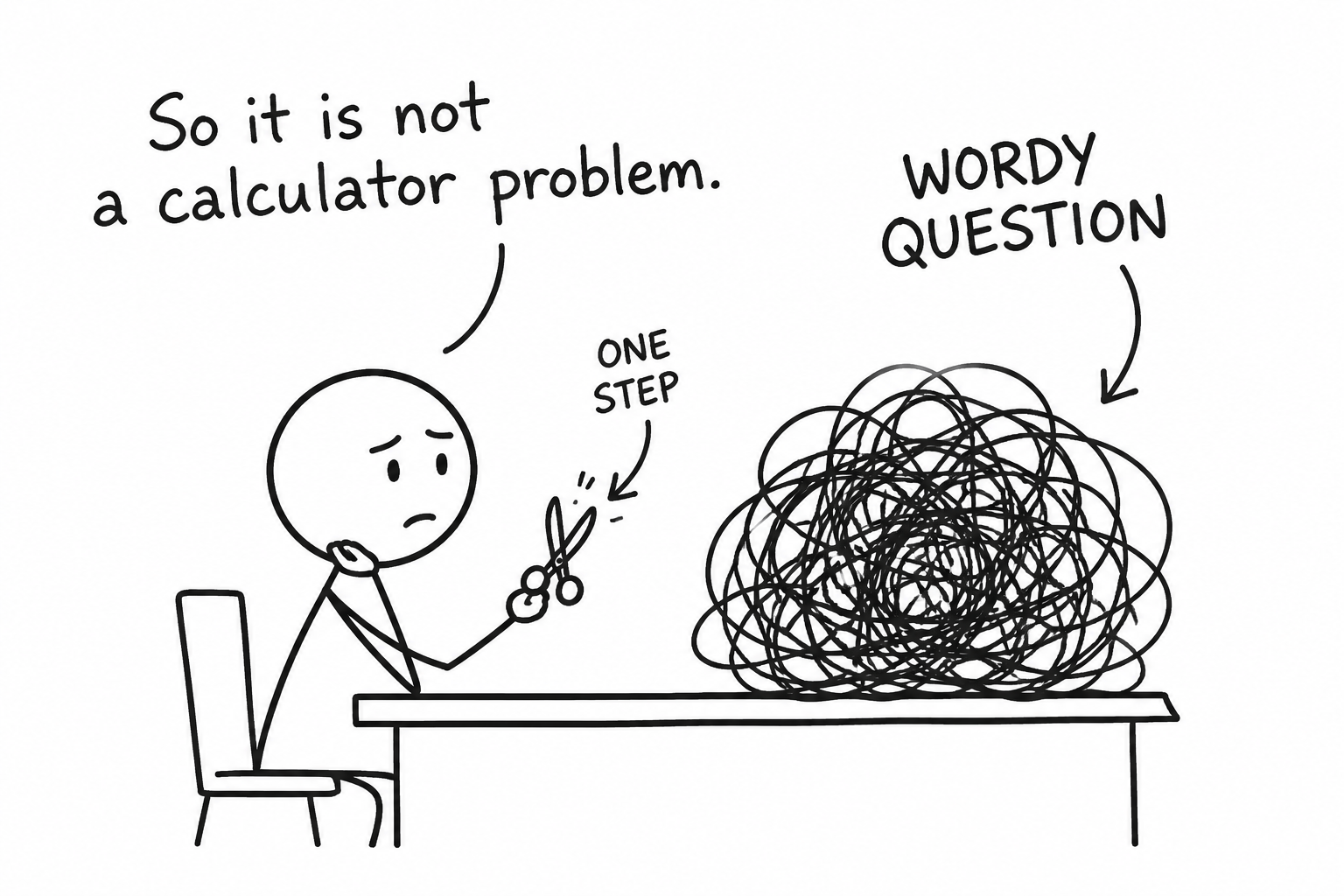 A student uses one small step to untangle a wordy GCSE question
Question two: combining ratios and finding an amount
Exam-style question: Ava's money to Bilal's money is 3:73:73:7. Bilal's money to Chen's money is 2:52:52:5. Together they have £630\pounds630£630. How much does Chen have?
Combine the ratios
Bilal is the shared person:
A:B=3:7,B:C=2:5. A:B=3:7,\qquad B:C=2:5. A:B=3:7,B:C=2:5.The lowest common multiple of 777 and 222 is 141414. Multiply the first ratio by 222 and the second by 777:
A:B=6:14,B:C=14:35. A:B=6:14,\qquad B:C=14:35. A:B=6:14,B:C=14:35.Therefore:
A:B:C=6:14:35. A:B:C=6:14:35. A:B:C=6:14:35.Use the total
The total number of parts is:
6+14+35=55. 6+14+35=55. 6+14+35=55.One part has value:
630÷55=12611. 630\div55=\frac{126}{11}. 630÷55=11126.Chen has 353535 parts:
35×12611=441011. 35\times\frac{126}{11}=\frac{4410}{11}. 35×11126=114410.Under the exact ratio model, Chen's amount is £441011\pounds\frac{4410}{11}£114410, approximately £400.91\pounds400.91£400.91 to the nearest penny.
There is a useful limitation here: the stated total cannot be shared in this exact ratio using whole pennies. Rounding gives an approximation. If the intended question required exact penny amounts, its figures would need adjusting.
For comparison, a total of £660\pounds660£660 gives:
660÷55=12,35×12=420. 660\div55=12,\qquad 35\times12=420. 660÷55=12,35×12=420.Chen would then have exactly £420\pounds420£420. Checking the context matters as much as checking the arithmetic.
Question three: reversed order and a difference
Exam-style question: Priya's score to Rowan's score is 4:94:94:9. Sam's score to Rowan's score is 5:65:65:6. Rowan scores 141414 more than Priya. Find Sam's score.
Align the names
The given ratios are:
P:R=4:9,S:R=5:6. P:R=4:9,\qquad S:R=5:6. P:R=4:9,S:R=5:6.Reverse both labels and values in the second ratio:
R:S=6:5. R:S=6:5. R:S=6:5.Rowan's values are now 999 and 666. Their lowest common multiple is 181818:
P:R=8:18,R:S=18:15. P:R=8:18,\qquad R:S=18:15. P:R=8:18,R:S=18:15.Therefore:
P:R:S=8:18:15. P:R:S=8:18:15. P:R:S=8:18:15.Use the difference
Rowan's score exceeds Priya's by:
18−8=10 parts. 18-8=10\text{ parts}. 18−8=10 parts.Those parts represent the given difference of 141414, so one part is:
14÷10=1.4. 14\div10=1.4. 14÷10=1.4.Sam has 151515 parts:
15×1.4=21. 15\times1.4=21. 15×1.4=21.Sam's score is 212121. The key decision was using the difference between the relevant parts. Adding all three parts would answer a different question.
Common mistakes in combining ratios exam questions
Joining before matching
Combining A:B=2:5A:B=2:5A:B=2:5 and B:C=3:4B:C=3:4B:C=3:4 directly into 2:5:42:5:42:5:4 is invalid. The shared quantity must have the same number of parts first.
Scaling only one term
To change the second term of 2:52:52:5 to 151515, multiply both terms by 333:
2:5=6:15. 2:5=6:15. 2:5=6:15.Reversing numbers without labels
If S:R=5:6S:R=5:6S:R=5:6, then R:S=6:5R:S=6:5R:S=6:5. Keep each value attached to its quantity.
Confusing totals and differences
Before calculating one part, identify what the stated amount represents: the whole group, one quantity or a difference. That choice determines which ratio parts you use.
Turn the method into exam marks
Practise without looking at the worked steps. Label the quantities, match the shared parts, then pause to interpret the amount given. Show the combined ratio and each calculation on separate lines.
Use the MathsGenie ratio Question Bank for focused practice. If matching the common quantity still feels uncertain, revisit the combining ratios video lesson, then attempt another question independently.
When checking your work, identify the first line where your method differs from the solution. Correct that step, then retry the question later without prompts. This makes practice more useful than simply reading finished answers.
Confidence grows from recognising the same structure beneath unfamiliar wording. Start with MathsGenie's free revision resources and repeat the process until you can explain why every step works.















