Circles GCSE Maths Resit: Secure Grade 4 Skills
Circles GCSE maths resit revision made clear: learn radius, diameter, circumference and area, avoid lost marks, and practise calmly towards a grade 4.
A circles question can look deceptively familiar. You remember seeing π\piπ before. You know the shape. Then the question gives a diameter, asks for an area, and suddenly the method feels less certain.
For circles GCSE maths resit questions, the essential answer is simple: identify whether you need circumference or area, check whether you have the radius or diameter, choose the correct formula, and show every substitution. These are manageable marks for a student working towards grade 4, especially when the method becomes routine.
The goal is not to memorise a page of circle facts. It is to make a few reliable decisions under exam pressure.
Your circles grade 4 checklist
Before attempting exam questions, make sure you can:
- recognise the radius, diameter and circumference;
- use d=2rd=2rd=2r and r=d2r=\frac{d}{2}r=2d;
- calculate circumference using C=πdC=\pi dC=πd or C=2πrC=2\pi rC=2πr;
- calculate area using A=πr2A=\pi r^2A=πr2;
- select the correct units;
- keep the calculator value until the final line;
- round to the accuracy requested.
These skills sit within Foundation GCSE geometry and measures. They are useful marks because the mathematical steps are predictable, even when the wording changes. Start with the Area and Circumference of Circles revision lesson, which brings the explanation, questions and supporting resources together.
Know what the question is asking
The circumference is the distance around a circle. It is a length, so its units might be mm\text{mm}mm, cm\text{cm}cm or m\text{m}m.
The area is the space inside the circle. It uses square units such as cm2\text{cm}^2cm2 or m2\text{m}^2m2.
That distinction determines the formula:
C=πdC=\pi dC=πdor
C=2πrC=2\pi rC=2πrFor area:
A=πr2A=\pi r^2A=πr2The diameter travels through the centre from one side of the circle to the other. The radius travels from the centre to the edge. Therefore:
d=2rd=2rd=2rA useful exam habit is to write either circumference or area beside the question before touching the calculator. That small pause prevents many formula errors.
You can reinforce the distinction using the circle revision guide and exam-style practice.
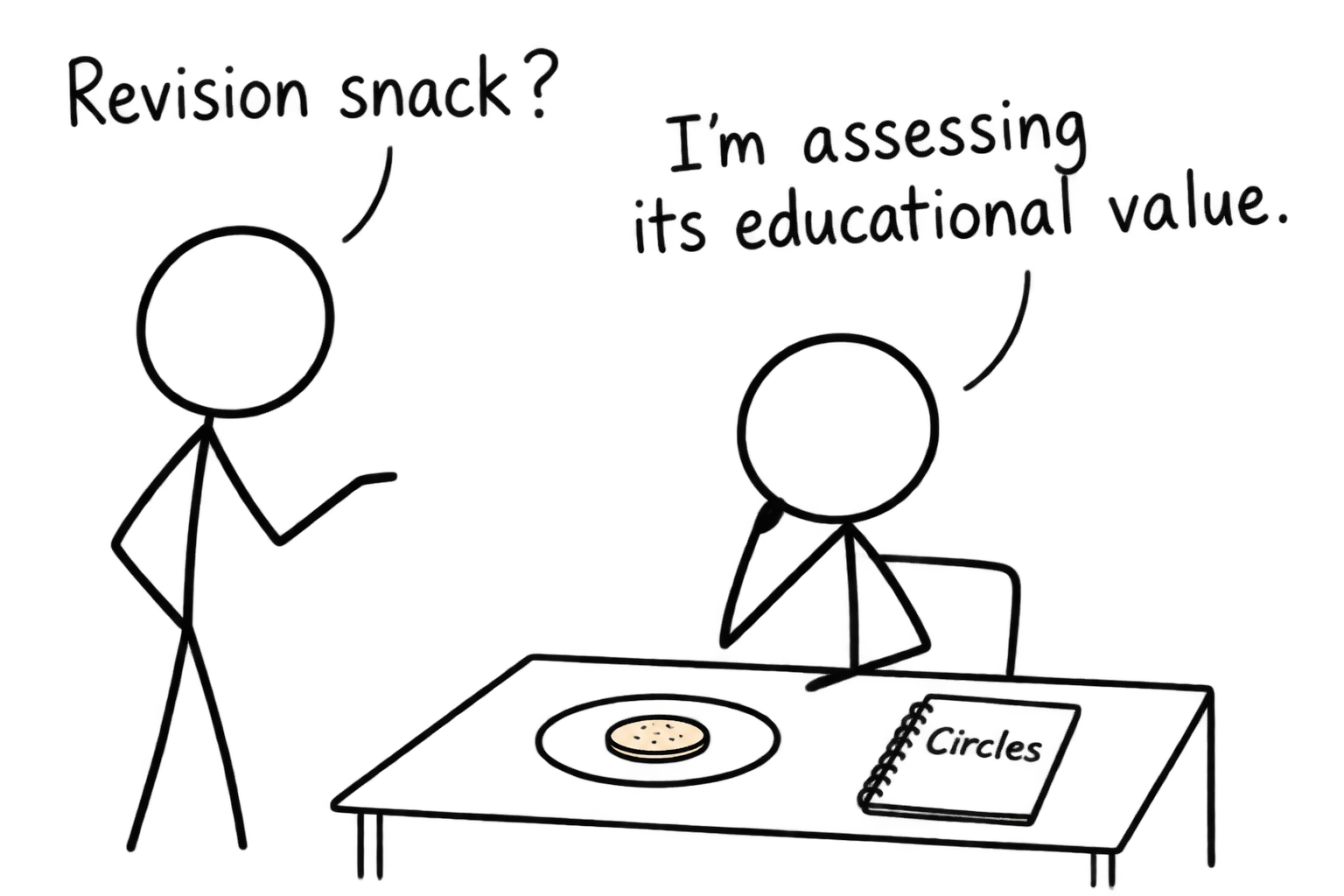 A resit student assesses the educational value of a circular biscuit
Worked example: circumference from a diameter
A circular sign has a diameter of 8.4 cm8.4\text{ cm}8.4 cm. Calculate its circumference. Give your answer to three significant figures.
The question gives the diameter, so use C=πdC=\pi dC=πd:
C=π×8.4C=\pi \times 8.4C=π×8.4 C=26.389378…C=26.389378\ldotsC=26.389378…Round only at the end:
C=26.4 cmC=26.4\text{ cm}C=26.4 cmThe answer is a length, so the unit is cm\text{cm}cm rather than cm2\text{cm}^2cm2.
Notice that no radius calculation was necessary. Converting the diameter first would not be wrong, but it would create an extra step and another opportunity for an error. The shortest correct route is usually the safest route.
Worked example: area from a radius
A circular garden has a radius of 3.5 m3.5\text{ m}3.5 m. Calculate its area. Give your answer to one decimal place.
Area requires the formula A=πr2A=\pi r^2A=πr2:
A=π×3.52A=\pi \times 3.5^2A=π×3.52Square the radius:
A=π×12.25A=\pi \times 12.25A=π×12.25 A=38.484510…A=38.484510\ldotsA=38.484510…Round to one decimal place:
A=38.5 m2A=38.5\text{ m}^2A=38.5 m2The squared unit matters. An area of 38.5 m38.5\text{ m}38.5 m would describe a length and would not answer the question fully.
When practising independently, use the GCSE circle question bank to become comfortable identifying the required method without being told which formula to choose.
How to show enough working
A calculator answer alone can hide a correct idea. It can also hide a typing error. A clear solution should usually contain three things:
- the relevant formula;
- the values substituted into it;
- the final answer with units and appropriate rounding.
For example, writing
A=π×3.52=38.5 m2A=\pi \times 3.5^2=38.5\text{ m}^2A=π×3.52=38.5 m2shows much more mathematical understanding than writing only 38.538.538.5.
If the final answer is wrong because of a minor calculator error, visible working may still correspond to marks in the mark scheme. More importantly, it lets you diagnose the problem during revision. You can tell whether the mistake came from choosing a formula, substituting a value or rounding.
The Edexcel GCSE exam booklets are useful for practising this exam-ready presentation rather than doing every calculation mentally.
Mistakes that cost marks
Using the diameter as the radius
In the area formula, rrr must be the radius. If the diameter is 10 cm10\text{ cm}10 cm, then:
r=102=5 cmr=\frac{10}{2}=5\text{ cm}r=210=5 cmThe area calculation is therefore π×52\pi \times 5^2π×52, not π×102\pi \times 10^2π×102.
Forgetting to square the radius
The area formula is A=πr2A=\pi r^2A=πr2. It is not A=πrA=\pi rA=πr and it is not A=2πrA=2\pi rA=2πr. Use brackets on a calculator if necessary:
π×(3.5)2\pi \times (3.5)^2π×(3.5)2Choosing area when the question asks for distance
Words such as around, edge, perimeter and circumference indicate a length. Words such as surface, space covered and area indicate square units.
Rounding too early
Keep the full calculator value and round once, on the final line. Early rounding can change the final answer, particularly in a question with several stages.
Omitting units
Circumference uses ordinary length units. Area uses squared units. Treat the unit as part of the answer, not an optional label added afterwards.
Turn one method into dependable marks
Resit revision works best when it is specific. Watching a video can clarify the method, but improvement comes from answering questions, checking the mark scheme and returning to the exact step that went wrong.
Use the Edexcel GCSE Maths revision hub to connect circles with related topics such as perimeter, area and compound shapes. MathsGenie's free revision lessons, practice questions, video solutions, mini tests, past papers and mark schemes let you move from explanation to independent practice without losing the thread.
Then build a targeted paper in the GCSE Mock Exam Builder. Select your exam board and include circles alongside the other grade 4 topics you need to strengthen. Sit the paper under timed conditions, mark it carefully, and record whether each lost mark came from the formula, the radius, the calculator or the units.
Circles become less intimidating once every question begins with the same calm decision: around the circle or inside it? Make that decision correctly, show the formula, and the rest becomes a method you can trust.