

How to Catch Up GCSE Bengali After Absence
Catch up GCSE Bengali after absence with a realistic plan for missed lessons, four language skills, speaking practice and balanced maths revision.
Missing several weeks of school can make every subject feel as though it has moved on without you. Bengali brings an extra difficulty: vocabulary, grammar, reading and speaking develop together, so one missed unit can affect several skills. Meanwhile, your GCSE maths revision has not disappeared.
The best way to catch up GCSE Bengali after absence is not to recreate every missed lesson. First confirm what was covered, identify the gaps that affect the exam, and follow a short cycle of learning, practice, feedback and retrieval. Protect your recovery, ask teachers to prioritise the work and keep maths moving through smaller, regular sessions.
You are not trying to erase an absence overnight. You are building a reliable route back into the course.
Your catch-up checklist
Before opening a textbook or copying weeks of notes, complete these actions:
- Tell your Bengali teacher what you have and have not received.
- Confirm your exam board, tier and current teaching unit.
- Request the lesson titles, essential vocabulary and assessed tasks you missed.
- Ask which gaps are urgent and which can wait.
- Check whether you missed speaking practice, a mock or an internal deadline.
- Choose a sustainable daily minimum rather than an ambitious temporary timetable.
- Reserve separate sessions for Bengali and maths.
- Arrange a review with your teacher after your first week back.
If illness is still affecting your energy, concentration or attendance, involve your form tutor, head of year or pastoral team. Schools are expected to help pupils reintegrate after lengthy or unavoidable illness. If an absence is likely to become prolonged, a parent or carer should discuss educational provision with the school rather than leaving you to manage everything alone.
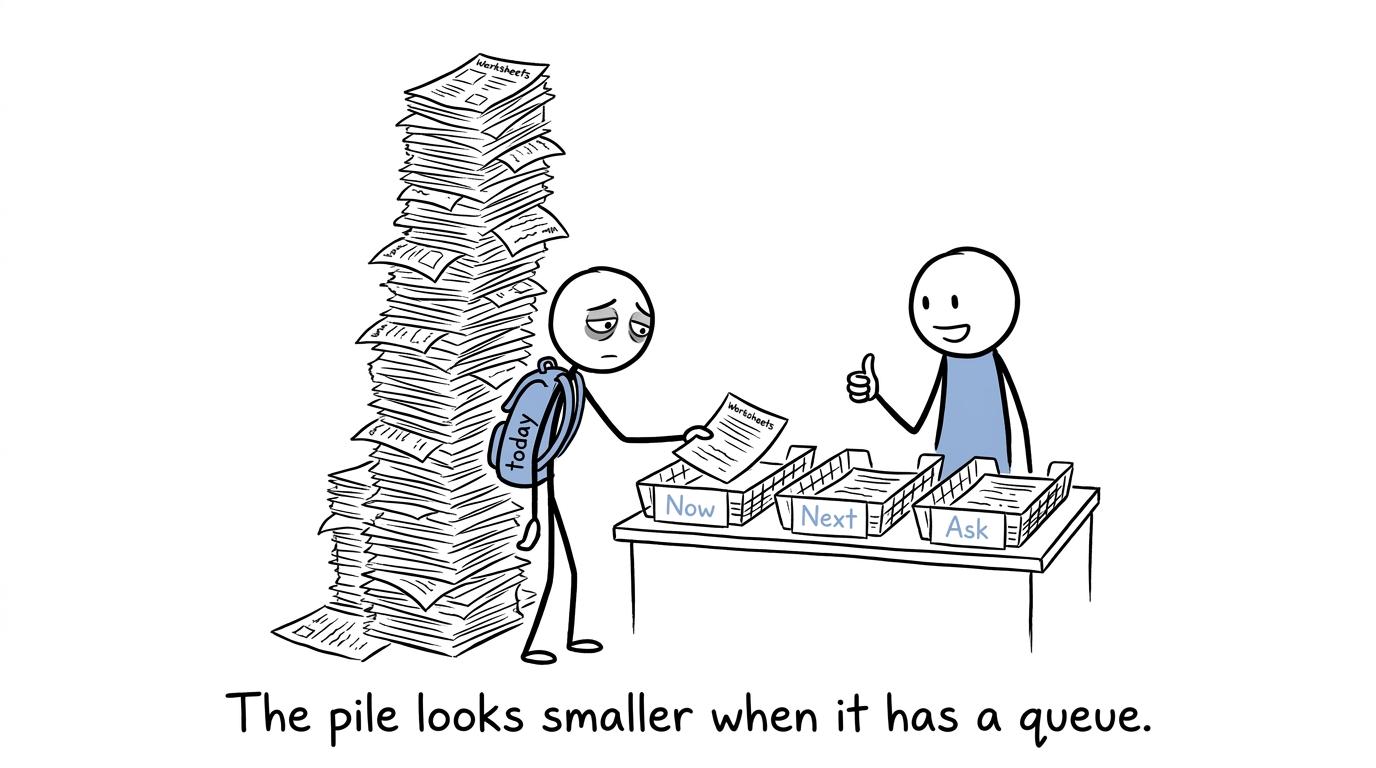 A returning student calmly sorts a large pile of missed work into manageable trays
Understand what GCSE Bengali actually assesses
GCSE Bengali is currently offered by AQA. Confirm your qualification with your school because International GCSE Bangla is a different qualification with a different assessment structure.
For AQA GCSE Bengali, students take four components: listening, speaking, reading and writing. Each contributes approximately 25%25\%25% of the qualification. Foundation tier covers grades 111 to 555, while higher tier covers grades 444 to 999, and all four components must be taken at the same tier in the same exam series.
That structure gives your catch-up plan a useful shape. Do not label the entire problem “Bengali”. Audit four separate areas:
| Skill | What to check after absence |
|---|---|
| Listening | Missed vocabulary, unfamiliar accents or speeds, and understanding details and opinions |
| Speaking | Missed role-play, photo-card or general-conversation preparation and teacher feedback |
| Reading | New vocabulary, recognising viewpoints, comprehension and translation into English |
| Writing | Sentence accuracy, response coverage, extended writing and translation into Bengali |
The course is based around themes involving identity and culture; local, national, international and global areas of interest; and current and future study and employment. Ask for the exact subtopics taught while you were absent. “I missed the unit on education and future plans” leads to a much better recovery task than “I need to revise Bengali”.
Diagnose the gap before revising
The number of missed lessons is not the same as the size of your learning gap. A fortnight containing revision and consolidation may create less unfinished learning than a few lessons introducing important grammar and a new speaking theme.
Create a catch-up map with three labels:
- Red: needed for an imminent assessment or required to understand current lessons.
- Amber: part of the specification, but not blocking your present work.
- Green: already secure or quickly recovered.
Use evidence rather than anxiety. Compare the school’s lesson list with your exercise book, online classroom and teacher resources. Then complete a short, untimed check from each affected skill. Its purpose is diagnosis, not a grade.
For every difficulty, record a specific next action. Replace “bad at listening” with “cannot identify opinions in the missed school-life vocabulary”. Replace “behind in writing” with “need to recover the past-tense structures from the previous unit”. Specific gaps can be repaired. Vague ones simply feel large.
The same principle works in maths. The MathsGenie GCSE maths revision hub organises material by exam board and topic, making it easier to identify one precise weakness rather than revising everything at once.
Follow a realistic two-week recovery plan
A catch-up plan should fit around your normal lessons and your health. It should not assume that returning to school means instantly returning to full capacity.
The first two days: collect and prioritise
Meet or message your Bengali teacher. Ask for:
- the titles of missed lessons;
- the essential vocabulary list;
- grammar or structures introduced;
- speaking questions currently being prepared;
- worksheets or recordings that are genuinely necessary;
- upcoming assessment dates;
- the highest-priority task for this week.
Do not begin by rewriting every classmate’s note. Notes are useful only when they help you retrieve, understand or apply something.
Days three to seven: rebuild the foundations
Use one focused Bengali session on each school day if your health allows. A practical session might contain:
- 101010 minutes retrieving vocabulary without notes;
- 151515 minutes learning one missed language feature or theme;
- 151515 minutes practising one exam skill;
- 555 minutes checking and recording the next action.
That is a 454545-minute session, not an entire evening. On a low-energy day, use a 151515-minute minimum: retrieve a small vocabulary set, read one short passage or record one speaking response.
Rotate the four skills rather than spending the whole week making vocabulary cards. Listening and speaking are easy to postpone because they require audio, privacy or another person, but they represent half of the AQA qualification together.
Week two: apply and obtain feedback
Move from recovering content to using it. Complete short tasks in the formats your teacher has identified, then request feedback on the areas that are difficult to judge alone, especially pronunciation, spontaneous speaking and written accuracy.
At the end of the week, repeat your diagnostic checks. Move secure items from red to amber or green. Any persistent red item becomes a question for your teacher, not a reason to extend every revision session.
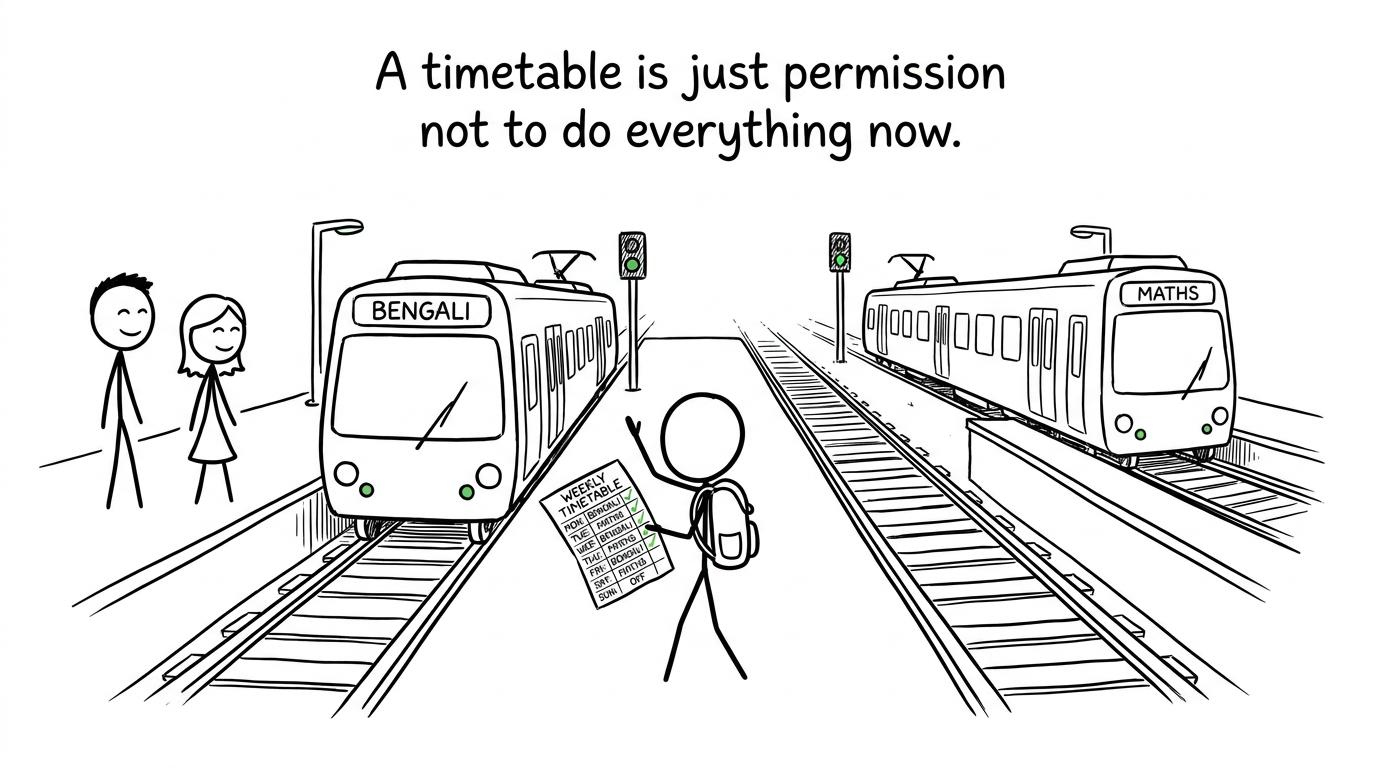 A student uses a timetable to alternate calmly between Bengali and maths revision
Catch up each Bengali skill efficiently
Listening and reading
Begin with familiar material from the missed unit before attempting full papers. Review the key words, then listen or read for the overall message, key details and opinions. Check the answer and identify why evidence was missed: unknown vocabulary, speed, a distractor or misunderstanding the question.
For reading, keep translation separate from general comprehension. Understanding the rough meaning is not always enough to produce an accurate English translation.
Speaking
Speaking improves through retrieval aloud, not silent recognition. Confirm which role plays, photo cards and conversation themes your class prepared. Record short answers, listen back and note one improvement at a time. A teacher, family member or trusted classmate can ask questions, but teacher feedback remains important where pronunciation or accuracy is uncertain.
Do not memorise one long paragraph so rigidly that an unexpected question breaks the entire response. Learn adaptable phrases, accurate structures and ways to justify an opinion.
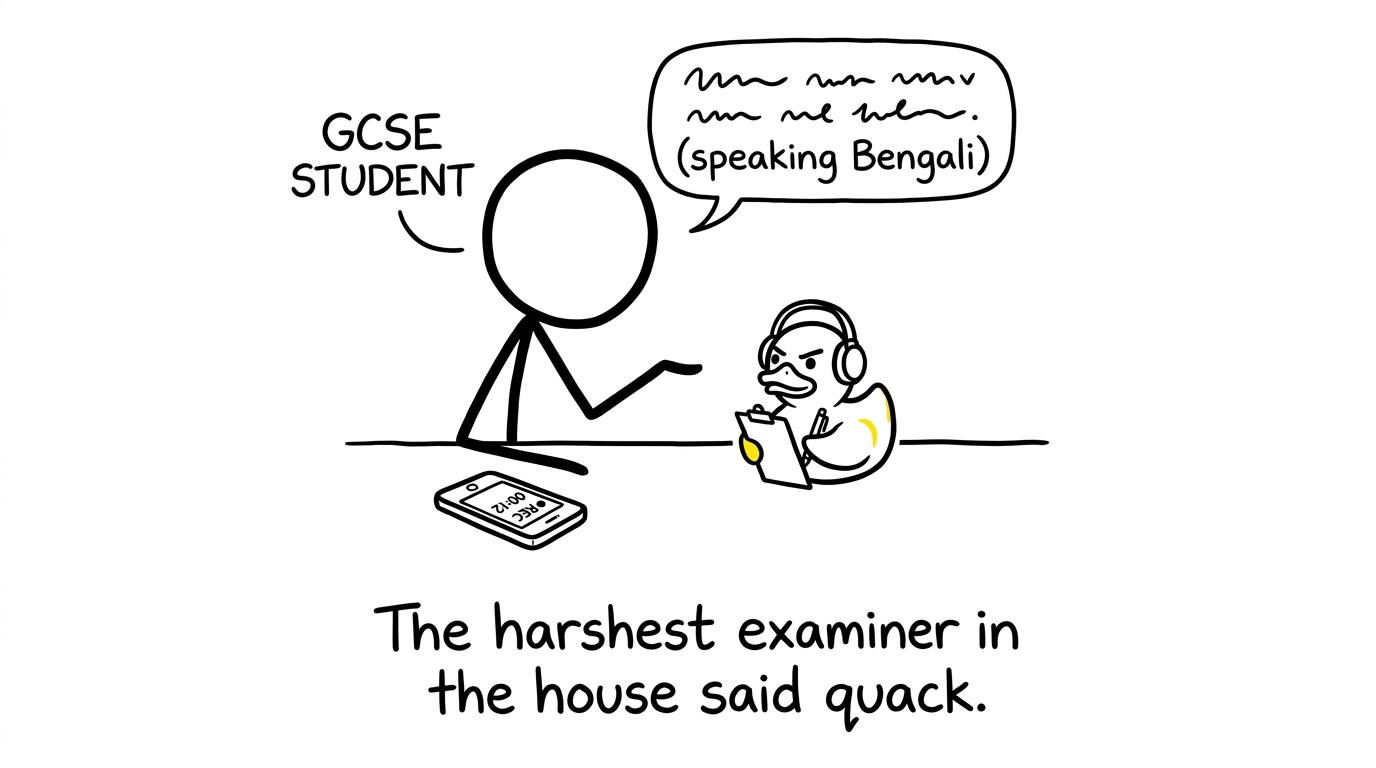 A serious rubber duck listens to a student practising a speaking response
Writing
Recover the structures your class actually used, then practise producing them from memory. Check whether your response addresses every bullet point, communicates clearly and uses language you can control accurately. Longer or more complicated writing is not automatically better.
Keep a correction log with recurring issues such as spelling, verb forms, word order or omitted details. Revisit the corrected feature several days later so that feedback becomes learning rather than decoration in the margin.
Balance Bengali catch-up with GCSE maths
Students often respond to absence by letting the loudest problem consume every evening. That can turn one subject gap into several.
Use separate, protected blocks. For example, schedule Bengali on three weeknights and maths on two, with one short weekend review for each. A timetable is not a promise to work constantly. It decides what you can safely ignore until its allocated time.
The GCSE maths revision timetable guide can help you create a weekly structure with room for catching up. If energy is limited, use the compact routine in the GCSE revision guide for busy or reluctant students: choose one weakness, learn, practise, mark and fix.
Keep maths revision measurable. Use a short topic lesson, a few practice questions and immediate marking rather than an unfocused hour of rereading. The wider MathsGenie GCSE subjects area provides a clear starting point, while the one-month GCSE maths revision plan is useful if exams are approaching.
When your core topics are secure, add timed work from the GCSE predicted papers collection. Predicted papers are practice tools, not guarantees of future questions. Past papers remain essential; Edexcel students can use the Edexcel GCSE maths past papers with mark schemes and available solutions.
Common mistakes when catching up after absence
Trying to complete everything chronologically
The first missed worksheet is not necessarily the most important. Prioritise content that unlocks current lessons, supports an approaching assessment or appears across several skills.
Copying notes without retrieving anything
A neat book can hide a fragile memory. Close the notes and recall vocabulary, answer a speaking question or plan a written response. Retrieval reveals what is actually secure.
Ignoring listening and speaking
Reading notes feels easier to organise, but GCSE Bengali assesses all four language skills. Put audio and spoken practice into the timetable from the beginning.
Working at pre-illness intensity immediately
Recovery is not laziness. Begin with a repeatable minimum and increase it only when school attendance, sleep and concentration remain stable.
Assuming missed teaching leads to exam compensation
JCQ special consideration concerns circumstances affecting a student at the time of an assessment and is handled by the school or college. It does not normally compensate for subject knowledge that was not developed because lessons were missed. If illness may affect an examination or speaking assessment, contact your exams officer promptly rather than making assumptions about eligibility.
Letting maths become the next catch-up problem
Maintain a small maths baseline. One MathsGenie revision lesson, a focused set of practice questions and careful use of the mark scheme can preserve momentum while Bengali receives temporary priority.
Return to the course one manageable task at a time
Catching up is rarely a dramatic moment. It is usually a sequence of quieter decisions: asking what matters, recovering one vocabulary set, recording one speaking answer, correcting one piece of writing and returning to the task a few days later.
Start today by requesting the missed-topic list and choosing your first red priority. Then protect a separate maths session using MathsGenie. Free revision lessons, practice questions, mini tests, past papers, predicted papers, mark schemes and video solutions give you a complete revision loop without adding more searching to an already crowded week.
You do not need to do everything now. You need to know what comes next, and complete it well.










